
Showing posts with label UNSW. Show all posts
Showing posts with label UNSW. Show all posts
Monday, June 29, 2026
UNSW Canberra Three Minute Thesis

Sunday, December 6, 2020
UNSW Ranking Of Universities: a Result Looking for a Rationale
The UNSW Aggregate Ranking Of Top Universities combines the Times Higher Education (THE), Quacquarelli Symonds (QS) and Academic Ranking of World Universities (ARWU) to create the ARTU. This is claimed to provide a long term comparison of top universities. But it is not clear if this combination has any theoretical unpinning, or practical purpose, except to boost UNSW's rating.
Such ranking systems are used by students in selecting an institution to study at. However, these rankings are heavily weighted to research performance, while most students are undertaking coursework. Also these ranking systems only include a few hundred universities, while there are thousands of other good educational institutions excluded. A reliable ranking of institutions would be useful for students, but ARTU is not that.
My favorite university ranking scheme is Webometrics, which relies on readily available information. As a result, about 30,000 institutions listed, including many vocational colleges, which are excluded other ranking systems.
Here are institutions I have studied at most recently. All these institutions provided a useful quality education, but only the first (ANU), is in the ARTU list:
| National Ranking |
World Rank | University | Presence Rank* | Impact Rank* | Openness Rank* | Excellence Rank* |
|---|---|---|---|---|---|---|
| Australian National University | ||||||
| University of Southern Queensland | ||||||
| Canberra Institute of Technology |
Canada
| National Ranking |
World Rank | University | Presence Rank* | Impact Rank* | Openness Rank* | Excellence Rank* |
|---|---|---|---|---|---|---|
| Athabasca University |
Wednesday, October 28, 2020
Company to Provide UNSW University Transition Course
The University of NSW have announced an agreement with company OpenLearning for a new Online Transition Program for international students. The course will be start in March 2021. This is is a study skills course to help students to more student active learning. The emphasis will be on project based learning and use techniques such as stand-ups and portfolio reviews. This is a welcome initiative but raises the question: does UNSW have staff qualified to teach in this way?
The ANU has been using this approach with its TechLauncher computer group projects. For several years this was done face to face, with the support of computer industry standard online tools and methodologies. COVID-19 has seen a relatively easy transition to online this year.
As a computer professional I was trained to routinely work in teams, supplemented by my graduate education in how to work, teach and assess this way. However, outside disciplines such as computing and engineering, which use these project based approaches, academic staff are unlikely to have experienced them, let alone been formally trained and qualified in their use in an educational context.
If UNSW use this project based approach for a transition course, will students be disappointed when they get to the main program of study and find these are run as old fashioned courses, with lectures, tutorials and examinations? Is there a crash program being run at UNSW to train academic staff to teach project based learning and revise all the degrees? Or will UNSW courses be run by new staff, based "in the cloud" who already have these skills, and existing staff made redundant?
Sunday, March 1, 2020
Standardization of Australian Higher Education is for Mugs

ps: Recently in a charity shop I found two mugs on the shelf: one branded UNSW, and the other UNE: same color, same size, so at least there is standardization of something. ;-)
Monday, October 29, 2018
Evolving Online Graduate Education: From Synchronous to Asynchronous

Greetings from EdTechPosium at the Australian Catholic University's new teaching building in Canberra. The keynote speaker is Julian Cox, Associate Professor, Food Microbiology, University of New South Wales on "Pedagogy, Peers, Professionalism, Platforms and Practice… and the Workshop Activity". He is describing evolving from online learning as an analogue of face to face lectures, with synchronous sessions, to something students can do in their own time (asynchronous).
I agree with most of what Professor Cox was saying, but suggest online students need some synchronization, just not in the form EdTech people normally think of it. Ideally a self disciplined students can be left to complete tasks, including assessment tasks, to when it suits them. However, as a student myself, I found that if there was no deadline, and no marks, I would put off a task forever.
One of my students has been working on a tool to break down the Synchronous/Asynchronous dichotomy. and hope to demonstrate this today at the conference.
Professor Cox went on to detail the use of the Moodle Workshop Module to have students peer assess. This module is unused, perhaps because the name makes it sounds like something you would only use for a live face-to-face activities.
Professor Cox then discussed how to guide students through preparing an e-portfolio (with Mahara). I fond it frustrating when I was told to "reflect" in an e-portfolio, as if this was an inherent skill. After six months hard work and guidance, I had a reasonable idea of what it was about. Then I had to tutor students who had been told to do this with no scaffolding.
Monday, April 16, 2018
Where is University Culture Going?
Greetings from the Australian Centre on China in the World, at the Australian National University
Canberra. I am here for a panel discussion on "University Academic Culture: Has It Gone Wrong?". But I am a half an hour early and so have been catching up with my mail. Two strange items are relevant to tonight's topic. One is a media release from University of New South Wales: "UNSW Sydney partners with Keypath Education to expand its digital campus" (16 April 2018). The other is a paper letter from Athabasca University (Canada) about a program review.
The media release from UNSW is a little odd. First of all it refers to "UNSW Sydney". Given that this is about on-line education, what relevance does a particular UNSW campus have? The release refers to "... the launch of a suite of new fully online Master’s programs ..." with the company a Keypath Education. However, there are no masters programs mentioned. Also it is claimed that "... Students aren’t comparing their online education experience to their experience on campus; they are comparing it to their online banking experience ...". This is not supported by the education research literature I have read, nor by my own recent experience as a student. It appears UNSW has launched some unnamed on-line programs and doesn't know what students expect from such education.
The second odd item is a paper letter from Athabasca University's Center for Distance Education in Canada. This says the university is conducting a scheduled review of the Master of Education program. I completed an MEd at Athabasca last last year and so I am being surveyed about it. That is not unusual, but what is odd is that there is no survey attached, nor any web address for a survey. There are no electronic addresses for anything, or anyone, in the letter. Athabasca prides itself on being an on-line university and in three and a half years of study I received only about a half dozen pieces of paper from them. From the wording of the letter it appears that the Center is not even conducing the survey, it is another part of the university.
Athabasca's letter is dated 26 March, postmarked 29 March and I got it 16 April. Is the survey on the way? Has it been lost in the paper or e-mail? Have I already completed it and forgot, as it was so long ago? What is the purpose of the letter? I suspect that the Center is worried about its future and hopes this letter will result in me completing the survey favorably (I will, if I ever get the survey).
Both the UNSW media release and the Athabasca University letter suggest a level of desperation from universities about where higher education is headed and what their role is in it.
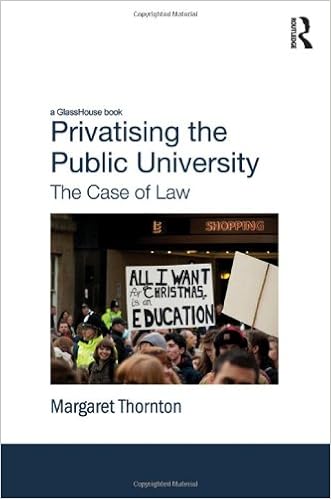
 The panel and audience have arrived and the event has started. Professor Margaret Thornton, ANU College
of Law (author of "
The panel and audience have arrived and the event has started. Professor Margaret Thornton, ANU College
of Law (author of "
Privatising the Public University: The Case of Law"), warned of the managerat (managers at university) expanding, with the lost of academic freedom and an emphasis on commercial aspects. Professor Thornton appeared to be wanting to a return to an age where universities were given funding with no obligation to do anything in return. I don't think such an age ever existed.
Canberra. I am here for a panel discussion on "University Academic Culture: Has It Gone Wrong?". But I am a half an hour early and so have been catching up with my mail. Two strange items are relevant to tonight's topic. One is a media release from University of New South Wales: "UNSW Sydney partners with Keypath Education to expand its digital campus" (16 April 2018). The other is a paper letter from Athabasca University (Canada) about a program review.
The media release from UNSW is a little odd. First of all it refers to "UNSW Sydney". Given that this is about on-line education, what relevance does a particular UNSW campus have? The release refers to "... the launch of a suite of new fully online Master’s programs ..." with the company a Keypath Education. However, there are no masters programs mentioned. Also it is claimed that "... Students aren’t comparing their online education experience to their experience on campus; they are comparing it to their online banking experience ...". This is not supported by the education research literature I have read, nor by my own recent experience as a student. It appears UNSW has launched some unnamed on-line programs and doesn't know what students expect from such education.
The second odd item is a paper letter from Athabasca University's Center for Distance Education in Canada. This says the university is conducting a scheduled review of the Master of Education program. I completed an MEd at Athabasca last last year and so I am being surveyed about it. That is not unusual, but what is odd is that there is no survey attached, nor any web address for a survey. There are no electronic addresses for anything, or anyone, in the letter. Athabasca prides itself on being an on-line university and in three and a half years of study I received only about a half dozen pieces of paper from them. From the wording of the letter it appears that the Center is not even conducing the survey, it is another part of the university.
Athabasca's letter is dated 26 March, postmarked 29 March and I got it 16 April. Is the survey on the way? Has it been lost in the paper or e-mail? Have I already completed it and forgot, as it was so long ago? What is the purpose of the letter? I suspect that the Center is worried about its future and hopes this letter will result in me completing the survey favorably (I will, if I ever get the survey).
Both the UNSW media release and the Athabasca University letter suggest a level of desperation from universities about where higher education is headed and what their role is in it.
The panel and audience have arrived and the event has started. Professor Margaret Thornton, ANU College
of Law (author of "Privatising the Public University: The Case of Law"), warned of the managerat (managers at university) expanding, with the lost of academic freedom and an emphasis on commercial aspects. Professor Thornton appeared to be wanting to a return to an age where universities were given funding with no obligation to do anything in return. I don't think such an age ever existed.
Dr Kim Huynh, ANU School of
Politics and International Relations, College of Arts and Social
Sciences (and roving reporter for ABC Radio) told a story about a weightlifter with depression. This person is now a councilor of men to help them not be macho. He then related this to the Center for Western Civilization advocated by Tony Abbot. As far I understand it, Dr Huynh is arguing western universities need to be less focused on a male-focused view of civilization.
 Ms Bianca Hennessy, PhD Candidate in the School of
Culture, History and Languages, College of Asia and the Pacific talked about how the college looks at decolonization. She then related that to what happens at universities, comparing Australian and pacific institution's practice. Ms Hennessy pointed out that regional institutions emphasize benefit to the community, not just the student's job prospects and produce free open access textbooks.
Ms Bianca Hennessy, PhD Candidate in the School of
Culture, History and Languages, College of Asia and the Pacific talked about how the college looks at decolonization. She then related that to what happens at universities, comparing Australian and pacific institution's practice. Ms Hennessy pointed out that regional institutions emphasize benefit to the community, not just the student's job prospects and produce free open access textbooks.
 Ms Tess Snowball, Manager, ANU Academic Skills and Learning Centre, pointed out how university is now accessible to first in family Australian students who are not familiar with academic life. She also pointed out that international students come from different cultures. These points are familiar to me, being from a first in family generation and as an international higher education student. As a course designer and instructor I am very aware that I make assumptions about what me students know and expect.

Wednesday, September 13, 2017
Deci and Centi-credentials for Australian Professionals?
There is a lot of hype about badges and micro-credentials by Australian universities, amongst others, but little concrete action on implementing them. Also it is not clear how these small units fit with conventional qualifications, which I guess should now be called "macro-credentials". ;-)
Mewburn, Freund and Rutherford (2014) frankly discuss the difficulties with an open badge pilot at the Australian National University. There is little agreement on what such micro-credentials are. Existing conventional educational institutions are likely to use micro-credentials to describe parts of existing programs. As an example, UNSW describes its half semester on-line courses, such as "Systems Engineering Knowledge" (ZEIT8238), as "Micro‐credential Courses" (UNSW, 2016).
Vocational institutions may also follow a similar practice, describing what are formally called "Units of competency" as micro-credentials. As an example, the Diploma of Information Technology (ICT50115) requires 20 Units of competency, which is about the same granularity as the UNSW micro-credential (training.gov.au, 2016).
Deakin University's "DeakinCo" commercial arm takes a slightly different approach with microcredentials, in "Growing workforce 4.0" (19 April 2017), describes a framework of core professional capabilities (such as "teamwork") and areas of specialist professional expertise (such as "Data-driven marketing").
DeakinCo is offering nineteen Professional Practice Credentials. Some of these micro-credentials are what would be usually considered graduate attributes, such as Self Management, Teamwork, Problem Solving, Critical Thinking, Emotional Judgement, Global Citizenship. Others might be aspects of courses, such as Digital Literacy, Communication, Innovation, Professional Ethics. Others would seem to be areas for whole qualifications, such as Digital Marketing, Content Marketing, Data-Driven Marketing, Creative, Data Analytics. Others appear to be attributes sought in job applications, rather than something for a formal education process: Lead and Develop People, Empower Others, Adapt and Change and Drive Strategic Results, but these are described as "credentials".
The DeakinCo credentials are offered at three levels: Intermediate, Proficient and Advanced.The process for obtaining a credential can be illustrated with the "Self Management" credential. Here the applicant must have 5, 7, or 10 years experience for the Intermediate, Proficient and Advanced levels respectively. The applicant collects two or three pieces of evidence and writes a reflective testimony of 500 to 1000 words. The applicant is then interviewed by video conference. The process and forms used are similar to those used for some higher education qualifications (such as the Athabasca MEd) and membership of academic bodies (such as the Higher Education Academy (HEA) Professional Recognition Scheme).
Athabasca, HEA and DeakinCo all use the collection of evidence, related to specific competencies, and reflective portfolio. Athabacsa's MEd also uses a video-conferecne interview, the HEA does not. However, unlike Athabasca and HEA, DeakinCo are using the process at a much finer level of granularity. Assuming completion of all nineteen of the DeakinCo micro-credentials, at a cost of $9,405 ($495 each), the applicant would have completed nineteen evidence statements, reflective works and interviews. In comparison the Athabasca Med student, at a cost of about $19,000, completes one e-portfolio, in two stages, covering five artifacts and then has one interview.
One of the problems with such recognition schemes has been the daunting nature of the process. DeakinCo's approach may be useful, even where the applicant wants a macro-credential. Dividing the task into small manageable pieces could help the applicant.
Another problem are the conflicting priorities of vocational and university educational systems and those of employers. An interesting report which sought to bridge vocational and university education with "Recognition of Current Competency" (RCC) as distinct from "Recognition of Prior Learning" (RPL) was produced for Australia's vocational sector (Mason, Perry & Radford, 2007).
ps: A micro-credential might be better termed a deci-credential or centi-credential, as they are tenths to hundredths of a full credential, not millionths. ;-)
for Attendance at Professional Education Courses, page 2, UNSW, 2016. https://unsw.adfa.edu.au/sites/default/files/uploads/UNSWCanberra-credit-for-professional-education-courses.pdf#page=2
ICT50115 - Diploma of Information Technology: Qualification details
(Release 2), Australian Government, 14 January 2016 https://training.gov.au/Training/Details/ICT50115
Mewburn, Freund and Rutherford (2014) frankly discuss the difficulties with an open badge pilot at the Australian National University. There is little agreement on what such micro-credentials are. Existing conventional educational institutions are likely to use micro-credentials to describe parts of existing programs. As an example, UNSW describes its half semester on-line courses, such as "Systems Engineering Knowledge" (ZEIT8238), as "Micro‐credential Courses" (UNSW, 2016).
Vocational institutions may also follow a similar practice, describing what are formally called "Units of competency" as micro-credentials. As an example, the Diploma of Information Technology (ICT50115) requires 20 Units of competency, which is about the same granularity as the UNSW micro-credential (training.gov.au, 2016).
Deakin University's "DeakinCo" commercial arm takes a slightly different approach with microcredentials, in "Growing workforce 4.0" (19 April 2017), describes a framework of core professional capabilities (such as "teamwork") and areas of specialist professional expertise (such as "Data-driven marketing").
DeakinCo is offering nineteen Professional Practice Credentials. Some of these micro-credentials are what would be usually considered graduate attributes, such as Self Management, Teamwork, Problem Solving, Critical Thinking, Emotional Judgement, Global Citizenship. Others might be aspects of courses, such as Digital Literacy, Communication, Innovation, Professional Ethics. Others would seem to be areas for whole qualifications, such as Digital Marketing, Content Marketing, Data-Driven Marketing, Creative, Data Analytics. Others appear to be attributes sought in job applications, rather than something for a formal education process: Lead and Develop People, Empower Others, Adapt and Change and Drive Strategic Results, but these are described as "credentials".
The DeakinCo credentials are offered at three levels: Intermediate, Proficient and Advanced.The process for obtaining a credential can be illustrated with the "Self Management" credential. Here the applicant must have 5, 7, or 10 years experience for the Intermediate, Proficient and Advanced levels respectively. The applicant collects two or three pieces of evidence and writes a reflective testimony of 500 to 1000 words. The applicant is then interviewed by video conference. The process and forms used are similar to those used for some higher education qualifications (such as the Athabasca MEd) and membership of academic bodies (such as the Higher Education Academy (HEA) Professional Recognition Scheme).
Athabasca, HEA and DeakinCo all use the collection of evidence, related to specific competencies, and reflective portfolio. Athabacsa's MEd also uses a video-conferecne interview, the HEA does not. However, unlike Athabasca and HEA, DeakinCo are using the process at a much finer level of granularity. Assuming completion of all nineteen of the DeakinCo micro-credentials, at a cost of $9,405 ($495 each), the applicant would have completed nineteen evidence statements, reflective works and interviews. In comparison the Athabasca Med student, at a cost of about $19,000, completes one e-portfolio, in two stages, covering five artifacts and then has one interview.
One of the problems with such recognition schemes has been the daunting nature of the process. DeakinCo's approach may be useful, even where the applicant wants a macro-credential. Dividing the task into small manageable pieces could help the applicant.
Another problem are the conflicting priorities of vocational and university educational systems and those of employers. An interesting report which sought to bridge vocational and university education with "Recognition of Current Competency" (RCC) as distinct from "Recognition of Prior Learning" (RPL) was produced for Australia's vocational sector (Mason, Perry & Radford, 2007).
ps: A micro-credential might be better termed a deci-credential or centi-credential, as they are tenths to hundredths of a full credential, not millionths. ;-)
Reference
Credit into UNSW Canberra Postgraduate Programsfor Attendance at Professional Education Courses, page 2, UNSW, 2016. https://unsw.adfa.edu.au/sites/default/files/uploads/UNSWCanberra-credit-for-professional-education-courses.pdf#page=2
ICT50115 - Diploma of Information Technology: Qualification details
(Release 2), Australian Government, 14 January 2016 https://training.gov.au/Training/Details/ICT50115
Mason, J., Perry, W., & Radford, A. (2007, 3 December) Processes, systems and tools supporting recognition of prior learning survey: Final report, Australian Flexible Learning Framework, Department of Education, Employment and Workplace Relations. http://vital.new.voced.edu.au/vital/access/services/Download/ngv:29396/SOURCE2
Mewburn, I., Freund, K., & Rutherford, E. (2014). Badge trouble: piloting open badges at the Australian National University. Ascilite. http://hdl.handle.net/1885/13233
Mewburn, I., Freund, K., & Rutherford, E. (2014). Badge trouble: piloting open badges at the Australian National University. Ascilite. http://hdl.handle.net/1885/13233
Friday, October 28, 2016
m-Learning in Sydney

UTS Bachelor of Technology and Innovation

Mobile Learning and Indigenous People

Kevinwâsakâyâsiw Lewis, then talked about the teaching of teachers of indigenous languages in the University of Saskatchewan's Certificate in Indigenous Languages. Asked about the relevance of song in language learning, Kevin pointed out that chant and song enables the learner to stop worrying about how they pronounce. Also the repetition in the song helps learning, as well as being culturally significant. This reminded me of Dr McComas Taylor, at ANU's Teaching Sanskrit online with chanting.
mLearning for Aboriginal Pre-service Teachers in Remote Communities

Mobiles for TEQSA Regulatory Course Compliance

IamLearn AGM
The AGM of the International Association for Mobile Learning (IamLearn), was held in conjunction with the conference. Because I registered for the conference I received a
year's membership. One
initiative is that a new website will allow members to add content
directly, rather than emailed to an officeholder who then puts it up.
This is something other organizations might like to try
Telstra on Personalised mEducation
Online Tutorials for Higher Education
UNSW mLearning Physics

Identity and the Mobile Learner
 Professor John Traxler,
University of Wolverhampton gave the last keynote on "The Role of
Education in Identity Transformation and Acculturation". Professor
Traxler challenged the assumption that m-learning (and education in
general) was a culturally neutral boon for developing nations. Rather
than telling us a canned answer, this was a presentation asking
questions, which was refreshing.
Professor John Traxler,
University of Wolverhampton gave the last keynote on "The Role of
Education in Identity Transformation and Acculturation". Professor
Traxler challenged the assumption that m-learning (and education in
general) was a culturally neutral boon for developing nations. Rather
than telling us a canned answer, this was a presentation asking
questions, which was refreshing.Professor Traxler is concerned about a Western European view of education and technology being culturally imposed on others. However, this might also be a product of that culture.
Online Education for Prisoners

Some of what USQ has done would be useful, more generally for students. For example, a problem with webinars is where students have inadvertent left their microphones turned on. I suggest that the off-line features could be built into Moodle and the Linux operating system, allowing the approach taken by USQ to be made available world-wide at no cost.
Encouraging Faculty Development

I suggest that university educators should follow the approach used by nurses and computer professionals in Australia to enhance their recognition of their profession. This could include draft policy for universities and government to require and recognize teaching qualifications of university academics. Also they could suggest changes to university ranking schemes to give teaching quality the same weighting as research output.
References
Koole, M., & Ally, M. (2006, April). Framework for the rational analysis of mobile education (FRAME) model: Revising the ABCs of educational practices. In International Conference on Networking, International Conference on Systems and International Conference on Mobile Communications and Learning Technologies (ICNICONSMCL'06) (pp. 216-216). IEEE. Retrieved from http://dx.doi.org/10.1109/ICNICONSMCL.2006.103
Townsend, P., Halsey, J.
R., & Guenther, J. (2016). Mobile Learning Congruencies with
Aboriginal and Torres Strait Islander Cultural Philosophies. In Publishing Higher Degree Research (pp. 25-32). SensePublishers. Retrieved from http://link.springer.com/chapter/10.1007/978-94-6300-672-9_3
Tuesday, October 25, 2016
UNSW mLearning Physics
Online Tutorials for Higher Education
Greetings from mLearn 2016 where Norman Wildberger and Joshua Capel presented an excellent live demonstration of "Higher Education Practice Online Tutorials and GeoGebra as Mobile Learning Tools" used for teaching mathematics at UNSW. However,what seemed to be missing was a business model to support the high up-front investment to produce such materials. The Open University (OUUK) pioneered the use of video and preprepared materials decades ago. What OUUK also did was work out the costing of preparation of such materials and tradeoffs between production values of video and teaching effectiveness. Many educators appear to be reluctant to address cost and consider this is not their role. However, if these forms of education are not cost effective, then they will be no more than one off experiments. Before carrying out research in this area, I suggest reading the excellent series of books produce by OUUK, some decades ago on how to produce education. This work is as applicable today to the MOOC.
Friday, April 15, 2016
Chinese Innovation Precinct for Sydney

"... Torch Center seeks to achieve four major objectives by cooperating with other pertinent authorities at central and local levels.
- To perfect the support system for high-tech industrialization, focusing on promoting indigenous innovation;
- To foster the growth of tech-based SMEs and boost technological innovation in enterprises;
- To promote the development of innovation clusters and advance upgrades in high technologies;
- To mobilize innovative resources including capital, technology and talent to reinforce support for innovation and industrialization.
To realize the above goals, we will try to carry out nine pillar tasks:
- To create favorable high-tech industrialization systems and mechanisms propitious to indigenous innovation;
- To boost the capacity for independent innovation in tech-based companies;
- To strengthen the construction of high-tech industrial bases;
- To speed up the establishment of the fostering and tutorial system of technology companies;
- To intensify the construction of a service system for innovation clusters;
- To further improve the financing and investment system for high-tech industrialization;
- To promote technology transfers and business-research cooperation;
- To encourage the globalization of high-tech industries."
From Mission: Torch High Technology Industry Development Center Program, Ministry of Science and Technology, China.
Reference
Segal, A. (2003). Digital dragon: high-technology enterprises in China. Cornell University Press.
Wednesday, March 18, 2015
Online education in solar cell manufacturing
 Greetings from the Australian national University in Canberra, where Keith McIntosh, from company PV Lighthouse, is speaking on "PV Factory: Online education and research in solar cell manufacturing". He demonstrated "PV Factory", an on-line application used at UNSW which students can use to design solar cells and see how they would perform, using a "Virtual Production Line" (VPL).

UNSW and QESST (at Arizona State University) and PV Lighthouse are working to make the UNSW Virtual Production Line generally available:
The project wil create a software platform called the Virtual Production Environment (VPE). The VPE will be a free online resource for the PV industry that will facilitate education and R&D by allowing users to (i) simulate the steps of a solar cell production line, (ii) access libraries of PV information, (iii) contribute to an integrated model of solar cell manufacturing, and (iv) evaluate innovation in terms of manufacturing cost. It will initially incorporate UNSW's Virtual Production Line for screen-printed crystalline silicon solar cells, used for several years in the UNSW undergraduate and postgraduate courses, SOLA3020, PV Technology & Manufacturing and SOLA9006, Solar Cell Technology and Manufacturing.
Interestingly Keith said that their server software generates text which is sent to the student's web browser and turned into graphics using Javascript. Also he showed some statistics as to how often the students access the system during their course, which shows, not surprisingly, that use increases just before assignments are due.
Keith is now working on how to have new research in solar cell making integrated into software which can be quickly made available to students and the industry. I suggest this could significantly reduce the cost and increase the efficiency of solar cells. This is very important to combating global warming and making energy available to developing nations. This could also be applied beyond the PV industry, to computer chip fabrication.
Subscribe to:
Posts (Atom)