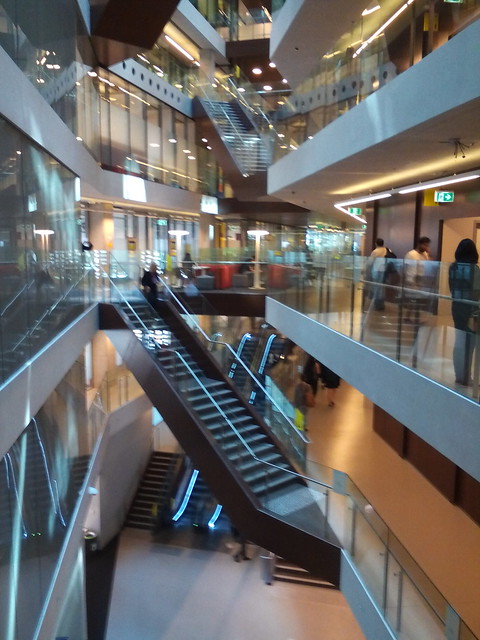
UTS Bachelor of Technology and Innovation

Mobile Learning and Indigenous People

Kevinwâsakâyâsiw Lewis, then talked about the teaching of teachers of indigenous languages in the University of Saskatchewan's Certificate in Indigenous Languages. Asked about the relevance of song in language learning, Kevin pointed out that chant and song enables the learner to stop worrying about how they pronounce. Also the repetition in the song helps learning, as well as being culturally significant. This reminded me of Dr McComas Taylor, at ANU's Teaching Sanskrit online with chanting.
mLearning for Aboriginal Pre-service Teachers in Remote Communities

Mobiles for TEQSA Regulatory Course Compliance

IamLearn AGM
The AGM of the International Association for Mobile Learning (IamLearn), was held in conjunction with the conference. Because I registered for the conference I received a
year's membership. One
initiative is that a new website will allow members to add content
directly, rather than emailed to an officeholder who then puts it up.
This is something other organizations might like to try
Telstra on Personalised mEducation
Online Tutorials for Higher Education
UNSW mLearning Physics

Identity and the Mobile Learner
 Professor John Traxler,
University of Wolverhampton gave the last keynote on "The Role of
Education in Identity Transformation and Acculturation". Professor
Traxler challenged the assumption that m-learning (and education in
general) was a culturally neutral boon for developing nations. Rather
than telling us a canned answer, this was a presentation asking
questions, which was refreshing.
Professor John Traxler,
University of Wolverhampton gave the last keynote on "The Role of
Education in Identity Transformation and Acculturation". Professor
Traxler challenged the assumption that m-learning (and education in
general) was a culturally neutral boon for developing nations. Rather
than telling us a canned answer, this was a presentation asking
questions, which was refreshing.Professor Traxler is concerned about a Western European view of education and technology being culturally imposed on others. However, this might also be a product of that culture.
Online Education for Prisoners

Some of what USQ has done would be useful, more generally for students. For example, a problem with webinars is where students have inadvertent left their microphones turned on. I suggest that the off-line features could be built into Moodle and the Linux operating system, allowing the approach taken by USQ to be made available world-wide at no cost.
Encouraging Faculty Development

I suggest that university educators should follow the approach used by nurses and computer professionals in Australia to enhance their recognition of their profession. This could include draft policy for universities and government to require and recognize teaching qualifications of university academics. Also they could suggest changes to university ranking schemes to give teaching quality the same weighting as research output.
References
Koole, M., & Ally, M. (2006, April). Framework for the rational analysis of mobile education (FRAME) model: Revising the ABCs of educational practices. In International Conference on Networking, International Conference on Systems and International Conference on Mobile Communications and Learning Technologies (ICNICONSMCL'06) (pp. 216-216). IEEE. Retrieved from http://dx.doi.org/10.1109/ICNICONSMCL.2006.103
Townsend, P., Halsey, J.
R., & Guenther, J. (2016). Mobile Learning Congruencies with
Aboriginal and Torres Strait Islander Cultural Philosophies. In Publishing Higher Degree Research (pp. 25-32). SensePublishers. Retrieved from http://link.springer.com/chapter/10.1007/978-94-6300-672-9_3