Wednesday, June 3, 2026
Indigenous Education at Edutech Au
Greetings from the Edutech_Au conference at Darling Harbour in Sydney. I a moderating a session on AI and equity tomorrow morning. Today I am wandering around the exhibition. Most interesting is in the back right corner, with three booths from indigenous education organisations (TIPIAC, indigenous Literacy Foundation, Wingaru Education), with an adjacent series of talks.
Sunday, February 25, 2024
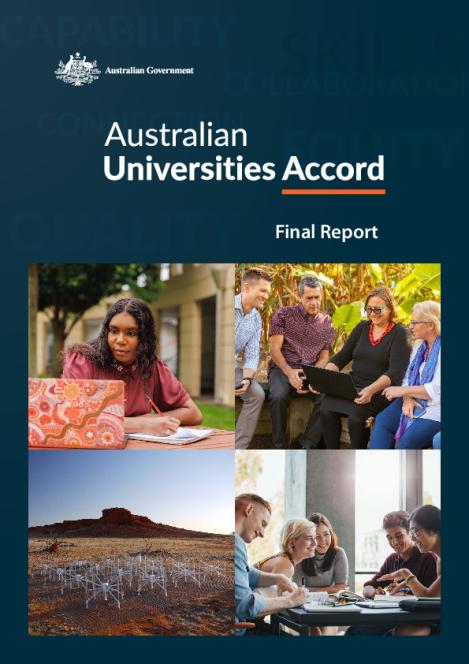
Australian Universities Accord Final Report: Mostly Good
![]() |
| Australian Universities Accord Final Report, 25 February 2024 |
There is also a Summary Report by the Department of Education, which at 34 pages is longer than the executive summary in the actual report, so seems a bit pointless (unless the department just wanted to put its own spin on things).
The report, while mentioning democracy and civic values, emphasizes the economic benefits of research and higher education. It raises issues of low demand from students, casualisation of the university workforce, and financial pressures. Equity also features prominently. The report makes 47 recommendations to address these, and other, issues.
Targets and VET
The recommendations under broad headings, the first of which is the "National Tertiary Education Objective". Interestingly this is proposed for both higher and vocational education, to:
a. "underpin a strong, equitable and resilient democracy
b. drive national economic and social development and environmental sustainability."
Vocational education is mentioned further in the Attainment targets:
a. "a skilled workforce to meet the changing needs of the economy through a tertiary education attainment target of at least 80% of the working age population with at least one tertiary qualification (Certificate III and above) by 2050 compared with 60% in 2023
b. growth in Commonwealth supported places in higher education to achieve this target, more than doubling the number of students in Commonwealth supported places from around 860,000 in 2022 to 1.8 million in 2050 across all age groups
c. growing numbers of younger Australians with a university education, through an attainment target of 55% of 25 to 34-year-olds with a bachelor degree qualification or above by 2050 compared with 45% in 2023, noting that many will also have a VET qualification
d. a strong and growing contribution to tertiary attainment driven by TAFE and the vocational system, with a planning assumption that 40% of 25 to 34-year-olds will have a tertiary level vocational or technical qualification in 2050, noting that some people have both a VET and higher education qualification ..."
As it happens, in my submission to the accord panel, I suggested an 80% vocational target but at a more ambitions Certificate IV level, rather than Certificate III. The panel's proposed target of 55% of young people with a bachelor degree may seem modest, given this is already at 45%. However, we may have already past peak degree, with enrollments dropping, as young people decide a degree is not their best investment. Government would do well to agree with this assessment, and decide to fund more flexible forms of education, rather than traditional bachelors degrees.
Flexible Courses and RPL
Under "A more flexible and responsive skills system" the panel recommends "working with tertiary education providers, industry and business to adopt a consistent, published, national approach to recognition of prior learning (RPL) and credit recognition":
i."address historical, cultural and institutional barriers to RPL and credit recognition
ii.make it easier for students to gain maximum credit for previous study and minimise
the time taken and cost to get a new qualification
iii.include recognising appropriate work experience
iv.improve student mobility to enter, exit and return to tertiary education"
While RPL is routine in VET, the difficulty will be in persuading and educating the university sector in how to do it. While universities could learn much from the VET sector, it will be difficult for the upper end of the university sector to accept this. Part of my day job for several years has been processing applications for credit for prior study, & RPL. This is something I have been formally trained to do in TAFE, & university programs, and though being on the accreditation standards board of my profession, but is not a skill many of my colleagues share, or value. Many universities in Australia share course designs across institutions, and international, where external professional recognition imposes standardization. However, this is not formally recognized, so a time consuming process is required to process every application for every course credit. This could be improved by giving incentives to universities to work together, and train staff.
The panel recognize the need for more flexible qualifications, with a recommendation for modular, stackable qualifications:
"5. That to help Australians quickly get the skills they need to fill jobs that are in shortage, the Australian Government establish a comprehensive system of modular, stackable and transferable qualifications, including microcredentials, consistent with a reformed Australian Qualifications Framework." (Page 19)
This one recommendation is worth a whole report in itself. In my submission, I recommended nested programs, rather than the more ambitious stackable. There is a subtle difference here. A university can create a set of qualifications which a student can undertake in sequence (nested). It is much harder to allow the student to assemble a larger qualification from an assortment of smaller ones (stackable). Even the much easier task of providing standalone micro-credentials is one that universities have been slow to achieve. The level of educational design skills would need to be considerably increased at Australian universities to achieve this aim.
Work Integrated Learning
The panel proposes to have studnts "earn and learn while studying" with a "Jobs Broker" for relevant part-time work, paid by employers.
"7. That to ensure students develop work relevant skills for employment after their study, the Australian Government increase opportunities for students to both earn and learn while studying by:
a. establishing a national brokerage system (‘Jobs Broker’) to support tertiary education students find part-time work and placements relevant to their fields of study. Delivery should be through a provider that charges paid subscriptions by employers. The service should be free for students, and allow them to earn income while studying and reduce cost of living pressures
b. promoting work-integrated learning (WIL) by working with peak bodies for employers, industry, business and tertiary education providers to deliver more WIL opportunities in curricula across all disciplines, and provide training to industry supervisors
c. improving measures of graduate generic skills as part of the Graduate Outcomes Survey and Employer Satisfaction Survey. The Australian Tertiary Education Commission should showcase best practice as part of its ‘State of the Tertiary Education System’ annual report
d. using models like degree apprenticeships that encourage an employment relationship as part of course design." (Page 19)
Again this is a recommendation which deserves a whole report itself, with implications for how higher education is provided. For students to be engaged in significant part time work requires them to be part time students. Flipping the Australian university system from a focus on full time study, to part time would seem radical, but is just a recognition of what has already happened. Much of the stress for students and staff comes from students who are holding down a job while studying full time.
For the last eight years I have been helping teach students undertaking Work Integrated Learning, mostly in groups, but also individual interns. Even in the vocationally orientated filed of computing, during a boom in demand for skills in areas such as cyber security, analytics, and AI, this is not easy. Outside vocationally orientated disciplines, such as computing, engineering, and business, this is going to be especially difficult. There is then the problem of training academic staff to design, teach and assess WIL.
Professional Accreditation
The Panel's recommendations on "Professional accreditation bodies", were slightly jarring for someone who has served on accreditation setting committees. As a member of my profession, I am used to telling universities, and governments, what they have to do, not the other way around.
"9. That to ensure professional accreditation including placement requirements are appropriate for industry and business skill needs, tertiary education providers and the Australian Government, through the Australian Tertiary Education Commission, work with professional accreditation bodies, to agree a code of conduct for these bodies. The code should ensure that any accreditation requirements are evidence-based and proportionate to the gain they provide and that placement requirements ensure that students gain industry relevant skills and experience without imposing onerous placement length and conditions." Page 20
That accreditation requirements should be evidence based is reasonable, and work placements not onerous. However this should be a mutual obligation, with the universities required to show they are teaching & assessing work relevant skills.
One example of where WIL assessment can go wrong is with e-portfolios. Students are told to reflect on what they learned on their placement, without training in how to write reflectively. The approach I have been using for the last few years is to frame the reflective e-portfolio in the form of an application for a job, so it is relevant to the student, and have the careers staff teach this.
Participation targets for First Nations, Low SES, Regional, Rural, Remote and Students with a Disability
In recommendation 10, the panel proposes participation targets for undergraduate university students by 2035: 3.3% First Nations, 20.2% low SES, 24.0% regional, rural, and remote, and current rate for students with disability. These are very modest targets, but even so no penalties for non-achievements, or incentives are proposed. Also by emphasizing university this may not be be in the best interests of studnts woH might benifit from attending VET first.
Building aspiration including through increasing readiness for tertiary education and providing career advice
In Recommendation 11, the panel proposes work by federal, and state governments on "... outreach programs designed to develop familiarity with tertiary education". Harder is to "... ensure post-school pathways are visible and integrated into secondary schooling ...".
Fee-free preparatory courses
The Panel calls for free university preparatory courses. One way to fit this in the current system, I suggest, would be to have the preparatory courses run by the VET sector.
Support to participate and succeed in learning
In recommendation 13 the Panel proposes funding for under-represented groups, to meet the targets set in Recommendation 10. It would have been a bit easier to follow the recommendations, if these had been together. No specific amounts are mentioned, or if this additional funding is to come out out of that already provided to universities. Also there is no mention of developing curricular, materials, delivery techniques to suit these students. As an example, it is likely many of the studnts would benifit from blended programs, delivered in part remotely at home, and on country. Also the content of courses may need to be different. Such course content and delivery techniques would also greatly enrich the leanring experience of other students.
Financial support for placements
The panel proposes in recommendation 14 government funding for work placements in nursing, care and teaching professions. The argument presented, that this would reduce financial hardship, makes no sense, unless the government support is extended to all disciplines.
Student income support
In recommendation 15 the panel asks the federal government increasing allowances and loosening rules. Hard to argue with that, except perhaps to suggest abolishing some of the rules.
Reducing student contributions and reforming HELP repayment arrangements
Of most interest to students will be the panels recommendation 16, to reduce the burden of HELP loans, and in particular the effect of the Job-ready Graduates (JRG) package. At the time it was introduced, many warned charging humanities students as a way to direct them to what the then government saw as more vocationally relevant programs would not work. It did not work, and the studnts should not be further punished for past bad government policy.
While previous recommendations were not specific about money, recommendation 17 proposes universities charging "high fees" (over $40,000) for graduate coursework (I assume a Masters), "be required to re-invest a proportion of income earned back into scholarships and bursaries to support students from under-represented backgrounds to access these courses". This Robinhood approach doesn't appear to be proposed for undergraduate courses, or for international student fees. Also it is a relatively mild levy, being retained within the institution.
Ensuring student safety and experience
The Panel calls for a National Student Ombudsman to handle complaints in recommendation 18. The Australian Government recently announced such an office would be established. It is usual for an industry ombudsman to be funded by the industry members, but there is no mention of funding in the announcement.
More controversial is recommendation 19, calling for student unions funded from student fees. This would go counter to the previous government's approach of cutting off funding to student unions. As an online student for seven years, I was slightly annoyed by services and amenities charges, when they went to the upgrading of facilities I had never seen, and would never use, because they were a thousand kilometers away.
Early at-school offers
Recommendation 20 reads like a cartel wanting to maintain the market share of its members. The panel recommends "early at-school offers for 2025 and 2026 should not be issued before September" to "maintain the integrity of senior secondary certificates". However, if universities are able to determine which students are likely to succeed at studies without certificates, they do not have integrity. If the certificates are no longer of value to universities, they should be modified to suit other users, such as employers, and VET. This would also certificates to emphasize work relevant skills.
Quality learning and teaching
Recommendation 21 shows the Panel placing hope over available evidence, by suggesting measures to "prepare the higher education sector for growth in student numbers". I suggest a further decrease in domestic student numbers is more likely, and would be a better outcome in terms of public policy. However, in any case I agree with the panel about "using proven innovative learning approaches which embrace online and hybrid teaching modalities". However, what is lacking is any proposal for university teachers being required to be qualified to teach. Paradoxically, while universities teach the highest level teachers they have the lowest requirements for teaching qualifications. The panel is not proposing to change that.
International education
At this point, it is time for a break ...
Thursday, November 23, 2023
ANU Bandalang Studio Launch
Greetings from the launch of Bandalang Studio at the Australian National University in Canberra. The Bandalang Studio at the ANU School of Engineering will explore indigenous knowledge systems in innovation, design, research and teaching. I tried the VR headset with Lynette Wallworth's 'Collisions', a 3d immersive film.We are having a reading from the book "The Visitors", by Jane Harrison. The point of this is that Bandalang Studio can teach non-indigenous people about how to live with country.
Indigenous engineering design demonstrates a highly sophisticated transdisciplinary systems thinking approach towards solving problems. ...
What is the Bandalang Studio?
Bandalang is a Wiradyuri language name which means ‘joining’ or ‘junction’. The name Bandalang was gifted to the studio by Ngambri (Walgalu), Wallaballooa (Ngunnawal), Wiradyuri (Erambie) custodian, Paul Girrawah House. The name symbolises the spirit of collaboration which is integral to the mission of the ANU Bandalang Studio. The Bandalang Studio is a place in which Indigenous Knowledge and traditional Western practice can collaborate to find sustainable solutions to our future in engineering. ...
Bandalang Studio Founding Principles
The Bandalang Studio is founded on four principles which guide our strategic priorities.
- Principle of Bandalang (Collaboration) bandalang = joining, junction (noun)
- Principle of Wudhagarbinya (Listening ) wudhagarbinya = listen or winhangarra = listen, hear, think or ngattai = listen
- Principle of Dhurinya (Equality) dhurinya = being, continuing to being
- Principle of Gurray (Change) gurray = change or refreshment
The above languages include Walgalu, Wiradyuri, Dhurga and Ngunnawal/Gundungarra.
Bandalang Studio Mission
- platforming Indigenous Knowledge Systems in engineering nationally and internationally
- building Indigenous ways of thinking, being and doing into the ANU School of Engineering course structure, curriculum development and delivery
- fostering interdisciplinary collaboration and partnerships that support Indigenous projects and enterprises
- create life-long learning support pathways for Indigenous students, practitioners and researchers in engineering
- to critically address existing traditions, norms and values in engineering and technology"
From About Bandalang Studio Indigenous Engineering Design, ANU, 2023
Friday, August 4, 2023
Funding Indigenous Students is Worthwhile if Suitable Courses Are Provided
The Australian Government has extended study funding of indigenous students to those in urban areas, as part of a package of changes in response to the Interim Report of the Australian Universities Accord inquiry. Professor Andrew Norton has asked if it will make much of a difference? I suggest funding for indigenous students will be beneficial, but only if there are courses, & services, for their needs. As Professor Norton points out, indigenous Year 12 completion rates are low, so bridging will be needed, but the Australian Government is not going to pay for them. I suggest that problem can be sidestepped, by building the needed training into the degree curriculum. This will help all students: urban, rural, indigenous, non-indigenous, domestic, and international.
Professor Norton points out that sub-bachelor programs were excluded from funding previously. But there is an easy workaround which universities use for other studnts, the Professor did not mention: tell the student to enroll in a Bachelor program, then exit early with a diploma (or now the option of a certificate). However, at present such a sub-degree program will likely be just the introductory units of the bachelors degree. What is needed are enabling courses on how to study, and communicate. Such courses would also be of use to non-indigenous, domestic and international students. Particularly in STEM programs, there is a tendency to do the hard science first, and leave the communication and teamwork skills to second and third year. I suggest reversing this for all students, teaching them how to work and learn at the start.
Building what are normally part of enabling courses into degree programs will go some way to solve funding programs. Professors will grumble that all this non-core stuff is at the expect of core subjects. But learning very technical content is of no use if the graduate can't communicate it, can't work in a team, or can't get to graduate because they don't know how to learn. As I have discussed previously in this Blog, these communication, teamwork, and leadership skills are key to the success of any professional.
Another way to support indigenous and other studnts is with online and mobile learning. Students learn best when in the community, not on a campus. Universities can provide all courses online, by default. This allows studnts to meet work and cultural commitments more easily, while studying.
Wednesday, May 9, 2018
Iimproving Health and Education outcomes for Indigenous Australians
Mr. Spencer discussed his commission's report "Human services in remoteIndigenous communities". The report pointed out that "Service provision in remote Indigenous communities faces challenges including isolation, time-consuming (and often costly) travel, and difficulty recruiting and retaining staff with the necessary skills and capabilities." (p. 265).
I found it disappointing that the report made only one mention of online services and it was negative: "Access to online service alternatives can also be challenging due to a lack of IT infrastructure and, in some cases, a lack of the skills required to utilise those services.". In his PHD thesis, Philip Townsend (p. 26, 2017), points out there has been rapid adoption of mobile devices in remote Aboriginal and Torres Strait Islander communities. Dr. Townsend investigated the use of mobile devices for remote education. Given the problems of isolation, travel cost, recruiting and retaining staff, the Commission could have done more than just dismiss online service alternatives in one sentence.
Reference
Monday, April 9, 2018
Mobile Devices for Aboriginal and Torres Strait Islander Pre-service Teachers
Recently I took part in a workshop on how to export renewable energy from Australia. The idea is to build large solar farms in outback Australia and send the energy to Asia, either directly via high voltage undersea cables, or as liquid gas in tankers. Along with the major engineering and geopolitical challenges, there is the issue of obtaining permission for use of the land to collect the energy. Negotiating with landholders is normally thought to be something where you send letters and call meetings. However, we now have the Internet to supplement conventional means.
Reference
Friday, June 2, 2017
ANU Science Teaching and Learning Colloquium
One of the points Dr Anderson made was on access to education for indigenous students in remote areas. His solution appeared to be to send the students away to boarding school in the cities. Last year at mLearn 2016 in Sydney, Philip Townsend talked on Mobile Learning indigenous student teachers in remote areas. This provides an alternative approach, where at least some of the education can be provided where the student is.
Monday, October 24, 2016
mLearning for Aboriginal Pre-service Teachers in Remote Communities
Philip pointed out that indigenous students have cultural obligations which can take them away from their studies for extended periods. A mobile device may assist, but who pays for the device and network access? In a remote indigenous communities prepaid access is typically used and the account may be shared with others. Also the institution has to offer an on-line strategy as part of the education. One important points was that Philip asserted that mobile devices are compatible with indigenous communities: this is not a technology which will be abandoned after the novelty wears off. Also he mentioned the Cooperative Research Centre for Remote Economic Participation.
I suggest that addressing the needs of remote students can assist all students. If we make courses flexible enough for the remote students, these courses will also be better for city and campus based students. For the last four years I have been an on-line distance education student and have been teaching this way for seven years. To me this is just normal education, which can be enhanced, where possible, with supplementary face-to-face classes.
References
Mobile Learning and Indigenous People
Kevinwâsakâyâsiw Lewis, then talked about the teaching of teachers of indigenous languages in the University of Saskatchewan's Certificate in Indigenous Languages. He commented there was limited access to dictionaries and where most existing educational materials are from the point of view of English speakers. An additional problem is to negotiate access to information by "pipe holders" (tribal elders).
Kevin demonstrated color coding of text with animation to show tenses, or "moving morphemes". Currently this is not available as an app for the students at Saskatchewan. He is mixing students at different levels of language literacy in the one class to aid their learning.
Asked about the relevance of song in language learning, Kevin pointed out that chant and song enables the learner to stop worrying about how they pronounce. Also the repetition in the song helps learning, as well as being culturally significant. This reminded me of Dr McComas Taylor, at ANU's Teaching Sanskrit online with chanting.
References
Wednesday, December 23, 2015
Mobile Devices for Tertiary Study by Remote Aboriginal and Torres Strait Islander Women
Townsend (2015) studied 64 students, but not all used mobile devices. I had difficulty working out from the paper exactly how many did.
Townsend (2015) found that students want videos suitable for mobile devices of the on-campus lectures and seminars (apparently the students don't get all the materials in a format they can use). Also announcements should be sent to the students’ mobile devices.This appears to indicate a failing with the configuration of the learning software used. The video lecture system and learning management system I use will, by default provide versions of videos and announcements for mobile devices.
The third student requirement reported by Townsend (2015) is non-technical:
However, this may not be common. In courses I have been a student of, it is rare for students to receive this level of attention, hearing from the tutor in person perhaps once a month. In some courses I have not received any personal message from the tutor at all over a three month course.
Townsend (2015) points to the value of mobile learning in terms of place, time, and pace of study, with work, family commitments and health issues preventing students from attending a class in person, even when they are in proximity to a study center. He also details the benefits in terms of collaboration between students from e-learning (I have found this as a student).
While these benefits of m-learning apply to the community generally, but to a lesser degree. Those in an urban environment are not so far from a university campus and may have better access through a laptop or desktop computer than in a remote indigenous community. However, issues of family and cultural obligations, along with ill-health, can prevent access to conventional campuses and study.
Rather than treat very remote indigenous students as a special case and provide them with special programs, I suggest that tertiary studies should be, by default designed on the assumption the student will be remote and part time. It is well past the time when a student could be assumed to be full time on campus and not have any work, family or cultural obligations.
References
Sunday, September 20, 2015
Deadly Mob Learning
The NBN is planned to use fibre optic and hybrid cable to households in the city, fixed terrestrial wireless in regional areas and satellite broadband in remote areas. But if applications are developed for the higher speed urban part of the network, they may not work as well (or at all) on the remote satellite service, or on wireless mobile devices.
Education was envisaged as one use for the NBN. But the NBN was designed on the assumption that the primary use of the Internet would be in the home (even the wireless part of the NBN is fixed, not mobile). If users are mobile, then the network may be of little use. In particular this will disadvantage remote indigenous communities, which already have limited access to services, including education.
Philip Townsend at Flinders University of South Australia, is researching connecting remote groups of teachers together for education with mobile devices, or deadly mob learning ("high quality group learning" in Australian Aboriginal English):
- Guenther, J., McRae-Williams, E., & Townsend, P. (2012). Can m-and e-learning support pathways for meaningful vocation in remote communities?. AVETRA 15th Annual Conference. The Value and Voice of VET Research for individuals, industry, community and the nation, Rydges Capital Hill, ACT Retrieved July. Retrieved from http://www.crc-rep.com.au/resource/AVETRA2012_GuentherAndMcRae-Williams_Paper59.pdf
- Townsend, P. (2014). Deadly Remote Teacher Education by Mobile Devices. Retrieved from https://acec2014.acce.edu.au/sites/2014/files/attachments/ACEC2014%20Philip%20Townsend,%20Deadly%20remote%20teacher%20education%20by%20mobile%20devices_0.docx
- Townsend, P. (2014). Mobile Learning Engagement is Location Neutral. Transactions on Mobile Learning, 5. Retrieved from http://www.researchgate.net/profile/Philip_Townsend2/publication/269932389_Mobile_Learning_Engagement_is_Location_Neutral/links/549a273e0cf2fedbc30cb24e.pdf
- Townsend, P. B. (2015). Mob learning-digital communities for remote aboriginal and Torres strait islander tertiary students. Journal of Economic & Social Policy, 17(2), 20. Retrieved from https://www.academia.edu/13856418/Mob_Learning_-_Digital_Communities_for_Remote_Aboriginal_and_Torres_Strait_Islander_Tertiary_Students
Monday, March 10, 2014
Blended Multi-lingual Schools for All Australians
I expect every Australian is familiar with the "Australian School of the Air" for students at home: now delivered by WiFi, rather than wireless. ;-)
As a student of education myself, recently I was undertaking a project on distance education for indigenous Australian students in remote communities. There have been some projects to issue computers to students in schools, best known being the XO Project. However, these focus on the hardware, not the integration into the curriculum.
What many might not know (I didn't), is that the NT and Queensland education departments provide a form of blended learning for remote schools. The students attend a local school and have a teacher, but where the school is too small to have a teachers for a specialist subjects, the materials and a teacher are provided on-line. The local and remote teachers work together to teach the students.
This, I suggest, could be the future of schools across Australia. Students would still attend a local school, but would also have the benefit of specialist on-line courses and teachers. This would allow students to learn in languages other than English and study specialist courses, using materials developed by Australian universities.
Australian and International On-line Support for Learning
Australia’s Northern Territory Open Education Centre (NTOEC, 2014) provides distance education to students at home. NTOEC also supports teachers in Community Schools in remote areas. This mode of education provides the student with a local teacher and a class for cultural awareness and group activities, as well as remote teaching for specialist subjects.
Kapitzke and Pendergast (2005) report positively on the early trials of the Queensland Education Department's Virtual Schooling Service, which provides both distance education to students in the home and support for students in the classroom in remote schools. While they argue that new pedagogy is needed, there does not appear to have been a development of this, with the Virtual Schooling continuing to be run as first envisaged.
Keegan, Taka Keegan and Laws (2011) describe how the Moodle Learning Management System and Mahara (e-Portfolio) are being used for bilingual/bicultural education of Māori in New Zealand, for both school and university students. This would allow the holistic approach to learning noted by Kitchenham (2013) for teaching Indigenous language and culture in Northern British Columbia (Canadia).
Srivastava (2002) compares higher education use of Distance Education (DE) in Canada and India. On Canada Srivastava comments that "There is little attention being paid to the kinds of education that might be appropriate to the aboriginal peoples". and notes only 6% were university graduates in 1996.
Kitchenham (2013) details the use of digital technology for teaching Indigenous language and culture in Northern British Columbian (Canadia) public schools. Rather than barriers to e-learning for indigenous students, Kitchenham argues that these may suit the learning styles of the indigenous students.
Indigenous Learning styles Supported by Online Courses
Kitchenham (2013) noted that of the fourteen indigenous learning styles identified by White (2008), ten are "well matched with educational technologies". These ten were:
It should be noted that these also correspond to the approach advocated for contemporary e-learning generally, including connectivist Massive Open On-line Courses (c-MOOCs). Yeager, Hurley-Dasgupta & Bliss (2013) list the four activities key to a cMOOC as: aggregation; remixing; repurposing (or constructivism); and feeding forward. Apart from aggregation, which is the curating of material by the educator, the others activities are for the learners to carry out cooperatively. These same approaches to learning and now applied in teaching postgraduate university students, using the same on-line tools as used in schools.
- participate at their own discretion;
- enjoy group-oriented tasks;
- favour one-on-one interaction with the teacher for clarification or for permission;
- learn from repeated and silent observation;
- are spatially and holistically oriented;
- prefer holistic approaches to learning;
- are interested in what other learners are doing;
- need time to answer teacher questions;
- spurn displaying knowledge that others might possess; and
- prefer collaborative learning over competitive learning.
From: Kitchenham (2013), after White (2008)
Free Open Access Courses for Schools from Australian Universities
ANU is currently accepting enrolments for its first two edX on-line courses: Engaging India and Greatest Unsolved Mysteries of the Universe. These courses are intended for school students. Engaging India is to be offered in two languages (English and Hindi).
References
Keegan, P. J., Taka Keegan, T., & Laws, M. (2011). Online Māori Resources and Māori Initiatives for Teaching and Learning: Current activities, successes and future directions. MAI Review, (1), 1-13.
Kitchenham, A. (2013).THE PRESERVATION OF CANADIAN INDIGENOUS LANGUAGE AND CULTURE THROUGH EDUCATIONAL TECHNOLOGY. Alternative: An International Journal Of Indigenous Peoples,9(4), 351-364.
Srivastava, M. (2002). A comparative study on current trends in distance education in Canada and India. Turkish Online Journal of Distance Education, 3(4), 1-11. Retrieved from http://tojde.anadolu.edu.tr/tojde8/articles/srivastava.htm
Yeager, C., Hurley-Dasgupta, B., & Bliss, C. A. (2013). CMOOCS AND GLOBAL LEARNING: AN AUTHENTIC ALTERNATIVE. Journal Of Asynchronous Learning Networks, 17(2), 133-147. White, F. (2008). Ancestral language acquisition among Native Americans: A study of a Haida
language class. Lewiston, NY: Edwin Mellen.
Thursday, March 6, 2014
Living Archive of Aboriginal Languages
Professor Christie criticised the current trend to require aboriginal students to use English for a specified period per day, driven by the requirement to meet nationally standardised test requirements. He instead described a process where students create the content for the curriculum based on recording local knowledge. He also said there were a lot of good funded projects in community centres and libraries, using mobile and digital technology. Also some linguists at the NT Department of Education may be used to adapt some indigenous materials for teaching. Professor Christie said that many within the Department of Education were unhappy with the direct of new policies which minimise aboriginal language.
Another aspect mentioned was the role of aboriginal teachers in teaching subjects such as mathematics in a way the indigenous students could relate to.
This was an inspiring presentation and one where some of the setbacks due to Northern Territory and Australian Government education policies policies were looked on with sadness, rather than anger. This is all the more remarkable as academics in the field of indigenous education are expecting an epidemic of youth suicides due to the new government policies.
Recently I have been looking at the use of computer for education in remote indigenous communities in Australia and Canada. Perhaps there are some lessons for Australia which can be learned from elsewhere. During the discussion this afternoon, comparisons were made with Canada, where 30 times as much was spent on preserving indigenous languages. One positive point was the role of universities.
Sharman Stone MP,, Member for Murray officially launched the new archive. She was deputy chair of a parliamentary committee which produced ‘Inquiry into language learning in Indigenous communities’ (2012). She commented that one problem was where the language the students actually speak is ignored and they are taught as if they spoke English.
Public lecture
Living Archive of Aboriginal Languages: Launch and public lecture The Living Archive of Aboriginal Languages (LAAL) (http://laal.cdu.edu.au)/ will be launched by The Honorable Sharman Stone, Member for Murray. Dr Stone was deputy chair of the House of Representatives Standing Committee on Aboriginal and Torres Strait Islander Affairs which in 2012 produced the report ‘Inquiry into language learning in Indigenous communities’
A public lecture entitled ‘Aboriginal languages, literatures and technologies in the Northern Territory since the 1970s’ will be given by Professor Michael Christie from Charles Darwin University following the launch. Professor Christie will reflect on over 40 years involvement with bilingual education, linguistics and literature production in the Northern Territory, and the ways in which Aboriginal philosophies and pedagogies have influenced the production and use of literature over the years.
LAAL, an ARC-funded project, contains thousands of books in Australian Aboriginal languages produced in the Northern Territory during the era of bilingual education that are now digitised with permission for public access.
The archive has been devised to be of use to both the remote Aboriginal communities of origin in the intergenerational transmission of traditional knowledge, and to the international research community interested in working collaboratively with Aboriginal languages, texts, and their owners.
The archive contains books in over 25 Indigenous languages from 20 different communities, and includes traditional stories, language instruction, histories, songs, experience stories, ethno-scientific texts and others.
Stage two of the archive project has been funded to radically extend the range of texts, and to engage language owners, educators, and researchers in exploring, enriching and engaging with the archive.
The event is part of a larger workshop on Aboriginal languages sponsored by ANU.
For information visit http://chl.anu.edu.au/languages/alw2014.php
Sunday, February 16, 2014
Rural and Remote Education in Australia
Wednesday, February 12, 2014
Prime Minister’s Closing the Gap Report Fails to Address Effective Education
2014" on improving the living standards of indigenous Australians. The targets included in the report are not particularity ambitious. Two related to education are: "Halve the gap for Indigenous/ children in reading, writing and numeracy within a decade (by 2018)" and "Halve the gap for Indigenous people aged 20–24 in Year 12 or equivalent attainment rates (by 2020)". In methods to improve education, the Prime Minister did not mention the use of the Internet, computers or distance education. It appears the only measure the PM is proposing is to punish students and their parents for non-attendance at school. Recently the NT Department of Education released a " Draft Review of Indigenous Education in the Northern Territory " by Bruce Wilson (6 February 2014), which proposed not providing instruction to indigenous students in their own languages and to move students into boarding schools away from their communities. It is disappointing that at the same time a global revolution in education is taking place to provide more self directed learning, relivant to the student, where and when they want it, the Australian and Northern Territory governments appear to be planning to move education for indigenous students back to the nineteenth century.
Sunday, February 9, 2014
Blended Learning Model for Remote Indigenous Education
Teaching Only English
Distance education
examine the three-school distance education arrangement and current practice to determine how well they are suited to the changed secondary schooling arrangements proposed in this report.However, the report does not appear to make mention of blended learning, that is using a combination of classroom and on-line learning. Nor does the report mention the One Laptop Per Child Program (OLPC), which has provided specially designed learning computers for students in some remote schools. The Australian OLPC program takes a different approach from countries where the computers are centrally issued by the education department, instead emphasising support for teachers (Howard & Rennie, 2013).
References
Howard, S., & Rennie, E. (2013). Free for All: A Case Study Examining Implementation Factors of One-to-One Device Programs. Computers In The Schools, 30(4), 359-377. doi:10.1080/07380569.2013.847316