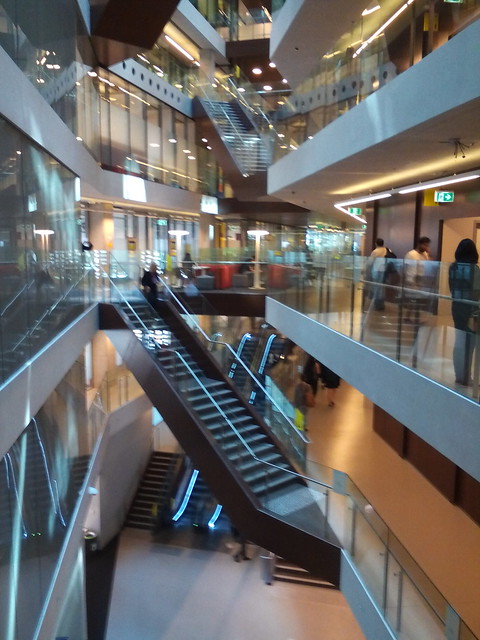
Australia appears to have faith in the financial viability of higher education, judging by the new buildings featured in
Architecture Australia (AA) and
Architectural Review Asia Pacific (ARAP). AA March/April 2014 features the
Science and Engineering Building by Sinclair Knight Merz at Federation University Australia (previously University of Ballarat), the
Cairns Institute by Woods Bagot at James Cook University and the
Doherty Institute, University of Melbourne,
UTS Broadway by Denton Corker Marshall for University of Technology Sydney, the
Braggs Building by BVN Donivin Hill for University of Adelaide and the
Translational Research Institute by Wilson Architects and Donovin Hill for University of Queensland and Queensland University of Technology.
While impressive looking buildings from the outside, they don't appear that innovative on the inside. Perhaps constrained by the conservative ideas of the clients, the building have traditional looking labs and teaching rooms. The Cairns Institute has what is called an "
Interactive Lecture Theatre", but this turns out to just have fixed benches and ordinary chairs, much like the
ANU Design Unit style of lecture theatre for the Australian National University fifty years ago.
How these buildings will adapt to the new research and educational environment, where most activities will be carried out online, is not clear. Within five to ten years the typical student will never need to visit a campus. A few students using specialised equipment may need to visit a campus for a few days a year. If the Australian economy is to prosper, researchers will similarly need to be pushed out into industry, corporations and government (the so-called
Cambridge Phenomenon). There is little value in researchers sitting in an ivory tower, no matter how prettily these are now clad in shimmering steel. There will still be a need for administration and support staff to run universities, but as with the students and researchers, there will be no compelling reason for them to be in a big building at a
campus.
Perhaps the best view of the future of the university campus is
QUT Science and Engineering Centre. This has a gym, swimming pool, food court and children's educational centre. Less obvious are places for groups of students to study, tutorial rooms, lecture theatres and administrative offices.