Showing posts with label Innovation Policy. Show all posts

Sunday, September 17, 2023

Tech Central Sydney Needs Old Buildings, a Good Cafe, & Course Credit for Students

In Clamperdown Park, for the
Tech Central Sydney consultation.
Tom Worthington CC-BY 2023
This is to suggest planners of the Tech Central Sydney Camperdown Node ensure there are old industrial and commercial building for startups to re-purpose at low cost, a start-up center in one of them, a good cafe, and course credit for students working on entrepreneurial projects.

I went along today to a consultation in Camperdown park, about the Camperdown Node. The collection of government lanyards, and branding, would rival an episode of ABC TV's Utopia. There was even someone from the Greater Cities Commission, successor to the Greater Sydney Commission. This is worryingly close to the "Even Greater Sydney Planning Committee", which was a comedy sketch on ABC Radio Sydney each Friday, by HG Nelson and James Valentine. 

It was a little odd having planning staff of three agencies consulting the public about a high technology precinct. There was a map showing the area, but little in the way of detail of what was proposed, so not much to be consulted on. I was asked about my views, and couldn't resist asking the staff what they would like me to tell them about how to set up a high tech hub, as I had spent a few decades looking into this.

Building Arcadia: Emulating Cambridge's High Technology Success

In my closing address as chair of the 1998 Information Industry Outlook Conference,in Canberra,  I argued that Australia should create a cultured image to market information industries. I suggested Cambridge (England) as the model, as detailed in the report The Cambridge Phenomenon. It is now possible to use Canberra as a model, with the Canberra Innovation Network (CBRIN), and a cluster of high tech companies adjacent to the Australian National University (ANU).

Old Building and Egg Rolls

I told the staff at the consultations, what was needed for an innovation precinct were old low cost industry and commercial building for startups to re-purpose. The problem for planners is how to prevent this transition zone close to the Sydney CBD being filled with retail outlets, and high rise apartments, with no place for companies, and advanced manufacturing. Also there needs to be a really good cafe for entrepreneurs to meet in. One angel investor keeps singing the praises of the egg rolls at the Australian Technology Park Cafe.

The other ingredient is a nearby university to supply people with innovative ideas. University of Sydney can provide this. One point I had to NSW, Sydney and Inner West planning staff on was not relying on graduates to provide entrepreneurs. There needs to be schemes to encourage current students, and staff to become entrepreneurs, as well as graduates. Through programs such as Techlauncher, the ANU allows studnts to work on a commercial startup at CRBIN, while a student. The students can get course credit for working on their own, or someone else's  startup. 

Innovating for Health at Your Fingertips

Oximeter from RPA in Use, 
Tom Worthington CC-BY 2022
The Royal Prince Alfred Hospital is located between the Sydney University campus and Clamperdown, making bio technology an obvious focus for the area. However, tech is tech, so there is no need to have particular policies, or restrictions on the area. Sydney's inner west has hosted diverse startups, including submarines and military drone builders. Developments don't need to be particularly tech intensive. As an example, I contracted COVID-19, and thus became a patient of RPA Virtual. After registering my location with NSW Health, I was contacted by a nurse at RPA, who took my details, and sent out an Oximeter. There is potential for companies offering more advanced forms of tele-medicine, to improve care, and lower costs.

Resources

Building Arcadia: Emulating Cambridge's High Technology Success, closing address to the ACS 1998 Information Industry Outlook Conference, Canberra,  7 November 1998


Tuesday, December 13, 2022

Some Thoughts on the Future of Australian Higher Education

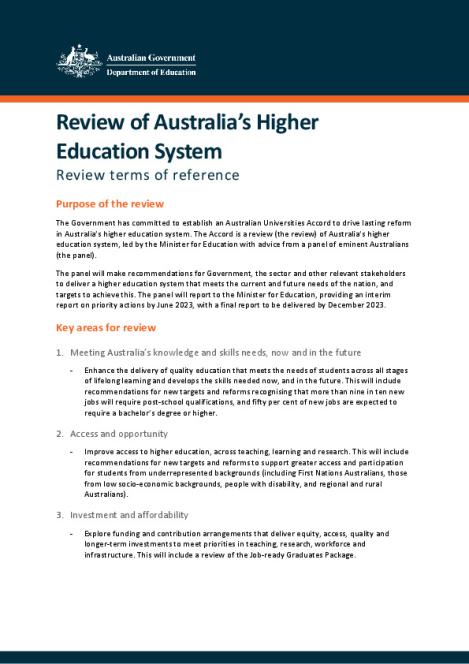
The Higher Education Review Terms of Reference, lists seven key areas for consideration (Department of Education, 2022). Here are some thoughts on the topic. Please note that while I am an Honorary Lecturer in Computing at the Australian National University, and a member of the Professional Standards Board of the Australian Computer Society, these recommendations are my own, and may not represent the views of any organisation I am associated with. 

The Review has asked for priorities. I suggest no radical change is needed. Universities should continue to provide educated professionals for the workplace, and applied research for industry, supported by fundamental research. Better funding of, and linkage with the VET sector is needed. This can be facilitated by training university academics in how to teach, using the work integrated techniques used in VET. Australia should double down on the use of online blended, and mobile learning, and promote this for international students. Government should target strategic areas for HE/industry cooperation, starting with a $20B defence drone program.

Recommendations on the Review Topics

1. Meeting Australia’s knowledge and skills needs, now and in the future

Recommendation 1: Australian universities should continue to be funded to focus on educating professionals, conducting applied research for industry, supported by fundamental research. The funding for the Vocational Education and Training (VET) sector in preparing professionals, both before and after university, should be expanded. 

Discussion: Universities should continue to provide first, and advanced degrees, with some vocational institutions offering first degrees, and other shorter qualifications. All should offer options for competency based, stacked short qualifications, with work integrated learning, and project capstones, as recently announced by Singapore Institute of Technology.

From the establishment of the first university, the top priority for Australian higher education has been to educate professionals for the workforce. The second priority has been applied research, in support of industry. Both education and applied research have been supported by fundamental research. There is no need to change these priorities. 

Alongside universities, have been vocational institutions, providing more focused courses, and providing  specific skills needed immediately. Schools have also been able to provide vocational qualifications, as well as preparation for university. A minority of jobs will require a bachelor's degree, or higher, as the specific skills required will be specified using small skills units, which can be obtained via industry certification, VET, or university.

2. Access and opportunity

Recommendation 2: Government funding should be contingent on universities continuing to offer online, blended, and mobile learning, as a way to enhance access for those who can't get to a campus regularly. Qualifications be required to be  stacked, so that students will receive a worthwhile outcome from months of study, while still being able to go on to a multi-year one.

Discussion:  hose from First Nations, low socioeconomic backgrounds, disability, regional and rural areas, have been underrepresented at Australian universities, both as students and staff, in part because they simply could not get to a campus. Online access can help correct this form of discrimination, further enhanced with a mobile option (Cochrane, Et. al, 2020). Allowing for online and hybrid access also forces better design of courses and work, lowering other more subtle barriers to access. The Australian government should make online access for staff and students a condition of funding. 

COVID-19 caused Australian higher education, & much of the research effort, to move online. For those trained to teach and work online in a pandemic emergency, this was less challenging (Worthington, 2020, & 2006). 

However, most students were already undertaking most of their studies online pre-COVID, even when officially enrolled on-campus. Researchers also collaborated online, across campus, the continent, and the world. The pandemic made these practices official. Australian institutions should build on the work done during COVID-19, with training provided for staff in how to teach, and work in teams online.

Having shown it is possible to provide an online option for staff and students, universities have a legal obligation to continue to do so. Remove the online option would unlawfully discriminate against those who cannot be there in person, for reasons of economic circumstance, disability, family care, community, or cultural obligations.

3. Investment and affordability

Recommendation 3: Governments fund VET programs for new students, nested with intermediate programs at university. All programs would have the option of competency based assessment, and recognition of prior learning. Funding be provided for university academics to be trained in how to design and teach using these techniques. 

Discussion: The lowest cost course is one the student doesn't have to do. If the student already has the required skills and knowledge, there is no need for them to do a course, and they can move on to something more advanced. This approach is well established in the Vocational Education Sector, but not higher education. It requires staff trained in how to carry out experience based assessment, and to accept qualifications of other institutions. It also requires embracing competency based assessment, which university academics are reluctant to do. These staff need training in how to perform such assessment, and be familiar enough with it that they are willing to accept it.

4. Governance, accountability and community

Anduril Dive-LD Ghost Shark XL-AUV, 
made in Sydney
Recommendation 4: The Australian Government fund  coordinated industry/education programs, starting with a $20B drone defence program. This would research, develop, build and deploy autonomous sub-sea, sea, land, air and space systems. This would include developing  automated systems for additive manufacture, train military personnel in tactics, and set up for mass production.

Boeing MQ-28 Ghost Bat UAV
made in Queensland.
Discussion: Past education/industry programs have been short term and piecemeal. The Australian Government is expected to spend $171B on nuclear submarines, to be partly built in Australia. However, remote sensing, and drone technology, may have rendered the submarines obsolete, before the first can be completed. The Australian government is already investing in joint air and subsurface drone development with US companies, with prototypes already being tested.

The Boeing MQ-28 Ghost Bat stealth unmanned aerial vehicle (UAV) which is made in Queensland, and Anduril Dive-LD Ghost Shark extra-large autonomous undersea vehicle (XL-AUV) recently completed in Sydney, show potential. The Australian Higher education sector has already assisted through activities such as the Navy Warfare Innovation Workshop 2020, which featured drones. Funds diverted from the nuclear program could make Australia a world leader in drones.

5. The connection between the vocational education and training and higher education systems

Recommendation 5: Governments fund university academics in the teaching techniques and course design approaches, including online, blended, work integrated, and other techniques used in VET.

Discussion: A striking feature of the Australian education system is how the higher the level, the less teaching qualifications are required. School teachers are required to have at least a first degree, and increasingly an advanced degree in teaching. VET teachers need at least a Certificate IV in Training & Assessment. However, university academics are expected to teach, and design learning, without any AQF qualification. 

Connecting VET and universities would be much easier if universities had staff qualified to teach. It would help if the teaching include the techniques used in the VET sector, both to improve the quality of university teaching, and allow better integration with the VET sector. This doesn't require university academics sitting in lecture halls listing to lectures on teaching. In fact they should not be doing that, and instead learning online, while teaching. 

6. Quality and sustainability

Recommendation 6: Discontinue the New Colombo Plan program, and instead fund university programs which allow domestic and international students to learn together collaboratively online.

Discussion: After a virus closed campuses in 2003, the National University of Singapore conducted an annual "E-learning Week", to practice teaching online in an emergency (Chandran, 2010). The Australian Government, and universities therefore had plenty of warning of the possibility of a pandemic, and prudent precautions to take.  Unfortunately Government, and most universities, failed to prepare for this known risk. As a result universities had to put in place ad-hoc online learning, using staff untrained for the challenge.

International students could again be kept offshore by a regional security crisis (Worthington, 2017). Also Australian universities face increasing international competition. Rather than just retreat into serving a shrinking premium market for onshore courses, Australian institutions can also offer premium online and blended programs. This can be done by training staff in how to teach online, and challenge the myth that online learning is inferior in quality. This learning can be engaging, and offer international students the chance to study with Australians (Worthington, 2014).

7. Delivering new knowledge, innovation and capability

Recommendation 7: Governments fund training for undergraduate, and graduate students to learn commercialisation techniques, at centres such as the Canberra Innovation Network, while receiving course credit, as exemplified by the ANU Techlauncher program (Worthington, 2019).

Discussion: For university research to deliver practical outcomes, researchers need to learn commercialisation skills. It is not sufficient for a researcher to pass on their discoveries for others to commercialise, they need to be actively involved. This training is best done at the innovation centres located near universities, in partnership with local, state government, and industry. This training should be integrated with formal programs of study, not as an optional extracurricular activity.

References

Terms of Reference, Review of Australia’s Higher Education, Department of Education, Australian Government, 10 November 2022. URL https://www.education.gov.au/australian-universities-accord/resources/terms-reference

Responding to the Coronavirus Emergency with e-Learning, Worthington, Tom, Athabasca University, April 17, 2020.  URL https://news.athabascau.ca/beyond-50/responding-to-the-coronavirus-emergency-with-e-learning/

Wireless Web System for an Avian Influenza Pandemic, Worthington, Tom, Australian National University, March, 2007. URL https://www.tomw.net.au/2005/wd/sahana3.shtml

Digital Teaching In Higher Education: Designing E-learning for International Students of Technology, Innovation and the Environment, Worthington, Tom., 2017. URL http://www.tomw.net.au/digital_teaching/introduction.shtml

Chinese and Australian students learning to work together: online proposal to expand the New Colombo Plan to the online environment. Worthington, T. (2014, August). In 2014 9th International Conference on Computer Science & Education (pp. 164-168). IEEE. URL https://doi.org/10.1109/ICCSE.2014.6926448

National University of Singapore's Campus-Wide ELearning Week. Chandran, R. (2010, May). In Global Learn (pp. 2062-3302). Association for the Advancement of Computing in Education (AACE). URL https://cpb-us-w2.wpmucdn.com/blog.nus.edu.sg/dist/0/119/files/2011/03/national-university-of-singapores-campus-wide-elearning-week.pdf

Blend and flip for teaching communication skills to final year international computer science students. Worthington, T. (2019, December).  In 2019 IEEE International Conference on Engineering, Technology and Education (TALE) (pp. 1-5). IEEE. URL https://doi.org/10.1109/TALE48000.2019.9225921

A collaborative design model to support hybrid learning environments during COVID-19. Cochrane, T., Birt, J., Cowie, N., Deneen, C., Goldacre, P., Narayan, V., Ransom, L., Sinfield, D., & Worthington, T. (2020, December). In Proceedings of the ASCILITE 37th International Conference on Innovation, Practice and Research in the Use of Educational Technologies in Tertiary Education, Armidale, Australia (Vol. 30). URL https://2020conference.ascilite.org/wp-content/uploads/2021/04/ASCILITE-2020-Proceedings-Cochrane-T-et-al.pdf



Thursday, October 22, 2020

Managing Change in Australian Higher Education

Greetings from the Australia and the post-pandemic world symposium at the Australian National University. I am on a panel at on "education and online learning in a pandemic".  By keeping international students away from Australian university campuses, COVID-19 has caused a sudden change in the way higher education is provided. The question now is: what of the future?

COVID-19 will hopefully be under control around the world in the next few years, but there may not be a return to business as usual at Australian universities. The geopolitical situation Australia finds itself in may again prevent international students from coming to Australian campuses and may also offer international alternatives to them.

The increasing number of domestic students attending Australian universities is also forcing a rethink of what it is for. When only a few attended university, they could expect a good job after, regardless of what they had studied. With many more at university, employers can be more selective, looking for those with relevant qualifications and practical experience.

Some academics long for the return to a golden age, when university was about the pure pursuit of pure knowledge. But Australian universities were founded to provide trained professionals and research to assist with economic development. What jobs should  graduates now being trained for? Which research will help the Australian economy?

Australian universities are now considering what to do in the longer term after COVID-19. As it happens my MEd studies focused on how Australian universities could provide online education to international students, particularly in China and India.

Some have argued that we need to retain traditional campus based teaching to provide quality education. However, the research I have examined over seven years studying the topic indicates online learning is at least as good. Also at international conferences on the topic I have seen how my colleagues from China and India have embraced large scale online learning. What has been holding them (and I) back has been a widespread perception online learning is inferior, some of which is set in government regulations. COVID-19 has seen regulations preventing online learning waved and a grudging acceptance of it. As with fax machines, email, and the web, which were all considered suspect at first and not for official purposes, I suggest we are just past the tipping point, where online learning has become the default option. This is not before time, as in 2017 I predicted it would happen by 2020. ;-)

While plans for change by private institutions tend to be hidden away, public universities operate with a level of consultation. The Australian National University has taken the step of consulting widely with staff and making its change management plans public.  This includes the Change Management Plan: College of Engineering and Computer Science (CECS), issued 15 October 2020. This is a detailed 39 page document covering the context of why change is needed, the current structure of the College and a proposed slimmed down structure with a new operating model using activity clusters. 

The current CECS structure has four research schools, three institutes, a professional services group and the deputy dean. The proposed new structure would have three clusters, plus the professional services group and the deputy dean. The new clusters would be Engineering, Computing and Cybernetics. The first two of these do not appear a radical change, and the third is built around the groundbreaking work of the 3Ai Institute.

Having spent decades as a public servant, an office holder in the Australian Computer Society, honorary lecturer at ANU and a Visiting Scientist at CSIRO, I have been through many organisational restructures.

The question which I first look at in any restructure is "How does the effect me?". I don't get paid by ANU for being an honorary lecturer, so there are no financial consequences from a restructure (I donate money to ANU for prizes and scholarships). However, I have a professional and emotional investment in helping with research and teaching at the university. Currently I am delivering a learning module for the TechLauncher Program and supervising a project to provide better online learning.  Can I continue with these, or what else can I help with in the new structure?

My area of interest is the human aspects of computing: professional ethics, human computer interfaces, communication and project skills for professional, how to teach these online and in the workplace. My background is in defence computing, so I also take an interest in cyber security. Currently I am associated with the RSCS Human-Centered computing (HCC) group. But where would I fit in the new organisation, if at all?

Looking at the proposed new structure there in no HCC group. The proposed new Computing cluster appears to be mostly "hard" science, with the human elements moved to Cybernetics. The closest match for my interests in Cybernetics appears to be "Systems" (that is systems engineering). This is of particular interest as it includes a proposal to provide professional development (PD) courses, which I have designed and delivered previously.

Considering the role of university more broadly, I encourage my students to think about who the customer is and what product they are being offered. The restructuring of the Australian university sector has to consider what products are to be produced, how, and who will be willing to pay for them. Universities produce two main products: educated professionals and research. 

Clearly, the education of professionals has changed: this will take place more online and (hopefully) in the workplace, not on a campus. My rule of thumb is that the typical student will need to be on campus (or an educational setting in the workplace) for about 20% of their studies. Students have jobs, families and other commitments, which they must fit in their studies around. This requires greater flexibility.

Universities need to be able to provide education in smaller units (thus the move to micro-credentials). However, this is not simply a matter of replacing lectures with Zoom and moving exams online. This requires staff, and I suggest students, to be formally educated (not just trained) in how to teach and learn.

For several years I  have been designing a set of micro-credentials, to teach computer students how to teach. Rather than think of teaching as something new employees at university are "trained" in, this could be part of the education of professionals. Advanced students would enroll in a course as part of their degree to learn to teach, while at the same time being tutors to less advanced students. The tutors would be paid to tutor, but would have to pay the university the usual course fee for their teaching course. This would enable enough time and resources to be made available to teach students to teach well.

Several times I have mentioned training for and in a workplace. This may sound like the sort of Vocational Education and Training (VET) done by TAFEs and not at university level. In practice TAFEs do a very good job of training (I have a a Certificate IV in Training and Assessment from the Canberra Institute of Technology). The upper end of VET training  with the lower end of university education and there are useful possible synergies from this. Also there are forms of advanced workplace and vocational training at universities. Medical practitioners are educated on university campuses and then trained in teaching hospitals. The same can be done with other professions, including engineering and computing.

Under the Australian university system, institutions and individual academics, have to balance conflicting demands of research and education. A university's reputation is based primarily on research. The more theoretical and specialized the research, the more highly regarded it is. In terms of public benefit, applied research carried out by multi-disciplinary teams is more useful. However, universities and individual academics tend not to be rewarded for applied useful research.

Similarly with education, that provided by a leading researcher is considered more prestigious. However, researchers don't necessarily make good teachers. What makes good teachers is formal training in teaching, incorporating practice. However, students tend to select a university and program based on public rankings which are largely based on research reputation, not measured of education quality.

The dilemma for university and individual academics is to provide research and education of a high quality, while the measures used reward them for something else. One way is to change the system, such as through promotion of new metrics, such as the Webometrics Ranking of World Universities. This ranks 30,000 educational institutions, many more than other measures, and included non-university institutions, such as Australian TAFEs and private providers.

Another approach is to train academics, particularly new ones, in collaborative commercialization and educational techniques, which will benefit them, their institution, their students and the community. 

ps: A very simple low cost ideas is "Student Ambassadors: One student in each on-campus activity monitors the chat from those remote by video and alerts the room of anything relevant.".