Showing posts with label student projects. Show all posts

Monday, September 23, 2024

Students to Catalog Art Works?

Work by Graham Radcliffe
Yesterday I visited the Phoenix Sculpture Garden near Brisbane. This is dedicated to the work of Graham Radcliffe, including unfinished pieces in his workshop. It reminds me of Barbara Hepworth's studio at St Ives. You have the sense the sculptor just downed tools for a cup of tea. 

I suggested to Margit Rradcliffe inviting teams of university students to scan and catalog the work. This could involve engineering, computing and art students. Anyone interested can contact her at the gallery. 

Wednesday, October 28, 2020

Company to Provide UNSW University Transition Course

The University of NSW have announced an agreement with company OpenLearning for a new Online Transition Program for international students. The course will be start in March 2021. This is is a study skills course to help students to more student active learning. The emphasis will be on project based learning and use techniques such as stand-ups and portfolio reviews. This is a welcome initiative but raises the question: does UNSW have staff qualified to teach in this way?

The ANU has been using this approach with its TechLauncher computer group projects. For several years this was done face to face, with the support of computer industry standard online tools and methodologies. COVID-19 has seen a relatively easy transition to online this year. 

As a computer professional I was trained to routinely work in teams, supplemented by my graduate education in how to work, teach and assess this way. However, outside disciplines such as computing and engineering, which use these project based approaches, academic staff are unlikely to have experienced them, let alone been formally trained and qualified in their use in an educational context.

If UNSW use this project based approach for a transition course, will students be disappointed when they get to the main program of study and find these are run as old fashioned courses, with lectures, tutorials and examinations? Is there a crash program being run at UNSW to train academic staff to teach project based learning and revise all the degrees? Or will UNSW courses be run by new staff, based "in the cloud" who already have these skills, and existing staff made redundant?
Saturday, August 1, 2020

Online real time student project team formation with Zoom and Slack

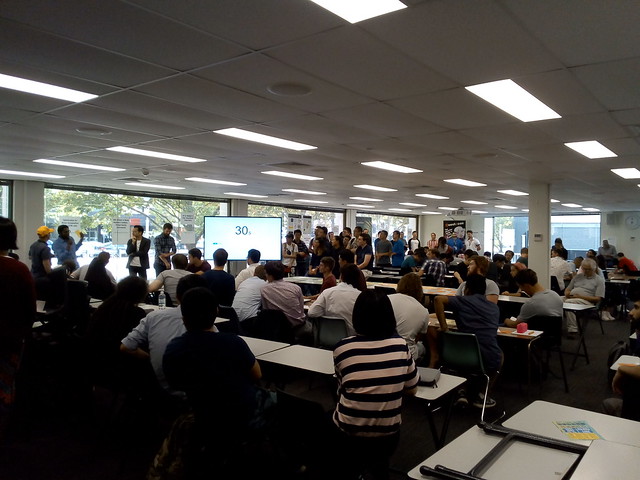
A flat floor large classroom at ANU, with large mobile LCD screens used to relay presentation to the back of the room.
ANU TechLauncher,
Team Formation Exercise, 2018

In previous years the ANU TechLauncher computer project team formation exercise was face to face in a large flat floor classroom for two hours with several hundred students. Due to COVID-19 restrictions, this semester the room was replaced with a Zoom video-conference, Slack text chat and web documents. The organizer gave an introduction on Zoom, after which each client pitched their project. Students could ask questions verbally via Zoom, or by text in Slack. Each student then selected a project and discussed the project with the client in the Slack channel for the project. They could also look up the video conference for that project in a web document. The Zoom conference remained open during this process for queries.

When a project had sufficient students, the newly formed teach would appoint two spokespersons who would register the team on a Slack channel. Those students were then free to leave. Instructors visited the forums answering questions. All unallocated students and clients then returned to Zoom for another round of pitches. The event ended when all students were allocated to a project (not all projects were successful in getting students).

This process was a reasonably direct translation from the face to face one used in previous years. Posters for projects had been placed on walls, with the client for each next to their poster pitching. Students would speak to the client and put their details on a post it note on the project poster.

One feature of Slack which might make the online process easier is the provision of video conferences in channels. This would allow students to click a link and open a video conference in Slack, rather than having to go to a web document to find the relevant conference.

However, slack and Zoom text chat have the limitation that information scrolls off the screen quickly. There was a need to keep posting some of the same information every ten minutes or so, as it was too difficult for participants to scroll back to find it (this also happened with the ACS Hackerthons using Zoom and Slack). One way around this would be to have a separate channel for very important information, or use a live web document.

Some form of status board might also be useful, with a traffic light indicator to show the progress of each project in obtaining a team.

Tuesday, March 24, 2020

Work Integrated Learning in the Age of COVID-19

The Australian Collaborative Education Network (ACEN) held a video meeting today to discuss what to do about Work Integrated Learning (WIL) in response to the COVID-19 Coronavirus. Post secondary educational institutions (and some secondary), have students who undertake part of their program gaining practical experience in a workplace. This is required for some accreditation to work in industry. But what happens to these students with workplaces closed?

Part of the answer to that was provided by ACEN, leading by example, in convening a video conference. This was attended by about 280 people around Australia, and some from other countries.

I help teach ANU TechLauncher students who undertake group software development projects for a real client. This is a little easier to manage, as these students are normally not on the client's premises. Also computing professional routinely do much of their work using computer based tools, and the students have already been introduced to coordinating their work online. I have provided some tips on how to work remotely, from the client, from their tutor, and from each other.

The ACEN video conference suffered from some technical glitches. I have provided some tips on what to do to place less strain on our digital infrastructure. This was my second video meeting for the day, with two to go.

Wednesday, March 18, 2020

Transition to On-line Study: Example message to team project students

The Australian National University is to pause all coursework teaching for one week from Monday 23 March and then deliver online for the remainder of the semester. Here is an example of a message I prepared for Techlauncher computer group project students about the change to e-learning. These students receive few conventional lectures, instead they work in teams on a project, and meet with a tutor regularly.

Transition to Online Study


The TechLauncher program is now being delivered online, due to COVID-19. I have some experience with online education, and so will be providing some tips for students, and tutors, over the coming weeks. Here are the first:

Use the tools you have: You already have an array of online collaboration resources available to you. With most of these, an individual can contribute at any time, and it is stored so others can view it later. In education, this is called asynchronous mode. Many software development teams, who are spread across the world, work this way. However, to get a sense of being a team, and when quick decisions are needed, nothing beats real-time synchronous communication, with everyone contributing at the same time.

For online tutorials, ANU has provided Zoom Videoconferencing. There is a Zoom "Meeting" for each tutorial group. You can use the meeting-id via the web, or download the client for your computer, or smartphone. With the agreement of your tutor, you can use an alternative conferencing product for tutorials. Teams can use whichever tool they find most useful for their own meetings.

You may not need video: While it is called a video conferencing tool, Zoom, and similar products, work well with audio, slides, and screen sharing. As team members already know each other well, you do not necessarily need to see each other. You can also use your asynchronous tools in a near real-time mode, talking together via Zoom, while looking at, and modifying shared documents. A headset greatly improves the quality of sound, and also using a smartphone, rather than a computer for audio tends to have fewer problems. You can use your smartphone for sound and your computer for documents, at the same time.

Meeting preparation is important: Whatever tool you use, keep in mind that good meeting preparation is even more important online than for a face-to-face meeting. You need to solicit items for the agenda well in advance, and preferably circulate the agenda, and any documents for discussion, well beforehand. It can become very confusing if documents participants have not seen before popup online during the meeting.

The tool you are using to distribute documents and images may fail during the meeting, leaving just audio (and perhaps text chat). During the face to face presentations, you have been encouraged to be ready to keep talking if the video display fails and the same applies online: if the video fails you need to be prepared to keep going, referring to documents the participants already have, or painting them a picture with your voice.

The Campus still open but be prepared: At present ANU has not closed the campus, so physical meeting rooms are available. However, this could change without notice, so please prepare now for on-line working. Also while you should take sensible precautions, there is no general requirement to self-isolate at this stage.

Don't Panic: I have been delivering on-line education at ANU for a decade, using the same proven techniques we are implementing for Techlauncher. From 2013 to 2017 I was a graduate student of education, refining these techniques for delivering international distance education. From this experience, I learned which techniques work, but more importantly, how it is key we remember there is a person on the other end of the network connection, and to treat them as such.

I would welcome comments, suggestions, and corrections.

Tom Worthington
Instructor for Learning to Reflect

Thursday, December 12, 2019

Design Thinking for Higher Educaiton

The final speaker at at the IEEE TALE 2019 engineering education conference, was Chathura K. Sooriya-Arachchi, Institute of Information Technology, Sri Lanka on Design Thinking Approach to Higher Educaiton Teaching and Learning.
"We live in a world that demands creative problem solvers, creative thinkers who can come up with innovative ideas and solutions to situations. However many believe that creativity is a trait one needs to be born with, whereas creativity is a muscle that needs training. There is great potential to incorporate creativity in teaching and learning. This interactive workshop aims in sharing a number of Creativity and Design
Thinking methods, tools and techniques that can facilitate teaching and learning, along with inspirational examples/case-studies from the real-world."

This was a useful overview of applying design thinking to creating better education.  However, I suggest that those teaching at university require basic training in how to teach, assess and design courses. Otherwise university academics waste a lot of time reinventing well established patterns of learning, or worse still training out approaches which are known not to work. I suggest the level of training which vocational education and training teachers are required to have, would be a good place to start (I noticed that Chathura is a Certified Trainer).

Australian Papers at TALE 2019

Greetings from Yogyakarta, at the IEEE TALE 2019 engineering education conference. Papers will be published, but in the interim, I have searched though the copy we were provided looking for Australian presenters and topics.

English Vocabulary Levels of University Engineering Students in a Sino-NZ Collaboration, Kerese Manueli, Victoria University of Wellington:
'Abstract—Internationalization of China’s higher education has been widely documented. A New Zealand university entered the crowded market and found that some things have not changed. English Medium Instruction (EMI) is the buzzword but are the engineering students at a “provincial or local university” ready for it? This paper will discuss an
exploratory study on the English productive vocabulary levels of the engineering students in a Sino-New Zealand collaboration. Students’ written work were analyzed using the online vocabulary profiler (VocabProfiler). Preliminary results suggest that participants’ productive vocabulary levels were below the authors’ expectations. This was consistent with other standards described in the literature. Pedagogical implications include the review of teaching resources and more emphasis placed on the vocabulary development of students, particularly for the academic and engineering words. In addition, more research needs to be conducted to identify other challenges faced by the engineering students.'

Capstone Project Implementation Using Infrastructure as a Service: The Learning Experience, CQUniversity:

'Abstract—This research paper discusses the learning
experiences during the implementation of a postgraduate
network security capstone project using cloud services as the
technical infrastructure. Using mixed methods, interpretations are drawn from students’ voices in a medium-sized Australian university, about the convoluted challenges and issues associated with the learning redesign of an advanced unit consistent with technology trends and industry demands. Despite finding the IaaS platform challenging and difficult to use, students perceived the learning experience to be highly rewarding and current in the development of their technical skills and job readiness.'
Sentiment analysis of preschool teachers’ perceptions on ICT use for young children, Mohd Ridzwan Yaakub, Universiti Kebangsaan Malaysia and others:
'Abstract—Sentiment analysis in gaining more attention as it is increasingly used in multiple domains, including in interpreting educational data. The article uses sentiment analysis technique to understand the early childhood educators reported beliefs (perception) on young children’s ICT use. The dataset was obtained from a comparative study of early childhood educators from two countries, Australia and Malaysia. The result shows a similar outcome where most teachers agreed upon the benefits of ICT use and conclude more positive sentiment polarity. This paper summarizes the findings using sentiment analysis
as well as comparing it to the quantitative data obtained from the survey.'

Blend and Flip for Teaching Communication Skills to Final Year International Computer Science Students, Tom Worthington:

"In addition to technical knowledge, graduates in computing and engineering disciplines are expected to have communication skills, and the ability to undertake lifelong learning. These skills are difficult to acquire using conventional lecture and tutorial based teaching. Final year international graduate computer science students at the Australian National University, College of Engineering and Computer Science, were found to have particular difficulty when asked to write about their learning. In response, lectures were replaced with online exercises, group workshops in a new purpose-built flat floor classroom, and peer-assessed progressive assessment. This approach was trialed with eighty students in 2019. Preliminary results indicate students performed at least as well as with conventional lecture-based instruction."

Wednesday, December 11, 2019

Teaching Generic Competences in Software Engineering via E-Learning

Greetings from Yogyakarta, at the IEEE TALE 2019 engineering education conference, where Marco Klopp from University of Applied Sciences Aschaffenburg (UASA), just talked on on "Teaching Generic Competences in Software Engineering via E-Learning". This described  a Moodle based e-learning module added to a group project software engineering course to teach communication and other "generic" competences.
"Abstract— The discipline ‘Software Engineering’ is difficult to represent in higher education, because of the complexity of software development projects and the variety of skills required. In addition to specialist skills (professional competences), generic competences are increasingly becoming the focus of education. This paper deals with the training of generic competences in the software engineering module. For this purpose, an existing didactic concept was enhanced by E-Learning with the help of a Moodle course."

This was of interest as last year I was asked to develop a similar Moodle module, and delivered it to about three hundred students in the ANU TechLaunhcer program this year. Marco's analysis found their module did not improve student competencies. I had a slightly more positive outcome, in that the Moodle module was no worse than traditional classroom teaching. The difference was perhaps because the UASA module did not count towards the student's final grade, so they may not have studied the material as diligently as they should. In contrast the module at ANU made up 20% of the mark for the course.

Incorporating Industry into the Curriculum

Ryan Kirwan,
Singapore Institute of Technology
Greetings from Yogyakarta, at the IEEE TALE 2019 engineering education conference, where Ryan Kirwan, Singapore Institute of Technology (SIT) is speaking on "Incorporating Industry into the Curriculum: Applied Learning in Computer Science". Ryan described how they have students undertake team projects for industry. 
"Abstract— Singapore Institute of Technology’s (SIT) Integrative Team Project (ITP) uses Applied Learning to expose student teams to industry’s cutting-edge projects and industry-ready evaluation, combined with academic supervision and assessment. Industry propose projects that fulfil real industrial needs, while SIT ensures projects meet students’ academic learning objectives. ITP affords students an integration of theory and practice coupled with the acquisition of specialist knowledge and development of professional skills in their respective industry. This paper serves as a case study, beginning with the pedagogical underpinnings, moving through the
various assessments and evaluations, and finishing with a discussion of issues encountered with corresponding preventions and mitigations. The aim is to provide a blueprint for course organization and assessment that incorporates academic excellence with industrial relevance."

This is similar to the ANU TechLauncher program, which I help teach. Students work in teams of about five, with an academic supervisor, and someone from industry. The teams submit project work, including details of who in the team is doing what. Students also produce an individual reflection, which they then provide peer feedback and a mark for. There is then marking of the team project work by the staff. There is then the problem of consistency between different markers. This is addressed at SIT by having the markers meet and come to a consensus. I suggest this consensus building activity is unnecessary and harmful.

Different assessors, be they students, or trained professional educators, will come up with different marks for the same student work. This is difficult for students to accept, but is inherent to the assessment process. For ANU TechLauncher students this year we had students peer assess each others reflective work, Each student assessed three (first semester), or four (second semester), reflective works. The Learning Management System calculated the average. In general, the result were consistent. If there was a wide spread of marks, or the result was not consistent with the studnt's previous work, this was remarked by staff.

Wednesday, July 17, 2013

Masters by Coursework Student Projects

Recently I created a student project on "Software for Synchronised Asynchronous Constructivist e-Learning" and put it in the list for Individual Project Courses in the ANU Research School of Computer Science. The project is based on my "paper for ICCSE 2013" and a frustration with current e-learning tools. The Master of Computing students have the option of a double Project Course COMP87*0. There are two assessment options for implementation and research orientated projects. There is also a proforma for an Independent Study Contract, for the student and supervisor to work out.