Showing posts with label University of Canberra. Show all posts

Wednesday, January 21, 2026

Everything Too Open?

Greetings from Everything Open 2026 at University of Canberra. This is Linux Australia's annual conference. The opening keynote presentation is by Kylie McDevitt, former Technical Director at the Australian Signals Directorate. Kylie is discussing security analysis of internet connected devices. This is very topical, with the ACT Government checking if their electric busses can be remotely sabotaged

Comping up today, my picks are:

10:45AM Encouraging democratic participation with software, Vanessa Teague

11:40AM Using open source strategies to enable medical data exchange at scale, Christopher Skene

12:25PM Lunch 

1:30PM The unreasonable cost of open source contribution, Rob Norris

2:25PM I hope this email talk finds you well., Jemma Bradshaw

3:10PM Afternoon Tea

3:45PM The nineteenth century smartwatch, Kit Biggs

4:40PM The next generation Big Data Radio Telescope for Astronomy, the Square Kilometre Array Observatory, Juan Carlos Guzman

Sunday, September 21, 2025

Bill Shorten doesn't need to re-imagines universities

In "Bill Shorten ‘re-imagines universities’, with specialist institutions and bespoke degrees", Michelle Grattan, Professorial Fellow, University of Canberra, reports on a speech by their new Vice Chancellor (VC). In this the VC is reported as  calling for a “fundamental re-imagining” of Australia’s universities. But much of what the Canberra VC is describing is routine in the Vocational Education and Training (VET) sector. Students from the Canberra Institute of Technology already undertake their initial training there, before transitioning to University of Canberra. However, there would be value in universities adopting some of the VET approach themselves. The 3 year degree model can be modified to make it more flexible, rather than "broken". 

Australian law already allows for specialist higher education institutions, both universities and vocational education, offering degrees, and run by not-for-profit government and non government bodies, as well as for-profit companies. However, most universities have chosen to expand by offering a broad range of programs and government have allowed them to duplicate what is already available from nearby institutions. At present some specialisation appears to be taking place, with universities shutting down unprofitable programs. However, this might result in them all offering the same limited range of business and STEM.

A more diverse education sector would, as the VC suggests, help with economic resilience and national security. However, our universities need to look to their own resilience first. COVID-19 might just be a small taste of the shocks to come. Our universities need to be ready with online teaching techniques and financial reserves, in case most of the international students leave Australia suddenly due to geopolitical tensions.

Australia's higher education sector already has considerable flexibility. in 2012 I was studying how to teach at the ANU. As part of this I wanted to learn how to teach online, which was uncommon at Canberra's university. With the approval of my ANU supervisor I enrolled for two terms at the University of Southern Queensland, a leading provider of online education. To learn about vocational education techniques, I later enrolled at the Canberra Institute of technology. To learn how to teach international students online, I enrolled as an international student in North America

As well as bolstering the economy with well trained workers, our universities can provide technology for defence. One team of students I was tutoring were testing the advanced phased array radars for Australian warships, and this technology will form the core of Australia's anti-ballistic missile shield. 

Higher education can strengthen the economy by being ready with the research inventions and trained staff needed to respond to threats and exploit opportunities. 

The VC suggested a "new architecture for learning was needed in today’s world". However, I suggest this is one of those areas where our academics have anticipated the need and already have what is needed developed and ready to implement. Some Australian educational institutions already have fast and flexible programs. These are mostly in the vocational education sector, but universities can quickly be brought up to speed. 

The monopoly of the 2 year degree was broken early this year, when the "vocational degree" was introduced. This allows government, private and for-profit vocational institutions to issue job-ready degrees. Those institutions can apply their nested, competency based and  work integrated learning techniques. In this way someone can enroll in a short program to get just enough of a qualification to get their first job. They can then build on that, getting course credit for skills gained at work, progressing through more advanced qualifications to a degree. The worker can then consider postgraduate studies at university.

The VC gave the example of quantum mechanics for defence applications. Australian universities have research programs in this area. The Australian National University spun off a company to provide quantium products for industry and defence.

The Graduate Certificate in Strategic Technologies proposed by the VC is an interesting idea. Canberra already has several institutions with experience in this area. As a defence employee, I attended short training courses at Australian Defence Staff College, and later helped teach at ADFA, through the use of hackathons

As the VC points out there is scope for using AI for Recognition of Prior Learning (RPL). At CIT I learned techniques for evaluating what students already know. I apply these skills at ANU processing applications for course exemptions and credit. This is a very complex process, already computer supported, and requiring teamwork from professional and academic staff. Some AI support would assist. 

In the past I have suggested a portfolio based program, where the student is given a table showing all the skills and knowledge they are required to demonstrate top graduate and all the ways they could do this, including RPL and work integrated learning. But this would be overwhelming if presented as a large spreadsheet and careful step by step help would be needed. There would still be the need for specialist advice to students. I vividly remember using USQ's pre-enrollment system to work through options. I scratched my head and though "what now?". At that point the phone on the desk beside me rang and it was USQ's staff offering help. This was a little spook, but they said they had saw I was having difficulty.

The VC's proposed re-imagining of university I suggest need to look further. The VC suggests areas of teaching STEM, artificial intelligence, & trauma-informed health care. However, these are already areas investigated, researched, planned and being implemented.

Government already subsidies higher education and this model can be applied to micro and shorter credentials. Where there is a shortage government can offer direct subsidies and incentives for industry. However, there is a risk of government and industry micromanaging skills and pushing students into programs which will be obsolete by the time they graduate.

All Australian universities are required to be a bit general. They can't specialise in just one discipline. But they are not required, as the VC suggests, to do everything. Recent criticism of several institutions has been because they are making painful cutbacks, dropping some discipline areas to focus on fewer. 

It is true that Australian universities use prestige in research to market education which has very little to do with that research. However, they do this because it is a very successful marketing strategy. Regional and education focused universities have difficulty coming up with an alternative approach. As a mature-age student from a first-in-family, low SES background I experienced some of these contradictions first hand. 

The VC's proposal for specialist universities, would be part of a Dedawkinsation, which is perhaps already underway. However, Australian governments have a poor track record at picking winners. It might be better to have policy and funding settings which encourage institutions to further specialise.

The VC also suggested creating a pre-Dawkins two-tiered system, with some institutions focused on teaching. I suggest instead policy and funding to promote teaching skills for academics, wherever they teach. It is one of the dirty little secrets of universities that their teach staff are less qualified to teach than those in vocational education, or schools. As a university academic I am one of the exceptions having a MEd. During COVID-19 I was able to quickly pivot to online teaching and assessment. When I colleagues asked me how I could do this with little apparent effort I said "I have a degree in this".

Higher education is important to national security. However, I suggest caution in the VC's suggestion of focusing exclusively on sovereign capability. Australia does have a lead in some areas, such as phased array radars and high speed multi-hull vessels. However, our two most successful current defence projects are partnerships with US companies: the Ghost Bat robot fighter jet and Ghost Shark robot submarine. However, there is no corresponding Ghost Geco robot tank project, and that might be an area for exclusively sovereign capability.


Friday, June 20, 2025

AI and Work Integrated Learning

Greetings from the University of Canberra, where I am attending the NSW/ACT chapter of WIL Australia's "Creative, Modern and Celebrating WIL". Associate Professor Bonnie Dean, University of Wollongong, is taking us through the reality behind the hype about AI and jobs. She cited research showing that organisations are tending to look to existing staff for AI skills, rather than asking for it in job ads. Bonnie pointed out that Microsoft Copilot's terms of service say it is intended for entertainment and use at the user's own risk (which I suggest is likely illegal under Australian consumer law). Professor Dean noted how the last trend was cyber security qualifications and universities are no announcing AI initiatives.

Bonnie pointed out surveys which show most students see AI as useful, but worry about being accused of cheating, but don't get support from the university in how to use it. As AI is new and novel I can see the need for specific training, both for staff and students, about it. After a few years this will just be integrated into basic training for students. Particularly for WIL is important for students to get this extra training now. As an example, students need to have it explicitly explained that public tools retain the information they enter, so they should not include anything sensitive, private. 


Wednesday, October 2, 2024

Thursday, June 9, 2022

Showing and Telling Virtual Reality in Health Education

Greetings from the ANU Medical School, where Dr Jane Frost, Associate Professor in Nursing, at University of Canberra, is talking about the use of extended reality, for teaching medical students. Jane is gently introducing us to how VR & AR can be used. She started with a view of a typical lecture theater, captured with a headset camera. This then switched to a simulated hospital ward, particularity useful for students who can't get to a real one, or one of the training wards with dummies the universities have.

Jane explained the difference between VR & AR, with AR overlaying an image on the wearers perspective, whereas VR provides everything. She also mentioned that use of VR requires safety protocol, so the students do not fall over objects they can't see. As well as training, Jane pointed out AR has potential to assist in everyday work.

It was good to see Dr Frost did not spend too long on simulated classrooms, as I don't think these are much use. We want students in a workplace, simulated or real, not a classroom (simulated or real). One compelling example was of a student looking at a simulated patient in a real hospital ward, responding as if they were real. Another was very disturbing, with a simulated patient screaming continuously (the lesson for students was that the noisy patient doesn't necessarily get priority). 

The event was chaired by Katie Freund, Manager of Technology-Enhanced Learning and Teaching (TELT), at ANU Medical School.

Sunday, February 20, 2022

Digital Inequality: Academic Heal Thyself


The University of Canberra is hosting what is claimed to be the "First International Symposium on Digital Inequality and Social Change" (ISDISC). The theme is  Bridging digital inequality for a better and inclusive society. Researchers, practitioners and policy makers are invited.

But I suggest university academics need to set their own house in order before being able to claim the moral high ground on digital equality. The scramble to convert university courses and research participation online over the last two years has shown a lack of thought given to this area by academia. Courses were converted from hard to access lectures, to hard to access video lectures. Assessment was changed from hard to access paper based examinations, to hard to access web based examinations. The sad part of this is that there were open online distance universities with decades of experience in how to provide equitable access to a wider range of people, but elite institutions willfully ignored the freely offered advice, as it would place their campus based business model at risk.

Similarly with research: it is open to anyone who  can afford to get to expensive conferences, and passes the entrenched gatekeepers of the academic publishing system.

Fortunately the University of Canberra is leading by example, offering virtual attendance for those who can't get to Canberra, with a low fee.

Thursday, March 25, 2021

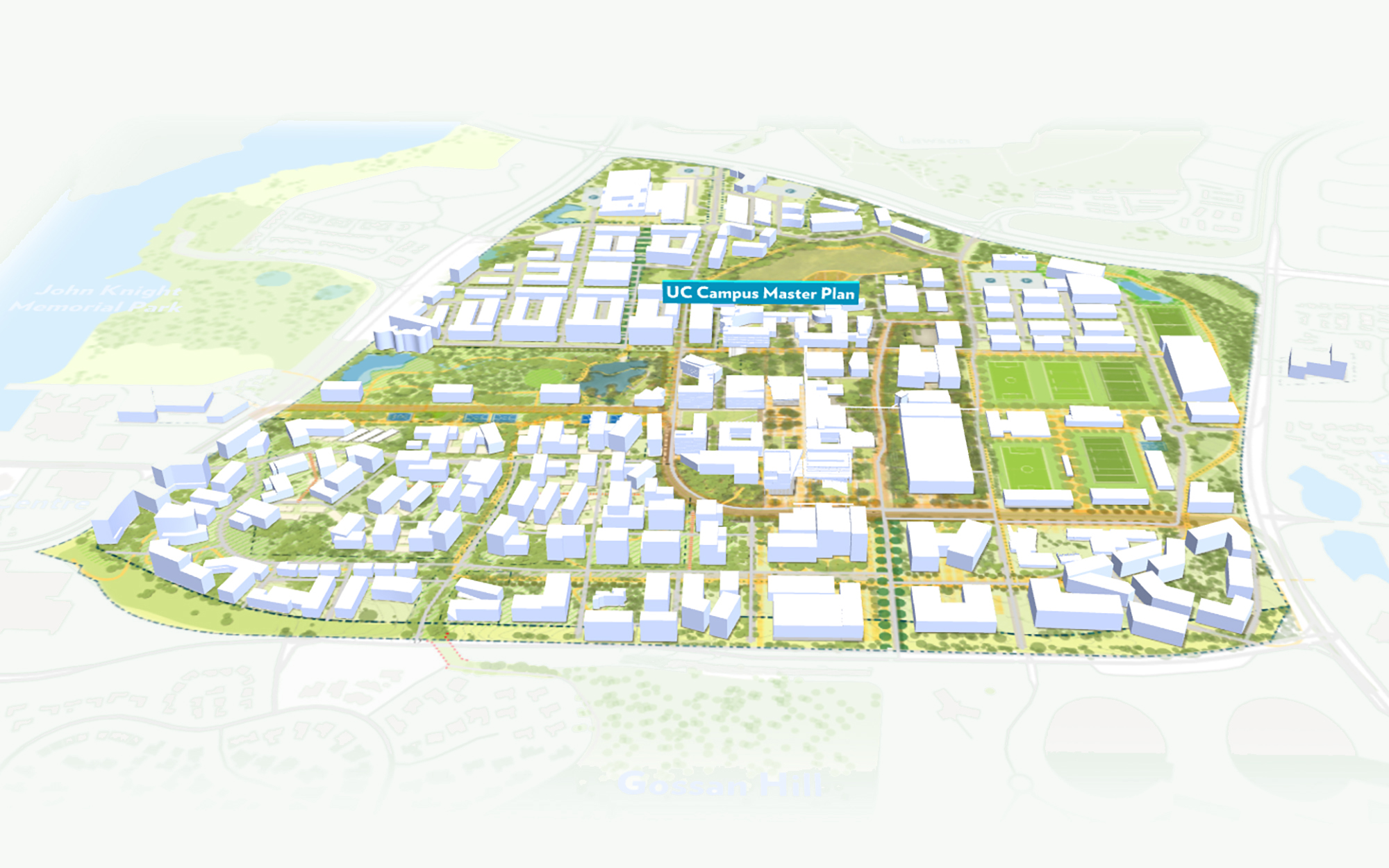
University of Canberra Campus Master Plan

Greetings from the University of Canberra Inspire Center, where the latest Campus Master Plan is being launched. The physical plan is by is by Rob McGauran, of MGS Architects. The Vice-chancellor  said they are aiming to build a town center linked to the community, health, research and community facilities. He reflected the unviersitey was built in a quad, surrounded by a moat, which could not be seen from the outside. 

The university is now outward looking and he made an ambit claim to be on a future light rail route to the city. In my view, it is a challenging time to plan a university, with COVID-19, and the prospect for further disruptions to international students in the short term due to regional tensions. There will also be increased competition from online international providers in the next decade, as online education becomes the default option for domestic and international students. 

The VC is looking to partner with the ACT Government, industry and the community. What wan't mentioned, and featured in past plans, were links to vocational education. The UoC 2012 Campus Master Plan, envisioned a polytechnic, as a "practice-led higher education institution with strategic partners delivering employer relevant programs". This was to have 5,000 students accommodated in dedicated premises.

The new plan places more emphasis on industry partnerships for innovation, with more than 18,000 non-university staff in210,000 m2 of office space.

Wednesday, March 24, 2021

How do you plan a university campus post-COVID-19?

The University of Canberra will launch an updated Campus Master Plan on Thursday. It will be interesting to see how this differs from the current plan, which was released in 2012. Flexibility, I suggest, should be the priority, with most students mostly studying online, even after COVID-19.

The university planned to have 10,000 full-time equivalent students on campus. Also there were plans for a bridging programs with 1,000 full-time equivalent students, including international ones, operating from purpose-built premises. The plan also designated a health precinct, which has seen the building of the University of Canberra Hospital.

As COVID-19 shows, there are predicable and foreseeable events which can case havoc for institutions which fail to plan for them. Australia's universities now face the prospect for further disruptions to international students in the short term due to regional tensions. There will also be increased competition from online international providers in the next decade, as online education becomes the default option for domestic and international students.

As I pointed out in 2012, the typical university student of 2020 and beyond "... will be on campus for only about 20% of their studies, with 80% on-line away from the campus ...". This has implications for the types of spaces provided. Buildings need to be able to be repurposed and flexible in day to day use. 

Monday, October 19, 2020

ACT Higher Education Post-COVID-19 Strategy

Canberra's universities need to change how they work to remain viable during, and after ,the COVID-19 emergency. The major post-secondary educational institutions in the ACT are the Australian National University, University of Canberra and the Canberra Institute of Technology. I have studied at all three and am on the staff at ANU, however, these suggestions do not necessarily reflect the current policy of any, or of the ACT Government. I will be discussing some of this at an ANU symposium on Thursday.


The approach to COVID-19 has been short term, assuming that it will be over in months. However, it may take years to recover and it is certain there will be further pandemics in the future. Also the geo-political situation Australia finds itself in may result in international students again being unable, or unwilling, to study on Canberra's campuses, without warning. In addition other countries are offering increasingly attractive quality online and blended learning. Both Australian and international students may decide to take up those offers, if Canberra's institutions do not have quality, cost effective, flexible educational offerings. 

1. Adapt Infection Control Measures for Institutions

Reduced distancing for students

COVID-19 restrictions in the ACT have been eased, but even the current STAGE 3 makes it difficult for educational institutions.  As an example, the ACT requires persons to remain 1.5 m apart. I propose that for educational institutions, this be reduced to the WHO recommended distance of 1 m

Where seated, people should be able to be 250 mm apart, side to side. This would allow existing fixed seating lecture theaters to be used at 50% capacity, with every second chair empty. Active lecture theaters, flexible learning spaces and laboratories could be used at full capacity. Institutions should be encouraged to build these guidelines into the design of new teaching spaces to reduce infection rates for annual respiratory infections and allow for future outbreak measures.

Tracking on campus

The ACT Government and institutions should commission a tracking application compatible with the Apple/Google Privacy-Preserving Contact Tracing Standard. Unlike the current Australian Govenrment's COVIDSafe App, this would be reliable, effective and voluntarily taken up.

2. Training for Hybrid Teaching 

Canberra's university have been able to quickly introduce online learning for students unable to get to campus. Unfortunately, most people teaching at university have not been trained to teach online. and have no formal qualifications for doing so. Vocational teachers at CIT, and private providers, are required to have a qualification in training and assessment. It is proposed that the ACT Government assist Canberra's universities to introduce a qualification for university teachers at least to the standard for vocational education. This could be provided a set of micro-credentials building to an AQF qualification.

3. Offering Hybrid Qualifications

In the past domestic and international students have been required to move to Canberra to undertake the majority of their university studies. I suggest this be changed so that a typical student can undertake 80% of their study online. The ACT Government can lobby the federal government to make the necessary changes to visa rules for international students. The Canadian government has already eased its visa rules, making Australia a less desirable destination. 

The ACT Government can assist Canberra's universities to develop advanced qualifications in the design and delivery of education to provide a quality online experience. This can then be used in marking campaigns national and internationally which emphasize students can have both the flexibility of an online education and the option of quality lifestyle experience in Canberra, leading to a world-class qualification.

4. Work Integrated Learning

Many vocational qualifications require students to undertake work experience as part of their degree. This is increasingly seen as a desirable part of any university qualification. However, international students experience problems obtaining access to a workplace in Canberra, due to federal government restrictions on non-citizens working for the public service and for government contractors. I suggest the ACT Government assist the Canberra Innovation Network to expand its current start-up program,. Also the ANU's Innovation ACT and TechLauncher programs could be expanded to provide cross institutional participation.

5. Vocational Supplementation to University Qualifications

The Canberra Institute of Technology has the capacity to provide training to supplement the university education of students. I suggest the ACT Government work with the universities to develop and market standard packages of degrees with vocational qualifications.

Friday, March 29, 2019

University of Canberra Reviewing Contingent-Continuing Academic Employment

The University of Canberra (UC) has announced an independent review of "Contingent-Continuing" academic employment, to be chaired by Professor Kevin Hall, from University of Newcastle.

Unfortunately the UC media release announcing the review (appended), doesn't explain what "Contingent-Continuing" employment is. Andrews, Bare, Bentley, Goedegebuure , Pugsley and Rance (p 15, 2016) offer a description of contingent continuing employment as "continuing employment but with easier termination arrangements":
"Fixed-term employment is almost invariably used for academic staff funded by research grants, although larger research-based universities have recognised the negative impact of contingent employment on researchers, and have introduced a “contingent continuing” employment category that provides continuing employment but with easier termination arrangements in the event that the researcher misses out on being engaged under a subsequent grant. The severance payments for this form of employment are also lower than the standard academic redundancy payment entitlements"
From: Andrews, Bare, Bentley, Goedegebuure , Pugsley and Rance (p 15, 2016)
Putting it more crudely, this is a form of indefinite temporary employment. While the uncertainty over research grants to fund employees has been the primary rationale for not employing academics permanently, the uncertainty around the need for teaching staff may also be a factor. Australian universities have experienced a boom in enrollments, due to government funding for domestic students, and demand from international students.  However, neither of these sources of income are certain to continue into the future. Also the use of new teaching techniques and educational technology, are changing the number of teaching staff required, and their skills. Most academics currently at Australian universities are not trained or qualified to teach in this new environment.

Dr Inger Mewburn (ANU), has proposed a study into  the nature and extent of academic work. Such a study would be useful for informing the UC review, as well as likely future government inquires into the Australian university system.
'University of Canberra
Media Release 
28 March 2019 

VICE-CHANCELLOR ANNOUNCES INDEPENDENT ASSISTANT PROFESSOR PROGRAM REVIEW

The University of Canberra Vice-Chancellor and President, Professor Deep Saini, has today announced an independent review of Contingent-Continuing academic employment—commonly referred to as the Assistant Professor program—to evaluate and improve the program.

Assistant professors comprise approximately 22.5 per cent of the academic staff at the University of Canberra through a unique program in Australia. The scheme allows assistant professors to fast track to promotion to associate professor within seven years via two performance reviews.

The independent review will aim to ensure that participants are valued, supported, professionally developed and well managed to continue to be successful.

 “Whilst the basis of the contract is sound and has delivered success for many of our academic staff in fast-tracking their careers, we endeavour to deliver the best possible experience and results in this Australia-first program—both for the assistant professors and the students they teach,” said Professor Saini.

“I have personally consulted with many assistant professors in the program to hear their suggestions on how the implementation and experience of the program can be improved.”

 “We have used input from the assistant professors, staff and the National Tertiary Education Union to develop the scope of the review.”

The Review Panel consists of four members, including three external independent members and one internal member.

Professor of Chemistry and Senior Deputy Vice Chancellor and Vice President at University of Newcastle, Kevin Hall, will act as chair with Professor of Psychology and Education Director at University of Sydney, Marie Carroll, as member, and Workplace Relations and Employment Law specialist, Dr Graham Smith, as an external consultant to the panel.

Professor of Biomedicine at University of Canberra Reena Ghildyal will be an internal consultant, having personal experience of the Assistant Professor program at the University of Canberra. The scope of the review includes, but is not limited to:
  • Examining new policy and procedures, terms and conditions and compliance with legislation;
  • Attracting the right talent for successful outcomes;
  • Frameworks for review and promotion;
  • Supervision and mentoring, including appropriate training for supervisors and managers;
  • Assessing if workload and performance-based remuneration encourages work/life balance;
  • Examine the success of the scheme from talent attraction, development and retention;
  • Ensure diversity, equity, access and inclusion;
  • Highlight the positive outcomes and identify the areas for improvement. 
The Review will be provided to the Vice-Chancellor within 12 weeks of the panel commencing. '

From: Media and Communication, University of Canberra, 28 March 2019

Reference

Andrews, S., Bare, L., Bentley, P., Goedegebuure, L., Pugsley, C., & Rance, B. (2016). Contingent academic employment in Australian universities. LH Martin Institute. URL https://melbourne-cshe.unimelb.edu.au/__data/assets/pdf_file/0009/2564262/2016-contingent-academic-employment-in-australian-universities-updatedapr16.pdf
 

Monday, May 14, 2018

Youth As Researchers

Greetings from the University of Canberra, where
Dr. Mark Brennan, UNESCO Chair
Dr Mark Brennan, UNESCO Chair in Community, Leadership, and Youth Development, and Professor of Leadership and Community Development at Pennsylvania State University, isspeaking on "Opportunities for Research Innovation and Expansion through Youth-led Research". He started by pointing out that "More than one-half of the world’s population is under the age of 25 years, and over a third is under 15." He described "a youth-led research program, which engages youth in topics of concern to them and their communities.
The curriculum materials for the "Youth as Researchers" program are available free online from Pen State University (but no online course):
However, the concentrations of young people are in poorer countries in South America, the Middle East and Asia, while the curriculum materials have been developed and tested in the USA and Ireland. This appears to be as much an exercise in promoting the value of Social Science in western universities as in helping young people in developing countries.

Saturday, May 12, 2018

Youth-led Research

Dr. Mark Brennan, UNESCO Chair
Dr Mark Brennan, UNESCO Chair in Community, Leadership, and Youth Development, and Professor of Leadership and Community Development at Pennsylvania State University, will be speaking on "Opportunities for Research Innovation and Expansion through Youth-led Research" at the University of Canberra, 12:30 pm 14 May 2018.
"More than one-half of the world’s population is under the age of 25 years, and over a third is under 15. The need to actively engage and empower this population has been recognized by major international organizations, NGOs, and local agencies as critical to achieving social, economic, environmental, and political development. Nonetheless, a generalizable, adaptive, and sustainable framework for achieving this global youth citizenship remains elusive. In response to this need, we present a youth-led research program, which engages youth in topics of concern to them and their communities."

Wednesday, February 21, 2018

Research to Impact Program

The Research to Impact program is on at Canberra Innovation Network (CBRIN), starting 14 March. This consists of four workshops, over two months, with participants undertaking exercises between. The workshops are derived from those at CBRIN for entrepreneurs to find market needs, value propositions, business models, value chain, collaboration and pitching. But the workshops have been adapted for researchers who want their work to have a real work impact and be applied. I attended these workshops when they were run in-house for ANU by Petr Adamek and Craig Davis in 2016 and they were excellent. Staff of ANU, UC, CIT, Data61, CSIRO and UNSW Canberra can attend for free.

Thursday, December 7, 2017

Reframing Teaching to Use Flexible Classrooms

Last Monday I attended "Work Integrated Learning - a disciplined approach" at University of Canberra. This was based on a recent paper by Ruge and McCormack (2017) on constructive alignment of the assessment for a course at University of Canberra. Two recent case studies in EduCause point to the need for new classroom designs, plus course design and the training of staff in how to do this (Morrone, Flaming,  Birdwell, Russell, Roman & Jesse, 2017).
ANU Union Court Redevelopment
New ANU Buildings
(artists' impression).

Universities are building new flexible learning classrooms (such as in the new teaching building at ANU). These typically have a flat floor, and tables for small student groups, with display screens on all walls. However, to effectively use these spaces course redesign and teaching staff training is required. There is no point in moving out of lecture theaters if the "lecturer" gives hour long non-interactive monologues in the new "flexible" room. There is no point in putting the students in groups and link them with tech, if the primary assessment is an end of semester individual paper based examination.

The "lecturer" needs to be trained how to teach without lecturing and the assessment redesigned to use group and project based work. New classrooms can then be used effectively and the learning aligned to vocational requirements beyond the classroom. For more on this, see my free e-book "Digital Teaching"

References

Morrone, A., Flaming, A., Birdwell, T., Russell, J., Roman, T., & Jesse, M. (2017, December 4) Creating Active Learning Classrooms Is Not Enough: Lessons from Two Case Studies, EduCause. URL https://er.educause.edu/articles/2017/12/creating-active-learning-classrooms-is-not-enough-lessons-from-two-case-studies

Ruge, G., & McCormack, C. (2017). Building and construction students’ skills development for employability–reframing assessment for learning in discipline-specific contexts. Architectural Engineering and Design Management, 1-19. http://www.tandfonline.com/doi/abs/10.1080/17452007.2017.1328351

Thursday, November 30, 2017

Reframing Assessment

I have registered for the University of Canberra's free workshop Monday on "Work Integrated Learning - a disciplined approach". The pre-reading is Ruge and McCormack (2017) on "reframing" assessment for employability. This is something I am comfortable with, as I teach computing and engineering students, where there are clear professional roles with defined skills.
As a computer professional I have been involved with setting national and international skills standards and the accreditation of university programs. I have then designed university courses to meet these standards.  But this would be a challenge for those from disciplines which are not so vocationally orientated. I suspect the greatest challenge for those facilitating the workshop will be the reluctance of some academics to see themselves as vocational educators, or worse "trainers". ;-)

Ruge and McCormack (2017) report on a five year Australian study of students in Building and Construction Management at the University of Canberra. This is clearly an industry related discipline and "Constructive alignment" should be easy for the construction industry. ;-) 
The researcher's suggestions are not  surprising, including linking curriculum to industry requirements and scaffolded assessment. The one suggestion I have difficulty with is the use of reflection to have student think about their own learning. Having been through several reflective writing exercises myself as a student and a HEA Fellows applicant, I find the process perplexing.
My computer and engineering students find it equally perplexing to be told to reflect on their learning. What worked well this semester was to re-frame the capstone reflective writing exercise for ANU Techlauncher students, as a job application, based on what they had learned in the course. They were still reflecting on what they learned, but in a way relevant to their short term goal: get a job.

Ruge and McCormack (2017) comment that "Unit-specific assessment items are therefore key building blocks and teaching and learning opportunities for students’ generic and early professional skills development for employability ...". However, this appears to be more for the administrative convenience of the university, than the quality of the student learning. Universities like to have a small set of standardized units which can be assembled into a large number of program offerings. However, it can be difficult to match the learning outcomes of these general purpose units to the requirements of a specific professional skills requirement. An alternative is to build units specific to the discipline, to have a project based program without units, or units plus a project capstone.

Ruge and McCormack (2017) discuss educational design principles for learning through authentic assessment. In theory this is not that difficult: simply provide assessment tasks which simulate what the graduate will have to do in the workplace. As an example, I teach students how to estimate the carbon em missions due to use of ICT in an organization, so I get the students to do that and assess the results. The terms I use to describe this assessment item comes from the learning objective for the course, which in turn comes from the skills definition of the gallivant international professional standard.

However, designing and delivering authentic assessment is a complex and time consuming process. Either the students are understanding the task in a real workplace, or a simulation of one. Having students in workplaces requires specialized supervision skills.
Students will not necessarily be interested in, or understand the alignment of assessment with
the profession's requirements. This understanding may only come years later.

Promises of "personalized" formative feedback can create unrealistic expectations in students and an unrealistic workload for staff. As with lectures, which students say they want, but do not attend, detailed feedback is something expected but not necessarily used. One a course as a student of assessment I read research results which indicated students did not read detailed feedback. I thought this nonsense: I spent a lot of time composing feedback and surely the students read it. My assignment on feedback reflected that view. The assignment came back from the assessor and I looked at the mark on the front (which was okay), then flicked it aside. At that point I stopped and realized I was a student exhibiting the behavior I said students did not have: I had not read the feedback. Since then I have adopted the practice of of very brief feedback next to the mark.

References

Ruge, G., & McCormack, C. (2017). Building and construction students’ skills development for employability–reframing assessment for learning in discipline-specific contexts. Architectural Engineering and Design Management, 1-19.


Thursday, October 19, 2017

The Best of EdTechPosium 2017 in Canberra

The EdTechPosium Conference 2017 on a theme of "Fitting the Tech to the Teaching", starts 30 October in the "Camouflage Building" at the Australian Defence Force Academy in Canberra. Here are my picks from the two day program:

Day 1


Rebecca Ng
10:50 “What are Blockcerts again?” — The role of communication in introducing new technologies for teaching at tertiary institutions. Rebecca Ng, Australian National University

Tom Worthington
11:25 Dogfooding: Learning to design for internationalstudents by being an international on-line student. Tom Worthington, Australian National University


Dr Scott Rickard
13:10 Motivating and inspiring students to work collaboratively on assessment items. Dr Scott Rickard, University of Canberra


13:45 Moving from Face-to-Face to e-learning. William Batten, Department of Defence


14:55 Simulations, Gamification and Creative Problem Solving. Sudantha Balage, UNSW Canberra


Emma Power
15: 25 Opening professional learning in Australian higher education using Open Educational Practice: A cross-institutional collaboration. Emma Power, University of Southern Queensland, Dr Katie Freund, Karlene Dickens
& Janene Harman, Australian National University


16:00 eLearning 101 — professional development for busy academics and technology-enhanced learning educators. James Nicholson, Australian Catholic University

Day 2

10:40 “Let’s See What Happens”: Introducing students to interactive online tutorials. Stephanie Kizimchuk, University of Canberra

11:15 Four embeddings and a mural: OK2A — A course layout informed by Constructive Alignment delivering better blended learning. Roderick Huggett, Centre for
Defence and Strategic Studies

11:50 What have we GotS here? New ways for delivering Information Literacy at the University of Wollongong Library. Laura Lidden & Nick Zografos, University of Wollongong

Jenny Edwards
14:45 ePortfolios — Where to next? Jenny Edwards, Australian National University, Shane Nuessler, University of Canberra

Thursday, August 17, 2017

University Open Day in Canberra on Saturday 26 August

Canberra's universities and Institute of technology are having an open day on Saturday 26 August 2017. Prospective students, and anyone else who would like to see what happens at a university, can come and look:
  1. Australian Catholic University (ACU)
  2. Australian National University (ANU)
  3. Canberra Institute of Technology (CIT)
  4. University of Canberra
  5. UNSW Canberra/Australian Defence Force Academy (ADFA).
Each institution has its own character.  ACU is calm and cloistered, being a former seminary. ANU has a grand tree lined avenue, from North America's Ivy League. CIT has workshops and funky designers. UCan has gone upwards with new high rise accommodation. UNSW/ADFA is a modern interpretation of West Point Academy, with a parade ground and everything squared away.

Tuesday, August 15, 2017

History of Innovation ACT in Canberra

renewable energy entrepreneur and rocket scientist, Dr Lachlan Blackhall,
Greetings from the Australian National University in Canberra, where renewable energy entrepreneur and rocket scientist, Dr Lachlan Blackhall, is recounting the history of Innovation ACT. This started in 2007 as a start-up competition for ANU students (Innovation ANU) and  opened to students at other Canberra higher education institutions in 2009.

Apparently at the first launch event I was so surprised by the large amount of prize money being offered, I asked the distinguished senior academic doing the launch: "Is this a scam?". After ten years of completions, I have concluded it is not a scam.

Students form teams and learn about how to turn an idea into a product or service. To give them incentive, there are prizes. The prizes are now in kind help with furthering their business idea, rather than just cash.

Innovation ACT has helped normalize the idea at Canberra's universities that it is okay to aspire to start a business, rather than just work for one, or be a researcher. With the popularization through media and many government and business programs on
entrepreneurship, perhaps it is time to remind everyone this is not easy.

here is a belief in some of the entrepreneur community that formal higher education is not needed any more and school kids should just learn on their own and go into business. I challenged Steve Baxter, best know for Shark Tank, at at River City Labs in Brisbane. Steve suggested that a tech entrepreneur could obtain business advice and training, but a business person without the needed tech training would have more difficulty. I think I managed to get him thinking that some formal training in both tech and business was worthwhile.

Currently I am tutoring ANU Techlauncher students, mostly computer science, with a few engineers and some interns. The students are learning what are referred to as "soft skills" but are hard, particularly for STEM students. Students who have mastered very technical computer skills soon discover that planning, management, estimating and communication are not easy. Competitions such as Innovation ACT help with this.

Wednesday, July 27, 2016

Models for Canberra Innovation

Greetings from the University of Canberra (UoC), where Dr. Josep M. Piqué, Managing Director of 22@Barcelona, is speaking on "Innovation districts". 22@Barcelona, also known as Districte de la innovació (the innovation district) is an urban renewal project for the Poblenou area of Barcelona.

UoC has invited  Dr. Piqué, as part of promoting their innovation precinct. However it is not clear what a small regional university can learn for its "Innovation Park" from the experience of the "Catalan Manchester". UoC might be better off looking to a smaller city for inspiration. The city I first suggested Canberra should model itself on twenty years ago is Cambridge (UK).

The Canberra suburb of Bruce, where UoC is located, has a history of attempted government funded technology startups going back 40 years. In the 1970s the company Information Electronics Limited manufactured computer terminals for government agencies in a factory opposite the university campus, on Haydon Drive. The nearby Fern Hill Technology Park was opened in October 1984, with limited success.

Tuesday, July 19, 2016

Innovation Districts in Barcelona and Canberra

Dr. Josep M. Piqué, Managing Director of 22@Barcelona, is speaking on "Innovation districts" at University of Canberra (UoC),  6pm, 27 July 2016. 22@Barcelona, also known as Districte de la innovació (the innovation district) is an urban renewal project for the Poblenou area of Barcelona.

Canberra Start-up Business Boomerang An innovation district I have called the "Canberra Start-up Business Boomerang" (due to its dog-leg shape) is developing in Canberra, on the western edge of the city center, adjacent to the Australian National University. This area has underused government offices and commercial property, ideal for reuse by start-ups. At its center is the Canberra Innovation Network, a block from the Australian Government Digital Transformation Office and a few streets from CSIRO's Data 61. It is located near bars and clubs in and the main Canberra transport hub. This area has similarities to the Cambridge Triangle, the "triangle of activity between the river, Bridge Street and Jesus Lane" identified by Matthew Bullock at Barclays Bank in Cambridge (Kirk, Cotton & Gates, 2012, p. 44).

References

 Kirk, Kate & Cotton, Charles & Gates, Bill, 1955- (2012). The Cambridge Phenomenon : 50 years of innovation and enterprise. Third Millenium, London