| Mick Ryan |
Showing posts with label Australian Defence Force. Show all posts
Tuesday, June 27, 2023
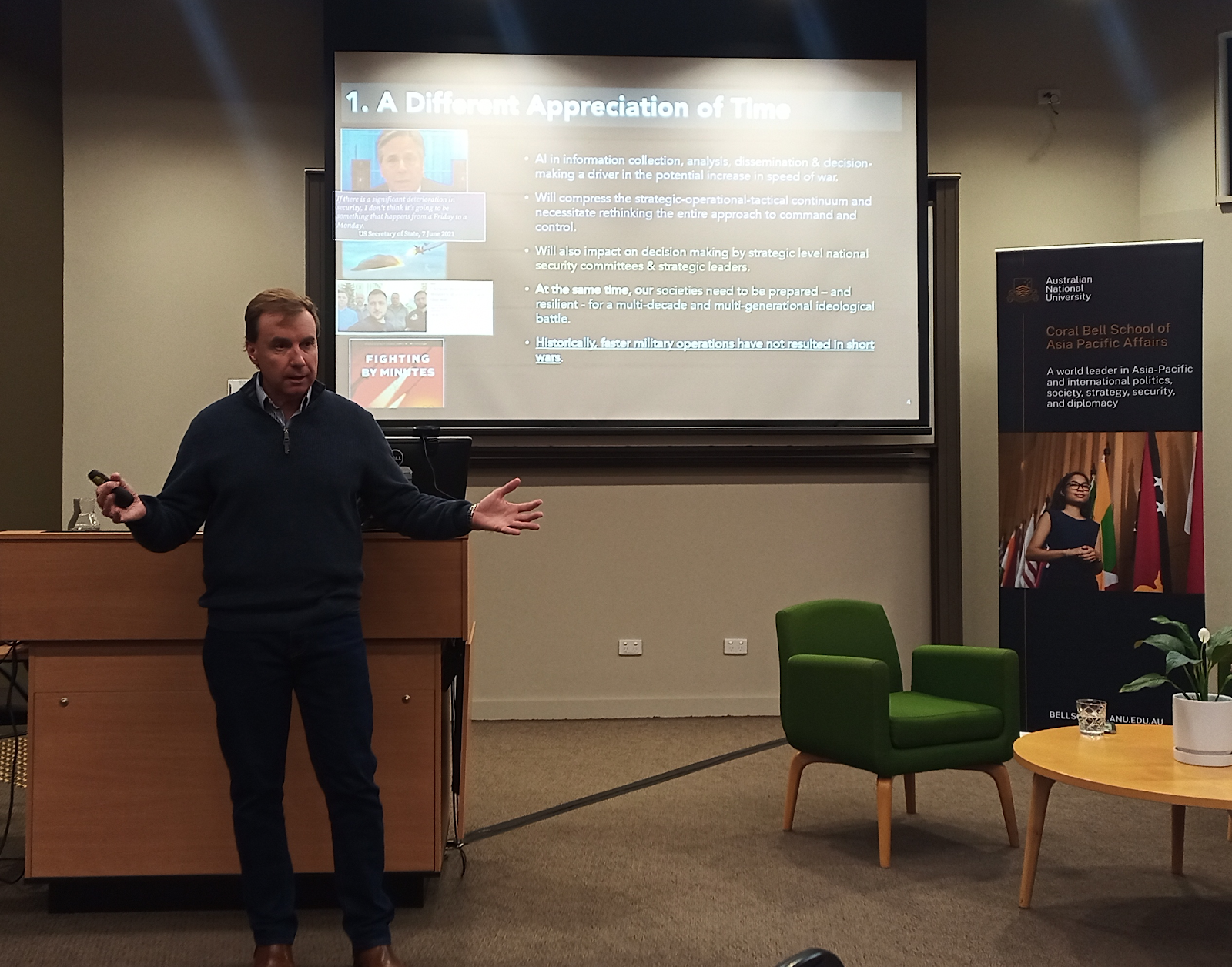
Drones, human-machine teaming, strategic influence and mass warfare
Mick went on to talk about integrating political, and military objectives, and operations. He asked for new ideas for Australian defence. He pointed out that some of Russia's new ideas have "not worked out that well". He contrasted this with Chinese new thinking, and suggested Australia needs do this. He suggested organizing the defence force differently, as current battalions are based on old Russian legions.
I suggest one thing the Australian military can do is make better use of universities, as industry are. Each semester, ANU has about 200 students working on group computer projects and 50 interns. Some of these people work on defence and security projects, mostly in companies contracted to the Australian Government. Examples are testing new radar for missile defence (an Australian system Ukraine has asked for), and testing cyber security of software for government. Universities across Australia are working on AI, cyber security, drones, and all that stuff.
In answer to a question about the potential for war over Taiwan, Mick Ryan suggested drone submarines would be more useful than nuclear powered ones. Another interesting point was what is the legal liability of civilians who help with defence online. Some seem reasonably clear to me: if you report a military aircraft going over, you have become a target. A great question from a public servant in the audience was what does a mass AI western influence operation look like? The first part of the answer surprised me: NATO (as a political influence organisation). The second part was to teach children that not everything on the Internet is true.
Wednesday, April 26, 2023
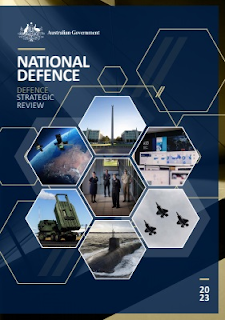
Cyber Security in Defence Strategic Review
Had a call from the media asking about cyber security in the Defence
Strategic Review (I was interviewed from the shower cubicle in my
Singapore hotel room). There is a section on "Cyber domain and
targeting" in the report (page 63):
https://www.defence.gov.au/about/reviews-inquiries/defence-strategic-review
"Australia’s cyber and information operations capabilities must be scaled up and optimised.
Under project REDSPICE, the Australian Signals Directorate is significantly expanding its signals intelligence and cyber capabilities and capacity.
Defence must enhance its cyber domain capabilities to deliver the required responsiveness and breadth of capability to support ADF operations. This must focus on: integrating the defence and management of Defence’s C4 networks and architectures; delivering a coherent and, where possible, centralised cyber domain capability development and management function; and building and sustaining a trained Defence cyber workforce."
But I am not sure centralizing is a good idea.
"Defence must also continue to develop its cyber and space capabilities." page 7Good.
"To maximise the deterrence, denial and response options for the Government, the ADF must evolve into a genuine Integrated Force which harnesses effects across all five domains: maritime, land, air, space and cyber." page 19
Will cyber have the corresponding funding and staffing?
"In the contemporary strategic era, we cannot rely on geography or warning time. Regional military modernisation, underpinned by economic development, has meant that more countries are able to project combat power across greater ranges in all five domains: maritime, land, air, space and cyber. Emerging and disruptive technologies are being rapidly translated into military capability." page 24
Is Australia planning to transition into combat in the cyber domain?
"Cyber warfare is not bound by geography." page 25So what are the implications of cyber war not being geographically bounded?
"Internal measures have included: increased defence and national security spending; the reorganisation of elements of the national intelligence and national security community; substantial investments in cyber security;" page 33In particular?
"Deterrence strategy and practice is evolving. In military terms it now spans five domains: maritime, land, air, space and cyber." page 37Is deterrence effective in the cyber domain?
"Although invasion of the Australian continent is a remote possibility, any adversary could seek to coerce Australia through cyber attacks ..." page 37
Could the attacks be made in a coordinated enough way to be useful for coerce? Under international law, Australia need not respond to cyber attack with a cyber attack, it can use missiles, bombs, and troops.For example, having backups."Resilience requires the ability to withstand, endure and recover from disruption. ... robust cyber security, data networks and space capabilities;" page 38
The strategy of denial must also recognise the importance of non-geographic security threats, including cyber, space and long-range missile capabilities." page 49
Could Australia be digitally blockaded?
How many cyber and information warfare troops does the ADF have? How many do they need? Will the ADF pay enough to retain them?
"The adoption of this approach will necessarily lead to a very different force structure and posture to what the ADF has today. More attention and resources must be devoted to crucial future-focused joint capabilities such as information warfare, cyber capabilities, electronic warfare, and guided weapons and explosive ordnance." page 51
How many cyber and information warfare troops does the ADF have? How many do they need? Will the ADF pay enough to retain them?
"The evolution to five domains – maritime, land, air, space and cyber – demands a new approach." page 54
"Defence’s cyber security arrangements should be enhanced in
close collaboration with the Australian Signals Directorate." page 83
"Defence’s cyber security operations capability in Chief
Information Officer Group should be increased and legacy systems and platforms should be decommissioned." page 83
What will that cost, and how long will it take? For Y2K we took years,
and hundreds of millions of dollars, to tidy up old systems.
"Options should be developed to change Defence’s recruitment framework to improve the eligibility pool of potential applications and to align service recruitment requirements to military employment, especially in key technical and specialist trades (cyber, engineering, space, etc.)." page 88
Perhaps the physical fitness requirement will be lowered for computer
nerds? 😉
"The Government also notes that in the contemporary strategic environment, developments in cyber, space and long-range precision strike mean our defence interests are not bound by geography alone." page 103
"A comprehensive framework should be developed for managing operations in the cyber domain that is consistent with the other domains. Agreed"
"Defence’s cyber domain capabilities should be strengthened to deliver the required breadth of capability with appropriate responsiveness to support ADF operations. Agreed in-principle" page 106
Only in principle?
"Options should be developed to change Defence’s recruitment framework to improve the eligibility pool of potential applications and to align service recruitment requirements to military employment, especially in key technical and specialist trades (cyber, engineering, space, etc.). Agreed" page 107
So the nerds will not need to do pushups?
"Defence’s cyber security arrangements should be enhanced in close collaboration with the Australian Signals Directorate. Agreed" page 108
And the universities?
Tuesday, February 22, 2022
Incident with patrol aircraft following hypothetical script
| HQ JOC storyboard of PLA-N ships, in the Arafura Sea. |
In 2016 I presented a hypothetical for IT Ethics at ANU. This was a fictional incident involving a maritime surveillance aircraft. The question for the students was what, as an IT professional, what military response they could participate in. This scenario became real last week when an Australian P-8A Poseidon aircraft reported being targeted by a laser from a Chinese warship, just north of Australia. Fortunately the real situation did not escalate, unlike the hypothetical:
The real report:
"On 17 February 2022, an Australian Maritime Patrol Aircraft P-8A Poseidon detected a laser illuminating the aircraft while it was conducting a routine surveillance flight over Australia’s northern approaches.
The laser was detected as emanating from a People’s Liberation Army – Navy (PLA-N) vessel. Illumination of the aircraft by the Chinese vessel is a serious safety incident. ... sonobuoys were used after the incident ... ahead of the PLA-N vessel. ..."
From: Chinese ship lasing of P-8A Poseidon on 17 February 2022, Australian Department of Defence, 22 February 2022.
My fictional report:
"At 02:20 Zulu, 1 April 2017, one of our maritime surveillance aircraft was reported missing. The aircraft was conducting a freedom of navigation flyover ... signals from a fire control radar ... aircraft's flares and electronic countermeasures were activated ... "
From: Briefing by Cyberspace Operations Wing at Headquarters Joint Operations Command (COW/HQJOC), 12:30 Zulu 1 April 2017 (Notional For Exercise Only)
Thursday, December 10, 2020
Navy Warfare Innovation Workshop 2020
![]() |
| Event canvas from NWIW 2020 by Paul Telling |
Participants use the same techniques as a business start-up competition, refining and presenting an idea, but one to defend the country. A panel of senior defence experts then select which merit further development.
However, the real value of such competitions is not to produce a product, but have the participants learn new skills and meet people they can later work with on projects.
Friday, May 22, 2020
ANZDF Logistics Hack Awards
Wednesday, May 20, 2020
Making a Better Hackerthon
At the moment I am in the post event meeting of Lead Mentors for the joint hackathon to Secure
Supply Chains for the Australian and NZ Defence Forces. The Slack communications tool used used for the event and worked well, but it has taken me about four such events to get used to it. Here some suggestions I offered, which may be applicable to other hackerthons:
Innovation ACT Participants 2020
The Innovation ACT competition have steps for the teams, with badges, to make sure they have done the basics. Some can be very simple things, like a tick for initially contacting your mentor: https://innovationact.org/iact19/participant-info/
Friday, May 15, 2020
ANZDF Logistics Hack: A Blizzard of Messages.
A joint hackathon to Secure Supply Chains for the Australian and NZ Defence Forces starts at 7pm (Canberra Time). I have volunteered to help, as a Lead Mentor, mentoring some of the mentors, who in turn provide advice to the participants). The Slack communications tool is being used for the event. This can be a little overwhelming, with a blizzard of messages. It can be easy to miss some important, in among lots of "hello I am...".
This is something academics teaching online at university could useful experience, as it is similar to the bewildering flood of messages a student receives. The academic running a course may send out a message and wonder why students did not receive it. What they do not see are the other several hundred messages the student will receive from the university the same day.Some of the pre-reading for the hack, may be of interest:
- COVID-19 crisis, By Katherine Ziesing, Australian Defence Magazine, 5 April 2020
- Covid-19 shows Australia needs a national sovereignty strategy, by David Fawcett, Australian Strategic Policy Institute,12 May 2020
- Three Examples of a Supply Shock, Simplicable,6 February 2020
- One hundred days of the coronavirus crisis, By Inga Ting and Alex Palmer, 4 May 2020
Wednesday, May 13, 2020
Hackathon Friday to Secure Supply Chains for the Australian and NZ Defence Forces
![]() |
| Senator Reynolds, Australian Minister for Defence |
Senator Linda Reynolds, the Australian Minister for Defence, announced today the Australian and New Zealand Defence Forces will host a joint hackathon to strengthen supply chains. This is to be run by the Australian Computer Society (ACS), starting this Friday. Australians and New Zealanders have been asked to contribute ideas to secure the logistics of our military, in the light of the COVID-19 pandemic, as well as recent bushfires, earthquakes and floods.

Participation can be as team members, mentors and partners. The event will be held over three days, with the same hackerthon format as used for the Flatten the Curve hack in April. On day one teams are formed, day two they design and build, and on day three they refine and present their proposals, which are judged for prizes.ps: I have volunteered to help, with my experience working at Australian Defence Force Headquarters in the 1990s, while President of the ACS, developing national policy online as part of what the media called the Internet "Cabal".
Monday, July 15, 2019
Qualifications of Australian Government Contractors will be Checked as Part of Security Procedures
Today I went along to a presentation at the Department of Defence about the new Defence Industry Security Program (DISP). Previously, companies and contract staff had to have a Defence contract to get a security clearance, but it was difficult to get a contract without a clearance. The new procedures allow a company to apply for DISP membership, and then tender for contracts. The company can then appoint their own Security Officer, to nominate staff for security clearances. That all makes sense, but one curious side effect is that companies will also have to check the qualifications of staff. This may require universities to improve the certification service they provide. An easily faked paper certificate will likely not be sufficient.
As well as private companies, universities can apply for DISP membership. There are four levels of membership (Entry, 1, 2, 3) and four categories (Governance, Personal Security, Physical Security, Information & Cyber Security), making a sixteen cell matrix.
Monday, October 30, 2017
Educational Leadership Getting Personal at EdTech Posium 2017
Greetings from the opening of EdTechPosium Conference 2017 at UNSW/ADFA in Canberra. The theme of the conference is "Fitting the Tech to the Teaching", but Kim Tairi, Librarian, AUT in Auckland, started her keynote on a more personal note. She discussed how she came to be the Librarian of a university and issues with taking on a leadership role. Kim emphasized the human aspects of scholarships, proposing "Circles of Kindness". This gives my more confidence about taking the person approach in my presentaion on "Dogfooding" at 11:25 am.
Thursday, October 19, 2017
The Best of EdTechPosium 2017 in Canberra
Day 1
10:50 “What are Blockcerts again?” — The role of communication in introducing new technologies for teaching at tertiary institutions. Rebecca Ng, Australian National University
11:25 Dogfooding: Learning to design for internationalstudents by being an international on-line student. Tom Worthington, Australian National University
13:10 Motivating and inspiring students to work collaboratively on assessment items. Dr Scott Rickard, University of Canberra
13:45 Moving from Face-to-Face to e-learning. William Batten, Department of Defence
14:55 Simulations, Gamification and Creative Problem Solving. Sudantha Balage, UNSW Canberra
15: 25 Opening professional learning in Australian higher education using Open Educational Practice: A cross-institutional collaboration. Emma Power, University of Southern Queensland, Dr Katie Freund, Karlene Dickens
& Janene Harman, Australian National University
16:00 eLearning 101 — professional development for busy academics and technology-enhanced learning educators. James Nicholson, Australian Catholic University
Day 2
10:40 “Let’s See What Happens”: Introducing students to interactive online tutorials. Stephanie Kizimchuk, University of Canberra11:15 Four embeddings and a mural: OK2A — A course layout informed by Constructive Alignment delivering better blended learning. Roderick Huggett, Centre for
Defence and Strategic Studies
11:50 What have we GotS here? New ways for delivering Information Literacy at the University of Wollongong Library. Laura Lidden & Nick Zografos, University of Wollongong
14:45 ePortfolios — Where to next? Jenny Edwards, Australian National University, Shane Nuessler, University of Canberra
Thursday, July 27, 2017
Stability in the Indo-Pacific
![]() |
| Admiral Scott H Swift at ANU in Canberra |
Greetings from the Australian National University in Canberra, where Admiral Scott H Swift, Commander, U.S. Pacific Fleet (COMPACFLT) is speaking on Stability in the Indo-Pacific: the roles of the US and Australian navies. He had just come from taking part in Exercise Talisman Sabre 2017 in Queensland.
| Tom Worthington on USS Blue Ridge |
Thursday, April 28, 2016
ICT Energy Saving Measures for DCNS Shortfin Barracuda Block 1A Submarine
Yesterday I gave a guest lecture at the Australian Defence Force Academy (ADFA) in Canberra. The invited topic for the computing students was "ICT
Sustainability", but to make it more relevant to a military audience I talked on "ICT Energy Saving Measures for DCNS Shortfin Barracuda Block 1A Submarine". Earlier in the week the Australian government announced that Australia had selected French company DCNS to design a submarine, 12 of which are to be built in Adelaide. Described as a "Shortfin Barracuda Block 1A", the design is based on the Barracuda-class nuclear attack submarine.
The 150 MW nuclear reactor of the Barracuda will be replaced with conventional diesel engines and batteries for the Australian variant. Running on battery power these will be very quiet submarines. However, they will will have limited electrical power. The K15 nuclear reactor of the Barracuda only needs to be refueled every ten years and the submarine is only limited by the amount of food it can carry for the crew. The Australian version will have a long range, but still be limited by the amount of diesel fuel which can be carried and the battery capacity underwater.
As I pointed out to the ADFA students, modern military increasingly reply on computers and telecommunications. The sixty crew, plus embarked special forces, will require computer equipment for the mission and for off-duty entertainment. This will make up a significant part of the "hotel power" of the submarine. The more efficient the use of ICT, the longer the range and endurance of the submarines. Even a few percent increase is significant.
The 150 MW nuclear reactor of the Barracuda will be replaced with conventional diesel engines and batteries for the Australian variant. Running on battery power these will be very quiet submarines. However, they will will have limited electrical power. The K15 nuclear reactor of the Barracuda only needs to be refueled every ten years and the submarine is only limited by the amount of food it can carry for the crew. The Australian version will have a long range, but still be limited by the amount of diesel fuel which can be carried and the battery capacity underwater.
As I pointed out to the ADFA students, modern military increasingly reply on computers and telecommunications. The sixty crew, plus embarked special forces, will require computer equipment for the mission and for off-duty entertainment. This will make up a significant part of the "hotel power" of the submarine. The more efficient the use of ICT, the longer the range and endurance of the submarines. Even a few percent increase is significant.
Tuesday, July 30, 2013
Demilitarizing the Education of Australian Military Officers
Major General Michael Smith, (Australian Army, Retired) has proposed that Australian military officers should attend civilian universities (ABC Radio National Sunday Profile, 28 July 2013 12:30PM). Currently officer cadets attend the Australian Defence Force Academy (ADFA), with an academic program provided by the University of New South Wales. General Smith suggests changing this would produce a better culture
towards women in the ADF (although civilian universities have a higher rate of sexual assault than ADFA).
General Smith's proposal implies that the current ADFA campus in Canberra would be closed down and the students sent to civilian campuses across Australia. The cadets would then receive separate military training. I suggest a simpler option would be to re-designate the ADFA campus a civilian university.
Currently the ADFA campus is run by the Defence Organization, with UNSW staff providing academic education programs. The students are in uniform and live in dormitories on campus under military discipline.
If it was felt necessary to have officer cadets attend a civilian campus, this could be done at ADFA relatively simply. The signs could be changed from "ADFA" to "UNSW", the students not required to wear uniforms and the accommodation run under university college rules. Military students could be allowed to live off campus and civilian students invited to stay on-campus.
More responsibility for running the campus would be taken on by the civilian Rector (the UNSW Canberra equivalent of Vice-Chancellor) and the Commandant ADFA would concentrate on the separate military training program the cadets would receive.
ADFA already has post-graduate civilian students. It is likely that UNSW would take the opportunity to recruit more civilian undergraduate and postgraduate students.
General Smith's proposal implies that the current ADFA campus in Canberra would be closed down and the students sent to civilian campuses across Australia. The cadets would then receive separate military training. I suggest a simpler option would be to re-designate the ADFA campus a civilian university.
Currently the ADFA campus is run by the Defence Organization, with UNSW staff providing academic education programs. The students are in uniform and live in dormitories on campus under military discipline.
If it was felt necessary to have officer cadets attend a civilian campus, this could be done at ADFA relatively simply. The signs could be changed from "ADFA" to "UNSW", the students not required to wear uniforms and the accommodation run under university college rules. Military students could be allowed to live off campus and civilian students invited to stay on-campus.
More responsibility for running the campus would be taken on by the civilian Rector (the UNSW Canberra equivalent of Vice-Chancellor) and the Commandant ADFA would concentrate on the separate military training program the cadets would receive.
ADFA already has post-graduate civilian students. It is likely that UNSW would take the opportunity to recruit more civilian undergraduate and postgraduate students.
Subscribe to:
Posts (Atom)