The Australian Computer Society (ACS) has issued a "Call For Feedback: Occupations Framework". The aim is to create a structure for describing cyber work in Australia.
Showing posts with label ACS. Show all posts
Showing posts with label ACS. Show all posts
Wednesday, May 20, 2026

Wednesday, December 10, 2025
ACS Statement on Social Media Ban
The Australian Computer Society has issued a statement on the Australian social media ban for children under 16. Among other luminaries I get quoted:
"We should be looking at how AI can help create kid-friendly alternatives. If kids are suddenly forced to go cold turkey, we’re risking some pretty severe mental health consequences. Overnight they lose their main way of connecting with friends, and for many young people that’s the only social connection they have. We could actually end up making things worse. There’s a real opportunity here to partner with tech companies to build a safer alternative, instead of cutting them off completely."
The ban has, surprisingly, effected me personally. Today, on the day the ban took effect, BlueSky has told me I have to verify my age. Presumably this is due to the Australian social media ban for under 16 year olds. This is not entirely clear as the notice (below) refers to verifying I am adult, and 16 year olds are not adults. I can read, but not post, until I do.
I have not been that impressed with the quality of discussion in Bluesky, not because it has kid-unfriendly material, but is a sort of "X for Democrats", full of US political material. I can do without Bluesky, so for the moment will not be age verifying.
The notice:
'We have partnered with KWS to verify that you’re an adult. When you click "Begin" below, KWS will check if you have previously verified your age using this email address for other games/services powered by KWS technology. If not, KWS will email you instructions for verifying your age. When you’re done, you'll be brought back to continue using Bluesky.This should only take a few minutes.'
Thursday, December 4, 2025
Australian Professional Standards Forum

The councils set professional standards, including computing. In return members of participating organisations have their liability capped. AI creates many challenges for organisations wanting to ensure their members act legally and ethically.
Dr Payne claimed that NFTs are making a comeback, which I hadn't noticed. He also mentioned a number of other technologies which have been coming real soon for a long time, but which AI will make mainstream.
Dr Payne claimed that AI had changed the words MPs use in Parliament and drafted in laws. He then touched on doomsday scenarios of AI optimizing human out of existence, or just subtly nudging human behavior. Of course, given governments, individuals and corporations have engaged in crimes against humanity, so could AI be worse?
Today Meta started suspending the accounts of children, ahead of the Australian ban. It occurs to me that it should be possible to use AI to make a safer social media for children. I worry that in the next few weeks we will have millions of children suffering real pain and at risk of their lives, due to the ban.
Then we got to play with Lego! Dr Payne used Lego to explain how a Large Learning Model (LLM) works. This was cleaver, as it got us out of the mode of just looking at Powerpoint slides.
Friday, August 1, 2025
Developing a national sovereign AI strategy

- Develop a national sovereign
AI strategy: The ACS is calling for a "long-term
vision for sovereign AI development". However, I suggest this should be looking for short term measures. If Australia looks to the long term the strategy will be out of date before it can be implemented. As I suggested for the ACT Government last week, we can look to countries such as Singapore, for mature AI strategies to emulate.
- Develop an innovation strategy: The Australian Government is to release a "Strategic Examination of Research and Development", this year. Aligning workforce readiness with innovation by encouraging entrepreneurship is my day job. Government can do more to support startups and scaleups. One area is for defence, where the nation needs new capabilities quickly. Cancelling a few failed big ticket defence projects reliant on overseas suppliers could provide thousands of billions of dollars for local innovation.
- Government co-investment in scaleups: Not so sure about this recommendation, as it sounds dangerously like government trying to pick winners. Apart from strategically important areas, such as defence, energy security and availability of vaccines, government should avoid direct investment in scaleups, as they are really, really bad at it.
- Greater incentives for R&D in AI and tech adoption by businesses: ACS point out there is a skills gap in the use of AI by business. The obvious solution, I suggest, is training. Many of the computer project students I teach are planning to work in AI. To them it is not new and exotic, just a tool they are very familiar with. We need vocational education programs which similarly give business people a deep understanding of AI.
- Executives take a digital skills health check: Rather than trying to get C-suite leaders up to scratch on digital capabilities, I suggest political parties, government agencies and company boards need to hire more technocrats. We need some digital professionals running the nation and corporations, not just lawyers who learned a bit about computers.
- Promote entry-level pathways for cybersecurity professionals: ACS point out that we simply can't get enough computer professionals to fill cyber security positions. What we can do is take people qualified in allied fields and train them up. This can be done online with vocational education techniques, rather than in university lecture theatres.
- Implement an ‘earn while you learn’ scheme: ACS proposes business and government sharing the cost of worker retraining. Unfortunately what has tended to happen is as federal government introduces subsidies for university and vocational education, business and state governments have stopped funding. We have the technology to do the retraining (I spent a decade learning how this works). The problem is to make a watertight agreement on funding which business and states will abide by. Assuming Jobs and Skills Australia release their national skills taxonomy promptly, this can be used (if not someone else can). This can be aligned with the UK based Skills Framework for the Information Age (SFIA), used by ACS. The match will not be perfect. When ACS commissioned me to design a course in Green Computing (way back in 2008), there were no relevant skills in SFIA. I sent SFIA HQ a copy of my course and they added green skills, but that took considerable time.
- A national commitment to alternative tech pathways: ACS argues for greater trust in vocational qualifications by business. Another approach to this, I suggest, is the use of the Vocational Degrees, added to the Australian Qualifications Framework in February 2025. With this entry level staff can obtain a certificate and then go on to a degree at the same vocational institution. This should give business more comfort as to the depth of training provided.
Thursday, June 26, 2025
Australian Cyber Resilience in a High Threat World Learning from Estonia

Over the last few years, Australian National University hosted a series of talks by small european states under threat, or in the case of Ukraine under direct attack. This may not seem relevant to Australia, but out online systems are under constant online attack. Ms Eesmaa described Estonia's industry security vetting system, which allows staff from those companies to more easily assist the government when needed. This is something perhaps Australia should adopt. Another suggestion was exercises with industry involvement. As a defence civilian employee I have been involved in defence exercises, but while these included personnel from allied countries, the only industry involved were contracted companies providing services. The ACS has run some hackathons for the Australian and NZ defence forces, and ANU has run simulations for students with support of security agencies (I mentored teams). This format could be used to include industry at low cost.

Monday, June 16, 2025
TechUplift25: Empowering Cyber Security through AI-driven Capability

Friday, May 9, 2025
Redefining the Australian Degree
Greetings from the Professional Standards Board of the Australian Computer Society (ACS), meeting in Adelaide. I jokingly told some academic colleagues that I was at a meeting to redesign the Australian degree. This is a slight exaggeration. Professional bodies, such as ACS, set accreditation standards. Universities and other educational bodies can choose to be accredited, but to do so must meet the requirements. As a result what professional standards are set influences what is in degrees. A current, and ongoing issue, is the balance between practical skills for immediate use, and what will be needed over a career. Another is how to improve, and formally recognise, learning which takes place outside the institution.
Some other issues are AI Adoption, and Digital Skills (such as DigComp 2.0). Also hanging over everything is cyber security.
ps: In terms of how moden meetings are run, while all the broad are physically present, we still have video conferencing running, for some staff giving presentations from offices in other cities. Even though I am in the room, I found it useful to join the video conference (with no sound), so I can see presentations up close on my laptop.
Tuesday, May 6, 2025
AI Generated Instructions

Thursday, December 12, 2024
Every business is a tech business

Speaking at the launch of the ACS Digital Pulse report John Griggs, ACS CEO, said "Every business is a tech business". This is at the National Press Club in Canberra. The point wat that all businesses need technical staff. The problem is that as the report details, universities cannot produce enough graduates and school leavers don't want to enrol anyway.
The ACS solution is non-traditional paths, through certification, and microcredentials. One problem I can see is convincing the workers, employers and regulators that the alternative pathways are as good as traditional education. This is similar to the poor reputation online learning has had: research shows it is as good, if not better than classroom based learning, but there is still a perception it is inferior.
Tuesday, October 15, 2024
Stephen Dunkerley on Leadership
 |
| Stephen Dunkerley, Matsue Leadership & Consulting |
Wednesday, July 10, 2024
Digital Technologies education in Australian schools
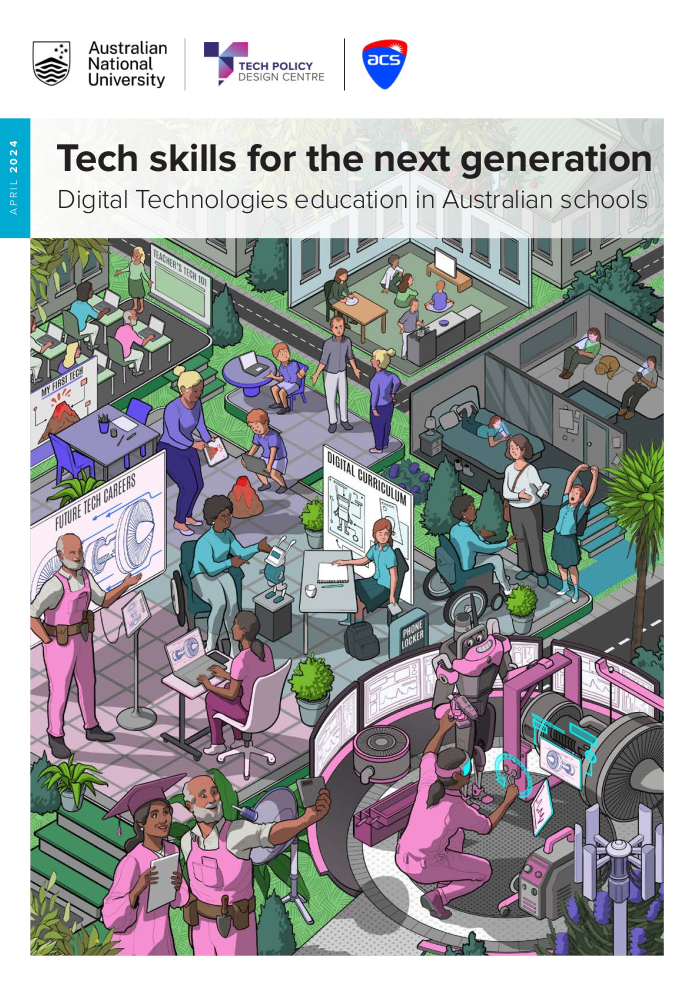
Ensuring there are accessible ready-to-use teaching resources
1. Expand support for, and increase visibility of, the online Digital Technologies Hub to ensure teachers have access to best practice exemplar teaching modules for the DTC.2. Improve schools’ internal information management processes regarding digital teaching resources to ensure they reach teachers who need them in the classroom.3. Support cross-fertilisation amongst professional associations and communities of practice for the DTC.Embedding digital-readiness training in Initial Teacher Education (ITE)
4. The Australian Institute for Teaching and School Leadership (AITSL) should incorporate into ITE accreditation a requirement that ITE programs demonstrate their capacity to prepare our future teachers to:
• teach with digital technologies (as expected by AITSL standards)• use digital technologies within all learning areas (including Digital Literacy development)• teach the F–10 Digital Technologies subject and/or senior secondary computer education courses.This could be supported through the Australian Technologies Teacher Educators Network (ATTEN) to provide end-user input from Digital Technologies teachers based in each state and territory.Supporting ongoing professional development and training for teachers
5. Ensure that training courses suitable for teachers are available and accessible across all essential areas of digital technologies knowledge and skills.6. Identify and promote existing recommended courses that provide training in software tools and core principles of digital technologies for teachers of all year levels.7. Invest in initiatives that support teachers to attend suitable training for digital technologies skills and in turn this will increase the number of skilled teachers at each school.Elevating awareness of the Digital Technologies Curriculum in the community
8. Empower parents with the tools and capabilities to understand and communicate at home the value of digital technologies, including the types of technology careers that can be pursued and how the skills can be applied to solve problems in a range of industries.9. Ensure that tools and capabilities that empower parents are inclusive and increase visibility of underrepresented groups in STEM fields, such as women and girls and Aboriginal and Torres Strait Islander Peoples.10. Establish a national coordinated data collection of DTC learning outcomes, and communicate these outcomes to the community to build better understanding and awareness of learning and career outcomes.11. Recognise and reward excellence in digital technologies education to increase visibility to parents and the education community and promote best practice-teaching in Australian schools.
Saturday, May 25, 2024
Aligning Computer Professional Skills With the Nation's Needs
Greetings from the Australian Computer Society (ACS), Canberra Branch Hub, where I am taking part in an ACS Professional Standards Board meeting. ACS sets the standards for the education of computer professionals in Australia, and in conjunction with sister societies, world wide. In the usual bureaucratic processes of being on any committee, it is easy to forget how important the work is. We need to ensure what Australian universities and vocational institutions teach is what industry needs, and aligns with international standards. We also need to ensure that working professionals can keep up with developments in the industry, either individually or through their employer. All of this has to be acceptable to Australian governments, and industry.
Being professionals, we first try to find an existing standard, but often have to enhance, or on occasion, write the standard from scratch. Not surprisingly new technology requires new skills of computer professionals, such as blockchain, and quantum computing. These are relatively easy to address. More surprising, and much harder, are soft skills, such as emotional intelligence. How do we define these, help professionals get them, and perhaps hardest, convince people they need them. Recently an assessment question I wrote for students was criticized by one of my colleagues as not being "academic", because it concerned soft skills. I look forward to being able to say "We are required to teach and test these professional skills".
The work of the board on skills standards goes all the way from high level definitions, down to how to document this, using digital badges, in electronic portfolios. This may all sound very esoteric, but it can result in someone being hired for a job much more quickly, a company getting a contract, a nation increasing productivity, and citizens being safer.
Monday, April 22, 2024
Australia 4.0 Communiqué
 |
| Pearcey panel at Aus 2.0 Launch |
A panel of industry people started by discussing expanding the engineering workforce, and opening it to more women. The point here is you can't refit the grid for renewable energy without trained people. One issue is recognizing the overseas qualifications of professionals (something I help with at ACS & ANU). Another issue is male biases built into technology courses. Another issue is consumer education, and if AI could help.
Curiously, some of the issues in terms of consumer behavior are not new. An example raised by the panel was controlled load hot water: the water heater turns off during time of high energy demand, and in return a lower tariff is charged. New technology allows this to be done with smart meters, but the problem from decades ago when it used a signal sent over the power lines, the consumer needs to be convinced it is worthwhile.
The panel touched on international collaboration to apply lessons from elsewhere in Australia. However, I suggest the reverse also applies, as Australia has the highest use of domestic rooftop solar in the world. That is something Australians can teach about, and charge money for.
Energy is a national security issue. One scenario discussed by the panel was cyber attacks on smart meters. This could be used to disconnect consumer's power, on a large scale. But I suggest it could also be used to attack the grid: of all the demand load is turned on during peak energy use. One of the panelists pointed out the national telecommunications control centers are at secret locations., whereas those for the electricity grid are not.
Professor Lachlan Blackhall's "light switch" was mentioned several times. He isn't here, so I asked the panel what it was. Apparently it is in the 2.0 report, and is the idea that consumers want a switch to control devices in their home, not trusting remote control. I suggest that this consumer sovereignty will have limited application. If the grid can't cope, the consumer will not be permitted to turn on non-critical appliances. The form of control will be like fly by wire pioneered on the Apollo Lunar Module, and no common on airliners. The flight controls are input to a computer, which can override the pilot.
Friday, December 1, 2023
Join the Dots Career Planning
Greetings from the Australian Computer Society national office in Sydney. I am here for two days of meetings of the ACS Professional Standards Board, and the Accreditation Committee. I am on the Board, which sets standards for computing professional education in Australia, and am sitting in on the committee which accredits individual degrees at universities.
During the break I went out for a coffee, and got chatting with an entrepreneur from a company in the start-up center ACS Harbor City Labs, at the other end of the floor. They said they were thinking of going back to finish their degree, which they left 15 years ago, and asked if that was feasible. I suggested their old university would be delighted to have them back, but they should not expect much credit for courses completed so long ago. They might instead apply for direct entry to a masters, based on experience. This got me thinking about the many staff in this situation, and how we can help them recognize their experience, and not have to do introductory courses.
Monday, July 3, 2023
IEEE AI Ethics and Governance Workshop in Canberra Hosted by the Australian Computer Society
 |
| Ruth Lewis, workshop facilitator |
IEEE have produced the 294 page "ETHICALLY ALIGNED DESIGN" (2019), and a suite of standards:
- 7000-2021 - IEEE Standard Model Process for Addressing Ethical Concerns during System Design
- 7001-2021 - IEEE Standard for Transparency of Autonomous Systems
- 7002-2022 - IEEE Standard for Data Privacy Process
- 7005-2021 - IEEE Standard for Transparent Employer Data Governance
- 7010-2020 - IEEE Recommended Practice for Assessing the Impact of Autonomous and Intelligent Systems on Human Well-Being
IEEE has been producing ethics standards for many years, but these do not appear to have had much effect on practice. The current public, government and industry interest in AI, and Generative AI (such as Chat GPT) is a good opportunity for IEEE to kindle interest in ethics. If there is an area needing consideration of ethics is AI.
An interesting issues, I suggest, is how standard largely developed by western couturiers will be seen in China, and Asia. In standards development the Golden Rule applies: "Those who have the gold make the rules". As China's economy expands, they will have more influence over global standards.
An interesting issues, I suggest, is how standard largely developed by western couturiers will be seen in China, and Asia. In standards development the Golden Rule applies: "Those who have the gold make the rules". As China's economy expands, they will have more influence over global standards.
While considerations of ethics in computing and engineering development is useful, it has its limitations. As an example, application of IEEE standards would not have stopped the RoboDebt system, as those in leadership positions had an different ethical framework. This held that persecution of disadvantaged citizens was acceptable, provided it boosted the government's ratings with its supporters. This approach was described as Authorized System Harassment in the UK dystopian TV series "1990" ("Ordeal by Small Brown Envelope", 1978), and the possibility of it resulting in suicide was explored. RoboDebt was not ended because it was clearly abhorrent to the ethical standards of most Australians, but because it was found to be technically illegal.
Thursday, December 1, 2022
Charting the Future of Technology in Australia
 |
| ACS Canberra meeting room |
This room demonstrates a good design for meetings, and education. There is a small stage at one end, with space for four chairs, and a projection screen behind. There is a window into the office area beside the stage. This allows an operator to sit behind the glass, controlling the A/V setup.
There are 30 chairs set out, with five flip top tables on wheels at the back. These are used for holding the snacks during a function, but can be spread out around the room for group work. Along one side is a kitchen with a bench facing the meeting space. Smaller meeting rooms have glass walls into the main space. Each room has two large LCD screens and an inbuilt video conferencing system, and seating for nine people. This layout would be good for a small satellite campus.
There are 30 chairs set out, with five flip top tables on wheels at the back. These are used for holding the snacks during a function, but can be spread out around the room for group work. Along one side is a kitchen with a bench facing the meeting space. Smaller meeting rooms have glass walls into the main space. Each room has two large LCD screens and an inbuilt video conferencing system, and seating for nine people. This layout would be good for a small satellite campus.
Tuesday, November 29, 2022
Deciding the Future of Higher Education in Australia
 |
| View from ACS HQ |
Questions for the future, I suggest, include: "What about micro-credentials? Can you chop a degree into small pieces, but still have it make sense?". As I was writing that I came across a post from May Sok Mui Lim at Singapore Institute of Technology (SIT), on a Competency-Based Stackable Micro-credential pathway (CSM). In the SIT scheme a micro-credential is about 4 months work, and is a standalone qualification. Students can complete several micro-credentials, plus a capstone project to be awarded a degree. As it happens I visited SIT recently, and was impressed with what they are doing, which gives me more confidence this approach will work. It will be interesting to see how much consideration it gets in the O’Kane Review of Australian Higher Education.
Also this morning I sat in on the ACS Professional Ethics Committee, which is revising the code of ethics of the society. Here the questions can get very philosophical, buit have to translate into guidance a working professional can use to deal with dilemmas.
Tuesday, August 23, 2022
Mentoring Computer Professionals
Greetings from the National Press Club in Canberra, where mentors & men

tees are talking about their experience in the ACS Mentoring Program. One lesson was "reality is harsh". I am one of the mentors.
Monday, July 25, 2022
Race to the Top for Talent Says new Australian Computer Society CEO


I asked the Minister about cyber training in the region, particularly Indonesia, where a recent ANU National Security College report expressed concern. The Minister mentioned his recent trip to Indonesia, and emphasized vocation education, and micro-credentials as areas with potenital.
Andrew Barr, Chief Minister of the ACT Government, and Attorney-General Shane Rattenbury, are also present.
ps: The release of the Pulse report is fortuitous, as tomorrow I am helping a class of several hundred ANU computer students think about their future career.
Sunday, June 5, 2022
ACS Recommendations to Improve Digital Technologies Education in Australia

The Australian Computer Society (ACS) has released a whitepaper on "Computer education in Australian schools 2022: Enabling the next generation of IT" (June, 2022). This is timely, with a new federal government. There are 55 recommendations, but the most important is for support for those teaching Digital Technologies to be trained and qualified in what they are teaching (Recommendation 3, Page 72). This training, I suggest, should ideally be done using digital technologies, without necessarily taking in service teachers away from their classroom for extended periods (there are several good Australian university programs for this). Also it would be useful to have a nationally standardized senior secondary computer education curriculum (Recommendation 25, Page 77). It would also be useful to have research on how well schools do, what resources they have and how are disadvantaged students helped (Recommendation 55, Page 78). I commend the report to those advising Government ministers, state and federal: I know you read my blog. ;-)
Declaration of Interest: I am a member of the ACS, and its Professional Standards Board. But I wasn't involved with the computer education whitepaper, which is from the ICT Educators Committee.
Subscribe to:
Posts (Atom)