Showing posts with label Australian Curriculum. Show all posts

Wednesday, July 10, 2024

Digital Technologies education in Australian schools

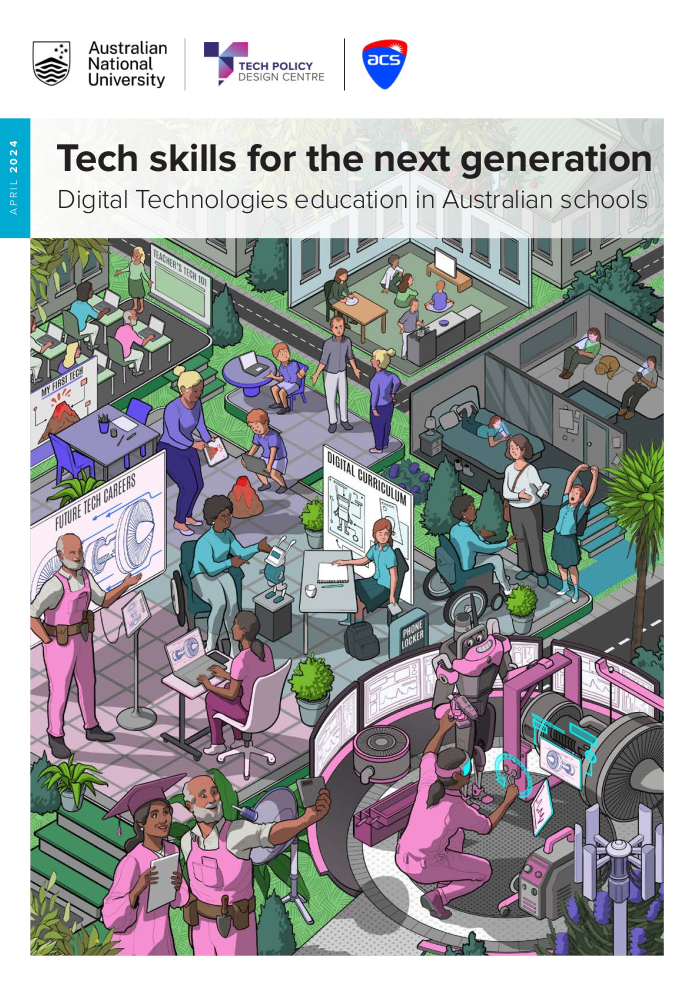
The Australian Computer society has released "Tech skills for the next generation: Digital Technologies education in Australian schools". The report makes 11 recommendations, in 4 categories. Initial Teacher Education is the area where I suggest there is the most scope. Teachers could be trained using digital technology to effectively use it in their teaching and administration. Rather than this being seen as adding to the burden of teaching and administrative responsibilities teachers already have, digital technology could be a way to make their jobs easier.

Ensuring there are accessible ready-to-use teaching resources

1. Expand support for, and increase visibility of, the online Digital Technologies Hub to ensure teachers have access to best practice exemplar teaching modules for the DTC.

2. Improve schools’ internal information management processes regarding digital teaching resources to ensure they reach teachers who need them in the classroom.

3. Support cross-fertilisation amongst professional associations and communities of practice for the DTC.

Embedding digital-readiness training in Initial Teacher Education (ITE)

4. The Australian Institute for Teaching and School Leadership (AITSL) should incorporate into ITE accreditation a requirement that ITE programs demonstrate their capacity to prepare our future teachers to: 
• teach with digital technologies (as expected by AITSL standards)
• use digital technologies within all learning areas (including Digital Literacy development)
• teach the F–10 Digital Technologies subject and/or senior secondary computer education courses.

This could be supported through the Australian Technologies Teacher Educators Network (ATTEN) to provide end-user input from Digital Technologies teachers based in each state and territory.

Supporting ongoing professional development and training for teachers

5. Ensure that training courses suitable for teachers are available and accessible across all essential areas of digital technologies knowledge and skills.

6. Identify and promote existing recommended courses that provide training in software tools and core principles of digital technologies for teachers of all year levels.

7. Invest in initiatives that support teachers to attend suitable training for digital technologies skills and in turn this will increase the number of skilled teachers at each school.

Elevating awareness of the Digital Technologies Curriculum in the community

8. Empower parents with the tools and capabilities to understand and communicate at home the value of digital technologies, including the types of technology careers that can be pursued and how the skills can be applied to solve problems in a range of industries.

9. Ensure that tools and capabilities that empower parents are inclusive and increase visibility of underrepresented groups in STEM fields, such as women and girls and Aboriginal and Torres Strait Islander Peoples.

10. Establish a national coordinated data collection of DTC learning outcomes, and communicate these outcomes to the community to build better understanding and awareness of learning and career outcomes.

11. Recognise and reward excellence in digital technologies education to increase visibility to parents and the education community and promote best practice-teaching in Australian schools.
Thursday, November 19, 2015

Mobile Devices Causing a Drop in Student ICT Literacy

A report on the ICT Literacy of Australian Year 6 and 10 concludes that this has decreased between 2011 and 2014, possibly due to the use of mobile technology (2014 NAP ICTL public report and 2014 NAP ICTL technical report).
"The assessment in 2014 has revealed that although the mean performance of students in Year 6 increased steadily from 2005 to 2011, it decreased between 2011 and 2014. The performance of Year 10 students had not changed across the three previous NAP – ICT Literacy cycles from 2005 to 2011, though it declined substantially between 2011 and 2014. Most of the relationships between ICT literacy and student characteristics have remained similar over time, so it does not appear that the overall decline is associated with particular groups of students. The decreases also appear to be similar in each of the jurisdictions.

The decline does not appear to be a result of changes in the test content, in the way the test was administered or sample obtained. One of the possible interpretations of the decline in ICT literacy is that the increased use of mobile technology devices has resulted in less emphasis on skills associated with information management and processing but more emphasis on communication applications. It is also possible that there has been less emphasis placed in schools on the teaching of skills associated with ICT literacy, with the development of young people’s ICT literacy competencies increasingly being taken for granted. Such a shift in emphasis may have contributed to changes in ICT literacy
achievement between 2011 and 2014. The reasons for the decrease in Year 6 and Year 10 students’ ICT literacy levels remain issues for further investigation." From NationalAssessment Program – ICT Literacy Years 6 & 10, Report 2014, p. xxvi, 2015.

SBS Learn Website for Schools

The SBS Learn website was launched last night at the Australian Centre for Photography (ACP) in Sydney. SBS provides teachers guides and materials for students to accompany their documentaries. These are now being collected at SBS Learn for ease of access by schools.  ACP is currently showing photos from school students as part of their "School Selfie" project on photography. For the students there is "How to sharpen your selfie skills" and for teachers a 30 pages "Teacher notes: School Selfie".

Also available are Go Back To Where You Came FromThe BoatFirst ContactWhat's the Catch, and  Once Upon A Time In Cabramatta.

This is a useful initiative, but SBS needs to provide an index to the materials, based on the Australian curriculum topics and student levels. Also it would be useful to have the materials available in low resolution versions for regional students on low bandwidth Internet connections and with the website formatted to be more mobile-friendly.

Monday, April 20, 2015

Equipping Teachers with Digital Skills

In "Equipping kids with digital skills key to future success" (The Australian, 15 April 2015),  Brenda Aynsley OAM FACS, President of the Australian Computer Society,  points out that free on-line courses are now available for teachers, to help them with the new Digital Technologies component of the Australia curriculum.

The course are run by the Computer Science Education Research Group (CSER), at the University of Adelaide. The next CSER Digital Technologies Course starts 1 May 2015, for those teaching years 7 and 8 (but others are encouraged to take part).

As I am a student of education, I have registered to take part. One of the most useful aspects I have found of such courses is to remind me (as a teacher) of how hard it is to be a student. Also it is useful for teachers to familiarize themselves with how on-line courses are run, as this will be the way they will teach their students in the future.

Saturday, June 28, 2014

Supporting International IT Students

A panel on "Curricular and Delivery of Engineering and IT Degrees in the changing Internationalization Landscape of Higher Education" is planned for the 9th International Conference on Computer Science & Education (ICCSE 2014), at UBC, in Vancouver, August 23 2014, 4:35 to 6:05 p.m.
Internationalization is widely accepted as the process of integrating international, intercultural or global employability dimensions into research, curricular and delivery of higher education. Internationalization is measured in several ways, including 1) What percentage of students have undertaken International study abroad/Internship opportunity? 2) What are the international networks the University interacts with? 3) Do staff publish and apply for collaborative grants with overseas researchers? 4) What are percentages of staff and students born overseas or gained overseas qualification? 5) Are some subjects/courses delivered in collaboration with overseas institutions? The panel members will draw on their experience from China, UK, Canada, Australia, India and Sri Lanka on both postgraduate and undergraduate education and comment on the following two questions: 1) What are innovations and unique features in curricula development and delivery that support Internationalization? 2) How can we negotiate between national/local requirements and needs and the desire for internationalization? There will to opportunities for the participants to make brief comments and ask questions.
My paper for the conference is "Chinese and Australian students learning to work together online" and I have been asked for 3 slides for a five minute presentation:

Supporting International IT Students Online

Australian Programs for International Students:

  • Colombo Plan for Cooperative Economic and Social Development in Asia and the Pacific (1951): Students to Australia
  • New Colombo Plan (from 2015): Students from Australia
  • ANU Engaging India (2014): Bilingual (English and Hindi) online course for international students.
Tom.Worthington, ANU,  Supporting International IT Students Online,  1

Local, National and International Requirements

IT programs already use national and international standards:
  1. ICT Professional Body of Knowledge (ACS BoK)
  2. International Professional Practice Partnership (IP3)
  3. Skills Framework for the Information Age (SFIA)
Used in Australian/Canadian course ICT Sustainability 
Tom.Worthington, ANU,  Supporting International IT Students Online,  2

Propose Extending New Colombo Plan Online

  • Mixed Online Groups to learn Ethics, Teamwork, Professional Communication
  • e-Portfolios for Learning and Assessment 
  • Run by Australian and other institutions
    Paper for ICCSE 2014: Worthington, T. (2014). Chinese and Australian students learning to work together online: Proposal to Expand the New Colombo Plan to the Online Environment.

    Tom.Worthington, ANU,  Supporting International IT Students Online,  3

    Tuesday, April 15, 2014

    Australian Curriculum: Digital Technologies

    Bruce Fuda, Director of Learning Technologies, Gungahlin College, Canberra is organising a teacher professional development workshop at University of Canberra on 2 to 3 May 2014, to develop resources for the Australian Curriculum: Digital Technologies. The idea is to help those who will have to teach the new digital curriculum with lessons and learning resources. This is being supported by  the Australian Council of Computers in Education (ACCE) , with resources to be shared nationally. Those who are able to attend and  interested in assisting can fill in the registration form.

    Saturday, September 7, 2013

    School Curriculum to Prepare Students


    The US has a "Common Core State Standards Initiative" to provide a set of education standards. But this is confined to K-12 school Maths and English. Australia has a national Australian Curriculum, Assessment and Reporting Authority (ACARA), which is developing standards for Arts, English,
    Health and Physical Education, Civics and Citizenship, Economics and Business, Geography, History, Languages, Mathematics, Science, Technologies, Work Studies and Trades.

    Australian curriculum standards have been controversial, with state education authorities reluctant to give up control to a central authority. But there has been extensive consultation with teachers, groups and the community.

    I contributed to submissions on the technology curriculum. The main issue here is how much we teach students technical computing and how much more general information literacy. Should this be a separate subject or integrated into other areas? See:
    1. Open Submission to the National Curriculum Consultation, Senator Lundy, 2010
    2. ICT in the Australian Curriculum: Position Paper, Australian Council for Computers in Education, 2011