Showing posts with label Climate Change. Show all posts

Thursday, July 3, 2025

Teaching Online in Response to Climate Change

Australasian Campuses Towards Sustainability (ACTS) have released the report Navigating Climate Change – Scenarios for Australia’s Tertiary Education Sector (June 2025). 

ACTS recommend universities:

  1. "Provide educational capabilities that ensure that future generations are resilient, creative and can provide the leadership Australia needs to navigate the challenges ahead.
  2. Undertake research that helps find the technological, societal, political and environmental solutions to the challenges ahead, thereby attracting increasing levels of research funding.
  3. Connect with their communities to support adaptation.
  4. Connect with local authorities in responding to extreme weather events."
More specifically ACTS says one way universities can address climate change is by educating students about it, and another is with online learning. The Australian Computer Society (ACS) commissioned me to design and run an online course for computer students, to teach them to address the problem of global warming. The course was first run in 2009 for ACS, then by ANU (as COMP7310). One of my ANU students adapted the course for Canada, where it is still offered by Athabasca University today. I suggest universities could run more such courses for relevant professions, making them available online, and as micro-credentials.  

Thursday, June 6, 2024

Free Online Course on Climate Change Adaptation and Mitigation in the Indian Ocean Region

The Australian National University is offering an online course on "Climate Change Adaptation and Mitigation", for the Indian Ocean Region, commencing 29 July 2024. This is funded by the Australian Government and is free for professionals in Bangladesh, the Comoros, France, India, Indonesia, Iran, Kenya, Madagascar, Malaysia, Maldives, Mauritius, Mozambique, Oman, Seychelles, Singapore, Somalia, South Africa, Sri Lanka, Tanzania, Thailand, the United Arab Emirates, and Yemen. Students are guided in the development of an develop an Adaptation Action Plan (AAP).

Tuesday, June 4, 2024

Reducing consumption by making Minimalism Cool

Sarah Boddington and Rebecca Blackburn at ANU
Greetings from "Addressing climate change by reducing consumption and phasing out gas cooktops" by Sarah Boddington and Rebecca Blackburn at the Australian National University in Canberra. 

Rebecca has researched minimalists. This is a philosophy and lifestyle of owning less and less disposable items. Those surveyed wanted smaller homes, and put surplus items back in circulation. Environmental benefits were not the most important for minimalists. 

It would be tempting to evangelize minimalism for environmental reasons, but would it work? Would enough be able to adopt this behavior to be worth the effort?

Sarah is researching consumers decisions to switch from gas to an electric cooktop. Will environmental concerns and government incentives overcome social practices which see gas as better. She pointed out that new appliances brought new practices, such as the fridge making cooking in batches common.

One surprise is consumers see an efficient electric cooktop as part of installing solar panels. However they didn't realize ACT government loans are for appliances as well as panels. This could be an opportunity for companies offering solar and appliance packages. One financial benefit rarely mentioned is disconnecting gas save the supply fee.

Monday, April 22, 2024

Australia 4.0 Communiqué

Pearcey panel at Aus 2.0 Launch
Greetings from the Australian Computer Society, in Sydney,where Ed Husic MP, Minister for Industry and Science is launching the Pearcey Foundation's Australia 4.0 Communiqué: Collaboration to Transform the National Electricity System. The Pearcey Foundation is named in honor of computer pioneer Dr Trevor Pearcey, and does good works in the industry. The foundation has convened forums to work out what to do about climate change. I provided some ideas, and previously wrote course on ICT Sustainability for the ACS.   which outlines five pilot projects to accelerate the progress towards the ultimate goal of a net-zero energy system for Australia. Through the wonders of technology, Ed isn't actually here, but on video.

A panel of industry people started by discussing expanding the engineering workforce, and opening it to more women. The point here is you can't refit the grid for renewable energy without trained people. One issue is recognizing the overseas qualifications of professionals (something I help with at ACS & ANU). Another issue is male biases built into technology courses.  Another issue is consumer education, and if AI could help. 

Curiously, some of the issues in terms of consumer behavior are not new. An example raised by the panel was controlled load hot water: the water heater turns off during time of high energy demand, and in return a lower tariff is charged. New technology allows this to be done with smart meters, but the problem from decades ago when it used a signal sent over the power lines, the consumer needs to be convinced it is worthwhile. 

The panel touched on international collaboration to apply lessons from elsewhere in Australia. However, I suggest the reverse also applies, as Australia has the highest use of domestic rooftop solar in the world. That is something Australians can teach about, and charge money for. 

Energy is a national security issue. One scenario discussed by the panel was cyber attacks on smart meters. This could be used to disconnect consumer's power, on a large scale. But I suggest it could also be used to attack the grid: of all the demand load is turned on during peak energy use. One of the panelists pointed out the national telecommunications control centers are at secret locations., whereas those for the electricity grid are not. 

Professor Lachlan Blackhall's "light switch" was mentioned several times. He isn't here, so I asked the panel what it was. Apparently it is in the 2.0 report, and is the idea that consumers want a switch to control devices in their home, not trusting remote control. I suggest that this consumer sovereignty will have limited application. If the grid can't cope, the consumer will not be permitted to turn on non-critical appliances. The form of control will be like fly by wire pioneered on the Apollo Lunar Module, and no common on airliners. The flight controls are input to a computer, which can override the pilot. 

Monday, February 5, 2024

Climate Update 2024: Extraordinarily Hot Globally

Greetings from the Climate Update 2024 at the Australian National University (ANU) where Genevieve Bell, the new Vice-Chancellor reflected on Nugget Coombs, who took her ten pin bowling. Dr Coombs is better know as one of the founders and early VCs of the ANU. Dr Bell pointed out that her predecessor had envisaged the University not just carrying out scholarship for its own sake, but addressing social issues.

Professor Mark Howden, Director of ANU Institute for Climate, Energy & Disaster Solutions and Vice-Chair of the UN Intergovernmental Panel on Climate Change then gave us the bad news on how the planet is heating faster than expected "Extraordinarily Hot Globally". There is much for those working on mitigation and adaptation.

Wednesday, September 13, 2023

Virtualize the Consumer Economy to Save the World?

Professor Sharon Friel
Professor Sharon Friel, chair of the  "climate change, social equity and health symposium at the ANU argues that consumption by the rich has to be reduced to combat global warming. The Professor suggests that social movements can accomplish this. However, asking rich powerful people to give up what they have has not proved successful so far. I suggest a better approach would be to redefine success and wealth. 

The Internet provides a way to virtualize wealth, decoupling it from material goods. As an example, art has very little physical substance, as does money. Marketers can label the same physical goods so they have more value for some people. We can make the wealthy continue to feel wealthy without having so much "stuff". That should make them feel better, and save the planet.

In a series of talks around the region I pointed out how this is routinely done in the automotive industry, selling versions of essentially the same car as a budget and luxury product. This can also be done in education with the same degree offered online in a low cost, low carbon emissions version, and on campus for those who can afford it. Those willing to pay for the on-campus experience will feel better about it, but receive the same learning as the online student. 

Climate change, social equity and health symposium now online

Paul Girrawah House, welcome to country,
Greetings from the "Extinction thwarted? The nexus between climate change, social equity and health" symposium at the ANU Research School of Physics theatre in Canberra. There is still time to join in free online. The symposium explores the interaction between climate change, social inequality, and disease. How do we fix that? One aspect was suggested Paul Girrawah House in his welcome to country, by learning from indigenous knowledge as part of Voice , Treaty and Truth. This was followed by the ANU Vice Chancellor, Brian Schmidt, pointing out the value of person to person learning. 
ANU Vice Chancellor, Brian Schmidt 

Wednesday, March 8, 2023

ANU New Research Showcase: Climate, Energy & Disasters


Greetings from the ANU New Research Showcase: Climate, Energy & Disasters. where the Vice Chancellor is opening the event. He mentioned recent "natural" disasters at ANU. This included a flood through the Library behind him, and a hailstorm, after which the roof is still being repaired (you can see the orange plastic wrap in the photo). 

Despite the topic, the symposium has an upbeat tone, as it is about what ANU researchers have been doing to help lessen the impact of severe weather events. An example is the first presentation is on AI for prediction of cyclones.

Thursday, November 24, 2022

Australia host a blended UN Climate Change Conference?

Greetings from the "Post COP27 – What happened, and where to from here?" seminar at the Australian National University in Canberra. There was criticism of access to COP27 for representatives of indigenous groups and those who could not afford to sent a large delegation across the world. Australia has bid to host a future COP in conjunction with Pacific Nations. So I suggested to the panel this should be a blended event, allowing participation online, with consensus building software used. The panel were mildiny enthusiastic, while pointing out that final negotiations still happen face to face. But I suggest that this need not be the case, and it is this process which has got the world into the mess it is in with global warming. The ANU Techlauncher studets could build a system, using free open source software, to do this. 

Thursday, April 21, 2022

Psychologists, Communicators, and Artists Setting Out to Save the World

Greetings from a meeting of the Institute for Climate, Energy,& Disaster Solutions  (ICEDS) Psychology, Communication, and the Arts Cluster, at the Australian National University. Most of us are in a high tech classroom at the university and a few online. We are setting out to save the world. The problem is global warming, the solution this group is looking at how to do this not by inventing solar panels, but by changing behavior. One of the options to be explored is how to bridge research and students, to the decision makers.

One comment made was about envisioning positive futures. A long time ago (1993) I wrote "Canberra 2020: World Information Capital". There is a similar exercise being run at present by the Canberra Information Network (CBRIN) as the "Adaptive City Innovation Challenge". My contribution is "Canberra World Center", combining a multi campus education facility with a new solar powered conference center. 


Tuesday, June 22, 2021

Solving the Big Problems

 Greetings from the Superfloor of the Marie Reay Teaching Centre at the Australian National University, were I am taking part in a planning meeting of the new Institute for Climate, Energy and Disaster Solutions (ICEDS). This merges three previous institutes, on disaster, energy and climate. The new name also emphasizes finding solutions, not just identifying problems. The Vice Chancellor emphasized this in his opening address, while reminding us of the challenges the university had faced recently, with fire and flood, as well as COVID-19, he suggested a positive attitude for the future.

After some speeches the people from across the university will look at what to concentrate on. There is a list of dozens of potential topics proposed, which needs to be refined.

Wednesday, September 9, 2020

Replace Old Lecture Theatres with Energy Efficient Flexible Teaching Spaces

The Australian National University is conducting a public consultation on "How can we reduce ANU contributions to climate change?". I submitted a suggestion to Shift 80% of ANU Learning Online to Reduce CO2 Emissions, under the Behavioral change theme. But I was also asked to contribute suggestions to the Energy and buildings theme, so have proposed to replace lecture theaters with flexible spaces. 

Replace Old Lecture Theatres with Energy Efficient Flexible Teaching Spaces

ANU's older lecture theatres have tiered floors with fixed seats. These can be replaced with flexible classrooms suiting modern education techniques, and which are more energy efficient. Modern teaching techniques emphasise student discussion and teamwork, which is difficult to do when all the seats are fixed facing forward. The Marie Reay Teaching Centre in ANU's Kambri precinct, has flat floors made of engineered sustainable plantation timber, with furniture on wheels. This has been used for flipped blended learning (Worthington, 2020). As students undertake more study outside the classroom with this approach, less teaching space will be required, reducing energy use further.

Reference

Worthington, T. (2020, June). Blend and Flip for Teaching Communication Skills to Final Year International Computer Science Students. Paper accepted for the IEEE International Conference on Teaching, Assessment and Learning for Engineering (TALE), 10-13 December 2019, Yogyakarta, Indonesia. URL https://openresearch-repository.anu.edu.au/handle/1885/204833

We can reduce a universty's contribution to climate change through e-learning

The Australian National University is conducting a public consultation on "How can we reduce ANU contributions to climate change?".

There are seven themes, each with the opportunity to contribute ideas, via a web page and video conference:
  1. Leadership and targets
  2. Energy and buildings
  3. Travel
  4. Behavioral change
  5. Removing atmospheric greenhouse gases
  6. Finance, investment and purchasing
  7. Integrating below zero operations, research and teaching
Under the theme, Behavioral Change, I have suggested more use of e-learning, to allow more students to be educated without increasing the buildings required, while also reducing carbon emissions from less travel:

Shift 80% of ANU Learning Online to Reduce CO2 Emissions


ANU's Vision for Excellence in Learning and Teaching only requires minor tweaking to boost online learning, without abandoning the campus. The average student needs to be on campus for about 20% of their study. By facilitating the other 80% of study off campus, the ANU can reduce its emissions per student, and also help students reduce their carbon footprint through reduced travel.

An example of such an online course is, appropriately enough, "ICT Sustainability" (COMP7310), first offered online in 2009 (Worthington, 2012). This course teaches students to estimate and reduce carbon emissions though the use of computers and the internet. Students undertake the course wherever in the world they happen to be.

Online learning can be part of an attractive package, with campus instruction. As an example, ANU TechLauncher students have been learning this way (Worthington, 2020).

References

Worthington, T. (2012, July). A Green computing professional education course online: Designing and delivering a course in ICT sustainability using Internet and eBooks. In 2012 7th International Conference on Computer Science & Education (ICCSE) (pp. 263-266). IEEE. URL https://doi.org/10.1109/ICCSE.2012.6295070

Worthington, T. (2020, June). Blend and Flip for Teaching Communication Skills to Final Year International Computer Science Students. Paper accepted for the IEEE International Conference on Teaching, Assessment and Learning for Engineering (TALE), 10-13 December 2019, Yogyakarta, Indonesia. URL https://openresearch-repository.anu.edu.au/handle/1885/204833


Thursday, November 7, 2019

Putting on my Tweed Coat to Save the World

Sam Jaffe as Professor Jacob Barnhardt
in
The Day the Earth Stood Still

As a child I watched black and white disaster movies. In these a scientist, in a tweed jacket, would discover an impending catastrophe (asteroids, sunspots, or giant radioactive creatures). He (it was always a male) would face a skeptical response, but eventually convince world leaders to act, just in time. With disaster averted, the last scene would be a homily about the hubris of mankind.

That scenario is now playing out, for real. Ripple, Wolf, Newsome, Barnard, and Moomaw (2019) have issued a warning to humanity of a "catastrophic threat" from global warming, on behalf of eleven thousand scientists. So I put on my tweed coat, before going to my university office, to help save the world, by teaching Green Computing (Worthington, 2012, July).

References

Ripple, W. J., Wolf, C., & Newsome, T. M. (2019). World Scientists’ Warning of a Climate Emergency. BioScience,  https://doi.org/10.1093/biosci/biz088

Worthington, T. (2012, July). A Green computing professional education course online: Designing and delivering a course in ICT sustainability using Internet and eBooks. In 2012 7th International Conference on Computer Science & Education (ICCSE) (pp. 263-266). IEEE.
 

Thursday, November 29, 2018

Public Policy as a Canberra Export

Greetings from the Australian National University in Canberra, where Andrew Barr, ACT Chief Minister is addressing the ANU Energy Update 2018. He mentioned that the ACT Government (the local government for Canberra), had worked with Reposit Power, to produce a virtual power station (claimed to the the world's largest). The Chief Minister also commented that one of Canberra's exports was policy, including energy policy.

Professor Ken Baldwin, Director of the ANU Energy Change Institute, then gave the history as to how Australia ended up in the unusual situation of the government abandoning its has no effective energy policy, and the opposition adopting. He commented that while there had been a lack of government policy, industry had powered ahead.with renewable energy. He projected that renewable will take over from fossil fuel in Australia by 2024. At the current rate Australia will exceed its renewable energy target by 2020 and exceed emissions reduction targets. Even so, Professor Baldwin said that the certainty of policy was needed for this investment to continue, and for energy prices to be contained. Or as Jane Austen might have said: "It is a truth universally acknowledged, that a country in possession of a good energy demand, must be in want of a carbon price."

Tuesday, October 23, 2018

Energy Transformation with Social Equity

Professor Kenneth Baldwin,ANU ECI Director
Greetings from the Australian National University in Canberra, where I am taking part in a symposium on
"Social equity in the energy transformation". ANU researchers project that the crossover to more renewable than fossil fuel electricity generation will happen in Australia by 2025. The question now is not if this will happen, but how to handle the social and economic effects of this. Without action this may make social inequities much worse in Australia.

Topics:
  1. Social Equity in Energy Supply
  2. Social Equity in Energy Consumption
  3. The Emerging Role of Energy Prosumers
ps: I am taking part as a member of the ANU Energy Change Institute and as I teach ICT Sustainability.

Tuesday, October 9, 2018

Stopping Climate Change One Classroom at a Time


As a child I enjoyed watching black and white science fiction disaster films. Scientists in white coats would warn of impending doom, but be ignored until it was almost too late.
I don't have a white coat, but I am a member of the Australian National University Climate Change and Energy Change institutes. Some of my colleagues helped write the "Special Report on Global Warming of 1.5°C" for the Intergovernmental Panel on Climate Change (IPCC), issued 8 October. The report warns of more extreme weather and rising sea levels if carbon emissions are not reduced. The report says limiting global warming to 1.5°C requires "rapid and far-reaching" transitions in land, energy, industry, buildings, transport, and cities."

Unfortunately, like those old science fiction films, such unwelcome news is not well received. But some changes can be made which enhance human well being while also reducing emissions.

At the EduBuild Asia 2018 conference in Singapore today I am suggesting the increased use of blended, online and mobile learning. Older students can spend more time learning via their mobile devices, away from campus. Classrooms can be reconfigured and teaching techniques changed, so when on campus students learn much more intensively. As well as improving student's education, this will reduce the carbon footprint of the campus.

Wednesday, April 11, 2018

A Sunburnt Country We Can't Love

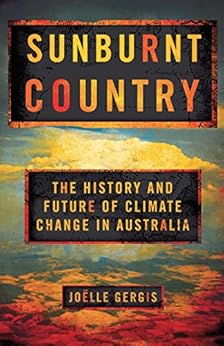
Greetings from the Australian National University, where the Climate Change Institute is hosting a talk by Dr Joëlle Gergis on her book "Sunburnt Country: The History and Future of Climate Change in Australia" (April 2, 2018). This started with an excerpt from Dorothea Mackellar's poem My Country: "I love a sunburnt country ...". Then some historical climate records about great droughts and floods were discussed. The story then went back further to natural records in tree rings and coral growth. Worryingly, the records show that Australia has been subject to extreme heat, drought in the past and this will become more extreme due to global warming. Dr Gergis' book is both scholarly and entertaining, even if makes for uncomfortable reading. If you want to read the raw science, which is still readable,  Dr Gergis' thesis is available on-line.

Reference


Gergis, J. L. (2006). Reconstructing El Nino-southern Oscillation: Evidence from Tree-ring, Coral, Ice and Documentary Palaeoarchives, AD 1525-2002 (Doctoral dissertation, University of New South Wales). URL http://unsworks.unsw.edu.au/fapi/datastream/unsworks:943/SOURCE01?view=true
ps: One point I don't agree with Dr Gergis on is that global warming is the biggest intergenerational challenge ever faced. I spent my childhood expecting to die in a nuclear war. That risk is now again increasing and it is a challenge which is yet to be faced. Ironically such a war would solve global warming, by causing a nuclear winter.

Tuesday, June 20, 2017

Finkel Review Explained?

Greeting from the Australian National University (ANU) in Canberra, where I am one of the packed lecture theatre, to heard a panel of experts have promised to explain the Explain the Finkel Review of of the National Electricity Market. This is hosted by the 
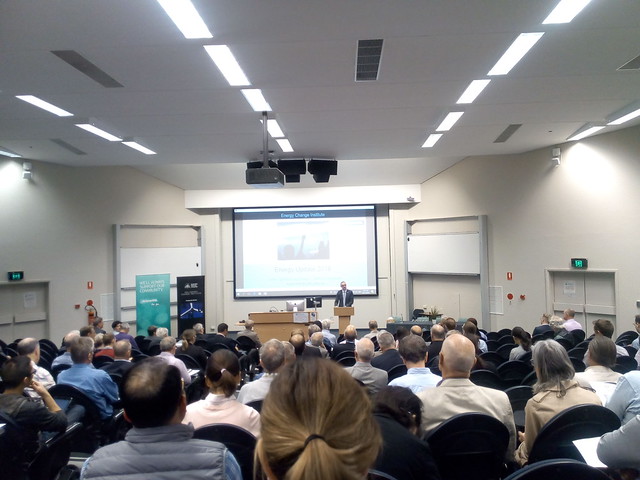
ANU Energy Change Institute. I am a member, but my expertise is confined to ICT and energy use.  From a quick reading of the report, I was not impressed. Previously, Dr Evan Franklin, Senior Lecturer, ANU Research School of Engineering, an excellent seminar "Electrical power systems with high penetration of renewables: the physics behind the political bluster".

The chair,  Professor Ken Baldwin, Director, ANU Energy Change Institute, presented the "energy trilemma": environment, security of supply and affordability. The problem is to maintain supply and contain costs, while also reducing carbon emissions, which Ken characterized as a "wicked problem" and Australia was "leading the OECD pack from the rear" on emissions. He gave a quick overview of the differences of Finkel's proposal, a Clean Energy Target, compared to Australia's previous scheme and no scheme at all. He then summarized the proposal for a mandated Generator Reliability Obligation. However, to me the central problem is not the engineering and economics, but the politics of the issue. As Ken points out Australia is in the current difficult situation due to a lack of planning. The question, I suggest, is if politics will allow this planning to happen.

Ken proposed a "Expert Foresighting Group", this sounded to me a little too much like the fictional "Nation Building Authority" in the TV comedy "Utopia". What are needed is a much smaller group of experts who are able to give government quick, politically feasible options quickly. University academics are used to having weeks, months or years to come up with a "quick" answer, whereas the political process needs answers in seconds, minutes or, at worst, "Action This Day".

Next to speak:
  1. Professor Quentin Grafton, ANU: Questioned the reliability of
  2. Honorary Associate Professor Hugh Saddler, ANU: Pointed out that land clearing changes have made dramatic reductions to emissions. Apart from that he pointed out that electricity generation is one of the few areas where reductions can be made.Also he pointed out that rooftop home solar generation is not regarded as part of the national generating system. Most interestingly, Professor Saddler suggested that state targets could result in a much larger reduction in emissions than the Finkle proposals. It may be that the policy log-jam at the federal level is irrelevant.
  3. Dr Matt Stocks, ANU: Dr Stocks stated up front he assumed the future was photovoltaics, which need storage and a network. He asserted that Australia does not have a robust national network, rather a series of state networks joined together, in a line, which increases the cost of electricity. Dr Stocks pointed out that renewable supplies generally do not provide the "inertia" which coal, gas and hydro provides. Curiously, rather than suggest that this could be provided by upgrading existing conventional generators, or creating new rotating inertia sources, he suggested batteries would be used. A battery will provide power for days, not the fractions of a second inertia will. The high tech equivalent is not a battery but a super-capacitor. Battery technology is being driven (pun intended) by the automotive industry. However, some vehicles, such as the Mazda 6 use a super-capacitor for fast, short term energy storage.
  4. Mr Dan Harding, ACT Government: Pointed out that many of the Finkle report recommendations have been included in previous expert reports, but it packages these all together into a coherent whole.
  5. Dr Nathan Steggel, Windlab: Suggested that the Finkel report overestimated the cost of wind generation. He suggested that market alternatives to a Generator Reliability Obligation should be investigated. 
Overall the panel was positive on the Finkel report recommendations. 

Thursday, April 14, 2016

We'll Always Have Paris? Banks and Climate Change

Greetings from the Australian National University in Canberra, where Dr Megan Bowman from King’s College London is speaking on "What does the Paris Agreement mean for private finance actors in the global response to climate change?".

Dr Bowman pointed out that the Paris Agreement on climate change has provision for non-nation state actors, which can be cities, regions and companies.

One difficulty I have is that the Paris agreement does not contain sufficient actions to achieve the stated aim of a 2 degree increase in temperature. Even these commitments by nation states are not binding, in that there is no penalty for not achieving what they promised. The money to help developing nations are also not committed. The money from the private sector is not firm.

As Dr Bowman pointed out probate companies will act on climate change when it is in their own self interest, in particular banks, insurance companies and pension funds. However, I suggest that nation states will also only act in their own interest.  So a better approach would be to craft an international agreement where it is in the interest of each individual party to act.

As an example, rather than developed nations "give" money to developing nations, it should be recognized that these are investments which the developed nations expect to receive a return on. It would be better if this self interest was explicitly recognized, rather than being hidden, as it is at present. This approach might use some aspects of Islamic banking: rather than giving a soft loan to a developing nation, the developed nation would be come a partner in the investment.

The question then is how to get nation states to act in the public interest, or in the case of companies, to act in the long term interests of their owners, not in the interests of the politicians and managers in power for a brief time. Given that the Panama Papers show government officials funneling funds to offshore accounts and companies acting dishonestly in the short term, it is difficult to see how any world order can make them act ethically in the long term. Unless there is something like a carbon market, which converts public interest into individual private interest, it is difficult to see how there could be changed.