Showing posts with label Energy & Disaster Solutions. Show all posts

Tuesday, August 6, 2024

Killing Bushfires with Drones

Associate Professor Roslyn Prinsley,
Head of Disaster Solutions,
ANU Institute for Climate,
Energy & Disaster Solutions
Associate Professor Roslyn Prinsley, Head of Disaster Solutions, ANU Institute for Climate, Energy & Disaster Solutions is taking about ways to prevent natural disasters. One of these being worked on at the Australian National University is to detect lightening strikes, resulting bushfires and quickly targeting them from the air with drones. This is a very challenging application as bushfires can start in large areas of Australia, and there can be thousands of lightning strikes which can potentially start a fire. Such a system can't simply water bomb every potential fire. This was at the ANU Disaster Solutions Update 2024.  The event is available live online.

The approach Professor Prinsley outlined was for small spot fires to be detected by UAVs and targeted with water dropped by steered parachutes. Such as system would be similar to those needed to defend Australia. Such a system has to scan large areas, decide what is a potential target deploy assets & assess results. Recent conflicts have shown it is no longer feasible to do this with crewed systems & human decision making. There are too many potential targets to be serviced & too much happening too quickly.


Minister says we are still putting homes in harm's way

The Hon Stephen Jones MP,
Assistant Treasurer and Minister
for Financial Services

Greetings from the ANU Disaster Solutions Update 2024, with Stephen Jones, Minister for Financial Services giving the keynote at the Australian National University's Institute for Climate, Energy & Disaster Solutions. He pointed out that in the past government have not done a good job, for example building low cost housing in areas which flood: "Its the fact that we are still putting homes in harm's way" , "We have to stop doing dumb things." He then went on to point out the importance of insurance, not only in paying out, but also influencing what gets built where. He went on to discuss what measures government needs to take to reduce the risk, encouraging people to put in place mitigation measures, as well as action by government.

The event is available live online

Wednesday, September 13, 2023

Virtualize the Consumer Economy to Save the World?

Professor Sharon Friel
Professor Sharon Friel, chair of the  "climate change, social equity and health symposium at the ANU argues that consumption by the rich has to be reduced to combat global warming. The Professor suggests that social movements can accomplish this. However, asking rich powerful people to give up what they have has not proved successful so far. I suggest a better approach would be to redefine success and wealth. 

The Internet provides a way to virtualize wealth, decoupling it from material goods. As an example, art has very little physical substance, as does money. Marketers can label the same physical goods so they have more value for some people. We can make the wealthy continue to feel wealthy without having so much "stuff". That should make them feel better, and save the planet.

In a series of talks around the region I pointed out how this is routinely done in the automotive industry, selling versions of essentially the same car as a budget and luxury product. This can also be done in education with the same degree offered online in a low cost, low carbon emissions version, and on campus for those who can afford it. Those willing to pay for the on-campus experience will feel better about it, but receive the same learning as the online student. 

Climate change, social equity and health symposium now online

Paul Girrawah House, welcome to country,
Greetings from the "Extinction thwarted? The nexus between climate change, social equity and health" symposium at the ANU Research School of Physics theatre in Canberra. There is still time to join in free online. The symposium explores the interaction between climate change, social inequality, and disease. How do we fix that? One aspect was suggested Paul Girrawah House in his welcome to country, by learning from indigenous knowledge as part of Voice , Treaty and Truth. This was followed by the ANU Vice Chancellor, Brian Schmidt, pointing out the value of person to person learning. 
ANU Vice Chancellor, Brian Schmidt 

Tuesday, May 9, 2023

Social infrastructure stronger than concrete

Daniel Aldrich
Greetings from the ANU College of Asia and the Pacific, where Daniel Aldrich is speaking on "Modest but critical: how we overlook social infrastructure at our peril". He argues that facilities like parks, churches, and libraries make communities more resilient when there is a disaster, to such extent that they reduce deaths due to a disaster more than hard infrastructure, such as sea walls. I asked about online social infrastructure and Dr Aldrich suggested that hybrid was best, combining physical infrastructure and online. 

It occurs to me that hybrid also makes public funding easier. It will be much easier to convince a politician to spend money on online forums, if they are associated with a building they can open. However, this may require new skills, and tools of those managing the infrastructure. As an example, public libraries host events, but these are purely physical. Similarly the act of going in to borrow a paper book is social, in that you might bump into someone. However, if you borrow an e-book, or audio book, online, it is just you and the computer. It would not be difficult to add some social aspect online, given you know what books people are interested in. However, libraries tend to use off the shelf electronic borrowing systems without a social aspect.
In answer to another question, Dr Aldrich speculated that there might be social spaces where leaders congregate. There are, and occasionally I stumble into them. One is the green room at a conference, and another is the cafe at Parliament house Canberra. There are a plethora of such places for different groups, such as the Bangalore Club (which I stayed at recently),  and affiliated institutions.

Monday, May 23, 2022

Global Energy Transition Accelerated by Ukraine Situation?

Professor Jotzo,  Ambassadors Pulch,
& Myroshnychenko, at ANU 
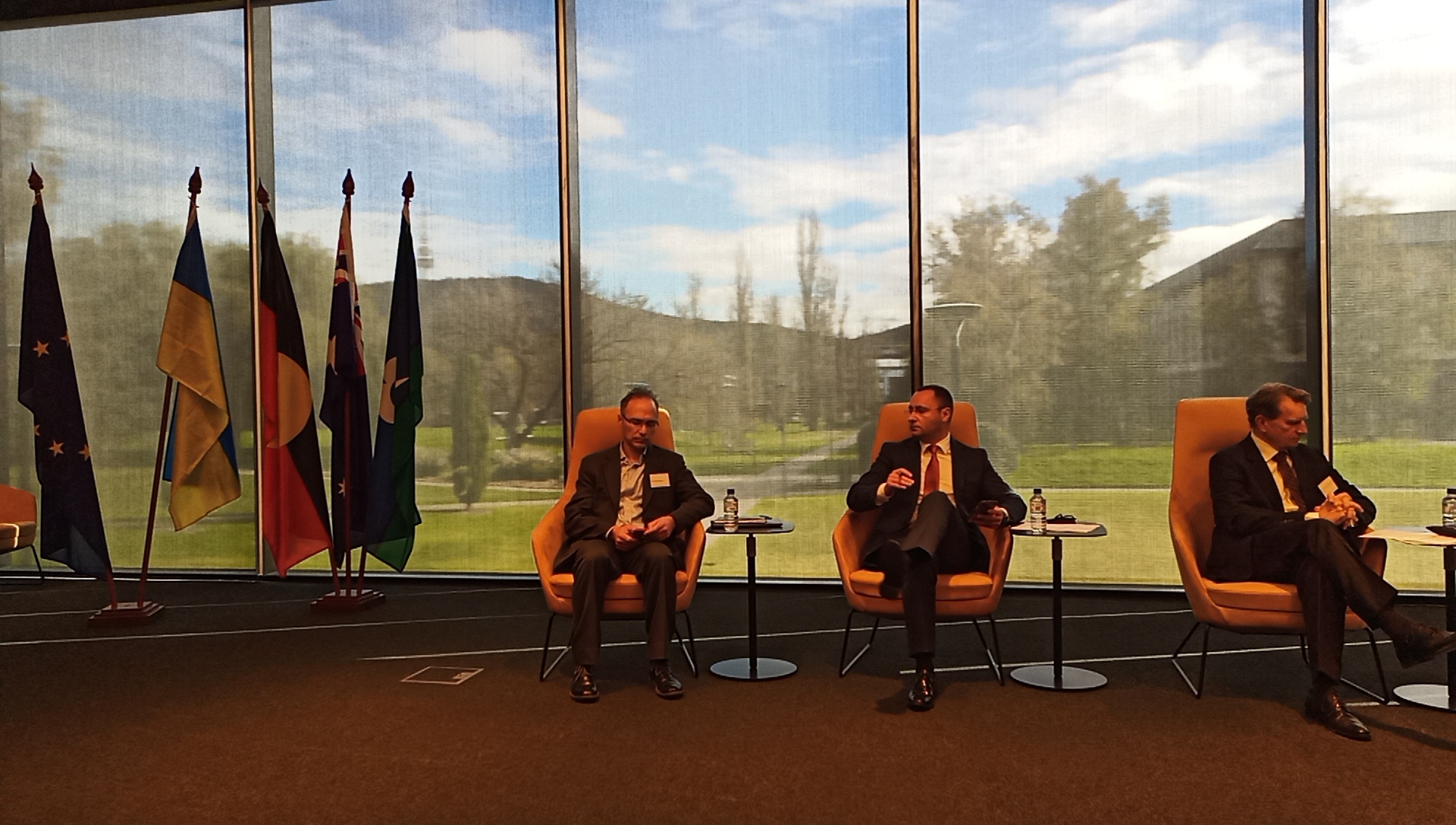
Greetings from the Australian National University in Canberra, where Dr Michael Pulch (European Union), and Vasyl Myroshnychenko (Ukraine),  Ambassadors to Australia, are speaking along with the ANU's own Professor Frank Jotzo on the energy implications of the situation in the Ukraine. The obvious solution is more use of renewable energy, but that is not easy, or cheap to do, especially quickly. The event is in a theater of the ANU Research School of Social Sciences, with a wonderful view of the Campus and Black Mountain. 

The EU Ambassador pointed that imported gas dependence had increased in the last few years, due to declining local extraction, and conversion from other fuels. Also they noted the spread of dependency was uneven across the EU. The Union this year decided to phase out dependency on imported gas, however that sound to me like the Captain of the Titanic deciding to buy more lifeboats, but only after seeing the iceberg. The Ambassador did note there are some short term moves possible, to increase gas imports other than from Russia, having more storage, and more use of coal. In the longer term the Ambassador said they were looking to follow Australia's example promoting rooftop solar. But they noted options would not be simple or cheap.

The Ambassador said they did not expect significant LNG exports from Australia, but Australia could increase experts to other regions, thus freeing up supplies for Europe. The Ambassador did not mention longer term opportunities for Europe to buy renewable energy from Australia, in the form of synthetic fuels, or Australian technology to reduce energy use.

The Ukrainian Ambassador noted Russian "weaponizartion" of energy policy. They argued previous German policy on gas from Russia propped up the Soviet Union. They referred to the "Schröderization" of energy,  German politician, Gerhard Schröder, advocating the Nord Stream pipeline, then after retirement taking up a board position. The Ambassador advocated phasing out Russian gas in Europe, facing up to the shock. They said Ukraine will buy more Australian coal and uranium. These will be unpalatable messages for European and Australian governments. Quickly phasing out Russian gas will have a local political cost, as would the new Australian government, which may dependent on cross benches, supporting coal and uranium. The Ambassador also may a very technical point that Australian LNG has a different composition, and so EU industry may need to make changes to use it for chemical production (simply burning it is less of a problem). 

Professor Jotzo pointed out that the Ukraine situation can lead to increased use of renewable energy in the long term, as well as energy trade within political blocks. However, there will be more investment in fossil fuels in the short term. What they did not mention was the potential for changes in behavior to reduce energy use. As an example of what can be done where needed, was the shift to online work and study during COVID-19. This was something many thought impossible, until their life, and livelihood, depended on changing behavior. 

National governments are understandably anxious to return to "normal" after pandemic restrictions. However, where "normal" involves the use of fossil fuel for travel, which could be eliminated with online work and study, government could productively work on a new normal. In my course "ICT Sustainability" (currently offered online from Canada)I invited students to consider how such changes could reduce emissions. So I asked the panel about this. Professor Jotzo suggested the energy savings from telecommuting would be marginal. ,  Ambassador Pulch pointed out the many small savings which could be made would add up. Ambassador Myroshnychenko pointed out that working from home has energy costs, may lower the quality of work decisions, and quality of life. He pointed out people were very keen to travel after the pandemic.