 |
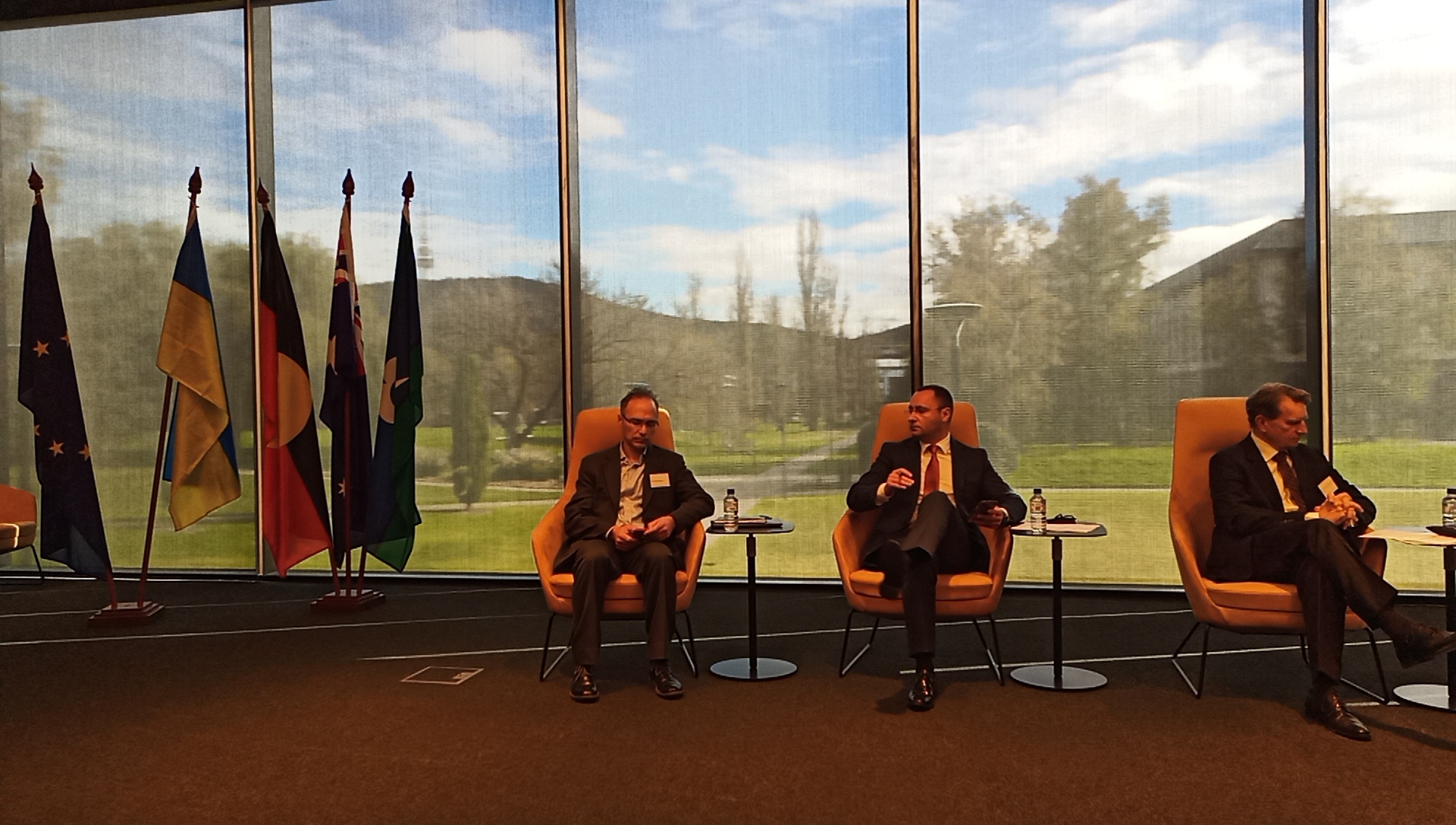
Professor Jotzo, Ambassadors Pulch,
& Myroshnychenko, at ANU |
Greetings from the Australian National University in Canberra, where Dr Michael Pulch (European Union), and Vasyl Myroshnychenko (Ukraine), Ambassadors to Australia, are speaking along with the ANU's own Professor Frank Jotzo on the
energy implications of the situation in the Ukraine. The obvious solution is more use of renewable energy, but that is not easy, or cheap to do, especially quickly. The event is in a theater of the ANU Research School of Social Sciences, with a wonderful view of the Campus and Black Mountain.
The EU Ambassador pointed that imported gas dependence had increased in the last few years, due to declining local extraction, and conversion from other fuels. Also they noted the spread of dependency was uneven across the EU. The Union this year decided to phase out dependency on imported gas, however that sound to me like the Captain of the Titanic deciding to buy more lifeboats, but only after seeing the iceberg. The Ambassador did note there are some short term moves possible, to increase gas imports other than from Russia, having more storage, and more use of coal. In the longer term the Ambassador said they were looking to follow Australia's example promoting rooftop solar. But they noted options would not be simple or cheap.
The Ambassador said they did not expect significant LNG exports from Australia, but Australia could increase experts to other regions, thus freeing up supplies for Europe. The Ambassador did not mention longer term opportunities for Europe to buy renewable energy from Australia, in the form of synthetic fuels, or Australian technology to reduce energy use.
The Ukrainian Ambassador noted Russian "weaponizartion" of energy policy. They argued previous German policy on gas from Russia propped up the Soviet Union. They referred to the "Schröderization" of energy, German politician, Gerhard Schröder, advocating the Nord Stream pipeline, then after retirement taking up a board position. The Ambassador advocated phasing out Russian gas in Europe, facing up to the shock. They said Ukraine will buy more Australian coal and uranium. These will be unpalatable messages for European and Australian governments. Quickly phasing out Russian gas will have a local political cost, as would the new Australian government, which may dependent on cross benches, supporting coal and uranium. The Ambassador also may a very technical point that Australian LNG has a different composition, and so EU industry may need to make changes to use it for chemical production (simply burning it is less of a problem).
Professor Jotzo pointed out that the Ukraine situation can lead to increased use of renewable energy in the long term, as well as energy trade within political blocks. However, there will be more investment in fossil fuels in the short term. What they did not mention was the potential for changes in behavior to reduce energy use. As an example of what can be done where needed, was the shift to online work and study during COVID-19. This was something many thought impossible, until their life, and livelihood, depended on changing behavior.
National governments are understandably anxious to return to "normal" after pandemic restrictions. However, where "normal" involves the use of fossil fuel for travel, which could be eliminated with online work and study, government could productively work on a new normal. In my course "ICT Sustainability" (currently offered online from Canada)I invited students to consider how such changes could reduce emissions. So I asked the panel about this. Professor Jotzo suggested the energy savings from telecommuting would be marginal. , Ambassador Pulch pointed out the many small savings which could be made would add up. Ambassador Myroshnychenko pointed out that working from home has energy costs, may lower the quality of work decisions, and quality of life. He pointed out people were very keen to travel after the pandemic.