A couple of weeks ago, Sara Custer, Digital editor of Times Higher Education asked if I would write some comment pieces for their blog, or re-posts from my blog. She suggested my posts on the Ramsey Center for Western Civilization, digital technology for partition rooms, or
dispersal of international students across Australia as candidates. I nominated my Ramsey Center post. Today I realized I heard nothing more, so went to look at the THE Blog, where I found: "Can a degree in Western civilisation prepare students for 21st century jobs?", January 16, 2019.
The post elicited some comments (I am surprised there were not more). One comment suggested that India was ruled by classically-trained Oxford graduates. Leaving aside the question as to if they governed well, not all rulers of India were classically educated in Oxford. The last Viceroy of India, Louis Mountbatten, attended naval college, was a Senior Wireless Instructor at the Naval Signals School, and a member of Institution of Electrical Engineers. He did also study English literature at Christ's College Cambridge, but only for two terms. Not all India's colonial rulers had this level of technical training, but they were backed by people who did, and could use advanced technology to suppress rebellion.
A second comment suggested that a degree should teach how to learn and think critically. I agree, but that does not preclude also teaching skills, and knowledge useful in a specific vocation. Many people have had successful careers outside the area they were trained in, but I would prefer they were trained for some sort of career, rather than none at all.
Showing posts with label University of Wollongong. Show all posts
Showing posts with label University of Wollongong. Show all posts
Tuesday, January 22, 2019

Monday, December 17, 2018
Ramsay Centre Curriculum in Western Civilisation to be Used at University of Wollongong
 |
| Ramsay Centre Signing |
Arts is not my area of expertise, but I was curious as to what a degree in "Western Civilization" would involve, and what career this would equip the graduate for. The center helpfully provides an Indicative Curriculum for a BA Western Civilization, described as a "... integrated degree programs focused on seminal texts of the Western tradition".
The educational technique mandated by the Ramsay Centre is groups of 6 to 8 students, instructed face-to-face. However, this format is unlikely to provide the most effective student learning. This will also prevent students who can't get to the campus often, or at all, from studying, and also severely limit the number of students who can study. While the Ramsay Centre is covering the cost of the tuition, there is still an opportunity cost for the student, who will be unable to progress as well as they could have otherwise. The Center might consider allowing blended, and online form of tuition, which would allow many more students, and a diverse range of students, to study.
The Center provides a brief explanation of how such an education could be useful. This asserts that entry and mid-level jobs will be replaced by automation, and the remaining workers will need continual on-the-job training. As a result, the Center suggests businesses will need interdisciplinary "innovators" with good communication skills.
While I agree that graduates will need good interdisciplinary, communication and innovation skills, it does not follow that this can be best obtained (or obtained at all), from a study of the history of Western literature and music. Also, I suggest the automation of entry-level technical and professional jobs is not a reason for abandoning technical education, but for more advanced technical education.
This is not to say BAs have no place in the 21st century. As the Center points out, their curriculum leaves room for other studies. UoW already offers BA majors in vocationally relevant areas, which would help make up for the limitations in the Center's curriculum, and teaching technique.
There may be some students who have an interest in western literature and music, who would welcome this curriculum. However, those students should be cautioned that, on its own, the Center's curriculum will result in very limited career prospects, and not make them much more employable in the 21st Century than a high school graduate. Recent high school graduates, who studied the Australian Digital Technologies Curriculum, will be better qualified for today's jobs, than through the Center's curriculum.
Our community needs a few specialists in the great books, but very few, who will become academics and teachers. The majority of students, should instead enroll in a program which leads to a career outside academia. They should, of course, balance their technical education, with some broad cultural knowledge, communication, and team skills. Students may also undertake studies in innovation, and I suggest should learn how to undertake lifelong learning. However, this can be accommodated within a professional degree.
 |
| Globe of the ancient world, Istanbul |
Taking an example from the Center's curriculum, learning how ancient Athenian democracy worked can inform today's debates on democracy. However, this will not protect a modern democracy from attacks conducted via social media. Such attacks are being mounted by scientists and engineers with advanced technical skills employed by nation-states. Someone with the Ramsay Center's education would be as useful defending western civilization in the 21st century, as a classical education was to military officers of the early 20th century on horseback facing a mechanized army.
Friday, December 7, 2018
Tales from TALE 2018
On my way home from speaking at the IEEE 7th International Conference on Teaching, Assessment, and Learning for Engineering (TALE 2108) in Wollongong, so time to reflect. Some surprises were that chat-bots could be useful in education, and China is preparing to scale up its international university education offerings (placing Australia's third largest export industry at risk). One disappointment was that while the leading educators could detail what needed to be done to improve the quality of university teaching, none could offer a strategy to ensure this was actually done.
I did not have high hopes for this conference. I decided to submit a paper because the conference I would usually attend was in a country I did not want to visit. TALE was two hours drive away, and was an IEEE event, so that was enough for me. Early in the year I started the grueling process of preparing a paper.
Come submission time I volunteered to also review. That turned out to be an unexpected pleasure, the management system worked well and the papers were of good quality. It was hard to find what to reject, and I worried my paper would never get accepted, with this competition. However, my paper was accepted, with lots of changes being required.
The last major frustration was the formatting, where there was something being rejected by the IEEE system, but no one could tell me exactly what. However, after many attempts, and days of work, laboriously reformatting the paper with different tools (and introducing new errors along the way), it was finally okay.
Keynote speaker Dr Bror Saxberg of the Chan Zuckerberg Initiative made the case for the engineering of education at the opening.
Dr Saxberg's argument seems to be we need to teach students in ways
which have been found to be effective. That may sound
self-evident, but as he pointed out, with numerous examples, formal
education is not necessarily using techniques show to be effective, and
in some cases shown to not work.
However, the problem I have found, is that just telling someone what
works for education does not get them to do it, we need to also have people actually do things,
to learn how to do them.
Dr Saxberg did not provide any policy strategies to have academics learn to teach.
 Professor Gregor Kennedy's keynote the next day was on "Learning Engineering: The Art of Applying Learning Science at Scale".
He did not seem happy with the term “learning engineering”, coined by
Herb Simon in the 1960's for the systematic design of learning, based on
research. But I suspect there were only a handful of people in the room
who had ever heard of the term (Dr Saxberg was obviously one), so why mention it at all? Professor Kennedy seemed to want evidence based teaching, but like Dr Saxberg did not seem to have any strategies to make this happen.
Professor Gregor Kennedy's keynote the next day was on "Learning Engineering: The Art of Applying Learning Science at Scale".
He did not seem happy with the term “learning engineering”, coined by
Herb Simon in the 1960's for the systematic design of learning, based on
research. But I suspect there were only a handful of people in the room
who had ever heard of the term (Dr Saxberg was obviously one), so why mention it at all? Professor Kennedy seemed to want evidence based teaching, but like Dr Saxberg did not seem to have any strategies to make this happen.
Later in the day Rebecca Shields (Central Queensland University) discussed the results of research on the "21st Century Skills" of Australian school students entering university. Rebecca suggested pre-teaching of students entering university, and in the longer term changes to school teacher training and education policy. Her proposed solution's would help answer Professor Kennedy's call for more systematic application of learning science.
Staff of the University of the South Pacific
(UPS) discussed "Smart Learning in the Pacific: Design of New
Pedagogical Tools". USP is multi-national, with students who have studied under different school systems. They have an "early warning system" which extracts data from their Moodle Learning Management System to indicate which students are struggling. This was useful actionable advice.
 Arjun Singh, Co-Founder & CEO of Gradescope talked on grading of large numbers of STEM exam papers. This product, recently acquired by TurnItIn, allows student exam papers to be scanned in, and then marked online by an examiner, using a rubric. The product was demonstrated for
engineering and computer science examinations, including for computer
code.
Arjun Singh, Co-Founder & CEO of Gradescope talked on grading of large numbers of STEM exam papers. This product, recently acquired by TurnItIn, allows student exam papers to be scanned in, and then marked online by an examiner, using a rubric. The product was demonstrated for
engineering and computer science examinations, including for computer
code.
 My own paper was near the end of the conference: "Blended Learning for the Indo-Pacific". This proposal has been entered in the the Solomon Islands Technology for Development Challenge to provide Micro-credentials by Mobile Phone for the Solomon Islands.
Worthington, Tom. (in press). Blended Learning for the Indo-Pacific. In Teaching, Assessment, and Learning for Engineering (TALE), 2018 IEEE 7th International Conference on. IEEE. url http://hdl.handle.net/1885/148733
My own paper was near the end of the conference: "Blended Learning for the Indo-Pacific". This proposal has been entered in the the Solomon Islands Technology for Development Challenge to provide Micro-credentials by Mobile Phone for the Solomon Islands.
Worthington, Tom. (in press). Blended Learning for the Indo-Pacific. In Teaching, Assessment, and Learning for Engineering (TALE), 2018 IEEE 7th International Conference on. IEEE. url http://hdl.handle.net/1885/148733
Why TALE?
I did not have high hopes for this conference. I decided to submit a paper because the conference I would usually attend was in a country I did not want to visit. TALE was two hours drive away, and was an IEEE event, so that was enough for me. Early in the year I started the grueling process of preparing a paper.
Come submission time I volunteered to also review. That turned out to be an unexpected pleasure, the management system worked well and the papers were of good quality. It was hard to find what to reject, and I worried my paper would never get accepted, with this competition. However, my paper was accepted, with lots of changes being required.
The last major frustration was the formatting, where there was something being rejected by the IEEE system, but no one could tell me exactly what. However, after many attempts, and days of work, laboriously reformatting the paper with different tools (and introducing new errors along the way), it was finally okay.
The Venue
An international conference from Australia usually involves a flight of at least half a day. So it was a strange feeling to just get in my car and drive an hour and a half to Wollongong. This is a beach-side city and the venue,was right on the beach.Workshop Chatbot Tutors for Blended Learning
The workshops were held at University of Wollongong, a short free shuttle bus ride from the city. I chose "Chatbot Tutors for Blended Learning" by Chi-Un Lei, Yuqian Chai, Xiangyu Hou, and Vincent Tam from TELI at University of Hong Kong. I had in mind using this for routine questions from students. The workshop is using the free version of the IBM Watson tool. In a few hours I was able to produce a credible Q&A. The process with the chatbot doesn't look any
more time consuming that a quiz, with the AI system providing
flexibility. What seems to be missing from this process is the intelligence to create
the answers. For example, I would like to just give the system the
rules for the course assessment and have it work out the possible
questions and answers.
The Engineering of Learning
Learning Engineering
Later in the day Rebecca Shields (Central Queensland University) discussed the results of research on the "21st Century Skills" of Australian school students entering university. Rebecca suggested pre-teaching of students entering university, and in the longer term changes to school teacher training and education policy. Her proposed solution's would help answer Professor Kennedy's call for more systematic application of learning science.
Smart Learning at the University of the South Pacific
Pedagogical Tools". USP is multi-national, with students who have studied under different school systems. They have an "early warning system" which extracts data from their Moodle Learning Management System to indicate which students are struggling. This was useful actionable advice.
Globalization of Chinese Education
Liang Zhao
from Shenyang Aerospace University was talked on "How We Face
Globalization of Chinese Education". International students in China are instructed in
English, even though this is not the first language of the instructors or the students. Australian universities will need to re-think their offerings, if China solves this problem, and takes most of the international student market in our region.
Arjun Singh on Gradescope
Arjun Singh, Co-Founder & CEO of Gradescope talked on grading of large numbers of STEM exam papers. This product, recently acquired by TurnItIn, allows student exam papers to be scanned in, and then marked online by an examiner, using a rubric. The product was demonstrated for
engineering and computer science examinations, including for computer
code.Blended Learning for the Indo-Pacific
My own paper was near the end of the conference: "Blended Learning for the Indo-Pacific". This proposal has been entered in the the Solomon Islands Technology for Development Challenge to provide Micro-credentials by Mobile Phone for the Solomon Islands. Reference
Thursday, December 6, 2018
Smart Learning at the University of the South Pacific
Greetings from the the IEEE 7th International Conference on Teaching, Assessment, and Learning for Engineering (TALE) in Wollongong where staff of the University of the South Pacific (UPS) are discussing "Smart Learning in the Pacific: Design of New
Pedagogical Tools". USP is multi-nationals with students who have studied under different school systems. They have ab "early warning system" which extracts data from their Moodle Learning Management System to indicate which students are struggling. They also use Big Blue Button (BBB), for synchronous webinars. Students are tested online for English skills and those who don't score well are automatically signed up of a support course.
Challenges at USP include limited bandwidth to some Pacific countries (something being addressed by the Australian Government funded fibre optic cable to the Solomon Islands). A major focus of USP is teacher training. I will be speaking on "Blended Learning for the Indo-Pacific" later in the conference.
Pedagogical Tools". USP is multi-nationals with students who have studied under different school systems. They have ab "early warning system" which extracts data from their Moodle Learning Management System to indicate which students are struggling. They also use Big Blue Button (BBB), for synchronous webinars. Students are tested online for English skills and those who don't score well are automatically signed up of a support course.
Challenges at USP include limited bandwidth to some Pacific countries (something being addressed by the Australian Government funded fibre optic cable to the Solomon Islands). A major focus of USP is teacher training. I will be speaking on "Blended Learning for the Indo-Pacific" later in the conference.
"Smart learning ecosystems leverage on state-of-the-art tools and technologies to help students learn better with Information Communication Technologies (ICT). The ubiquity, innovations and advancements of ICT have transformed pedagogies and approaches to content facilitation and delivery in higher education worldwide, the Pacific region being no exception. The paper essays a number of learning and support tools designed in-house or adopted (or outsourced) recently by a higher education institution in the Pacific contributing to the smart learning ecosystem. The institution has integrated these ICT driven tools to its academic and support programmes, and more recently the in-country science programmes introduced in its member countries. The strengths and challenges from the implementation of these new adaptive tools are highlighted with recommendations to the wider academic populace."
Tuesday, December 4, 2018
The Engineering of Learning
Dr Saxberg's argument seems to be essentially the same as that for education based on research. That is, we need to teach students in ways which have been found to be effective. That may sound self-evident, but as he pointed out, with numerous examples, formal education is not necessarily using techniques show to be effective, and in some cases shown to not work. Dr Saxberg's described Maslow's hierarchy of needs, as like Aristotelian physics, in that it was not based on experimental research.
However, the problem I have found, is that just telling someone what works for education does not get them to do it. I even have difficulty convincing myself to do teaching differently, let alone others. Dr Saxberg might argue this requires putting the new techniques into long term memory. However, I suggest we need to also have people actually do things, to learn how to do them. It was only after I had used educational techniques, as a student of education, I was confident I could use them as a teacher.
Dr Saxberg pointed out that research shows learning requires persistence, through motivation. He said "you don't have to like it, you just have to do it". I suggest top-down educational design can help with this. As an example, I am designing a module to help STEM students reflect on learning. The first step is to align the learning objectives with external professional job requirements.
Chatbot Tutors for Blended Learning
Greetings from the University of Wollongong where I am taking part in a workshop on "Chatbot Tutors for Blended Learning" by Chi-Un Lei, Yuqian Chai, Xiangyu Hou, and Vincent Tam from TELI at University of Hong Kong. This is part of the IEEE 7th International Conference on Teaching, Assessment, and Learning for Engineering (TALE).
I had in mind using this for routine questions from students. I provide tutors with a list of standard answers, but perhaps these could be provided by a chatbot."Creating a pedagogical agent requires complex computer programming skills and it is usually built from scratch to fit the intended educational purpose. This makes it difficult for teachers to adapt existing systems or to attempt in creating a similar version. Recently, we have leveraged the IBM Watson Assistant chatbot engine to develop some chatbots. These chatbots have been adopted in a common core (general education) course for inquiry-based learning, with a promising outcome. In this workshop, we would like to share our experience gained from developing a set of chatbots for an online blended learning environment. Through the workshop, attendees will identify what and how chatbots can be designed for their own blended or fully online courses. They will also develop a simple chatbot system that can responses to some assessment inquiries."
The example given in the workshop is for training forensics scientists in crime scene analysis. The chatbot answers the easy questions and passes on the hard ones to the tutor.
The workshop is using the free version of the IBM Watson tool. A JSON file was provided for the workshop to upload to Watson.We were cautioned that there were "25 steps" to do this from scratch.We were simply asked to enter the "intent", which we have to be specific about (such as the second assignment deadline). Then the "Entities", such as a specific assignment the student is asking about. The "Dialog" would be the answer.
While the example in workshop was to answer simple logistics questions (is the exam open book?), the idea is to use this for teaching. A simple example might be, rather than say "No, the exam ins not open book", but to guide the student through where they find the answer. This might address teascher's frustrations where students don't read the material given.
The prepared chatbot is not very bright and very single-minded. It reminds me of the talky toaster in Red Dwarf, which was obsessed with toast. One trick shown to make the dialogue more interesting was simply random versions of the same responses.A dialogue is added with answers for the questions. One of the features of using Watson is that it has a dictionary and lists of synonyms. As an example with the Q&A I prepared was about "books", Watson correctly interpreted "document" as being a sort of book (it even understood "Bring Dongle?").
Next we added an "entity". These can be physical objects (the textbook for the course) or something more abstract.
This chatbot process reminds me of my first encounter with preparing a multiple choice online quiz. The process of setting up the questions and answers was very tedious. The reward only comes when you have many students using the system. The process with the chatbot doesn't look any more time consuming that a quiz, with the AI system providing flexibility.
What seems to be missing from this process is the intelligence to create the answers. For example, I would like to just give the system the rules for the course assessment and have it work out the possible questions and answers. As it is this form of AI seems to making the type of promises fourth generation programming language, did last century. Claims were made about programmers not being used, as it was easy for anyone to do. The reality was that it was easy for anyone to write a simple program, but it required a highly skilled expert for complex tasks. The result was a lot of time wasted by unskilled people writing bad code, and experts trying to untangle the resulting mess.
ps: The workshop was held in a UoW lab. This had about 32 desktop PCs in four long rows of eight. There is a large display screen near the instructor's console at one end and on the opposite end. However, it would be useful f there were screens on the other two walls. The room is carpeted, but was still a bit noisy, with multiple tutors helping students. Perhaps the ceilings should be sound absorbing in these type of rooms(at the cost f requiring a microphone for the presenter).
Thursday, November 1, 2018
Blended Learning for the Indo-Pacific
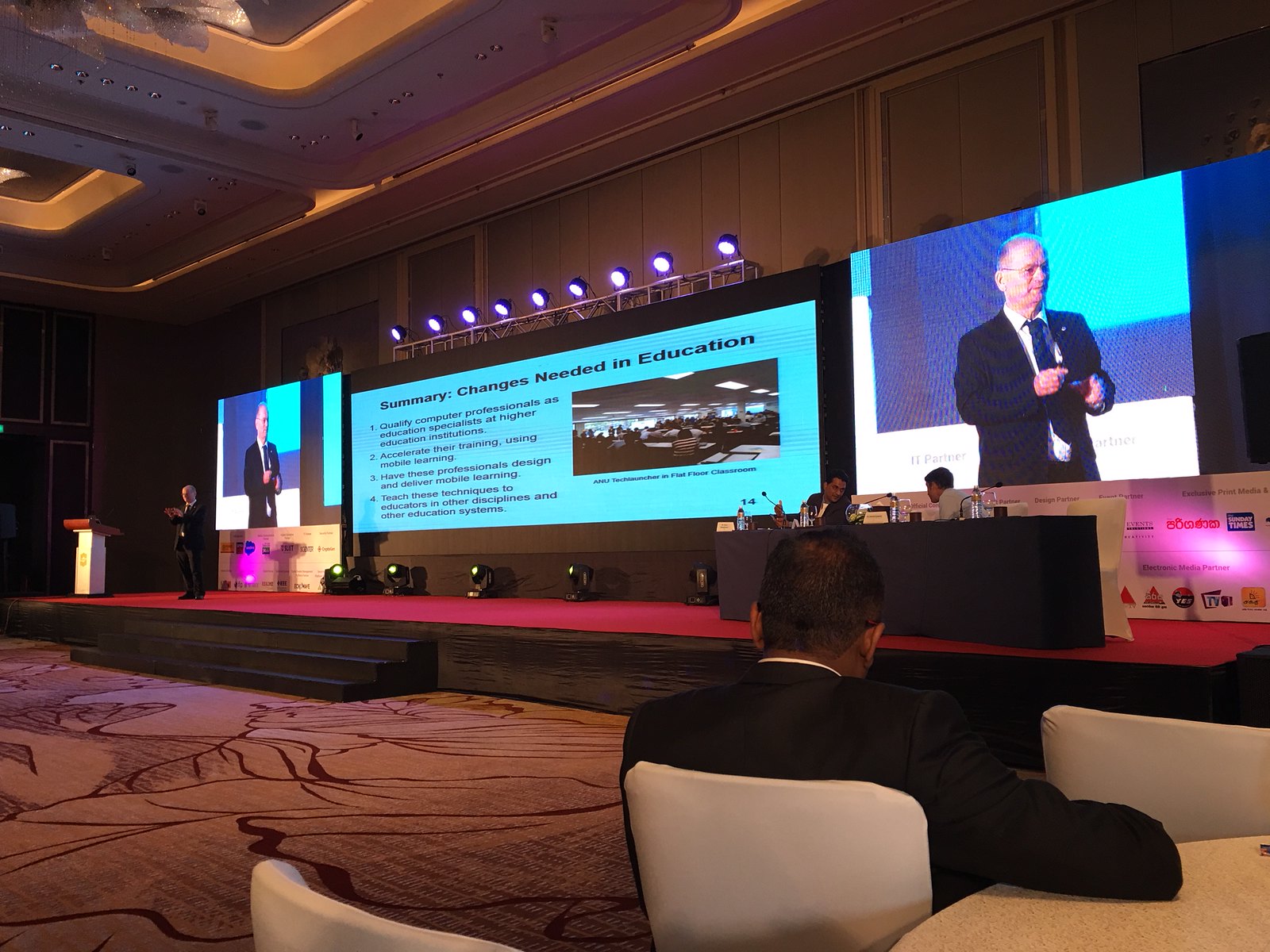 |
| Tom addressing the Computer Society of Sri Lanka |
A short paper to present on this has been accepted for TALE 2018, in Woolongong, 4-7 December 2018:
- Worthington, Tom. Blended Learning for the Indo-Pacific. In Teaching, Assessment, and Learning for Engineering (TALE), 2018 IEEE 7th International Conference on. IEEE. url https://doi.org/10.1109/TALE.2018.8615183
Thursday, October 19, 2017
The Best of EdTechPosium 2017 in Canberra

Day 1


13:45 Moving from Face-to-Face to e-learning. William Batten, Department of Defence
14:55 Simulations, Gamification and Creative Problem Solving. Sudantha Balage, UNSW Canberra
& Janene Harman, Australian National University
16:00 eLearning 101 — professional development for busy academics and technology-enhanced learning educators. James Nicholson, Australian Catholic University
Day 2
10:40 “Let’s See What Happens”: Introducing students to interactive online tutorials. Stephanie Kizimchuk, University of Canberra11:15 Four embeddings and a mural: OK2A — A course layout informed by Constructive Alignment delivering better blended learning. Roderick Huggett, Centre for
Defence and Strategic Studies
11:50 What have we GotS here? New ways for delivering Information Literacy at the University of Wollongong Library. Laura Lidden & Nick Zografos, University of Wollongong
Subscribe to:
Posts (Atom)