Showing posts with label Pacific. Show all posts

Monday, January 21, 2019

Education for the Indo-Pacific Does Not Need 5G Mobile Communications


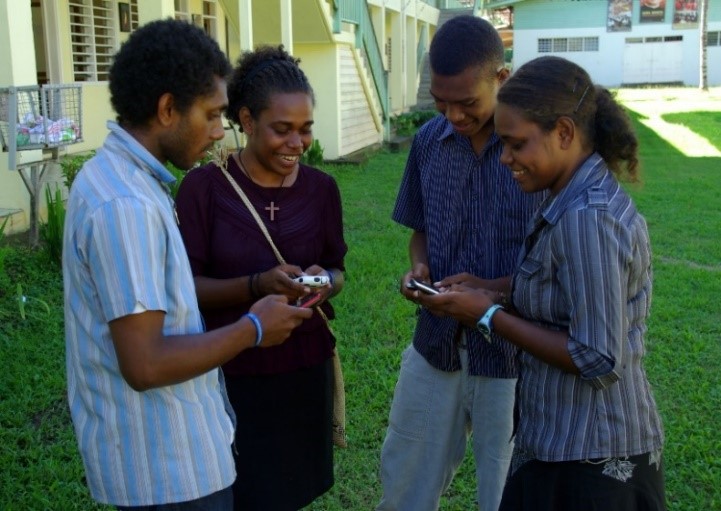
Exploring the mobile internet,
Solomon Islands,
Photo: Irene Scott/DFAT.
The short paper I presented on "Blended Learning for the Indo-Pacific" at the International Conference on Teaching, Assessment, and Learning for Engineering (TALE) in Wollongong last December, has been published by IEEE. One curious addition to the paper is the keyword "5G mobile communication". The paper discusses using smarphones for education, but I never mention fifth generation mobile networks, nor do I think these are really necessary.

A 3G or 4G network connection is more than enough for a student. A 3G network provides tens of megabits per second and 4G hundreds. This is sufficient for a student to watch videos, and upload their own, as well as take part in live video conferences. In practice students may have much more limited access, due to cost and logistics, so I design online courses where the student can download large materials infrequently, and then use a much slower connection for interaction.

An example of where this may be an issue is the Solomon Islands. The Australian Government is funding a fibre optic cable to the Solomon Islands and the Department of Foreign Affairs and Trade has asked for ideas how this could help young people with skills and education. I have submitted a proposal "Micro-credentials by Mobile Phone for the Solomon Islands", which is based on my TALE paper.

The problem in the Solomon Islands will be getting the data from the point where the fibre optic cable lands, to where the population is. It is likely the the capital, Honiara on Guadalcanal, will be connected, but not all of the other populated islands.

To address this issue I design online courses which do not require a high speed connection. The student can download all the materials required at the start of the course from a cyber cafe (or be sent a data file in the post). They then only need a slow connection to read announcements and participate in text based forums. Live interactive video is nice to have, but not at the cost of excluding many students. If a 2G GPRS connection is available, providing about 100 kbps, the student can take part in Webinars with audio and slides.

Where video and audio are not available, the course designer and instructor have to make sure that the student gets a sense of human connection, through the text based forums. This is not ideal, but can be made to work.

Paper

T. Worthington, "Blended Learning for the Indo-Pacific," 2018 IEEE International Conference on Teaching, Assessment, and Learning for Engineering (TALE), Wollongong, Australia, 2018, pp. 861-865. doi: 10.1109/TALE.2018.8615183 URL https://doi.org/10.1109/TALE.2018.8615183

Keywords: 5G mobile communication; Australia; Conferences; Education; training; employment; educational institutions; teaching; Australian educational system; assessment; cognitive learning theory; social learning theory; Indo-Pacific; blockchain; micro-credentials


Thursday, December 6, 2018

Blended Learning for the Indo-Pacific

Tom Worthington. Photo by Stuart Hay, ANU Senior Photographer, 2014Greetings from the the IEEE 7th International Conference on Teaching, Assessment, and Learning for Engineering (TALE) in Wollongong where I was speaking on "Blended Learning for the Indo-Pacific". This proposal has been entered in the the Solomon Islands Technology for Development Challenge to provide Micro-credentials by Mobile Phone for the Solomon Islands.
"Information technology disciplines make up a significant proportion of the degrees taken by international students at Australian universities. These programs are primarily delivered on-campus, but are increasingly using e-learning techniques and becoming, in effect, blended. This provides the opportunity to offer international students part of their program by distance education before, or instead of, traveling to Australia. This could complement the campus-based education provided and complement initiatives by China, Australia, Japan and the United States for regional development. However, Australian university academics have little background or training in e-learning and program designs have not made use of the flexibility this provides. In this paper, we discuss how computer professionals can be trained online to deliver online training to students of the Indo-Pacific. The application of learning theory to support distance learners is also discussed in this paper."
This followed papers from others at the conference on the globalization of Chinese education, Smart Learning at the University of the South Pacific and 21st Century Skills.

ps: TALE 2019 will be December 3-6,  in Yogyakarta, Indonesia. And, just announced, TALE 2020 will be in Takamatsu, Japan. 

Smart Learning at the University of the South Pacific

Greetings from the the IEEE 7th International Conference on Teaching, Assessment, and Learning for Engineering (TALE) in Wollongong where staff of the University of the South Pacific (UPS) are discussing "Smart Learning in the Pacific: Design of New
Pedagogical Tools". USP is multi-nationals with students who have studied under different school systems. They have ab "early warning system" which extracts data from their Moodle Learning Management System to indicate which students are struggling. They also use Big Blue Button (BBB), for synchronous webinars. Students are tested online for English skills and those who don't score well are automatically signed up of a support course.

Challenges at USP include limited bandwidth to some Pacific countries (something being addressed by the Australian Government funded fibre optic cable to the Solomon Islands). A major focus of USP is teacher training. I will be speaking on "Blended Learning for the Indo-Pacific" later in the conference.

"Smart learning ecosystems leverage on state-of-the-art tools and technologies to help students learn better with Information Communication Technologies (ICT). The ubiquity, innovations and advancements of ICT have transformed pedagogies and approaches to content facilitation and delivery in higher education worldwide, the Pacific region being no exception. The paper essays a number of learning and support tools designed in-house or adopted (or outsourced) recently by a higher education institution in the Pacific contributing to the smart learning ecosystem. The institution has integrated these ICT driven tools to its academic and support programmes, and more recently the in-country science programmes introduced in its member countries. The strengths and challenges from the implementation of these new adaptive tools are highlighted with recommendations to the wider academic populace."