Showing posts with label Australia Solomon Islands Technology for Development Challenge. Show all posts

Monday, January 21, 2019

Education for the Indo-Pacific Does Not Need 5G Mobile Communications


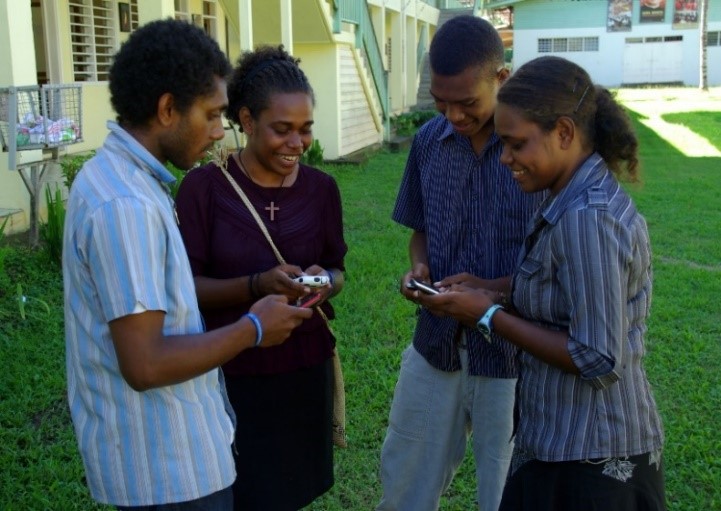
Exploring the mobile internet,
Solomon Islands,
Photo: Irene Scott/DFAT.
The short paper I presented on "Blended Learning for the Indo-Pacific" at the International Conference on Teaching, Assessment, and Learning for Engineering (TALE) in Wollongong last December, has been published by IEEE. One curious addition to the paper is the keyword "5G mobile communication". The paper discusses using smarphones for education, but I never mention fifth generation mobile networks, nor do I think these are really necessary.

A 3G or 4G network connection is more than enough for a student. A 3G network provides tens of megabits per second and 4G hundreds. This is sufficient for a student to watch videos, and upload their own, as well as take part in live video conferences. In practice students may have much more limited access, due to cost and logistics, so I design online courses where the student can download large materials infrequently, and then use a much slower connection for interaction.

An example of where this may be an issue is the Solomon Islands. The Australian Government is funding a fibre optic cable to the Solomon Islands and the Department of Foreign Affairs and Trade has asked for ideas how this could help young people with skills and education. I have submitted a proposal "Micro-credentials by Mobile Phone for the Solomon Islands", which is based on my TALE paper.

The problem in the Solomon Islands will be getting the data from the point where the fibre optic cable lands, to where the population is. It is likely the the capital, Honiara on Guadalcanal, will be connected, but not all of the other populated islands.

To address this issue I design online courses which do not require a high speed connection. The student can download all the materials required at the start of the course from a cyber cafe (or be sent a data file in the post). They then only need a slow connection to read announcements and participate in text based forums. Live interactive video is nice to have, but not at the cost of excluding many students. If a 2G GPRS connection is available, providing about 100 kbps, the student can take part in Webinars with audio and slides.

Where video and audio are not available, the course designer and instructor have to make sure that the student gets a sense of human connection, through the text based forums. This is not ideal, but can be made to work.

Paper

T. Worthington, "Blended Learning for the Indo-Pacific," 2018 IEEE International Conference on Teaching, Assessment, and Learning for Engineering (TALE), Wollongong, Australia, 2018, pp. 861-865. doi: 10.1109/TALE.2018.8615183 URL https://doi.org/10.1109/TALE.2018.8615183

Keywords: 5G mobile communication; Australia; Conferences; Education; training; employment; educational institutions; teaching; Australian educational system; assessment; cognitive learning theory; social learning theory; Indo-Pacific; blockchain; micro-credentials


Saturday, November 24, 2018

Micro-credentials by Mobile Phone for the Solomon Islands


Exploring the mobile internet,
Solomon Islands,
Photo: Irene Scott/DFAT.
The Australian Government is paying for a fibre optic cable to the Solomon Islands. With the Solomon Islands Technology for Development Challenge, the Department of Foreign Affairs and Trade has asked for ideas how this could help young people with skills and education. The winning idea will receive up to $250,000 AUD for implementation.

I have entered the Challenge with "Micro-credentials by Mobile Phone", to develop courses delivered via smart phones, which provide a vocationally relevant credential, within months, rather than taking years. The winning idea will receive up to $250,000 AUD for implementation, as part of the Australia’s Cyber Cooperation Program. I outlined my proposal to the Australian Computer Society's Canberra conference a few months ago National IT Conference in Colombo in October and will be presenting a short paper on it at the 7th International Conference on Teaching, Assessment, and Learning for Engineering, in Woolongong, 6 December 2018.

Micro-credentials by Mobile Phone

Explain your idea

Provide short courses to students via mobile phones. To provide maximum benefit, the courses would provide a micro-credential, as well as industry certification, and credit towards more advanced qualifications. The courses would be designed and delivered jointly, by institutions acrossExploring the mobile internet,
Solomon Islands,
Photo: Irene Scott/DFAT.Exploring the mobile internet,
Solomon Islands,
Photo: Irene Scott/DFAT. the Indo-Pacific, to mixed classes of students from the region.

Who will benefit from your idea?

Courses will be delivered to those with at least a primary school education. The course content will be designed to work on low cost phones now available and with limited network access. Initially courses would focus on teaching teachers in how to use the technology for teaching. Courses would connect students from across the Indo-Pacific, reducing isolation. Micro-Credentials would be achievable with a few weeks study, unlike conventional qualifications, which take months or years.

How will your idea have a development impact?

Providing training and qualifications will improve the prospects for employment of youth employment. The use of short mobile courses will provide education to those who could not be catered for in conventional courses.

How developed is your idea?

Research & Early Testing
A short formal paper on this has been accepted for thExploring the mobile internet,
Solomon Islands,
Photo: Irene Scott/DFAT.e 2018 IEEE 7th International Conference on Teaching, Assessment, and Learning for Engineering (TALE), in Woolongong, 4-7 December 2018.  http://www.tomw.net.au/technology/it/indo_pacific_blended_learning/
A project at the ANU has developed prototype software to deliver courses: https://cecs.anu.edu.au/research/student-research-projects/async-sync-learning-system

Tell us more about you

I am an independent educational technology consultant, and an Honorary Senior Lecturer in the Research School of Computer Science at the Australian National University. I am a Certified Professional member of the Australian Computer Society, as well as a Fellow of the Higher Education Academy, and have a a Master of Education in Distance Education  and am the author of "Digital Teaching In Higher Education".
My plan is to make use of some of the 300 ANU Techlauncher students to build software, and education students to build content. I am also looking to work with academic, and business, partners.
Some of the other ideas proposed so far are: