Showing posts with label DFAT. Show all posts

Thursday, May 13, 2021

Protecting Australian Education Exports

Van der Kley and Herscovitch, have produced a four page policy paper, for the ANU National Security College, on the risks to international student enrollments from China, due to tensions with Australia. Unfortunately, the provocative title of the paper may make the situation situation worse. I suggest policy proposals for protecting Australia's interests can be worded in a way which avoids giving offence.

As the paper points out, education is a $10B export industry which employs many Australians, and one of the few major ones not effected by Chinese restrictions. The industry is fragmented, with Australian public and private institutions both  competing for international students. The authors propose an Office for Education Trade, but Austrade, I suggest, is particularly unsuited to this role and may well do more harm than good. It is perhaps the lack of government intervention, which has been behind the success of this export sector. Australia has excellent, independent institutions, which international students value highly and government branding may damage this. 
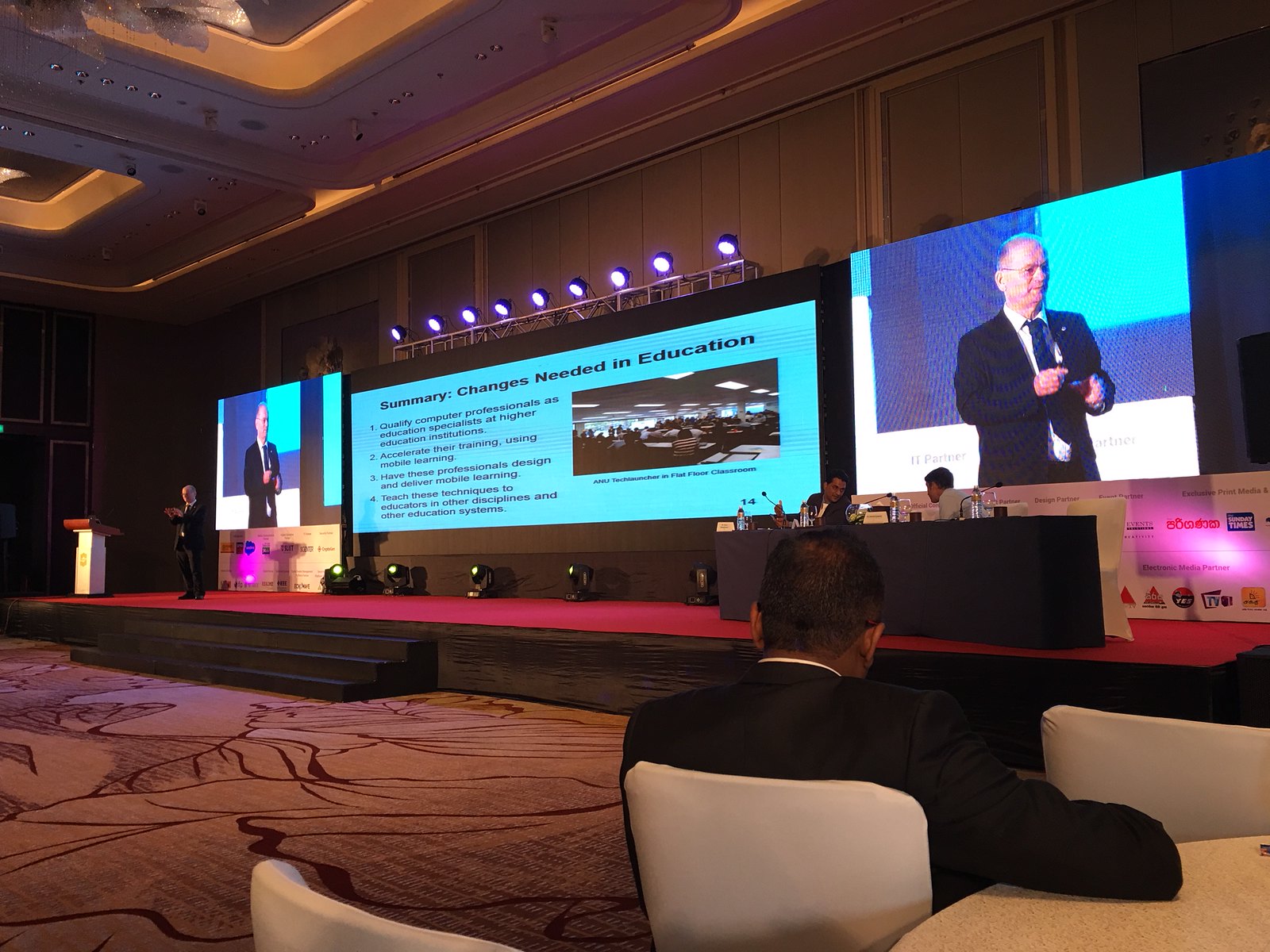
Tom Worthington Speaking at NICT 2018 in Colombo
Tom Worthington, proposing Indo-Pacific
joint education initiative
, in Colombo, 2018

Australia should, obviously diversify its education market to new countries. That can take years, but Australia academics connections with the region can help with this (obvious markets are India, Sri Lanka and Indonesia).

As the authors suggest, Australia should prepare for Chinese students being discouraged from studying in Australia. In 2017 I warned of this possibility and suggested online learning should be prepared as an option. In this I avoided explicitly mentioning China, to avoid giving offence. The crash programs to implement e-learning in 2020 for COVID-19 have now made this possible. However, while providing some flexibility, a reliance on e-learning also creates a risk, as technical means could be used to cut off Australian institutions access to their students in China. 

The paper recommends increasing Australia’s education diplomacy. However, there is no mention of , its implications for Australian education exports, or the geopolitical and geoeconomic situation of the region. Rather attempting to directly challenge China, I have suggested offering alternative forms of education to the region (Worthington, 2014 & 2018). While the loss of Chinese international students is of concern, in the longer term there are far graver implications for Australian education, and the nation's strategic situation.

References

Protecting Education Exports: Minimising the damage of China’s future economic coercion, Policy Options Paper No 18, Dirk van der Kley and Benjamin Herscovitch, National Security College, May 2021. Url https://nsc.crawford.anu.edu.au/sites/default/files/publication/nsc_crawford_anu_edu_au/2021-05/digital_nsc_policy_options_paper_no18.pdf

Worthington, T. (2014, August). Chinese and Australian students learning to work together online proposal to expand the New Colombo Plan to the online environment. In 2014 9th International Conference on Computer Science & Education (pp. 164-168). IEEE. URL https://doi.org/10.1109/ICCSE.2014.6926448

Worthington, T. (2018, December). Blended Learning for the Indo-Pacific. In 2018 IEEE International Conference on Teaching, Assessment, and Learning for Engineering (TALE) (pp. 861-865). IEEE. URL https://doi.org/10.1109/TALE.2018.8615183

Sunday, August 11, 2019

Australia Pacific Security College

Hon Marise Payne,
Minister for Foreign Affairs
Marise Payne, Minister for Foreign Affairs, announced the creation of an Australia Pacific Security College (APSC), 10 August. This will be established with the Australian National University, to "deliver strategic security and leadership training to Pacific security agencies".

An APSC Design Summary is available. It is envisaged the APSC activities could include "... workshops, seminars, courses, secondments and online resources...". I suggest that this could be flipped, to make online resources the priority. The Pacific is a big place*, and the students will learn better if they spend most of their time at work, in their own country, studying online. They can keep in touch with their teachers, and peers in other countries, in online forums. There are well established processes for doing this.

Tom Worthington speaking on e-learning in Colombo
One outcome expected of the APSC is an "... active network of security officials across the region ...". This network, I suggest, could be supported by a secure online network, linking the staff, students, and alumnus. Given the ANU has already been the victim of a data breach, the APSC will make a tempting target, so additional measures, such as two factor authentication, might be used.

* In 2005 I conducted a five day workshop in Samoa for staff from museums around the South Pacific region, on the use of computer and telecommunications technologies. I spent most of a day traveling to Apia, but due to the International Dateline, I arrived shortly before I left. ;-)

Monday, January 21, 2019

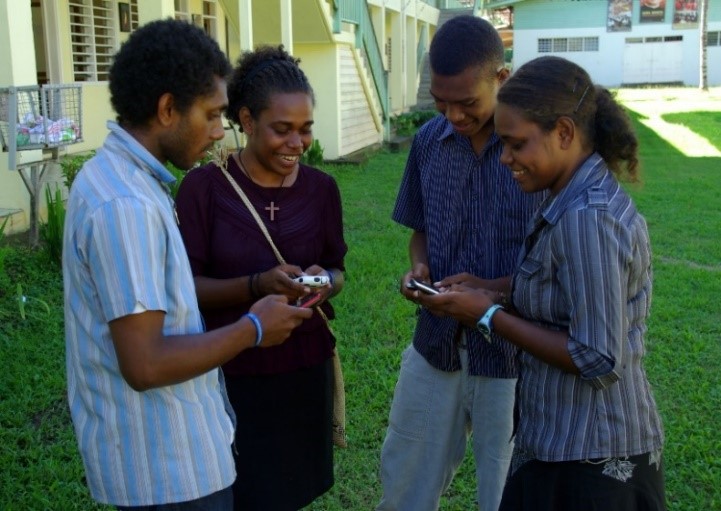
Education for the Indo-Pacific Does Not Need 5G Mobile Communications


Exploring the mobile internet,
Solomon Islands,
Photo: Irene Scott/DFAT.
The short paper I presented on "Blended Learning for the Indo-Pacific" at the International Conference on Teaching, Assessment, and Learning for Engineering (TALE) in Wollongong last December, has been published by IEEE. One curious addition to the paper is the keyword "5G mobile communication". The paper discusses using smarphones for education, but I never mention fifth generation mobile networks, nor do I think these are really necessary.

A 3G or 4G network connection is more than enough for a student. A 3G network provides tens of megabits per second and 4G hundreds. This is sufficient for a student to watch videos, and upload their own, as well as take part in live video conferences. In practice students may have much more limited access, due to cost and logistics, so I design online courses where the student can download large materials infrequently, and then use a much slower connection for interaction.

An example of where this may be an issue is the Solomon Islands. The Australian Government is funding a fibre optic cable to the Solomon Islands and the Department of Foreign Affairs and Trade has asked for ideas how this could help young people with skills and education. I have submitted a proposal "Micro-credentials by Mobile Phone for the Solomon Islands", which is based on my TALE paper.

The problem in the Solomon Islands will be getting the data from the point where the fibre optic cable lands, to where the population is. It is likely the the capital, Honiara on Guadalcanal, will be connected, but not all of the other populated islands.

To address this issue I design online courses which do not require a high speed connection. The student can download all the materials required at the start of the course from a cyber cafe (or be sent a data file in the post). They then only need a slow connection to read announcements and participate in text based forums. Live interactive video is nice to have, but not at the cost of excluding many students. If a 2G GPRS connection is available, providing about 100 kbps, the student can take part in Webinars with audio and slides.

Where video and audio are not available, the course designer and instructor have to make sure that the student gets a sense of human connection, through the text based forums. This is not ideal, but can be made to work.

Paper

T. Worthington, "Blended Learning for the Indo-Pacific," 2018 IEEE International Conference on Teaching, Assessment, and Learning for Engineering (TALE), Wollongong, Australia, 2018, pp. 861-865. doi: 10.1109/TALE.2018.8615183 URL https://doi.org/10.1109/TALE.2018.8615183

Keywords: 5G mobile communication; Australia; Conferences; Education; training; employment; educational institutions; teaching; Australian educational system; assessment; cognitive learning theory; social learning theory; Indo-Pacific; blockchain; micro-credentials


Saturday, November 24, 2018

Micro-credentials by Mobile Phone for the Solomon Islands


Exploring the mobile internet,
Solomon Islands,
Photo: Irene Scott/DFAT.
The Australian Government is paying for a fibre optic cable to the Solomon Islands. With the Solomon Islands Technology for Development Challenge, the Department of Foreign Affairs and Trade has asked for ideas how this could help young people with skills and education. The winning idea will receive up to $250,000 AUD for implementation.

I have entered the Challenge with "Micro-credentials by Mobile Phone", to develop courses delivered via smart phones, which provide a vocationally relevant credential, within months, rather than taking years. The winning idea will receive up to $250,000 AUD for implementation, as part of the Australia’s Cyber Cooperation Program. I outlined my proposal to the Australian Computer Society's Canberra conference a few months ago National IT Conference in Colombo in October and will be presenting a short paper on it at the 7th International Conference on Teaching, Assessment, and Learning for Engineering, in Woolongong, 6 December 2018.

Micro-credentials by Mobile Phone

Explain your idea

Provide short courses to students via mobile phones. To provide maximum benefit, the courses would provide a micro-credential, as well as industry certification, and credit towards more advanced qualifications. The courses would be designed and delivered jointly, by institutions acrossExploring the mobile internet,
Solomon Islands,
Photo: Irene Scott/DFAT.Exploring the mobile internet,
Solomon Islands,
Photo: Irene Scott/DFAT. the Indo-Pacific, to mixed classes of students from the region.

Who will benefit from your idea?

Courses will be delivered to those with at least a primary school education. The course content will be designed to work on low cost phones now available and with limited network access. Initially courses would focus on teaching teachers in how to use the technology for teaching. Courses would connect students from across the Indo-Pacific, reducing isolation. Micro-Credentials would be achievable with a few weeks study, unlike conventional qualifications, which take months or years.

How will your idea have a development impact?

Providing training and qualifications will improve the prospects for employment of youth employment. The use of short mobile courses will provide education to those who could not be catered for in conventional courses.

How developed is your idea?

Research & Early Testing
A short formal paper on this has been accepted for thExploring the mobile internet,
Solomon Islands,
Photo: Irene Scott/DFAT.e 2018 IEEE 7th International Conference on Teaching, Assessment, and Learning for Engineering (TALE), in Woolongong, 4-7 December 2018.  http://www.tomw.net.au/technology/it/indo_pacific_blended_learning/
A project at the ANU has developed prototype software to deliver courses: https://cecs.anu.edu.au/research/student-research-projects/async-sync-learning-system

Tell us more about you

I am an independent educational technology consultant, and an Honorary Senior Lecturer in the Research School of Computer Science at the Australian National University. I am a Certified Professional member of the Australian Computer Society, as well as a Fellow of the Higher Education Academy, and have a a Master of Education in Distance Education  and am the author of "Digital Teaching In Higher Education".
My plan is to make use of some of the 300 ANU Techlauncher students to build software, and education students to build content. I am also looking to work with academic, and business, partners.
Some of the other ideas proposed so far are: 

Tuesday, March 8, 2016

Pacific regionalism and higher education

Greetings from ANU where Professor Rajesh Chandra, Vice-Chancellor, The University of the South Pacific (USP), is speaking on "Pacific regionalism and higher education".

Professor Chandra is here for high level consultations with the Australian Department of Foreign Affairs (DFAT).


Professor Chandra argued that USP was at the center of development in the Pacific region. He pointed out that the new Framework for Pacific Regionalism (FPR) allows for involvement by non-government organizations and the private sector. The professor pointed out the importance of e-leaning and cyber- security.

Professor Chandra pointed out that USP has decades of experience working on regional issues, not just national ones. USP has 14 campuses in 12 countries, with 30,000 students. He listed the seven Strategic Research Themes:
  1. Economic Growth, Regional Cooperation & Integration for Sustainable Pacific Economies
  2. Environment, Sustainable Development and Climate Change
  3. Government, Public Policy and Social Cohesion
  4. Human Capacity Building & Leadership
  5. ICT & Knowledge Economy
  6. Pacific Cultures and Societies
  7. Pacific Ocean & Natural Resources
Professor Chandra pointed out that half their students are studying using flexible learning. In addition USP offers Skills Based Qualifications through Pacific Technical And Further Education (Pacific TAFE). Professor Chandra emphasized that Pacific TAFE does not depend on government funding.

Pacific TAFE is also interesting as it appears to be based on the Australian vocational system. As an example, the Pacific TAFE program "Certificate IV in Professional Training, Assessment & Evaluation" appears similar to the Australian "Certificate IV in Training and Assessment". The Pacific TAFE program is quality assured by Sydney TAFE, in Australia. The Pacific TAFE certificate articulates to a"Diploma in Non-formal Education" at USP, but I am not sure what "non-formal education" is: perhaps the same as workplace learning (such as for apprentices)?

There is a USP/ANU Memorandum of Understanding. It will be interesting to see if the two institutions collaborate on on-line programs and courses.

There is a Pacific Education Development Framework (PEDF) 2009-2015. This included a SSE 3: TECHNICAL & VOCATIONAL EDUCATION & TRAINING (TVET) Goal "Ensuring that learning needs of all young people and adults are met through equitable access to appropriate learning and life skills programmes." and SSE 5: TEACHER DEVELOPMENT : IN -SERVICE EDUCATION AND PRE - SERVICE EDUCATION OF TEACHERS, but with no specific agreed targets. Also there is a CROSS - CUTTING THEME 4: INFORMATION AND COMMUNICATIONS TECHNOLOGIES (ICT) to "Develop a Global Partnership for Development ... In cooperation with the private sector, make available the benefits of new technologies, especially information and communication technologies.". It is not clear if anything was achieved as a result of the framework and there appears to be no replacement plan. Such frameworks, I suggest, are of little practical value and may hinder development. The best way universities can assist with development is to focus on their expertise: research what should be done and then educate people to go out and do it.

One point Professor Chandra did not mention is that USP's Bachelor of Net-centric Computing and Bachelor of Software Engineering were accredited by the Australian Computer Society in December 2015.


An interesting question from the audience was if USP might cooperate with India on education. Professor Chandra was generally positive on the idea. He suggested the most useful action would be more satellite coverage of the Pacific.