Showing posts with label Belt and Road Education Plan. Show all posts

Sunday, June 13, 2021

Education for a Better World


Yesterday, President Biden announced that "The United States is rallying the world’s democracies to deliver for our people, meet the world’s biggest challenges, and demonstrate our shared values". I suggest part of this could be an online education program, to complement, rather than confront, China's Belt and Road Education Plan (Worthington, 2014 & 2018).

Expanding infrastructure in low and middle-income countries will required trained workers. The Build Back Better World  (B3W) program aims to invest trillions of dollars in developing countries infrastructure. That will require millions of trained professionals, in the fields of energy, health, digital technology, and education. 

I propose Australia be the lead partner for B3W Education, in the indo-pacific, but world wide. We can mobilize our decades of expertise in higher education. In doing so, we can create new opportunities around the world, as well as jobs at home.

References

Worthington, T. (2014, August). Chinese and Australian students learning to work together online proposal to expand the New Colombo Plan to the online environment. In 2014 9th International Conference on Computer Science & Education (pp. 164-168). IEEE. URL https://doi.org/10.1109/ICCSE.2014.6926448

Worthington, T. (2018, December). Blended Learning for the Indo-Pacific. In 2018 IEEE International Conference on Teaching, Assessment, and Learning for Engineering (TALE) (pp. 861-865). IEEE. URL https://doi.org/10.1109/TALE.2018.8615183

Thursday, May 13, 2021

Protecting Australian Education Exports

Van der Kley and Herscovitch, have produced a four page policy paper, for the ANU National Security College, on the risks to international student enrollments from China, due to tensions with Australia. Unfortunately, the provocative title of the paper may make the situation situation worse. I suggest policy proposals for protecting Australia's interests can be worded in a way which avoids giving offence.

As the paper points out, education is a $10B export industry which employs many Australians, and one of the few major ones not effected by Chinese restrictions. The industry is fragmented, with Australian public and private institutions both  competing for international students. The authors propose an Office for Education Trade, but Austrade, I suggest, is particularly unsuited to this role and may well do more harm than good. It is perhaps the lack of government intervention, which has been behind the success of this export sector. Australia has excellent, independent institutions, which international students value highly and government branding may damage this. 

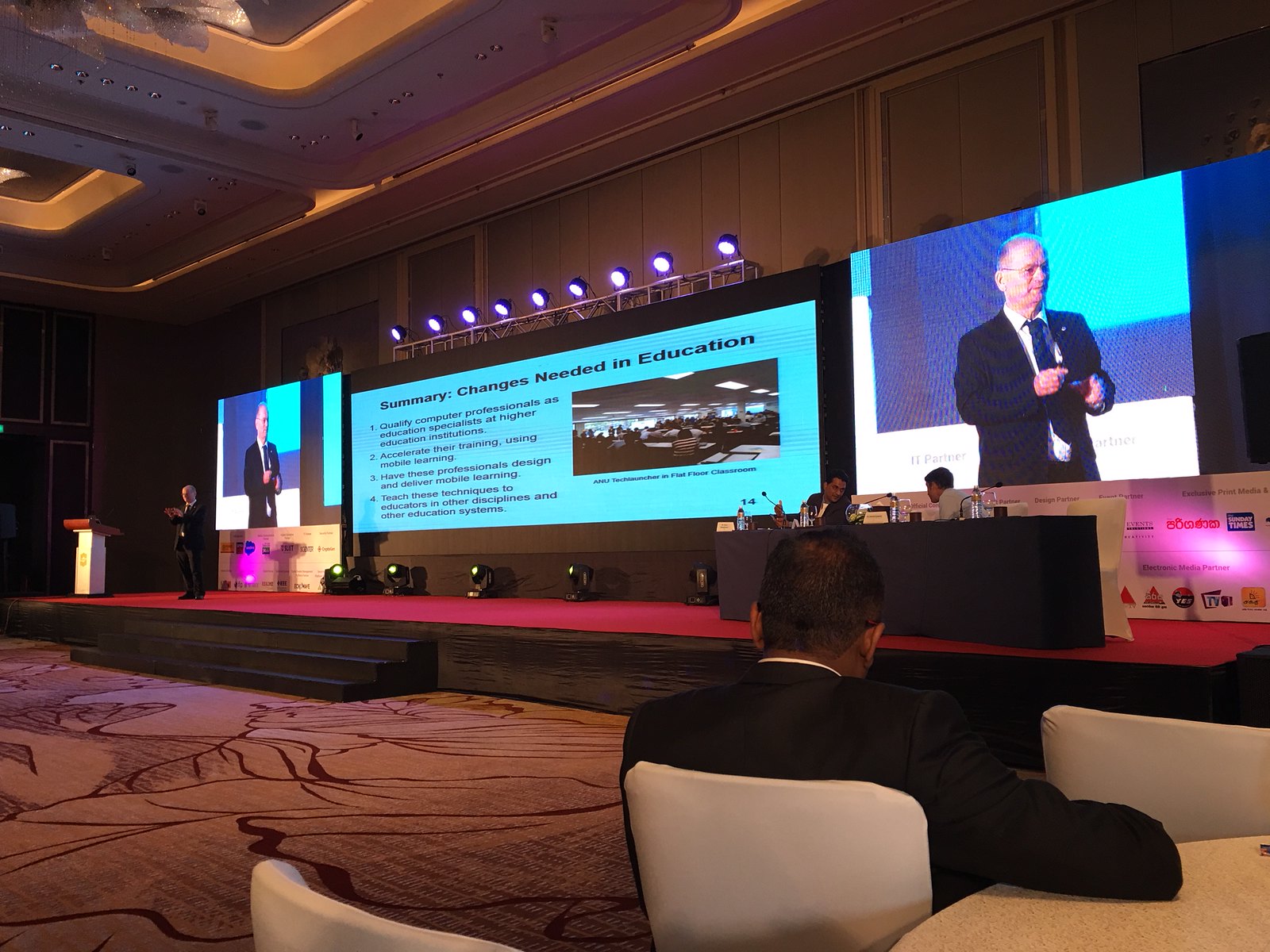
Tom Worthington Speaking at NICT 2018 in Colombo
Tom Worthington, proposing Indo-Pacific
joint education initiative
, in Colombo, 2018

Australia should, obviously diversify its education market to new countries. That can take years, but Australia academics connections with the region can help with this (obvious markets are India, Sri Lanka and Indonesia).

As the authors suggest, Australia should prepare for Chinese students being discouraged from studying in Australia. In 2017 I warned of this possibility and suggested online learning should be prepared as an option. In this I avoided explicitly mentioning China, to avoid giving offence. The crash programs to implement e-learning in 2020 for COVID-19 have now made this possible. However, while providing some flexibility, a reliance on e-learning also creates a risk, as technical means could be used to cut off Australian institutions access to their students in China. 

The paper recommends increasing Australia’s education diplomacy. However, there is no mention of , its implications for Australian education exports, or the geopolitical and geoeconomic situation of the region. Rather attempting to directly challenge China, I have suggested offering alternative forms of education to the region (Worthington, 2014 & 2018). While the loss of Chinese international students is of concern, in the longer term there are far graver implications for Australian education, and the nation's strategic situation.

References

Protecting Education Exports: Minimising the damage of China’s future economic coercion, Policy Options Paper No 18, Dirk van der Kley and Benjamin Herscovitch, National Security College, May 2021. Url https://nsc.crawford.anu.edu.au/sites/default/files/publication/nsc_crawford_anu_edu_au/2021-05/digital_nsc_policy_options_paper_no18.pdf

Worthington, T. (2014, August). Chinese and Australian students learning to work together online proposal to expand the New Colombo Plan to the online environment. In 2014 9th International Conference on Computer Science & Education (pp. 164-168). IEEE. URL https://doi.org/10.1109/ICCSE.2014.6926448

Worthington, T. (2018, December). Blended Learning for the Indo-Pacific. In 2018 IEEE International Conference on Teaching, Assessment, and Learning for Engineering (TALE) (pp. 861-865). IEEE. URL https://doi.org/10.1109/TALE.2018.8615183

Wednesday, February 17, 2021

Adapting Geoeconomic Competition to Australian Advantage

Adapting Australia to an era of geoeconomic competition by Wilson, 2021
The report "Adapting Australia to an era of geoeconomic competition" (Wilson, 2021) was launched yesterday at the Australian National University in Canberra. I had a ticket to attend, but decided to stay home and participate online. This reflects one of the new realities of Geoeconomics, which threatens the viability of Australia's universities. 

This report defines Geoeconomics as "the application of economic instruments for geopolitical ends" and points out its reemergence in the  Indo-Pacific, between the USA and China. The report suggests that Australia needs to adapt its liberal approach in response.

Wilson points out that education makes up 9% of Australian exports (p. 8), which is much higher than tourism at 5%, with education exports dominated by China (p. 9). 

The report singles out China’s Belt and Road Initiative (BRI) as an "archetypal geoeconomic strategy" (p. 23), for economic development and international political influence. However, as well as targeting trade and heavy industry, the BRI also has an Education component which Wilson doesn't mention. This is similar to the Colombo Plan which Australia and western allies implemented during the cold war (Worthington, 2014). However, online learning considerably increases the scope for education as part of geoeconomic strategy.  Guthrie et al. (2021) predicts onshore international students at Australian universities will drop 60% by 2030 due to competition from China.

Reference

James Guthrie, Martina K Linnenluecke, Ann Martin-Sardesai, Yun Shen, and Tom Smith (January 2021). On the resilience of Australian public universities: Why our institutions may fail unless Vice-Chancellors rethink broken business models, Macquarie University Business School working paper. URL https://www.dropbox.com/sh/f3idf8xogq5r8rj/AAA35NWKaxYTmR2DF3V0FcFIa?dl=0

Wilson, p. (January 2021), Adapting Australia to an era of geoeconomic competition, Perth USA Center. URL: https://perthusasia.edu.au/getattachment/Our-Work/Embracing-the-Indo-Pacific-South-Korea%E2%80%99s-progress/PU-184-Geoecon-201207-PRESS.pdf.aspx?lang=en-AU

Worthington, T. (2014, August 23). Chinese and Australian Students Learning to Work Together Online: Proposal to Expand the New Colombo Plan to the Online Environment. Paper to be presented at the 9th International Conference on Computer Science & Education (ICCSE). Vancouver, Canada.

Friday, February 5, 2021

Blend of Onshore, Offshore and Online to Save Ten Australian Universities at Risk

Gwilym Croucher,
University of Melbourne
Croucher, Elliott, Locke and Yencken (2020) define two types of Transnational Education (TNE): offshore campus-based and online. They are are cautiously optimistic about the future of Australian TNE, both in existing markets, particularly China, and new ones, such as Sri Lanka and Indonesia.

However,  I could find no mention of China's Belt and Road Education Plan, in the report. More recently with COVID-19 there is more emphasis on delivering courses online by China. This could prove attractive for students wanting a low cost education, which is aligned with the region's dominant economy.

Also, the authors don't mention a third form of TNE, a blended model using an onshore campus in Australia, plus online study in the student's nation. I suggest this could prove an attractive option for students and is, in effect, what many international students have been forced to do, due to COVID-19. It is also cost-effective and logistically easier for universities, as they do not have to maintain overseas campuses.

Australian universities already enhance their online courses through partnerships with universities in other countries. I saw this in action at the Sri Lanka Institute of Information Technology (SLIIT). This approach can be combined with the option of onshore study, so students undertake introductory studies online and at a campus of a local institution, and then travel to Australia for advanced studies.

James Guthrie,
Macquarie University
These options might form part of new business models for ten Australian universities which Guthrie et al. (2020) warn are at "high risk of financial default". The authors identify a "rapid expansion of onshore and offshore international students" as one factor threatening the viability of the universities, and the expanding Chinese higher education sector as a future risk. Their "probable" scenario, predicts onshore international students dropping 33.3% in 2021 due to COVID-19 and 60% by 2030 due to competition from China.

References

Gwilym Croucher, Kristine Elliott, William Locke and Edward Yencken (0 Mar 2020) Australia’s higher education delivery offshore and online – trends, barriers and opportunities, Melbourne Centre for the Study of Higher Education. URL https://melbourne-cshe.unimelb.edu.au/__data/assets/pdf_file/0009/3568275/Australias-higher-education-delivery-offshore-and-online.pdf

James Guthrie, Martina K Linnenluecke, Ann Martin-Sardesai, Yun Shen, and Tom Smith (January 2020). On the resilience of Australian public universities: Why our institutions may fail unless Vice-Chancellors rethink broken business models, Macquarie University Business School working paper. URL https://www.dropbox.com/sh/f3idf8xogq5r8rj/AAA35NWKaxYTmR2DF3V0FcFIa?dl=0


Friday, January 22, 2021

More Flexible Australian Visas Needed to Attract International Students

I suggest Alan Tudge, the new Australian education minister, needs to lobby his cabinet colleagues for more flexible visas for international students. Some accommodation has been made for students stuck overseas and studying online due to COVID-19. However, this should be extended and made permanent, to compete with countries such as Canada. Also the Australian universities and the government need to get together on a long term strategy which integrates online learning, rather than hoping it is something which will go away: it won't. As well as having to compete with developed nations such as Canada offering flexible packages of online and on campus study with the right to work, our universities will increasingly need to compete with elements of China's Belt and Road Education Plan.

Monday, January 4, 2021

New Australian Education Minister Needs to Put Online at Core of Strategy

Recently I was asked for comment by John Ross at Times Higher Education for an article on what might be Alan Tudge, the new Australian education minister's approach. In 2013 he chaired a committee investigating online learning particularly for International students. This did not appear to receive support from his colleagues, or the Australian higher education sector at the time. However, as I commented in THE article, the need to teach students during COVID-19 has shown the value of on-line learning. The problem for the new Minister  is now to recast the national strategy for higher education,  with online learning at its core. 

Even when COVID-19 is hopefully overcome, in a few years time, students will not necessarily flock back to campuses. In 2016 I suggested Australian providers should be ready with an online option if an international crisis kept students from campus. The crisis I had in mind was not a pandemic, but a military confrontation. That could still occur, again depleting our campuses of international students. Also we need a strategy to address increasing competition for students from campuses in their own country, as well as offshore and online. In particular China's Education Action Plan for the Belt and Road Program presents a challenge.  The Australian government should see value in helping with education in our region of the world, for strategic, humanitarian and economic reasons.

Australian educators have demonstrated that they could rapidly pivot from classroom to online teaching in an emergency. University and government leaders now have the difficult but important task of turning this from a short term unplanned expedient to the core of the new national strategy.

On 5 December 2019, Dan Tehan, the then Australian Minister for Education, announced a refresh of the National Strategy for International Education 2025 to be conducted in 2020. As I suggested in 2015, the strategy should have online learning at its core, to allow for short term crises which may keep students from campus (as later happened with COVID-19 ), and address the long term challenge of China's Education Action Plan for the Belt and Road Program.

I wrote of the strategy in 2015: 

'In my view the strategy does not place sufficient emphasis on the importance of on-line education, without which Australian education providers will not be viable ... international education needs to be "flipped" [with] on-line education as the central issue, not a peripheral one'. 

 I predicted most teaching would be online by 2020, but regrettably most institutions did not plan for this and had to implement crash programs due to COVID-19. However, even when COVID-19 has been overcome there may be regional geopolitical tensions which again keep students from Australian campuses without warning. Also there will be increasing competition for students from campuses in their own country, offshore and online, particularly from China's Education Action Plan for the Belt and Road Program.

References

Australian minister tipped to rethink building blocks of degrees by John Ross, Times Higher Education, January 3, 2021

The video contains images that were used under a Creative Commons License. Click here to see the full list of images and attributions: https://link.attribute.to/cc/1785196


Thursday, September 17, 2020

China Upgrades the Education Action Plan for the Belt and Road Program

Greetings from the Carbon Energy for the Asia-Pacific Project Workshop at the Australian National University. One topic is the role of renewable energy and carbon emission reduction in China's Belt and Road Program. However, the plan is not just abut building power stations, there is also an Education Action Plan for the Belt and Road Program. The Australian Department of Education issued a summary of an update of the plan in June and changes to education policy. China plans to share lessons learned during the COVID-19 pandemic and continue to support developing nations. One aspect which might be of interest to Australian higher education is that Chinese vocational training teachers will have more scope to study overseas. This has relevance to renewable energy as the cost of wind and solar equipment has now dropped so low that labor for installation is a major part. There is scope for specialized skills to speed installation and so lower cost.

Wednesday, April 15, 2020

China Pivots to International e-Learning: Should Australia Follow?

China has announced that universities and colleges will offer online courses in English to international students due to COVID-19. This is a significant pivot for the little known Education Action Plan for the Belt and Road Initiative. This Plan is about boosting China's trade, but also has similarities to the Colombo Plan. During the Cold War, Australia provided free education to students from the region, as a form of soft diplomacy. Australia's Government, and universities, have so far made only tentative moves with international education. That may now have to change, as I suggested in 2017.

It would be tempting for Australian universities to assume that  online courses from China in English would be of low quality, and so not direct competition for on-campus Australian courses. However, Chinese institutions have been adapting the online techniques used by some of the world's leading universities. Also research over decades shows that graduates of online courses are at least as employable as those from on-campus.

Australian universities might decide to concentrate on quality advanced degrees, conceded the introductory and first degree market to online overseas institutions. However, graduates make very good online students, and someone who has done an introductory online course will think an online first and second degree perfectly normal.

The Australian automotive industry  assumed that Japan, and later Korea, were not a threat due to poor quality products. However, the quality improved, and we do not now have an Australian automotive industry. Australian universities need to not make the same mistake.

For several years I have been attending international technical education conferences run by, or with large attendance of Chinese academics. They reported steady progress with scaling up offerings of education in China to international students from developing nations.

As well as students studying in China, the Plan also envisaged campuses in the student's country, built and staffed with Chinese help. While China has some large online universities with decades of experience, online learning was not mentioned in the Plan.

Here is what I suggested in 2017:
"Education is Australia’s third-largest export and the government's "National Strategy for International Education 2025" points out that Moodle is an Australian product serving a global market and identifies on-line learning as an area for growth (Australian Government, 2016). However, Australia's universities are predominantly set up for students traveling to Australia to study on campus, and the government strategy provides little practical guidance for changing this. International tensions could disrupt the flow of students to Australia very quickly. Competition from universities in other countries and DE is likely to increase. We can produce quality on-line and blended programs to remain competitive, based on demonstrated success and research results." (Worthington, 2017).

References

Mo Jingxi, Millions to benefit from online vocational training, Apr 14, 2020, China Daily, State Council, China.

Education Action Plan for the Belt and Road Initiative , Ministry of Education of the People’s Republic of China, July 2016

Worthington, T. (2014, August 23).  Chinese and Australian Students Learning to Work Together Online: Proposal to Expand the New Colombo Plan to the Online Environment. Paper to be presented at the 9th International Conference on Computer Science & Education (ICCSE). Vancouver, Canada. URL https://doi.org/10.1109/ICCSE.2014.6926448 Preprint available at: http://hdl.handle.net/1885/11724

Worthington, T. (2017). Digital Teaching In Higher EducationDesigning E-learning for International Students of Technology, Innovation and the Environment (book).

Tuesday, November 13, 2018

Implications for Victoria's Education Industry in Signing of China Silk Road Agreement

Premier Daniel Andrews with
Chinese Ambassador Cheng Jingye.
Photo by Chinese Embassy

The Victorian government has released the agreement signed with China on the Maritime Silk Road (aka Belt and Road) on 8 October. One part of China's plan, not mentioned in the agreement, is expansion of Chinese education services to the region.  Education is Victoria's major service export to the region. It is not clear if the Victorian Government envisages joint education initiatives under the Silk Road plan, or has worked through implications of competition from China's education providers.

I will discuss some of the educational implications of the Silk Road at the 7th International Conference on Teaching, Assessment, and Learning for Engineering in Woolongong in early December.

The agreement was released as a facsimile, so I have converted it to searchable text and there may be errors:

MEMORANDUM OF UNDERSTANDING BETWEEN THE GOVERNMENT OF THE STATE OF VICTORIA OF AUSTRALIA AND THE NATIONAL DEVELOPMENT AND REFORM COMMISSION OF THE PEOPLE’S REPUBLIC OF CHINA ON COOPERATION WITHIN THE FRAMEWORK OF THE SILK ROAD ECONOMIC BELT AND THE 21ST CENTURY MARITIME SILK ROAD INITIATIVE


The Government of the State of referred to “the Victoria, Australia (hereinafter and the National Development and Reform Commission (NDRC) of the People’s Republic of China.

Based on the aspiration of promoting the silkroad spirit centering on peace, cooperation, openness, inclusiveness, mutual learning and mutual benefits and aspiration to further enrich such spirit in keeping with the new era; welcoming and supporting China’s initiative to jointly promote the Silk Road Economic Belt and the 21st Century Maritime Silk Road Initiative (hereinafter referred to as the Belt and Road Initiative); willing to enhance practical cooperation within the framework of jointly building the Belt and Road, the Parties decide to work together to explore and form synergy in cooperation, enhance policy coordination, and further promote friendly cooperation.

Recognizing that the NDRC is in charge of macroeconomic management and comprehensive economic management within the as Parties”) Government of China while the Government of the State of Victoria is dedicated to growth in knowledge intensive industries and services sectors, and the State of Victoria boasts strengths in infrastructure development, liveability, health, science and technology, and agriculture, thus providing opportunities for cooperation and partnership under the Belt and Road Initiative.

The Parties have reached the following understanding:

1 

Article I

Objectives and Guiding Principles of Cooperation


I. The Parties will work together within the Belt and Road Initiative, with the aim of promoting connectivity of policy, infrastructure, trade, finance and people, so as to seek new opportunities in cooperation and inject new momentum to achieve common development; strive to develop an open global economy, jointly combat global challenges and promote the building of a common future.

II. The Parties will promote cooperation based on the following principles:

(i) Guided by the principles of extensive consultation, joint benefits, the Parties will respect common and interests major concerns of each other, deepen mutual trust and contribution beneficial and shared cooperation for common development;

(ii) In accordance with the concept of cooperation, development and mutually beneficial progress under the Initiative of jointly building the Belt and Road, the Parties will enhance coordination and provide each other with support.

(iii) The Parties will endeavor to carry out cooperation within their respective areas of responsibility and strengths as mutually agreed through bilateral communication.

Article II

Areas of Cooperation


I. Based existing cooperation, the Parties will enhance policy cooperation, facilities connectivity, unimpeded trade, financial cooperation, people-to—people bond, and promote Digital Silkroad Cooperation, etc;

II. Innovate cooperation modes and platforms, encourage businesses, organizations and relevant agencies on both the Chinese side and the Victorian State side to play facilitating roles and foster long—term, stable, sustainable partnerships.

III. Create enabling, growth-friendly policy environment for investment cooperation between the businesses on both sides.
2


IV. Other cooperation that the Parties agree on.

Article III


Modes of Cooperation


Mode of cooperation may include but are not limited to:

I. Through exchange of visits and existing cooperation mechanisms, the Parties will seek convergence between respective policies and planning.

II. Focus the demands of bilateral cooperation, the Parties will carry out dialogues and exchanges, joint researches, pilot programs, knowledge sharing, capacity building, etc.

III. The Parties will discuss cooperation with a third Party on jointly building the Belt and Road, and provide convenience to such cooperation.

IV. The Parties may conclude agreements or other cooperation documents for cooperation in a specific field.

V. Both on common Parties will review periodically the progress of cooperation under the Memorandum of Understanding through diverse forms of communication as necessity arises at various working levels, such as the exchanges of visits, video conferences, correspondence, etc.

Article IV

Settlement of Differences


The Parties will settle differences in the or implementation of this MOU interpretation, application through friendly consultations.

Article V


Entry into Force, Amendment and Termination


I. This MOU will enter into force from the date of signature.

II. This MOU will remain in effect for five years and will be automatically extended for subsequent five year periods and so forth unless terminated either party by giving the other party a written at least three months in advance.

III. This MOU may be amended by written consent of the two Participants and the amendment will be an integral part of this MOU.

3


IV. To terminate this MOU one party should give the other party a written notice through diplomatic channels at least three months in advance. This notice will be terminated after joint agreement. The termination of this MOU will not influence executing programs which will continue according to the agreement timetable until completion of programs.

V. This MOU does not create legal relations or constitute a legally binding contractual agreement between the parties.

Signed in duplicate on 8th, October, 2018, in the Chinese and English languages, both texts having equal validity.

Premier, the State Government of Victoria, the Commonwealth of Australia

Chairman, the National Development and Reform Commission of the People's Republic of China.

Thursday, November 1, 2018

Blended Learning for the Indo-Pacific

Tom Worthington Speaking at NICT 2018 in Colombo
Tom addressing the
Computer Society of Sri Lanka
A few weeks ago I outlined a proposal for a Colombo Plan 2.0, in the city of Colombo, at an international conference opened by the nation's president. This proposed delivering micro-credentials via mobile devices, to students of Indo-Pacific.  It would bootstrap mobile education by using m-learning to teach computer professionals how to design and deliver such courses. To provide maximum benefit from the courses, each would provide a micro-credential, as well as industry certification, and credit towards a degree. The courses could be designed and delivered jointly, by institutions across the Indo-Pacific, to mixed classes of students from the region. It would provide a response to China's Belt and Road Education Plan, but in a non-confrontational way.

A short paper to present on this has been accepted for TALE 2018, in Woolongong, 4-7 December 2018:
  • Worthington, Tom. Blended Learning for the Indo-Pacific. In Teaching, Assessment, and Learning for Engineering (TALE), 2018 IEEE 7th International Conference on. IEEE. url https://doi.org/10.1109/TALE.2018.8615183
     

Saturday, October 6, 2018

Changes Needed for Higher Education in the Indo-Pacific

Tom Worthington Speaking at NICT 2018 in Colombo
Greetings from Colombo, where I gave a plenary presentation for the Computer Society of Sri Lanka (CSSL) National IT Conference (NITC 2018). I suggested Sri Lanka, Australia and other countries of the Indo-Pacific region could jointly educate their IT professionals to teach using mobile devices.

I suggested "Colombo Plan 2.0", which would see a genuine partnership between the countries. Computer professionals who teach at universities would be trained using mobile learning to apply mobile learning for their students. These professionals would be recognized as having specialist teasing skill within their discipline of computing. These, and other students, could learn in online groups with people from around the region.

Teaching students in multi-national online groups, I suggest, will also help where students later travel internationally to continue their studies.

China has a Belt and Road Education Plan as part of the Belt and Road Initiative (also known as the "Maritime Silk Road"). This is for Chinese universities and joint ventures with student exchanges, and joint programs. However, the emphasis is on face-to-face education. An m-learning initiative could complement, rather than necessarily competing with this.


ps: Next stop is Singapore, to talk on energy use and flexible classrooms at EduBuild Asia 2018.