Showing posts with label International Education. Show all posts

Wednesday, August 28, 2024

Untangling Australian Higher Education from Migration Policy

Professor Andrew Norton (Australian National University) makes a well reasoned case for Australia not needing caps on international student numbers. He suggests recent changes to regulations will be sufficient to correct problems with the system. However, I suggest some of these problems are political, rather than administrative, but the government's proposed close regulation will make things harder for them, rather than easier. Universities should be ready with alternative policy proposals, for when this government, or a future one, realises they need another solution.

As Professor Norton points out the pent up demand for international education caused by COVID coincided with a a shortage of housing in Australia. But as other commentators have pointed out, these are not necessarily connected: students have different housing needs. Reducing the number of students competing for inner-city share houses and on-campus dorms, will not provide suburban houses for Australian families.

The Australia government proposes to set quotas for the number of students in each course at each university. A political calculation has been made to set the quotas higher at regional universities in sensitive electorates, and lower for capital city universities. The elite capital city universities are perceived to be well off and it is assumed will not elicit sympathy from voters. It is likely a flawed calculation.

Apart from the politics, Australia needs universities to provide a trained workforce to service the community and support the economy. International student revenue has been used to supplement decreasing funding from government. 

In my submission to the accord panel, I suggested Australian universities need to design an education product which appeals to both domestic and international students. These should not be reliant on a work visa to be attractive to international students. They should not be dependent on students, international or domestic, being at a particular location, country, or on a campus. The universities should end the arms race of offering more and more advanced degree programs to each student. Vocational and university offerings should be combined to meet current real world work needs. Education should be offered online wherever the student is, in small nested packages, which can build into degrees.


Sunday, May 12, 2024

Australia’s International Education and Skills Strategic Framework


The Australian Department of Education has released a 41 page draft "Australia’s InternationalEducation and SkillsStrategic Framework" for consultation (10 May 2024). The report has an odd mix of conflicting objectives, based on false premises. There is nothing wrong with the Australian Government setting targets to meet national priorities. This could be to maximize student fees, meet national skills needs, or to aid regional development. However, measures to do any one of these will work against the other two.

The report makes the claim several times that integrity issues are due to "unmanaged growth" (pages 5, & 15), rather than the obvious failure of government regulation. Also it blames international students for a housing shortage, rather than successive Australian governments failure to invest in public housing. However, the major problem with the report is that it doesn't seriously address the need to offer online education, and broaden the countries Australia draws students from. I suggest the way to broaden the market is with online education (Worthington, 2018). Also the report does not mention the threat, and opportunity, of Artificial Intelligence, at all. This is surprising, as it is not possible to attend an education forum at present, without AI dominating the discussion (I will be talking about it at EduTech Asia 2024).

The report envisages international students providing a trained workforce for Australian industry, as well as assisting economic development of the countries the students are from, and also strengthening ties with those countries. In the past these separate and conflicting objectives were supported by individual, separately funded and administered programs. This report does not acknowledge, let alone attempt to resolve, these competing mutually exclusive goals for international education.

The report highlights some of the measures previously introduced to address flaws in the system. However, it fails to acknowledge how the ad-hoc nature of the measures, where the Australian government went from under to over regulation, harmed students, and the reputation of the Australian high education system. As an example, in 2023, the Australian Government restricted students ability to switch education providers. This was done to address a practice where students would switch providers after arriving, to facilitate work, rather than study. Had effective measures been in place, this ad-hoc measure would not have been needed.

Previously the Australian Government introduced domestic student loans for Vocational Education and Training. This was followed by scamming of the system by unscrupulous providers. The Government seems to have not anticipated this, and took years to respond, resulting in hardship for students, and a loss of a large amount of public funds. It is surprising that government would repeat this experience, being caught unawares, repeatedly, by sharp practices by international training providers, and student agents. Assuming that organisations which can obtain large amounts of government money will act honestly, being surprised when they don't, then overreacting with restrictive regulations, doesn't make for a well ordered international education system.

To add to the conflicting aims in the report, it attempts to promote regional Australia, through international education (page 21). As the report notes international students are concentrated in metropolitan areas, particularly capital cities. However, this is also where domestic students prefer to study. Regional Australia might provide students students with "unique experiences", but these are ones they, domestic and international, don't want to have. Forcing students to study at regional campuses would be good for the local economy, but what incentives would be required for students to study where they do not want to? The report suggests promotion of sustainable energy jobs in regional Australia, but that is likely to have regional appeal.

An option not mentioned is to use regional campuses as part of the growth of non-capital Australian cities. As an example, the NSW government is considering high speed rail options from Sydney to Newcastle. Newcastle already offers an attractive location for students, with its beaches, and fast access to Sydney would make this a much better offering. One option would be a battery powered high speed rail line from Newcastle to Canberra, via Sydney and Woolongong, with trains recharging via overheard catenary while decelerating and accelerating for each station.

References
T. Worthington, "Blended Learning for the Indo-Pacific," 2018 IEEE International Conference on Teaching, Assessment, and Learning for Engineering (TALE), Wollongong, Australia, 2018, pp. 861-865. doi: 10.1109/TALE.2018.8615183 URL https://doi.org/10.1109/TALE.2018.8615183


Thursday, February 29, 2024

Australian Universities Accord report: Some Final Thoughts


Australian Universities Accord
Final Report
, 25 February 2024
It has taken me a full day to work my way through the 44 recommendations of the Australian Universities Accord final report (25 February 2024). The headline items are the later recommendations are the later ones to do with funding. What was disappointing was that the Panel did not explore new forms of tertiary education. There is mention of micro-credentials, stacked qualifications, regional education, and support for indigenous, low SES, and disabled students. However, there is a lack of recognition that the average student now learns primarily online, while working, undertaking many courses at different institutions. 

Much of the report is irrelevant to my recent experience of being a university, and TAFE, student. I did undertake a half semester on campus, but the rest of my studies were online. At one stage I was enrolled in three institutions at the same time. The fact that my university was in another state, or another country, made very little difference to my student experience. What mattered to me as a student was what credit I would get between systems. 

With increasing number of students undertaking micro-credentials, and other sub-degree programs, involving multiple institutions, I suggest more attention needs to be given to the administrative burden for government staff, institutions, and the students. When I attempted cross institutional enrollment in a course, I could not find any way to complete the required paperwork (each institution required me to get permission from the other first). The prospect of registering with the Australian government for student support for just a couple of courses was too daunting, so I paid the course fees with my credit card. Similarly, when enrolling as a TAFE student at the same time, I simply paid directly. As an international online student, I avoided any government paperwork, paying fees directly by credit card (the fees were lower than I had paid for similar courses as a domestic Australian student).

Some initiatives worth expanding did not get a mention in the report. One of these is Open Universities Australia, where institutions (not all universities) cooperate to provide flexible online education. Learning hubs in outer suburbs of cities, as well as regional areas, might be set up under a similar shared scheme. 

The Panel has made useful recommendations about Work Integrated Learning (WIL). However, what is lacking in this and several other areas are academic staff who are qualified to teach these subjects. The major challenge is to either implement mandatory requirements requiring academics to be qualified to teach using these techniques, incentives to encourage them, or both.


Universities Accord Report: International and Regional Education Needs Credible Online Offerings

Australian Universities Accord
Final Report
, 25 February 2024
Despite the export revenue from, and controversy over, international education, the Australian Universities Accord final report (25 February 2024), waited until recommendation 22 before addressing the topic. The focus of the recommendations is aligment between what Australian tertiary instutions, both universities and vocational education and training (VET) institutions teach, and Australian economic needs. This assumes that the international student's aim is to migrate to Australia (I was an international student but did not move to Canada). The Panel also proposes growing international education in regional and remote areas. Unless there are specific jobs for the students, such as in mining, this seems unrealistic.

Why would a student, particularly a young student, prefer to student in a remote area, which they could study in one of Australia's exciting cities? The mining industry has to provide very high salaries to attract workers. Will regional universities be prepared to offer cut price courses, or a guarantied high salary part time job to students?

More realistic are proposals from the panel to streamline visa processes. Australian universities are dependent two markets: China, and India. As I warned in 2016, a regional crisis could result in the loss of most on-campus international students. Universities need to diversify markets, and delivery methods.

The panel suggests improving alumni engagement in the region. This is certainly one way to boost links, but other more direct forms of marketing should also be used.

The recommendations on international students from the panel are excessively timid. Rather than see international students as a source of funds, and workers, it can be a way to provide a more vibrant environment for domestic students, who are preparing to be part of a global workforce. I presenting a proposal in 2018 to have students of the region working together online.

Producing new knowledge and using research capability


The panel rightly chose to put learning issues before research. With recommendation 24 the panel proposes a an examination of
national research funding. However Australian universities should have already being doping that, routinely, as part of their normal planning.

Professor Lachlan Blackhall,
ANU
Deputy Vice-Chancellor
(Research and Innovation).
Panel recommends Australian governments use university research output. However, that presupposes that universities have staff with consulting skills, which are different from research skills. If universities want the results of their research to be used, then academics have to learn new skills. Many universities have made a start with this, by establishing innovation centers to teach entrepreneurial skills. Some of promoted academics with exceptional entrepreneurial knowledge, such as Professor Lachlan Blackhall, the new ANU
Deputy Vice-Chancellor (Research and Innovation).

Unfortunately the most important recommendation for using research capability is buried down in 26:
"e. ensuring that training in entrepreneurial, business, teaching and leadership skills is offered through additional qualifications in parallel with research training in preparation for careers beyond academia"
However, it is not clear that professional skills should be optional for doctoral graduates, and not a core part of their training. The government could take an alternative approach, and require this training, or transfer some of the funding to support professional doctorates, which have as their primary purpose the application of knowledge.

Establish an Australian Tertiary Education Commission

The panel recommends an "Australian Tertiary Education Commission", as an umbrella agency over existing federal higher education bodies. The idea has some merit. However, I spent some time working for the Commonwealth Schools Commission (more on this later), which lacked the powers to be truly effective. Whatever the administrative structure, education will remain a highly political issue.

Improving workforce capability and capacity

Recommendation 31 "b. encourage minimum teaching qualifications for higher education teaching roles" would not be acceptable for schools, or VET, and I suggest should not be for universities. There should be mandatory minimum teaching qualifications for universities. A simple approach would be to set these at the same level as VET, with a Certificate IV, although universities might find it easier to offer undergraduate and graduate certificates (although I found my Cert IV in T&A of more practical use than my Grad Cert in HE).

Centre of Excellence in Higher Education and Research

Recommendations 32 to 36 I suggest could be addressed together. The first is for a "Centre of Excellence in Higher Education and Research". That could then work on the others: 33 Tertiary Education Racism Study, 34 A First Nations-led review, 35 First Nations governance, supported by the last: 36 Data, measurement, and reporting.

Planning the tertiary education system of the future

Recommendation 37 is for the Australian Tertiary Education Commission to look at what tertiary education providers are needed and where. However, there are more fundamental questions to be addressed, in terms of the mix of VET and university, the mix of online and on-campus, and the mix of not and for-profit universities. One major question the Panel did ask is if specialist university should be permitted, which address one area of research. A question the Panel did not ask is if non-research institutions should called universities.

Regional tertiary education and communities

Curiously, than recommendations appear to be listed in order of importance, with the lost important last. Recommendation 39 addresses higher education delivery in regional and remote Australia. Unfortunately the Panel had confused delivery to regional, rural and remote areas, with the location of campuses in those areas. Australia was a pioneer in paper based distance education, 50 years ago. That was enhanced with the Internet and made mainstream by the COVID-19 pandemic. The idea that a student's first consideration of where a campus is belongs in the past. The Panel have some useful recommendations, such as renaming and expanding Regional Study Hubs. However, Australian Government need to seek advice on how to structure higher education more widely, or risk building a system for last century.

In 2013, when considering further study, I first looked at universities in the city where I lived. I then looked at universities within commuting distance. But I quickly dismissed these options, and enrolled at a campus 1,700 km away. For follow on studies I enrolled 17,000 km away, in another country. This was much simpler to do, and cheaper, than enrolling at an Australian university. It is this world Australian universities need to be able to compete in. Campuses are still useful to supplement learning, and research, but are no longer the main game.


Thursday, June 22, 2023

What is One University's Course Equivalent to Another?

There is some comfort in being an "honorary" lecturer at a university. As you are not getting paid a salary, you feel no obligation to go to administrative meetings. You just take on the teaching, or research, you want to do. Some prefer to avoid the stress of grading student work, and just do some mentoring. I have been formally trained in how to mark students so don't find it too stressful. One thing I have avoided, for decades, is an administrative role at a university. But recently I was asked to help process applicants for credit from studnts for study done elsewhere. In a way this is an extension of assessment. But in another way it is a very tedious administrative process, involving many rules, and use of precedents. As a former bureaucrat, I can cope with rules, but even so it is a tedious process. 

Processing applications for credit for Australia courses is not so hard. First of all all Australian universities are real universities, federally accredited. In some countries anyone can call something a university, but in Australia that is illegal. 

Next of all Australian universities professors borrow heavily from each other. Often courses at different institutions have the same titles, descriptions, learning objectives and assessment. Also degrees are accredited by the Australian Computer Society and Engineers Australia, and have much the same content. 

Checking out an institution in another country is a little more difficult. First of all is it real? Australian universities employ staff to carry out forensic analysis of documents presented by students. Then there is the problem of the quantity of learning in courses, and the form of assessment. This becomes a particular issue for practically orientated skills: can a student learn to program in a few weeks, and be assessed with multiple choice questions on their coding ability? Can a student learn project management, without actually being a member of a project team? How much does workplace experience count, be it as part of a formal internship program, or concurrently with study, count? Ultimately these things come down to judgement.

Saturday, October 22, 2022

Inquiry into Australia’s tourism and international education sectors

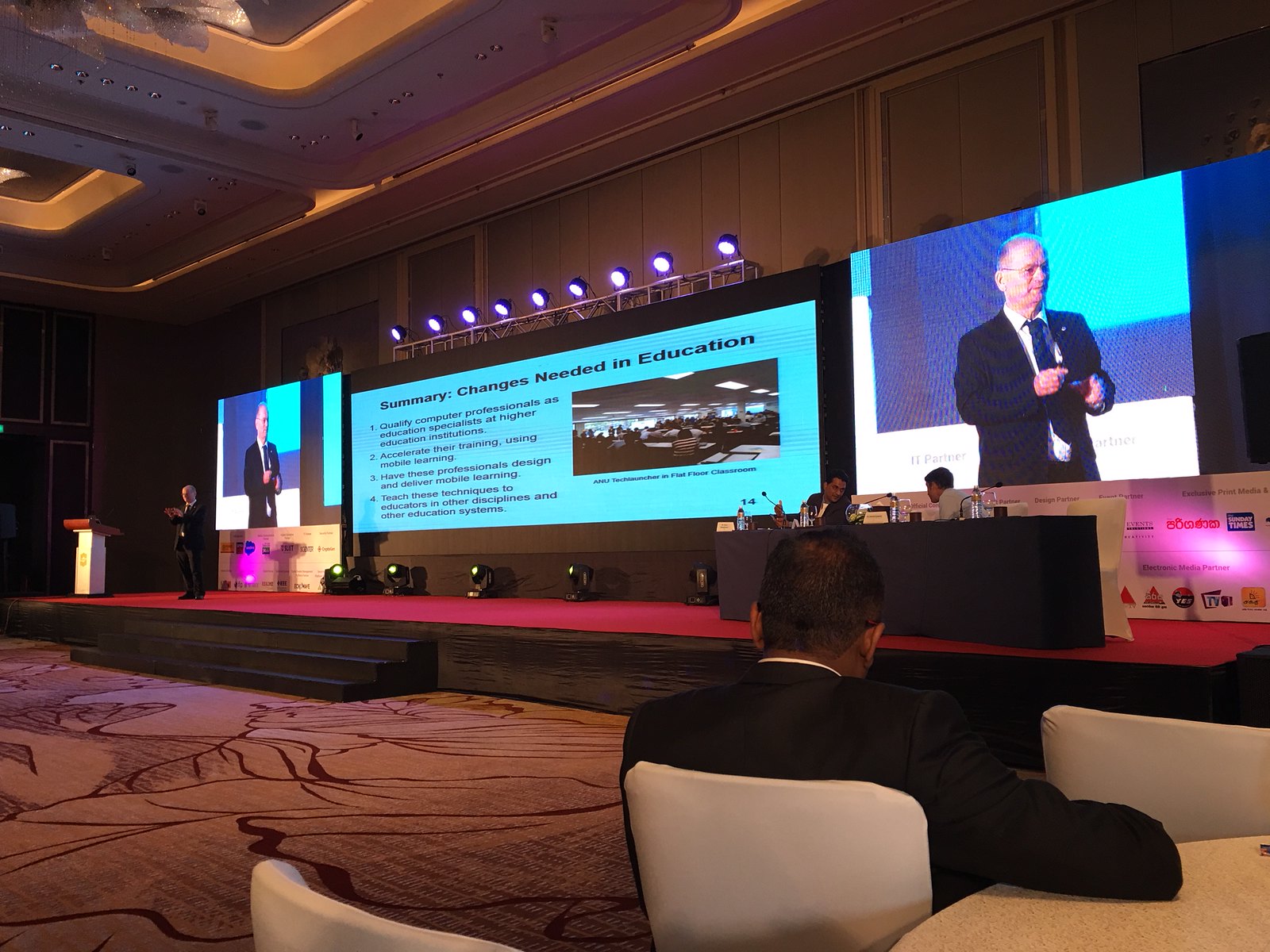
Tom Worthington Speaking at NICT 2018 in Colombo
Presenting on M-learing for the Indo-Pacific,
Colombo, 2018. 

The Australian Parliament's Joint Standing Committee on Foreign Affairs, Defence and Trade is holding an Inquiry into Australia’s tourism and international education sectors. The committee is accepting submissions. For  international education the terms of reference are:

  1. "challenges associated with the loss of international student numbers as a result of the significant disruption caused by the COVID-19 pandemic and effective measures to attract and retain students to Australia;
  2. online innovations in education delivery and potential opportunities to strengthen the sector's resilience;
  3. initiatives to ensure positive international student experience and support pathways to build their skills and contribute to Australia's prosperity; and
  4. opportunities for international education to support strategic and foreign policy objectives"
Some initial thoughts:

COVID-19: A White Swan Event

The COVID-19 pandemic was a shock for traditional campus based universities, especially those with a research focus. These universities had to quickly convert to online delivery to students, who were unable to get to campus. This was done by turning lectures into video conferences, and exams into online quizzes. However, the limitations of this approach was already well known in the distance education community. Also it challenged how teaching staff see their role, and what students want from a university. 

The institutions which had the lest difficulty were education-focused online, distance, and open universities. These institutions have been in the business of delivering education to remote students, in some cases for half a century, or more. Some more conventional campus based universities, particularly in Singapore, had practiced online delivery in an emergency, after their experience with SARS-CoV-1 in 2002 to 2004 (Chandran, 2010).

After being alerted to the need for an online alternative in an emergency, I investigated how this might be done for international students of an Australian research intensive university (Worthington, 2017). In 2016 and 2017 I gave a series of talks warning Australian universities to be ready with an online option in case international students were unable to get to campus. In the case of Australia, it seemed at that time that international tensions over the South China Sea were more likely to interrupt student access, rather than a pandemic.

In 2019 I redesigned the learning module I was delivering to allow for blended delivery, plus the option of full online delivery in an emergency (Worthington, 2019). This contingency was activated in 2020 for to COVID-19. No changes were required to content, or assessment. The face to face components were simply replaced with Zoom webinars (Cochrane, Et al., 2021). 

1. Measures to attract and retain students

Australia can continue to use essentially the same marketing techniques for attracting international students. These emphasize Australia as a safe place, with quality respected institutions, and job opportunities. Universities can continue to use their campuses as part of the marketing. However, in reality most students spent most of their time not in a classroom, even before COVID-19. Conventional lectures are a very poor way to learn, and exams a poor way to assess. Universities were replacing these with experiential learning, and project based assessment, and COVID-19 has accelerated this trend. Unfortunately, these are difficult to market learning formats, with parents wanting to see students in class, and potential employers seeing scope for cheating in online assessment.

The key to marketing the new educational techniques is through the person to person learning, for vocationally relevant outcomes. One example is Work Integrated Learning (WIL), where students learn, and earn course credit, while in a workplace. WIL is part of the requirements for membership of professions, including engineering, and computing, as it is way of providing students with so-called "soft" skills. This is attractive for students, especially where the WIL is through paid work. However, arranging sufficient work places is an expensive process for universities, which are currently undertaking this is an ad-hoc way, and competing for job placements.

Coordination of WILL opportunities with universities, industry bodies and government could improve the attractiveness of Australia as an educational destination, while also meeting staff shortages.

2. Online education for resilience

For those who were already using online learning, and those who had planned to use it in an emergency, the pandemic proved to be mostly business as usual. In particular, asynchronous learning to provide the scaffolding for a course, with embedded synchronous activities added (Worthington, 2013). This proved resilient to problems with equipment, bandwidth, and students and staff unavailable at set times. With this approach students are provided with all the materials they need, and all assessment tasks, at the beginning of a course. The student works through the materials on their own, or with others, occasionally checking in with a tutor. 

The approach to course design I suggested in 2016, and implemented in 2019, had a traditional distance education format, with face to face components for those who could get to campus, or online for those who could not. This approach evolved from that used by the Australian Computer Society for professional development, modified for delivery at university with face to face components. This approach is supported by education theory (Narayan, Et al., 2012).

3a. Providing a positive student experience

Unfortunately most online education delivery during the pandemic was not designed for online distance delivery, and undertaken by staff not trained in digital education. The students were not inducted into the distance format, and had to learn about it, at the same time as their instructors, as courses evolved. Despite these impediments, overall learning was achieved. However, with training, staff can deliver a much better experience. Decades of research shows that online and distance institutions provide a learning experience at least equal to face to face (Worthington, 2012). 

For students who are unable to get to campus due to cost, disability, employment or family commitments the distance option is their only best option. In the past Australian universities routinely discriminated against students by refusing to provide an online option which was feasible, affordable, but too much trouble. It would be unfortunate if universities were permitted to withdraw the online option, and return to discriminating against students. One promising development to provide 

3b. Pathways to build skills and contribute to Australia

The previous Australian government introduced undergraduate certificates, as a form of short university qualification. Universities responded by taking the first semester of their degrees and packaging these as the certificate. This was a worthwhile initiative, but does not provide the flexible "micro-credentials" talked about. For these to be designed and become useful universities will need to adopt the techniques for standardizing, and packaging short qualifications used in the vocational education and training (VET) sector (Worthington, 2018).

4. Supporting strategic and foreign policy

A key component of the cold war Colombo Plan was to provide subsidized education to people from developing nations of the Indo-Pacific region. This was done to help with development, and engender friendly relations with Australia. Now that Australia, and other western countries have switched to using education as a for-profit premium product, China has stepped in to offer low cost education, as an element of foreign policy. Australia can't compete directly with the scale of provision of low cost education by China, but could offer premium blended low cost education targeted at the region (Worthington, 2014). Delivery of education via low cost mobile devices has potential (Sinfield, Et al., 2020).

References

Chandran, R. (2010, May). National University of Singapore's Campus-Wide ELearning Week. In Global Learn (pp. 2062-3302). Association for the Advancement of Computing in Education (AACE). URL https://cpb-us-w2.wpmucdn.com/blog.nus.edu.sg/dist/0/119/files/2011/03/national-university-of-singapores-campus-wide-elearning-week.pdf

Cochrane, T., Narayan, V., Aiello, S., Birt, J., Cowie, N., Cowling, M., ... & Worthington, T. (2021, November). Back to the Future Post Pandemic Socially Constructed Blended Synchronous Learning-Vignettes from the Mobile Learning SIG. In ASCILITE 2021. ASCILITE.

Narayan, V., Cochrane, T., Aiello, S., Birt, J., Cowie, N., Cowling, M., ... & Worthington, T. (2021, November). Mobile learning and socially constructed blended learning through the lens of Activity Theory. In ASCILITE (Vol. 2021, p. 38th).

Sinfield, D., Narayan, V., Cochrane, T., Cowie, N., Hinze, M., Birt, J., ... & Worthington, T. (2020, December). A mobile ecology of resources for Covid-19 learning. In ASCILITE 2020: ASCILITE’s first virtual conference. ASCILITE.

Worthington, T. (2012, July). A Green computing professional education course online: Designing and delivering a course in ICT sustainability using Internet and eBooks. In 2012 7th International Conference on Computer Science & Education (ICCSE) (pp. 263-266). IEEE.

Worthington, T. (2013, April). Synchronizing asynchronous learning-Combining synchronous and asynchronous techniques. In 2013 8th International Conference on Computer Science & Education (pp. 618-621). IEEE.

Worthington, T. (2014, August). Chinese and Australian students learning to work together online proposal to expand the New Colombo Plan to the online environment. In Computer Science & Education (ICCSE), 2014 9th International Conference on (pp. 164-168). IEEE. URL https://doi.org/10.1109/ICCSE.2014.6926448

Worthington, T. (2017). Digital Teaching In Higher Education: Designing E-learning for International Students of Technology, Innovation and the Environment. ANU Open Research Repository. https://openresearch-repository.anu.edu.au/handle/1885/148737

Worthington, T. (2018, December). Blended learning for the indo-pacific. In 2018 IEEE International Conference on Teaching, Assessment, and Learning for Engineering (TALE) (pp. 861-865). IEEE.

Worthington, T. (2019, December). Blend and flip for teaching communication skills to final year international computer science students. In 2019 IEEE International Conference on Engineering, Technology and Education (TALE) (pp. 1-5). IEEE.

Thursday, September 30, 2021

Possibilities for Australia/India Education Partnerships

Today I took part in the Australia India Business eXchange 2021, in the Education section. After some short presentations (which was a relief as they can be long at these shows), we had some small group discussions. One issue here was how Australian unviersites can get a presence in India. The approach I suggested was a local partner. I was impressed when on a visit to Colombo (yes I know that is not India), I came across Curtin University staff at the  Sri Lanka Institute of Information Technology (SLIIT). They had a very productive partnership where students studied locally for an Australian degree. One possibility discussed in the breakout room was an Indian institution providing an Australian vocational qualification (such as a Diploma), with the student also getting credit towards an Australian degree. Another possibility discussed was the local Indian partner assisting students with work integrated learning.

While AIBX was using Zoom, I experienced some difficulties with how it was implemented. Normally I would click on a link, or enter a Zoom address, and the Zoom App would start. In this case instead Zoom started in the web browser. This is much slower, to the point of being unusable on my computer. So I had to read the room number from this Zoom session and enter it in the desktop Zoom application. At one point other messages covered the number, so I had to ask the help desk for the Zoom link (they responded quickly).

Wednesday, September 29, 2021

Australia India Education Trade Show Online with International Education EdTech Vendors

Greetings from the virtual exhibition floor of the Australia India Business eXchange 2021, currently underway online. The program has five streams: Agrifood, Mining, Infrastructure, Healthcare and Education. There are two education areas on the trade floor: Transnational and Edtech. It is not too late to register.

The interface works much better than I was expecting. I clicked on Transnational Education and the response was instant. From their I could get a list of recorded presentations and documents for my show "swag bag".

Transnational Education:
  1. Australian TNE in India - Presentation
  2. Deakin University - Brochure
  3. Flinders University - Presentation
  4. Flinders University - Flyer
  5. University of Southern Queensland - Flyer
  6. Vetassess - Flyer
  7. Mission Delegate Profiles
  8. La Trobe University International Course Guide
The only of these I am not familiar with is Vetassess. So I clicked on it and got a 12 page capability statement. It turns out they do skills assessment.

For Edtech:
  1. Didasko Institute - Flyer
  2. Didasko Institute - Presentation
  3. Typsy - Flyer
  4. Typsy - Brochure
  5. Mission Delegate Profiles
Here I found about Didasko (tech used to deliver university courses). However, Typsy, who deliver online hospitality training, appear to be in the wrong category. Presumably the target market is international students wanting to be certified to work in Australian hospitality.

Here is the education program: 

Wednesday 29 September 2021

11:00-12:00 IST / 15:30-16:30 AEST
Transnational education (TNE) roundtable: partnering for success
In this session Australian and Indian institutions will explore new possibilities in TNE in light of the internationalisation agenda in India’s National Education Policy, and in order to service India’s significant skills demand.

12:00-12.30 IST / 16:30-17:00 AEST
TNE networking (happy half hour)
Opportunity for informal networking with Indian institutions.

13:00-15:00 IST / 17:30–19:30 AEST
Find your partner
Visit our virtual booths anytime to explore partnerships with Australian businesses. Our Austrade India industry sector experts in transnational education and edtech will be available 13:00 to 15:00 IST for live chat.

Thursday 30 September 2021
11:00-12:00 IST / 15:30-16:30 AEST
Limitless learning: opportunities in India’s burgeoning edtech sector
This roundtable discussion focuses on growth trends in India’s education technology industry, key aspirations of Indian edtech companies, and opportunities to partner on content, product development and scale-up.

12:00-12:30 IST / 16:30-17:00 AEST
Edtech networking (happy half hour)
Opportunity for informal networking with key Indian edtech companies.

13:00-15:00 IST / 17:30–19:30 AEST
Find your partner
Visit our virtual booths anytime to explore partnerships with Australian businesses. Our Austrade India industry sector experts in transnational education and edtech will be available 13:00 to 15:00 IST for live chat.

Friday 1 October 2021
10:00-11:30 IST / 14:30-16:00 AEST
AIBX 2021 Business Leaders Forum: Partnering for Prosperity
Official proceedings with Minister Tehan, Indian Government representatives and industry leaders. A physical event in Delhi delivered in partnership with CII and the Economic Times and livestreamed to Business Mission participants. Program will include keynotes from ministers and a business leaders panel discussion on trade and economic partnership opportunities, moderated by the Economic Times.

13:00-15:00 IST / 17:30–19:30 AEST
Find your partner
Visit our virtual booths anytime to explore partnerships with Australian businesses. Our Austrade India industry sector experts in transnational education and edtech will be available 13:00 to 15:00 IST for live chat.

Tuesday, September 28, 2021

Australia India Business eXchange 2021

Greetings from the Australia India Business eXchange 2021, being held over the next three days online. I registered to explore education business  opportunities in India. The organizers have gone to considerable lengths to create the online equivalent of a trade show. One interesting feature is a "swag" bag, where you can browse through the information filling your virtual show bag with electronic brochures. There are live events via Zoom as well as chat. 

The main interface looks a lot like Second Life,or Mozilla Hubswhich is not necessarily a good thing. The physical meeting venue does not necessarily make for a good online interface, and might just slow things down. A more intimidate problem is that the interface is only available when live sessions are on. This makes no sense and differs from other online trade shows, where you can look at the program, browse virtual trade booths, and leave messages to arrange meetings, at any time. 

Friday, July 23, 2021

Australia Should Aim for the Stratosphere with Online Learning

In "Nation-building moonshots and why they matter" Georgie Skipper argues Australia should "aim big", as the USA did with the Apollo program. However, history only remembers the winners of a race, and I suggest we should also learn from the losers. Like the USA, the USSR had a space program shooting for the moon. But their big rocket failed and the vast expense was wasted, placing the country further behind. Australia can't afford all-or-nothing moonshots and should adopt the more cautious approach exemplified by the Chinese space program, focusing on smaller goals and learning from others. I suggest an area which Australia can safely reach the stratosphere, if not the moon, is online education.

China has had success with rockets and automated probes. But because of the risk, time and cost in developing technology for crewed space travel, China instead purchased proven technology from Russia. China's  Shenzhou spacecraft is an improved version of the Russian Soyuz, and China's Feitian space suit is derived from Russia's Orlan-M. Each new Chinese version incorporates more local technology, but starting from a proven base.

Australia should adopt the same approach, not reinventing what is already available for the sake of being different, but instead adding local unique features. We should choose projects with ambitious, but achievable goals which have real tangible outcomes. We can't afford to build moon rockets in the hope it might lead to a better powdered orange juice. A little symbolism is okay, but better are projects aimed to help people here on earth.

The USA new approach to space may also be useful in Australia. While Elon Musk's Space X private space venture has been rightly hailed, it is backed with funding from NASA and the US Government. The US is funding private space ventures, offering competitive tenders for delivery of people and cargo to orbit, and the construction of a lunar lander. Like the Chinese approach, this takes older proven technology developed by government and updates it.

The COVID-19 vaccines delivered by Pfizer, Astra Zeneca, and Johnson & Johnson are another example of government funding combined with private enterprise. Governments around the world funded fundamental research into vaccines over decades. When COVID-19 hit, governments provided billions of dollars to companies for development. However, this was not a moonshot, this was a measured response to a very real threat to the world. 

History shows that a big bet sometimes pays off, but a slow steady, modest investments can also give good returns. While vaccines have received most attention, there are other technologies, such as online education, which have been key to dealing with the pandemic. Few realise that the Moodle learning management system, used by schools and universities around the world for teaching students online, was developed in Perth, Australia. Australian governments failed to back the development of Moodle, and Australia lost the opportunity to lead the world in online education. Moodle is still based in Perth, but in 2018 announced a new Barcelona headquarters. While Moodle will not say so publicly, this was due to the lack of support from the Australian and WA governments. 

After mining, international education is Australia's major export industry. However, Australian governments have failed to back this industry, in the way they back mining, even though it employs far more people. It is not too late to aim for orbit with online learning, if not the moon. Australia's current international export industry is under threat from new competitors, as well as new technology. We need to invest now to save this industry and see it flourish.

Monday, May 24, 2021

Global Education in Australia

Greetings from the "Global Educators Workshop" at the Australian National University. This follows on from last week's Cross-Culturally Responsive Teaching Strategies Workshop and online Cross-Culturally Responsive Teaching the week before. We have had presentations on China and Indian educations systems. This raises the question as to if Australian universities should adjust teaching techniques and content to suit the students, or are we teaching them skills, including learning skills, which are not offered in the own education system.

I teach computing and engineering students in programs accredited by Australian professional bodies. The national requirements are aligned with international professional standards, through the Seoul and Washington Accords. However, these are heavily influenced by the USA, UK and Australia. Also they do not specify the pedagogy to be used.

Thursday, May 6, 2021

Two Phase Approach to Australian International Education: Offshore VET Plus Onshore University

One useful source of migrants for Australia has been international graduates of Australian universities. It will be interesting to see what effect COVID-19 and the resulting shift to online education has. This may result in a two phase process, where international students do their initial training offshore online in the Australian Vocational Education and Training (VET) system, then come to Australia for further study at university, and to work.

Dirk Mulder
There are some indications this is happening. It may involve students studying first at a vocational institution offshore, before moving to a university onshore ("International student growth – it’s all in VET and it’s all from India", Dirk Mulder, Campus Morning Mail, May 5, 2021). While international enrollments are falling at Australian universities, VET is growing, especially from India at Victorian institutions.

The option of starting study in the VET sector and then moving to university is a sound approach for vocational qualifications. Some Australian universities have the option of doing this in-house, offering VET qualifications as well as university degrees. The student can first enroll in VET, complete a diploma and then go straight to the second year of their degree. I was asked by one of these institutions to be on a review panel for their computing degree and was impressed by how it worked.

There are differences in how and what VET and universities teach. VET focuses on vocational skills, offers recognition of prior learning (RPL) and "competency" based assessment. You learn what you need for a job, and if you have evidence already have that skill you don't need do that part of the course. University tends to teach more theory, it is harder to get credit for prior experience and the assessment looks for excellence.

But in terms of learning how to do something both VET and university approaches work. I undertook a certificate in education at  both university and VET, with more similarities than differences. Also the move to online learning over the last year by universities has made their courses more like VET (which is not a bad thing). 

Saturday, April 3, 2021

Planning the future of international education in Australia

Hon Alan Tudge MP
The Hon Alan Tudge MP, Minister for Education and Youth issued a media release "Shaping the future of international education in Australia" (31 March 2021). The Minister was launching consultations for the Australian Strategy for International Education 2021-2030. I suggest a key part of the strategy should be to make international students feel welcome and appreciated. However, the Minister suggested maximizing the long-term benefits of international students for Australia. Unfortunately this may further discourage internaional students from enrolling in Australia, with them feeling exploited, rather than helped. This comes after the Prime Minister suggested that if students already here were short of funds, due to the COVID-19 pandemic, they should go home.

The Minister suggested "... the disruption of COVID provides an opportunity to look at the sector and ensure it is working for students and for Australia in the long-term ...". This appears to suggest that international students in some way interfere with Australia students education and are a determent to the Australian economy. I don't understand how this can be the case, given that international students contribute billions of dollars to the Australian economy and also contribute to university intellectual life. Also I am not aware of any other sector where Australian government ministers set out to insult our major export customers in this way.

The Minister also suggested targeting international enrollments to Australia's skills needs. However, I suggest the students may object to being exploited in this way and the nations the students are citizens of may object to this form of reverse brain drain. We should offer education to the benefit of the students and their nation.

The Minister suggests investigating new delivery models in new markets. However, I suggest there is considerable scope for expansion of existing markets with already well understood delivery models. As an example, pre-pandemic, I studied the potential of distance education from Australia to students in our region. Markets which could be expanded are India, Sri Lanka and Indonesia. In the last few years I have visited Sri Lanka, and Indonesia, meeting with their academics and government officials,. Australia is known and well regarded. One issue was the need to satisfy national authorities, business and students that online learning was legitimate.

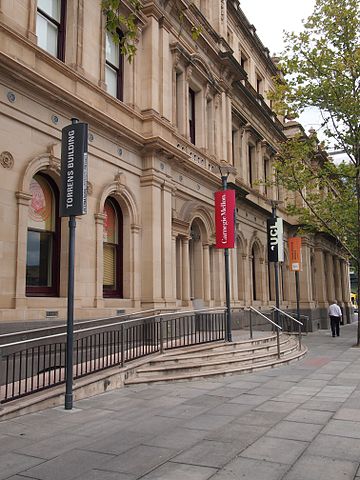
Torrens Building Adelaide,
Photo by Bahudhara, CC BY-SA 3.0,
via Wikimedia Commons
One approach proven by Australian universities is a partnership with institutions in-country. An example is the the Sri Lanka Institute of Information Technology (SLIIT). This private institution is affiliated with several Australian universities. I visited SLIIT in 2013 and it is accredited to deliver programs in Sri Lanaka.

Another approach would be to replicate the Torrens Building Adelaide in countries of the region. This building is shared by multiple international universities, to provide them with a local presence. There may be value in universities using Australia as a brand, while competing for international students. An example of this approach is Open Universities Australia, which provides a single brand for multiple institutions offering online education. That approach could be extended to naming rights for buildings in the region. International students could undertake face to face classes for part of their studies while attending other classes online at the Australian institution of their choice.

Some initiatives from the Australian Government for domestic students may be of interest to international ones. Last year an undergraduate certificate was introduced as a response to COVID-19. This allowed students to receive a formal qualification after only one semester of full time study. Universities could offer this to international students, with the option to go on to a degree. Flexibility to allow for this and online study while on a student visa would also help attract international students. The students could be undertaking work integrated learning, with an Australian employer, while studying at an Australian university.

Friday, February 5, 2021

Blend of Onshore, Offshore and Online to Save Ten Australian Universities at Risk

Gwilym Croucher,
University of Melbourne
Croucher, Elliott, Locke and Yencken (2020) define two types of Transnational Education (TNE): offshore campus-based and online. They are are cautiously optimistic about the future of Australian TNE, both in existing markets, particularly China, and new ones, such as Sri Lanka and Indonesia.

However,  I could find no mention of China's Belt and Road Education Plan, in the report. More recently with COVID-19 there is more emphasis on delivering courses online by China. This could prove attractive for students wanting a low cost education, which is aligned with the region's dominant economy.

Also, the authors don't mention a third form of TNE, a blended model using an onshore campus in Australia, plus online study in the student's nation. I suggest this could prove an attractive option for students and is, in effect, what many international students have been forced to do, due to COVID-19. It is also cost-effective and logistically easier for universities, as they do not have to maintain overseas campuses.

Australian universities already enhance their online courses through partnerships with universities in other countries. I saw this in action at the Sri Lanka Institute of Information Technology (SLIIT). This approach can be combined with the option of onshore study, so students undertake introductory studies online and at a campus of a local institution, and then travel to Australia for advanced studies.

James Guthrie,
Macquarie University
These options might form part of new business models for ten Australian universities which Guthrie et al. (2020) warn are at "high risk of financial default". The authors identify a "rapid expansion of onshore and offshore international students" as one factor threatening the viability of the universities, and the expanding Chinese higher education sector as a future risk. Their "probable" scenario, predicts onshore international students dropping 33.3% in 2021 due to COVID-19 and 60% by 2030 due to competition from China.

References

Gwilym Croucher, Kristine Elliott, William Locke and Edward Yencken (0 Mar 2020) Australia’s higher education delivery offshore and online – trends, barriers and opportunities, Melbourne Centre for the Study of Higher Education. URL https://melbourne-cshe.unimelb.edu.au/__data/assets/pdf_file/0009/3568275/Australias-higher-education-delivery-offshore-and-online.pdf

James Guthrie, Martina K Linnenluecke, Ann Martin-Sardesai, Yun Shen, and Tom Smith (January 2020). On the resilience of Australian public universities: Why our institutions may fail unless Vice-Chancellors rethink broken business models, Macquarie University Business School working paper. URL https://www.dropbox.com/sh/f3idf8xogq5r8rj/AAA35NWKaxYTmR2DF3V0FcFIa?dl=0


Thursday, February 4, 2021

Australian Universities Need to Sell the Value of International Students to Public and Government

Prof Nick Klomp, 
CQU VC
Professor Nick Klomp, Vice-Chancellor of CQ University has proposed a regional strategy for the return of international students ("International students need certainty, and so does our nation", February 1, 2021). That has merit, but I suggest Australian universities need to work much harder to convince the public, and governments, of the value these students to our community during a pandemic. Our universities also need to come up with a long term strategy which accepts the reality that students were studying mostly online, even before COVID-19.

Students are not going to wait around for Australia to open its borders: they are going to enroll elsewhere. In 2013, to learn how to teach international students, I became one myself, enrolled in Canada. It stuck me how similar the experience was to Australia, apart from some confusion over what a Loon was. ;-). 

While Australia's existing international students may be willing to make the best of the situation, their younger siblings will not. New students will take up invitations from other countries, which are welcoming them. Professor Klomp makes the case that International students injects billions into Australia’s economy. However, in my Canadian studies, I learned that emotion can be a bigger driver than hard-headed logic.

Australian sport is a much smaller export industry than education, but international sporting events have a strong pull on the Australian public and governments. Similarly, primary industry has a central place in the Australia ethos, with appeals from miners and farmers for international labor finding a receptive audience. 

If universities want the support of the Australia community and government, they need to appeal to emotions, as well as wallets. During the COVID-19 pandemic, our universities have been key, not only through providing health experts, but also medical and support staff. This could be communicated to the public, along with the important role universities have in keeping our crops growing and our mines functioning.

Professor Klomp points out that most international graduates return home. But while they are here, and those who stay, make a valuable contribution to our nation. Would anyone argue that advanced students studying medicine, or engineering medical devices, should not be allowed into Australia during a pandemic?

Australia'a universities are comparable to those of other developed nations, and with the added attraction of our lifestyle, are popular with international students. However, our universities can't rely on this continuing. The "Come to Australia for a good degree and a good time" marketing will not work much longer. Most university education had moved online even before COVID-19. However, Australian universities were reluctant to admit this, which contributed to the difficulty of their responding to the pandemic.

Universities had spent years denying their students were mostly studying online, so when the students need to study entirely online, universities had no coherent strategy to deliver this. That lack of strategy will see a decline in Australian education, if not addressed.

Australia was doing well in comparison with countries such as the  UK as a popular student destination. However, this little like Ford Australia thinking they were doing well against GM Holden, before they were both forced out of making cars in Australia. Australian universities need to adopt new ways of providing a blended education, or they will be forced out of the international education business in the next ten years by new entrants. This can be addressed, in part, by lobbying government for student and work visas which keep Australia competitive and reflect the realities of how and where students study.

Professor Klomp's regional strategy for the return of international students has merit. The general public, and governments, will be far more welcoming of students in regional areas, than major capital cities. Charles Darwin University has shown this is possible. However, this can only be a short term measure. It is not going to insulate regional universities, or any universities, from the changes in the way education is provided.

Tuesday, June 16, 2020

Allow International Students More Online Study in Line with Canada

UBC Irving K Barber Learning Centre
Reports indicate international students will be able to do up to 50% online study at Canadian universities and still qualify for a Post-Graduation Work Permit (PGWP). For an Australian Post-Study Work Visa, international students have to be studying in Australia for 16 months and when in Australia must do 75% of their study on campus. This makes Australian universities less competitive. So I suggest the requirement for study in Australia be cut to 6 months and  25% on campus.

Canberra' universities are planning to trial special flights for returning international students. This an ambitious and  complex exercise*, however it is only a short term measure.

Universities need to, I suggest focus on quality online courses, so students can study wherever they are. Having large numbers of students coming to Australia to study for long periods is no longer a sustainable business.

In 2016 and 2017 I was one of those who warned Australian universities of the risk from international students suddenly being unable to get to campus. I suggested universities be ready with an online contingency in the short term, and transition to in the longer term to online education supplemented by a campus experience.

In February 2020 Australian universities had to scramble to implement e-learning, first for international students overseas and then domestic students, unable to get to campus due to COVID-19. Australian universities should learn from this experience and prepare transition to a sustainable hybrid model of education, rather than be unprepared for the future.

*  I received training in how to conduct an operation to repatriate people from the region at the Australian College of Defence and Strategic Studies, when working at HQ ADF.

Saturday, November 2, 2019

Open Access, Funding and International Student Numbers at Australian Universities


Dr Danny Kingsley,
Scholarly Communication Consultant
Kingsley and Vandegrift (2019) suggest that open access scholarly publishing has has been held back in Australia, in part because of universities reliance on revenue from international students.

Micah Vandegrift,
Open Knowledge Librarian
at NC State University Libraries.
Kingsley and Vandegrift  point out that, unlike their UK equivalents, Australian universities are reliant on government funding for research. The two main government funding bodies, the National Health and Medical Council (NHMRC) and the Australian Research Council (ARC), have been less than enthusiastic on open access. These bodies have polices which encourage open access, but does not require it. Even that relatively weak policy took a lot of prodding.

But what does any of this have to do with international students?
Kingsley and Vandegrift  point out that Australia has a much higher proportion of international students than other countries. The revenue from these enrollments is much greater than that from government for  research. The authors then make the link between international enrollments and university rankings: students enroll at universities which rank well. The quality of research, as measured by publications, makes up a significant part of the international rankings of universities. Australian academics are therefore under pressure to publish often, and in high ranking journals, which tend to not be open access ones.

Kingsley and Vandegrift conclude by asking "Is it possible to uncouple decisions about research practice from financial or political/ideological considerations?". I suggest it is not, but it is possible to adjust the financial incentives to give more socially desirable outcomes.

International university rankings are heavily weighted towards the quality of research, as measured by publishing in commercial for-profit journals. Students are attracted to universities with high research rankings, even though this has nothing to do with the quality of the teaching. One way to fix this problem is to create ranking systems which value education, and open access, more highly. One example is the Webometrics Ranking of Wold Universities, which includes "openness". This produces a slightly different ranking of Australian universities. Also Webometrics includes many small vocational institutions, excluded from other ranking schemes. Many of these vocational institutions provide quality education.

From a national policy point of view, how many international students should Australia have? International students make up about 23% of the total for Australian universities (Ferguson & Sherrell, 2019). There have been concerns in Australia that the number of international students lowers the quality of education. Perhaps Australia should aim for a similar figure to Canada, at 14% (Usher, p. 21, 2019). Canada may have hit the sweet-spot for international students. Usher suggests the international students in Canada "burnish" (increase) institutions perceived quality, rather than diminish it (Usher, p. 21, 2019).

References

Ferguson, H., and Sherrell, H., (2019). Overseas students in Australian higher education: a quick guide, Parlimentary Library, Parliment of Australia, URL https://www.aph.gov.au/About_Parliament/Parliamentary_Departments/Parliamentary_Library/pubs/rp/rp1819/Quick_Guides/OverseasStudents


Kingsley, D. & Vandegrift, M. (2019). Chasing cash cows in a swamp? Perspectives on Plan S from Australia and the USA, in Unlocking Research, Office of Scholarly Communication, University of Cambridge. URL https://unlockingresearch-blog.lib.cam.ac.uk/?p=2698

Usher, A., (2019). The State of Postsecondary Education in Canada,
2019. Toronto: Higher Education Strategy Associates. URL http://higheredstrategy.com/wp-content/uploads/2019/08/HESA-Spec-2019-Final_v2.pdf