
Showing posts with label Entrepreneurship. Show all posts
Showing posts with label Entrepreneurship. Show all posts
Saturday, August 3, 2019
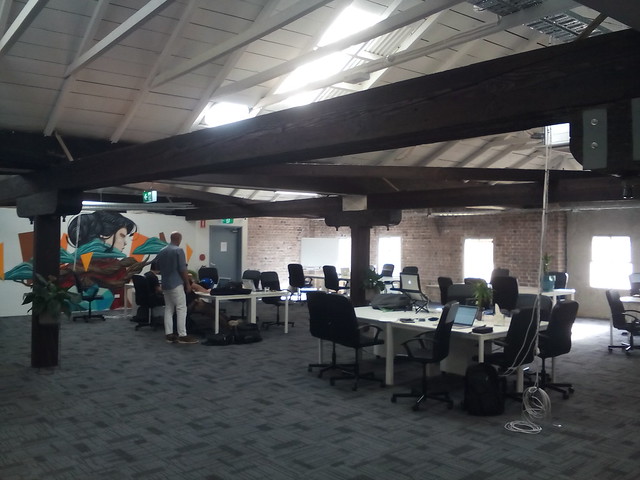
Square One Coworking Space at ANU

Wednesday, February 21, 2018
Research to Impact Program

Sunday, October 22, 2017
Educating Tomorrow’s Digitally Enabled Workforce
The report Tomorrow’s Digitally Enabled Workforce (Hajkowicz, Reeson, Rudd, Bratanova, Hodgers, Mason & Boughen, p. 87, 2016) suggests, not surprisingly, that education is critical for the future
workforce. The researchers suggest new jobs require lifelong learning (and relearning) provided by the educational sector, with business and government.
One initiative the researchers point to is Iceland's ‘Innovation Education’ (Thorsteinsson & Denton, 2003), teaching students to identify, research and solve problems. They suggest using nationally developed teaching materials, which are then adapted for local use. A local example cited is the National Digital Learning Resources Network (NDLRN), used by Australian teachers.
Hajkowicz et al. (2016) touch on the potential of so-called Massive Open Online Courses (MOOCs), but point out their low retention rate. Unfortunately, the authors seem to be assuming that MOOCs are the only form of digital learning available, ignoring several decades of successful delivery of on-line courses by open and distance universities, which predates the now fading MOOC fad. The authors suggest "better understanding" is needed if digital learning is to be into traditional campus life. However, I suggest Australian universities have now passed the tipping point where most courses are blended. Better understanding of how such on-line materials are used is required, but essentially the change to e-learning has already happened.
Hajkowicz et al. (2016) suggest that workplace learning combined with mobile technology is a natural fit for re-skilling and training. I agree, but this is not as nascent as the researchers suggest. My work in the field suggests it is happening informally, driven by the needs of the students, even where not officially recognized, or endorsed by educational institutions. This is not being held back by technology (existing Learning Management Systems such as Moodle, have been retrofitted for mobile access). The problem is that while VET teachers are trained in workplace learning, their university counterparts are not.
While discussing the need for investment in re-skilling the workforce, Hajkowicz et al. (2016) don't address the need to re-skill university educators in how to provide this form of education. Initiatives such as the ACS Intern Program, currently running at the University of Melbourne and the Australian National University, require specialised supervisory skills.
Hajkowicz SA, Reeson A, Rudd L, Bratanova A,
Hodgers L, Mason C, Boughen N (2016)
Tomorrow’s Digitally Enabled Workforce: Megatrends and scenarios for jobs andemployment in Australia over the comingtwenty years. CSIRO, Brisbane. URL http://www.data61.csiro.au/~/media/D61/Files/16-0026_DATA61_REPORT_TomorrowsDigiallyEnabledWorkforce_WEB_160204.pdf
One initiative the researchers point to is Iceland's ‘Innovation Education’ (Thorsteinsson & Denton, 2003), teaching students to identify, research and solve problems. They suggest using nationally developed teaching materials, which are then adapted for local use. A local example cited is the National Digital Learning Resources Network (NDLRN), used by Australian teachers.
Hajkowicz et al. (2016) touch on the potential of so-called Massive Open Online Courses (MOOCs), but point out their low retention rate. Unfortunately, the authors seem to be assuming that MOOCs are the only form of digital learning available, ignoring several decades of successful delivery of on-line courses by open and distance universities, which predates the now fading MOOC fad. The authors suggest "better understanding" is needed if digital learning is to be into traditional campus life. However, I suggest Australian universities have now passed the tipping point where most courses are blended. Better understanding of how such on-line materials are used is required, but essentially the change to e-learning has already happened.
Hajkowicz et al. (2016) suggest that workplace learning combined with mobile technology is a natural fit for re-skilling and training. I agree, but this is not as nascent as the researchers suggest. My work in the field suggests it is happening informally, driven by the needs of the students, even where not officially recognized, or endorsed by educational institutions. This is not being held back by technology (existing Learning Management Systems such as Moodle, have been retrofitted for mobile access). The problem is that while VET teachers are trained in workplace learning, their university counterparts are not.
While discussing the need for investment in re-skilling the workforce, Hajkowicz et al. (2016) don't address the need to re-skill university educators in how to provide this form of education. Initiatives such as the ACS Intern Program, currently running at the University of Melbourne and the Australian National University, require specialised supervisory skills.
Reference
Hajkowicz SA, Reeson A, Rudd L, Bratanova A,
Hodgers L, Mason C, Boughen N (2016)
Tomorrow’s Digitally Enabled Workforce: Megatrends and scenarios for jobs andemployment in Australia over the comingtwenty years. CSIRO, Brisbane. URL http://www.data61.csiro.au/~/media/D61/Files/16-0026_DATA61_REPORT_TomorrowsDigiallyEnabledWorkforce_WEB_160204.pdf
Thorsteinsson, G., & Denton, H.
(2003). The development of Innovation Education in Iceland: a pathway to modern pedagogy and potential value in the UK. Journal of Design & Technology Education, 8(3). URL https://dspace.lboro.ac.uk/dspace-jspui/bitstream/2134/2261/3/4205.pdf
Friday, October 6, 2017
Canberra's Entrepreneurial Ecosystem
A report on "The role of VET in the entrepreneurial ecosystem" by Scott-Kemmis (2017) has been released from the National Centre for Vocational Education Research (NCVER). This report investigated start-ups in the Australian Capital Territory (substantially the same as the city of Canberra) and what role vocational education and training (VET) qualifications of the founders had.
A high proportion of startups in Canberra were by graduates and staff of local universities. The report appears to confirm that initiatives by Canberra's local Government and universities, specifically with the Canberra Innovation Network (CBRIN) has been effective in creating a ACT entrepreneurial ecosystem. In contrast, VET qualifications appear to play little part in the startups, and the authors make recommendations for improving this.
ps: I came across this report while researching a presentation on "Digital Teaching for Entrepreneurship" for academics from China. To my surprise, I found a very recent report, not about China, but about Canberra's entrepreneurial ecosystem, which is based a less than a km from my office.
A high proportion of startups in Canberra were by graduates and staff of local universities. The report appears to confirm that initiatives by Canberra's local Government and universities, specifically with the Canberra Innovation Network (CBRIN) has been effective in creating a ACT entrepreneurial ecosystem. In contrast, VET qualifications appear to play little part in the startups, and the authors make recommendations for improving this.
ps: I came across this report while researching a presentation on "Digital Teaching for Entrepreneurship" for academics from China. To my surprise, I found a very recent report, not about China, but about Canberra's entrepreneurial ecosystem, which is based a less than a km from my office.
References
Scott-Kemmis, D. (2017). The role of VET in the entrepreneurial ecosystem, NCVER, Adelaide. URL https://www.ncver.edu.au/__data/assets/pdf_file/0028/809560/The-role-of-VET-in-the-entrepreneurial-ecosystem.pdf
Wednesday, January 11, 2017
Starting an E-Learning Business in China

Yesterday Australian entrepreneur, Nick Jenkins (詹宁锴) talked about starting the e-learning business "Language Confidence" in China.
Nick talked about his founding an education start-up at Telstra's Muru-D Start-up Accelerator, but then changing from trying to sell education on-line direct to consumers and finally concentrating on selling testing services. He was frank about the difficulties of doing business in China, but pointed out the potentially large rewards.
This raises the question of how higher education can assist such entrepreneurs. Apart from provided some basic education in the mechanics of business, which I suggest can be done on-line, courses could allow students to integrate their practical experience. I asked Nick about this and he related how he was not permitted to use is direct practical experience of leading a multi-national team in assessment for a business course (in contrast I encourage students to use their work experience).
Nick talked about his founding an education start-up at Telstra's Muru-D Start-up Accelerator, but then changing from trying to sell education on-line direct to consumers and finally concentrating on selling testing services. He was frank about the difficulties of doing business in China, but pointed out the potentially large rewards.
This raises the question of how higher education can assist such entrepreneurs. Apart from provided some basic education in the mechanics of business, which I suggest can be done on-line, courses could allow students to integrate their practical experience. I asked Nick about this and he related how he was not permitted to use is direct practical experience of leading a multi-national team in assessment for a business course (in contrast I encourage students to use their work experience).
Terry will be speaking at the next HHQ Square table event about his work with Innohub.io (Shenzhen). For upcoming HHQ Square Table Events, see the meet-up group.
Thursday, March 10, 2016
Entrepreneurship University of Canberra

Tuesday, January 5, 2016
Australian Entrepreneurs Are Thirtysomething Male Graduates in Sydney

Startup Muster published their survey of entrepreneurs and startups in December 2015. The typical person surveyed (and presumably the typical Australian entrepreneur) is male (76%), has a postgraduate qualification (41.2%), is aged 30 to 35 (23.8%), born in Australia (62%). They had no previous startup experience (50%), were previously employed in the technology field (27%). They went into a startup due to dissatisfaction with their job (33.3%).
The typical startup is in Sydney (44%) and was started in 2014 (48%). The business is abut B2B (29.1%) marketing (12.9%). The team of two people (39%) is working part time (51%) and have business skills (80.4 %) but are working on software development (72%). The team outsources (69%) its software development (64.2%) to Australia (50%). The team does not use an accelerator or incubator (75%), but they have a mentor (63%).
Monday, November 2, 2015
Boosting Entrepreneurship in Australian Universities

This report studies several universities with impressive track records as breeding grounds for entrepreneurs, and finds the following common attributes:
- Strong engagement between the university and the local startup ecosystem
- Courses delivered by experienced entrepreneurs
- Students given multiple opportunities for engagement— ranging from short courses to immersive programs such as internships and overseas placements
- Programs support multi-disciplinary collaboration that includes STEM
- Emphasis on experiential programs and learning by doing
- Funding arrangements with government drive investment in establishing and delivering student entrepreneurship programs that operate at significant scale
- Recognition and reward for academics who engage in student entrepreneurship activities
- Programs based on modern startup approaches such as Lean Startup."
From “Boosting High-Impact Entrepreneurship in Australia: A role for universities” (for the Office of the Chief Scientist for Australia, by Colin Kinner, 28 October 2015).
Examples of Australian universality start-up centers mentioned by Kinner include the Michael Crouch Innovation Centre (University of New South Wales), iAccelerate (University of Wollongong), New Venture Institute (Flinders University) and Canberra Innovation Network (Australian National University, University of Canberra, UNSW Canberra, NICTA and CSIRO). Kinner also mentioned "Piivot" at University of Technology Sydney, but this appears to be more of a concept than a specific center. UTS has what I call the "UTS Innovation Building" which has their UTS Hatchery Pre-Incubator. Kinner also mentions Ormond College (University of Melbourne), but this appears to just be a residential student college.
On Saturday I attended the Innovation ACT awards, run in conjunction with the Canberra Innovation Network (CBRIN) for Canberra's university students (the team I mentored won an award). This meets Kinner's criteria for entrepreneurial courses (and more), being by entrepreneurs made up of short modules linked to longer formal educational units and supporting multi-disciplinary collaboration.
Unlike the other centres Kinner mentions, CBRIN is multi-institutional, allowing student from different institution to work together. The ANU has also linked Innovation ACT to its degree programs through ANU TechLauncher, with students about to do the technical part of innovation in their degree program and the business part in the Innovation ACT competition.
The report has a chapter on "Best Practice Entrepreneurship Education" (Chapter 4, Page 33). However, I suggest what Australia's universities first need is introductory entrepreneurship education. This is something which takes time to develop and the first step is to tell the students that this is an acceptable activity for them to undertake and will be recognize in formal educational programs. I don't agree with distinction between "high-impact entrepreneurship" and other types: just getting the students to consider this is a useful start. Experiential programs is the worthwhile approach, but before incubators and internships, I suggest that start-up competitions and short courses are a cost effective first step for students.
Teaching entrepreneurship requires entrepreneurs to be involved, however Kinner overlooks the role of educators in the process. Entrepreneurs tend to be good talkers, but not necessarily good teachers. Start-up programs can falter after the initial enthusiasm wears off. I suggest that these programs need to be designed like any other learning experience. In particular I suggest the use of the same e-learning tools and techniques used for university courses. These can now make use of mobile devices for blended learning. In this way the program can avoid being bogged down in mountains of post-it-notes and paperwork.
The Cambridge Model
Kinner lists the University of Cambridge as third in the world for its impact on creating and supporting technology innovation and the highest ranking non-US institution, after MIT and Standford University (Figure 8, p. 35, 2015). The Cambridge approach is one which I proposed for Australian universities in 1998. Kinner points to the Centre for Entrepreneurial Learning (CfEL) at Cambridge University, which I made a brief visit to in July. However, Kinner fails to mention the decades of work which preceded this, referred to as "The Cambridge Phenomenon".Boosting Entrepreneurship in Australian Universities with Blended Mobile Learning
I will speaking at the Australian Computer Society in Sydney, 6:30pm, 4 November on "Global Green Computing On-line: Evolving Content and Assessment for an International Moodle Course" and will add some comments on entrepreneurship and blended mobile learning.Wednesday, September 16, 2015
Entrepreneurship on the Increase in Australia

"Start-up rates have been on an upward trend since the crisis in many countries, particularly in Australia and the United Kingdom, and more recently in Denmark, Portugal and Sweden. In many Euro area economies, start-up rates nonetheless remain below pre-crisis levels."
From Forward, Entrepreneurship at a Glance 2015, OECD, 5 August 2015.
Table of contents
Subscribe to:
Posts (Atom)