Showing posts with label digital teaching. Show all posts

Friday, September 17, 2021

Survey Volunteers Needed for Study of Digital Communication and Work Stress in Universities:


E-stress Survey Link
The University of South Australia is leading a study into "Digital Communication and Work Stress in Universities". They are seeking volunteers who work in Australian universities to survey.

This is an excellent initiative, however, they are focusing on those who have a full time working week. Much of the university workforce is part time and casual. These people have been exploited by universities through systematic wage theft, and threatened with loss of work. So I suggest excluding them from studies of work stress will skew the results.

As for how to reduce stress, I suggest courses designed with an asynchronous core, supplemented with online and classroom synchronous events, can help, by lowering student stress and therefore staff stress. With this approach no special arrangements are needed for a campus lock-down, or individual student emergency. The same approach can also be taken to staff meetings, with it not assumed that everyone can turn up on campus at a particular time. I will be touching on this in the webinar "Keep Calm and Carry Online", 20 October from ANU (all welcome).  

Also work stress could be reduced by teaching staff good practices as to how to work online. In response to seeing people waste a lot of time on email, in 1997 I wrote "How to Read and Write E-mail Messages". 

Scaffolded learning, where students do their assignments a bit at a time helps, as do more flexible assessment schemes. One example I have used is "best X out of X+2" assessment in a "Green computing professional education course online". The idea is that students are assessed on their best work, so do not have to worry about doing badly in, or missing, a couple of assessments. This reduces the need for students to ask for special consideration, extra time, and remarking. It also encourages students to work steadily through a course, not leaving everything to the end.

Monday, March 23, 2020

Australian Has Been Doing Distance Educaiton for 100 Years

A timely article  today on "Online schooling and distance ed? Don’t be afraid, we’ve been doing and improving it for 100 years" by Philip Roberts and Natalie Downes (Edu Research Matters, 23 March 2020). I was talking about this on ABC Radio Canberra this-morning, reassuring students and parents that distance and online education is not completely new in Australia. However, there will be frustrations for students, parents and teachers. One thing I did, as an international online student of distance education was to keep a personal journal. In my journal I expressed my frustrations with the course, the teachers, my fellow students, and the world in general. Much better than lashing out in a class, or public forum. ;-)

Sunday, March 22, 2020

Don't Depend on Live Video for Teaching: Flip It

I suggest a flipped approach for on-line educaiton, which supplements text and pre-recorded material with live participation. While video conferences, webinars, and live streaming of video with synchronous participation are popular, these makes demands on the national network infrastructure, which may not be sustainable over the coming months. This not to say don't use video conferences and live streaming, but don't depend on them working.

ps: Last year I had a project for streaming with synchronous participation, in a way which would be tolerant of network problems. Unfortunately this work has been suspended due to the pandemic emergency, so I don't have a usable product.

Thursday, March 19, 2020

Free Online Teaching Course Starting 20 March

Dr. Martha Cleveland-Innes,
Instructor
Athabasca University (Canada), is offering a free five-week online course Learning to Learn Online, starting 20 March. This is the university where I undertook a Master of Educaiton in Distance Educaiton. I was an online international student, and Athabasca certainly know how to use e-learning to teach digital teaching.
"In this , you will explore the fundamentals of the learning process and various models of online courses to determine your learning preferences and which forms of online learning are best for you. Activities will address common misconceptions, frustrations and fears about online learning, and introduce techniques to help overcome such obstacles and gain confidence as a learner.

Throughout the course you will be guided through an interactive and reflective process by a team of online learning specialists, with the opportunity to join in live sessions with leading researchers in online education.
COURSE OBJECTIVES 
On completion of this course, you will be able to:
  • Describe what it means to learn - anywhere, anytime.
  • Clarify personal learning preferences.
  • Identify common components of an online learning environment.
  • Compare differences between online and traditional learning.
  • Plan for areas of personal adjustment required for success in online learning.
  • Analyze different types of learning environments including a personal learning environment.
  • Explore and employ effective online communication tools and strategies.
  • Describe the role of an online learning community in supporting learning.
Certificates of completion are available for participants who pass all five module quizzes."

Tuesday, September 3, 2019

Teaching and Learning at Australia's Newest University College

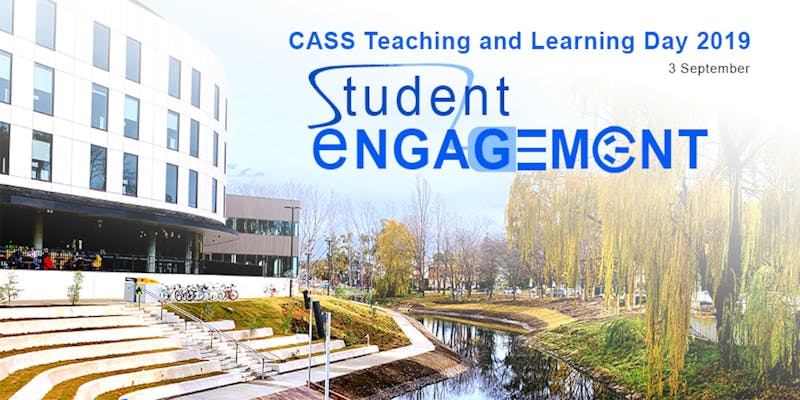
Greetings from the the Australian Nation University in Canberra, where the  CASS Teaching and Learning Day, just started. The theme is student engagement, with  interactive learning strategies and technologies. The event is being held on the "super-floor" at the top of the Marie Reay Teaching Centre. I will be using this for large format workshops later in the semester.

The keynote is by Professor Maria Northcote, Director of Higher Research Degrees at Avondale College of Higher Education. Beforehand, Maria mentioned she reads this blog, so I thought I should blog. Professor Northcote started by saying she was a constructivist in educational terms. Yesterday TEQSA approved Avondale to be an Australian University College (one step down from being a university).

Professor Northcote raised the topic of student involvement in educational design. She proposed to go beyond simply asking for feedback after the course, to negotiate what should be in it, beforehand. Also Professor Northcote discussed having advanced students teaching.

One research project Professor Northcote  described was "But when do I get my mark?".  With this the students were given qualitative feedback on their assignments, but then there was a delay before they got the mark. The idea was to get them to focus on the feedback, but in line with the title of the work, this was frustrating for the students. What surprised me was that there was no step built into the process to at least justify the delay. An obvious step would be to allow the students to revise their work, based on the feedback, before they get their mark. That would give them a positive reason for the delay.

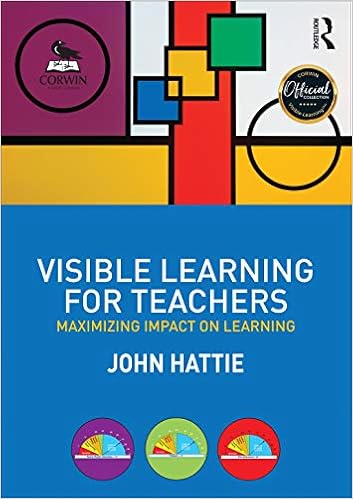
Professor Northcote  recommended the book "Visible Learning for Teachers"  by John Hattie (2012).

Coming up are:

11.00am – 1pm: Designing Interactive Learning Space – MARKETPLACE (Morning Tea through Lunch)

5 stations:
Station 1Flexible Studio Recording and Green Screen: Tips & Practices
Station 2How to Design Interactive Learning Contents using H5P
Station 3Virtual Reality in Education
Station 4Examples of good Wattle pages
Station 5Examples of Successful Innovation in Teaching at the College of Arts and Social Sciences
1pm – 3pm: Principles and Examples of Student Engagement
3 speakers:
  • Mr Eamonn McNamara, (School of History) – 2019 Vice Chancellor’s Awards for Excellence in Tutoring or Demonstrating
  • Dr Kate Flaherty, (School of Literature, Languages and Linguistics) – 2019 Vice Chancellor’s Awards for Teaching Excellence
  • Dr Kim Cunio, (School of Music) – Advocate of emerging cultures, indigenous Australians and women

Sunday, July 28, 2019

Free Teaching and Learning Day at ANU 3 Sep

The ANU College of Arts & Social Sciences (CASS) is holding a Teaching and Learning Day, in Canberra, 3 September 2019 from 9:00 am to 3:00 pm. This is free and open to anyone interested in higher education (not just ANU staff). The theme is student engagement, with  interactive learning strategies and technologies.

PROGRAM 9.00am – 9.30am: Registration
9.30am – 11.00am:
  • Welcome Address – Professor Rae Frances, Dean of College of Arts and Social Sciences (CASS), ANU
  • Opening - Professor Grady Venville, Deputy Vice-Chancellor (Academic), ANU
  • Keynote - Professor Maria Northcote, Director of Higher Research Degrees at Avondale College of Higher Education
11.00am – 1pm: Designing Interactive Learning Space – MARKETPLACE (Morning Tea through Lunch)
5 stations:
Station 1Flexible Studio Recording and Green Screen: Tips & Practices
Station 2How to Design Interactive Learning Contents using H5P
Station 3Virtual Reality in Education
Station 4Examples of good Wattle pages
Station 5Examples of Successful Innovation in Teaching at the College of Arts and Social Sciences

1pm – 3pm: Principles and Examples of Student Engagement
3 speakers:
  • Mr Eamonn McNamara, (School of History) – 2019 Vice Chancellor’s Awards for Excellence in Tutoring or Demonstrating
  • Dr Kate Flaherty, (School of Literature, Languages and Linguistics) – 2019 Vice Chancellor’s Awards for Teaching Excellence
  • Dr Kim Cunio, (School of Music) – Advocate of emerging cultures, indigenous Australians and women

Friday, October 6, 2017

Canberra's Entrepreneurial Ecosystem

A report on "The role of VET in the entrepreneurial ecosystem" by Scott-Kemmis (2017) has been released from the National Centre for Vocational Education Research (NCVER). This report investigated start-ups in the Australian Capital Territory (substantially the same as the city of Canberra) and what role vocational education and training (VET) qualifications of the founders had.


A high proportion of startups in Canberra were by graduates and staff of local universities. The report appears to confirm that initiatives by Canberra's local Government and universities, specifically with the Canberra Innovation Network (CBRIN) has been effective in creating a ACT entrepreneurial ecosystem. In contrast, VET qualifications appear to play little part in the startups, and the authors make recommendations for improving this.


ps: I came across this report while researching a presentation on "Digital Teaching for Entrepreneurship" for academics from China. To my surprise, I found a very recent report, not about China, but about Canberra's entrepreneurial ecosystem, which is based a less than a km from my office.

References


Scott-Kemmis, D. (2017). The role of VET in the entrepreneurial ecosystem, NCVER, Adelaide. URL https://www.ncver.edu.au/__data/assets/pdf_file/0028/809560/The-role-of-VET-in-the-entrepreneurial-ecosystem.pdf


Friday, May 19, 2017

Visible Learning: see learning through the eyes of students

Professor John Hattie
John Hattie (2015) argues that most teaching techniques work, but what works best is "visible learning": seeing learning from the students point of view, so they learn to learn. In this updated meta-meta-analysis it is easy to get lost ion the detail. But there are some useful, practical points for school and higher education teaching:
  1. Minimal effects of class size: Reducing class size only makes a small improvement in student's learning (Hattie mentions classes of 600 to 15). It occurs to me that the cost of staff is a large part of the education budget, so the way to improve the quality of education may be to increase class sizes. The staff time saved can be devoted to helping students.
  2. Student preparation is important: Flipped classrooms work where students actually do the preparatory work and are aware of what they have learned. As an example, I have students in my "ICT Sustainability Course" undertake a automated on-line quiz after each module.
  3. Reviewing increases learning dramatically: Hattie finds that taking notes does not help learning much, but reviewing the notes does. Also students learn from each other. As an example, I have my ICT Sustainability students answer two or three questions after each module, discuss it and them peer assess each other's contribution.
  4. Problem Based Learning (PBL) later: Hattie suggests that PBL has not been show to be effective as it has been used for first-year students who do not yet have the basic knowledge required. They argue this will be more effective for later years. In my teaching of students in the ANU TechLauncher program, this seems to be the case. Teams of third year and graduate computing and engineering students work on real projects for real clients.
  5. E-learning is just as effective as a classroom: Hattie points out that online and distance courses are just as effective as on campus learning. This has been well established in the research as the so called "No Significant Difference Phenomenon". However, many academics find it difficult to accept that their live lectures make no difference to student learning: live video, recorded video and no video at all is just as effective.
  6. Training university academics to teach: Hattie argues that training university academics to be effective teachers improves student learning. This may seem obvious, but university academics still resist the idea that they need to be trained to actually teach. Particularly at research orientated universities the emphasis is on academics conducting research on teaching, but not undertaking the type of basic learning of teaching techniques which school and vocational college teachers are required to undertake as a condition of employment.
  7. Alignment of Assessment and Course Aims: Hattie points out that students use the assessment as a guide to what is important in a course. As a recent graduate student myself, I found this very much the case. It was frustrating when the instructor had us study what was not assessed, then assessed us on something only briefly touched on in the course.

    There seems to be an article of faith amongst some in academia that students should not be driven by assessment and marks. Curiously, when it comes to rewards in the form of research grants and promotions, these same academics are very much directly driven by short term concrete rewards, not the esoteric pursuit of knowledge. ;-)

    In my own course design, I am careful to show the students the explicit link from the skills demanded by industry, the course learning objectives derived from those skills and the assessment items supporting the learning outcomes. For each module of a course the student can see there is some assessment at the end, with a deadline.

The paper is an update of the earlier book. 

Visible Learning and the Science of How We Learn

Visible Learning and the Science of How We Learn


Reference


Hattie, J. (2015). The applicability of Visible Learning to higher education. Scholarship of Teaching and Learning in Psychology, 1(1), 79. retrieved from http://psycnet.apa.org/doi/10.1037/stl0000021

Friday, February 17, 2017

Digital Learning and the Future of Education

Digital Teaching In Higher Education (book cover)
I will be speaking at the ACS e-Learning Special Interest Group in Canberra, 5:30pm, 22 February 2017. The event is free, but you need to book a seat:

Topic: Digital Learning and the Future of Education

Speaker: Tom Worthington

In January Tom completed a masters in educational technology in North America, studying the design of on-line mobile courses and use of e-portfolios (Worthington, 2016). He will discuss the experience of being an international on-line student and the implications for Australian Higher Education. Tom argues that we can expect 80% of university education to be delivered on-line by 2020 and has produced a book on "Digital Teaching" available free on-line, to help get there (Worthington, 2017).

References


Worthington T. (2016). Capstone e-Portfolio for Master of Education in Distance Education. Athabasca University e-Lab. Retrieved from http://www.tomw.net.au/masters_eportfolio/

Worthington T. (2017). Digital Teaching In Higher Education: Designing E-learning for International Students of Technology, Innovation and the Environment. Tomw Communications. Retrieved from http://www.tomw.net.au/digital_teaching/

Presentation notes: http://tomw.net.au/technology/it/digital_learning/