Showing posts with label ANU College of Arts and Social Sciences. Show all posts

Wednesday, March 30, 2022

Ukraine Destroyed the Myth of Russian Invincibility Says Ambassador Designate to Australia

Mr Myroshnychenko,
speaking in the ANU Moot Court.
Photo by Tom Worthington, CC-BY 30 March 2022

Greetings from the Moot Court at the ANU, where  Ukraine's Ambassador Designate to Australia is making an unscheduled speech, opening day two of
 "Russia's Invasion of Ukraine: A Colloquium". He said that the Ukraine destroyed the myth of Russian invincibility. Mr Myroshnychenko pointed out he doesn't have a background in diplomacy, but is a businessperson. However, his biography shows he is a specialist in strategic communications, and co-founded Ukraine Crisis MediaMr Myroshnychenko will become the ambassador to Australia officially on Friday.

In answer to a question Mr Myroshnychenko said that the US Starlink satellite communications system had been useful for both civilian and military communications in the Ukraine. He also pointed out how Russia sought manipulate public opinion using messages different for internal and external audiences.

Mr Myroshnychenko referred to the use of talk shows by Russia, 
which manipulate emotions, modeled on those popularized in the USA. He then looked ahead to how difficult it will be to reeducate the people influenced by Russian messages. He pointed out how difficult this was, with people in Germany after WWII. But perhaps a better analogy today would be with those convinced by QAnon conspiracy theories.

Information Warfare Division
Australian Department of Defence
The Australian Government yesterday announced a doubling of the staff of the Australian Signals Directorate, and expansion of offensive cyber operations. As well as technical operations, to hack into enemies computers, I suggest it would be prudent to spend some of this money on the softer side of cyber operations, with information warfare. Australian personnel have been assisting Ukraine with cyber-security training, but I suggest there is much Australia could learn from Ukraine about information warfare.

In the Q&A I asked if Australian could learn from the information warfare situation in Europe. Mr Myroshnychenko replied that Australia could play a useful role countering Russian propaganda in the Pacific. Also Dr Robert Horvath, La Trobe University, suggested Australia could learn from Estonia's experience countering cyber attacks.

Monday, March 28, 2022

European Ambassadors Discuss Russia in Ukraine in Canberra

 Chancellor Bishop opening the
Greetings from "Russia's Invasion of Ukraine: A Colloquium", at the Moot Court of the Australian National University in Canberra. Chancellor Bishop is opening the colloquium. With a row of distinguished European ambassadors, flags, and a judges bench behind, it is perhaps a foretaste of the war crimes tribunals to come. But those are likely years away.  

The colloquium is an example of one of the uses of a research university. Whatever the topic,  you can likely find an expert on it at a major university. This event has the ambassadors today, and the the ANU's strategic experts give their views Wednesday. 

One ambassador, mentioned the effect of cyber attacks on European countries, another the unexpected unity, but this will be tested as sanctions harm European economies, as well as Russia. Unexpected unity was mentioned again. The claim was made the war was "unprecedented", which seems at odds with Europe's bloody history. The prospect of chemical, biological and "other" (ie: Nuclear) weapons were mentioned, with the suggestion European countries needed to be ready with a response. Option may be limited as US doctrine call for a response in kind, if a weapon of mass destruction is used against it. So what happens if a stray chemical, biological, or nuclear weapon which causes mass causalities of US personnel deployed to a European ally? Also it was chilling to hear ambassador's saying their countries were preparing for war, and that under the NATO alliance, an attack on one country is an attack on all. In particular the representatives of the smaller European countries on the western edge of the EU think of themselves as already at war, by proxy. 

In his response Mr Kyle Wilson, Visiting Fellow,  ANU Centre for European Studies, suggested that the conflict started with a cyber attack on Estonia in 2007.

"Day 1: A diplomatic perspective from Europe

Panel 1: Collective responses to shared challenges

  • H.E. Dr Michael Pulch, Ambassador of the European Union
  • H.E. Mr Michał Kołodziejski, Ambassador of the Republic of Poland
  • H.E. Ms Satu Mattila-Budich, Ambassador of the Republic of Finland
  • H.E. Ms Kersti Eesmaa, Ambassador of the Republic of Estonia

Panel 2: The future of Europe’s security architecture

  • H.E. Mr Jean-Pierre Thébault, Ambassador of the French Republic
  • H.E. Ms Pernille Dahler Kardel, Ambassador of the Kingdom of Denmark
  • H.E. Dr Thomas Fitschen, Ambassador of the Federal Republic of Germany
  • H.E. Ms Betty Bernardica Pavelich, Ambassador of the Republic of Croatia

Day 2: Liberal democracies and threats to the rules-based international order

Date and time: 30 March, 9.30am-4.30pm

Australia’s leading authorities on Eastern Europe will examine Russia’s invasion of Ukraine from political, strategic, historical and cultural angles, and will reflect on the possible threat the conflict poses to the rules-based international order.

The speakers include Dr Robert Horvath (La Trobe University), Prof Paul Dibb (ANU), A/Prof William Partlett (The University of Melbourne), Dr Stephen Fortescue (UNSW), Mr Petr Kuzmin (President of Svoboda Alliance VIC), Mr Bertil Wenger (Konrad Adenauer Stiftung), Dr Matthew Sussex (Australian Defence College), Dr Sonia Mycak (ANU), Dr Elena Govor (ANU).

See the program and speakers here."

Tuesday, September 3, 2019

Teaching and Learning at Australia's Newest University College

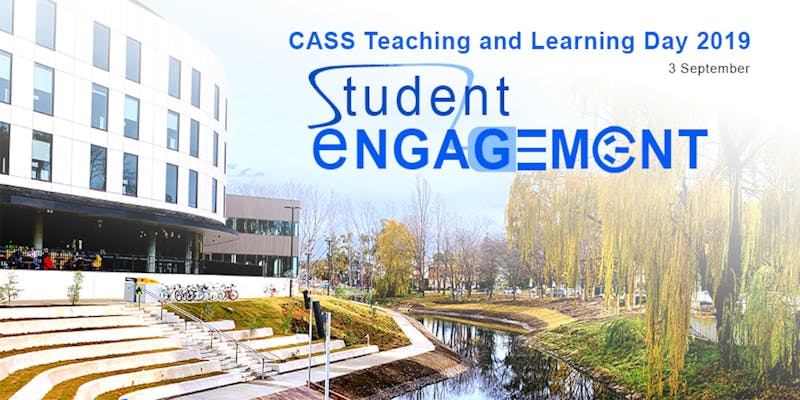
Greetings from the the Australian Nation University in Canberra, where the  CASS Teaching and Learning Day, just started. The theme is student engagement, with  interactive learning strategies and technologies. The event is being held on the "super-floor" at the top of the Marie Reay Teaching Centre. I will be using this for large format workshops later in the semester.

The keynote is by Professor Maria Northcote, Director of Higher Research Degrees at Avondale College of Higher Education. Beforehand, Maria mentioned she reads this blog, so I thought I should blog. Professor Northcote started by saying she was a constructivist in educational terms. Yesterday TEQSA approved Avondale to be an Australian University College (one step down from being a university).

Professor Northcote raised the topic of student involvement in educational design. She proposed to go beyond simply asking for feedback after the course, to negotiate what should be in it, beforehand. Also Professor Northcote discussed having advanced students teaching.

One research project Professor Northcote  described was "But when do I get my mark?".  With this the students were given qualitative feedback on their assignments, but then there was a delay before they got the mark. The idea was to get them to focus on the feedback, but in line with the title of the work, this was frustrating for the students. What surprised me was that there was no step built into the process to at least justify the delay. An obvious step would be to allow the students to revise their work, based on the feedback, before they get their mark. That would give them a positive reason for the delay.

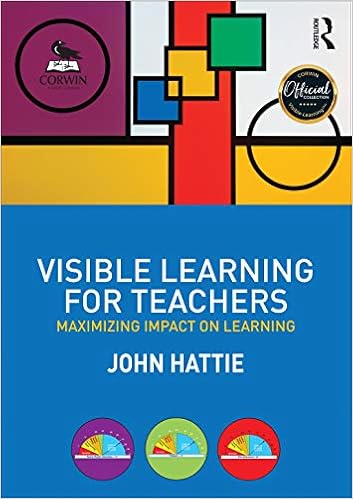
Professor Northcote  recommended the book "Visible Learning for Teachers"  by John Hattie (2012).

Coming up are:

11.00am – 1pm: Designing Interactive Learning Space – MARKETPLACE (Morning Tea through Lunch)

5 stations:
Station 1Flexible Studio Recording and Green Screen: Tips & Practices
Station 2How to Design Interactive Learning Contents using H5P
Station 3Virtual Reality in Education
Station 4Examples of good Wattle pages
Station 5Examples of Successful Innovation in Teaching at the College of Arts and Social Sciences
1pm – 3pm: Principles and Examples of Student Engagement
3 speakers:
  • Mr Eamonn McNamara, (School of History) – 2019 Vice Chancellor’s Awards for Excellence in Tutoring or Demonstrating
  • Dr Kate Flaherty, (School of Literature, Languages and Linguistics) – 2019 Vice Chancellor’s Awards for Teaching Excellence
  • Dr Kim Cunio, (School of Music) – Advocate of emerging cultures, indigenous Australians and women

Sunday, July 28, 2019

Free Teaching and Learning Day at ANU 3 Sep

The ANU College of Arts & Social Sciences (CASS) is holding a Teaching and Learning Day, in Canberra, 3 September 2019 from 9:00 am to 3:00 pm. This is free and open to anyone interested in higher education (not just ANU staff). The theme is student engagement, with  interactive learning strategies and technologies.

PROGRAM 9.00am – 9.30am: Registration
9.30am – 11.00am:
  • Welcome Address – Professor Rae Frances, Dean of College of Arts and Social Sciences (CASS), ANU
  • Opening - Professor Grady Venville, Deputy Vice-Chancellor (Academic), ANU
  • Keynote - Professor Maria Northcote, Director of Higher Research Degrees at Avondale College of Higher Education
11.00am – 1pm: Designing Interactive Learning Space – MARKETPLACE (Morning Tea through Lunch)
5 stations:
Station 1Flexible Studio Recording and Green Screen: Tips & Practices
Station 2How to Design Interactive Learning Contents using H5P
Station 3Virtual Reality in Education
Station 4Examples of good Wattle pages
Station 5Examples of Successful Innovation in Teaching at the College of Arts and Social Sciences

1pm – 3pm: Principles and Examples of Student Engagement
3 speakers:
  • Mr Eamonn McNamara, (School of History) – 2019 Vice Chancellor’s Awards for Excellence in Tutoring or Demonstrating
  • Dr Kate Flaherty, (School of Literature, Languages and Linguistics) – 2019 Vice Chancellor’s Awards for Teaching Excellence
  • Dr Kim Cunio, (School of Music) – Advocate of emerging cultures, indigenous Australians and women

Tuesday, June 25, 2019

Free Workshops on the Philosophy and Techniques of University Teaching in Canberra 16 July

The Australian National University College of Arts and Social Sciences is hosting two workshops for university teachers. These are by Dr. Dieter J. Schönwetter, University of Manitoba. Both are free and open to staff from any institution.

1. (Re)Valuing teaching philosophy statements in changing times


• Identify the purposes of a teaching philosophy statement and connect to new research findings on the holistic value of the statement
• Explore and construct the value of a teaching philosophy statement, and
• Collaboratively share ideas about the role of a teaching philosophy statement for teacher, learner, and institution

2. Teaching Techniques: engaging classroom activities


• Define theories of student engagement
• Apply theories of student engagement through teaching techniques
• List the various classroom activities that engage students

Thursday, August 9, 2018

ANU Innovation in Teaching Showcase

The Australian National University is holding the 2018 CAP – CASS Innovation in Teaching Showcase in Canberra, 4 & 5 September. The ANU College of Asia and the Pacific, and the College of Arts and Social Sciences will discuss teaching innovations. Highlights include ANU language courses with Open Universities Australia. The event is free and all teachers and academics are invited to register through Eventbrite.

Tuesday, September 10, 2013

Evolving Practice and Expectations in Teaching and Learning

Greetings from the Australian National University in Canberra, where I am talking part in "Education Development Studio Teaching & Learning Day: Evolving practice and expectations". The event is organized by the ANU College of Arts and Social Sciences and chaired by Deborah Veness. As well as ANU staff there are educators and researchers from University of Canberra and UNSW Canberra (ADFA).

Professor Robert Fitzgerald, Inspire Centre, University of Canberra, started by describing agricultural extension projects for developing nations, using mobile phones and tablet computers. He emphasized user lead design, video and delivery when needed. He then went on to describe the Inspire Centre at University of Canberra, which is purpose designed for teaching of teaching, using a "flipped" approach. He emphasized that purpose designed spaces are needed for this.Rob also pointed out that research shows reducing class sizes does not significantly improve learning outcomes (even from 30 to 15 students), the nature of the teaching needs to change with more active student involvement. He entered a controversial issue by explaining that some University of Canberra courses are combining tutorial;s to have groups of up to 70 students. There has been controversy over similar proposals to at ANU to replace tutorials with large groups.

Evolving practice and expectations

College of Arts and Social Sciences

Education Development Studio: Teaching & Learning Day

10 September 2013 - 9am for 9:15am

Program for the day

9-9.15 Coffee and introductions
9.15-9.30 Welcome from the Dean
9.30-10.30 Keynote: Professor Robert Fitzgerald, University of Canberra, Learning in the clouds, feet on the ground
10.30-11 Amanda Burrell, Lecturing as Performance: Embodied Learning - Transformed Practice
David Meacheam
11-11.30 David Meacheam, UNSW Canberra, Turnitin's GradeMark
11.30- John Minns,
ANU College of Arts and Social SciencesCombining forms of teaching delivery
12-12.30 Maria Rost,  Rublee Student Engagement – Not Entertainment – With Theory and Policy
12.30-1 Alan Hajek, ANU School of Philosophy, Philosophy and Empathy
1-2 LIGHT LUNCH

Friday, August 2, 2013

Interactive Engagement In Place of Tutorials at ANU

The College of Arts and Social Sciences (CASS) at the Australian National University (ANU), is phasing out tutorials, according to two reports in the Canberra Times ("Staff freeze and bug exposure leave ANU students susceptible", and "Small is out at ANU, worrying students", Emma Macdonald, 2 August 2013) and one in the ANU student newspaper ("CASS Tutorials an Art of the Past", Sam Bradley and Vincent Chiang, Woroni, 1 August 2013).

Tutorials will be replaced with what are described in the articles as "large interactive workshops and forums", "forums/workshops" and "flip the classroom". Dr Royston Gustavson, CASS Associate Dean (Education) is quoted:
''... Such forums/workshops are typically run by the course lecturer, rather than tutors, thereby giving students a significantly increased opportunity to interact with their lecturer. ...'' From: Staff freeze and bug exposure leave ANU students susceptible", Emma Macdonald, Canberra Times, 2 August 2013
A student quoted in the second Canberra Times article makes the point that they didn't attend lectures as an undergraduate, but learned in tutorials.

There were no further details, but the large classroom format with a lecturer and interaction appears similar to the flipped classroom approach which Dr Adam Butt describes being used for teaching Actuarial Techniques at ANU:
Butt, Adam, Student Views on the Use of Lecture Time and their Experience with a Flipped Classroom Approach (November 8, 2012). Available at SSRN: http://dx.doi.org/10.2139/ssrn.2195398

Dr Butt describes how he converted the lecture notes into readings for students before a class. The classes started with questions from students about the readings. The readings also had exercises to be completed in class (which took up most of the class time). Dr Butt also made use of Votapedia, this is a free student feedback system, similar to the use of "clickers, but using a mobile phone, smart phone or web application (developed in the CIST Building on the ANU campus by Dr Ken Taylor, of CSIRO). Students were surveyed on the teaching technique with 75% seeing it as beneficial.

Rendering of the TEAL classroom at MITIn 2007 Philip Long and Mark Schulz visited ANU to talk about the iCampus implementation of the Technology Enabled Active Learning (TEAL) at MIT and later at University of Queensland for teaching science to undergraduates. The Technology Enabled Active Learning (TEAL) project at MIT adapted what was essentially a laboratory style of teaching to other science subjects, with a technique called "interactive engagement". Short lectures are interspersed with group work in a room holding about 100 students, clustered around tables. Display screens are placed on all walls to allow students to see a presentation without the need for a mobility-limiting raked lecture theater.

The Canberra Times articles imply that tutorials would be replaced to reduce staff costs. However, MIT's research on TEAL rooms indicates they produce superior educational outcomes. Also it is not just a matter of one lecturer with a class of one hundred students: tutors are still required to assist student groups.

It should be noted that many on-line courses now incorporate live "Webinars" which use the interactive engagement technique. There are short presentations  interspersed with student activities, using the communication facilities of the webinar software for students to be able to respond. As with large face-to-face classes, it is not feasible for the presenter alone to run such a class on-line, they need assistants to help the students.

In my course ICT Sustainability I have weekly asynchronous forums for students to discuss topics. This format has proven very popular with students. Relaxing the real time constraints of a face-to-face classroom allow one teacher to handle a large class.

It should be noted that use of Interactive Engagement requires a significant investment in new course materials, teaching skills, equipment and new classrooms (when not delivered on-line). The course materials need to be carefully packaged into units of work which can be completed during the sessions. The work students need to do in advance of a workshop must be carefully considered and incentives put in place for them to actually do the work. Lecturers need new skills to teach intensively in short bursts "in the round". Tutors need to learn to think on their feet to support the fast pace. Rooms are required with furniture for small groups and display screens "in the round". Assessment needs to be designed in to enhance the student's learning.

Changes to teaching methods can't be made overnight and require years of planning. As an example, after the 2007 presentation at  ANU about TEAL rooms, I looked at how I might use these. But that would require reconfiguring current teaching spaces. Most university campuses currently have a large lecture theaters with raked floors and small tutorial rooms with flat floors. TEAL rooms are as large as a lecture theater, but with a flat floor like a tutorial room. The best example of such a facility in Canberra is the Inspire Centre at University of Canberra, with specialist furniture and a TEAL Teaching Room. But this is a new purpose built facility.

To see how an existing building might be reconfigured, in 2007 I discussed "Turning a classroom into a flexible learning space" and updated this in 2012 as "Designing a Decision Support Centre".