Showing posts with label Philosophy of Teaching. Show all posts

Sunday, March 29, 2020

Zen Martial Arts Maxims for Online Teaching

To those working hard to move courses online, due to the  COVID-19 Coronavirus, remember there is no need to replace every lecture with a video, every tutorial with a webinar, or every paper examination with an online test. I recommend the Zen martial arts maxims: Economy of effort, Realism, and Switching smoothly between techniques.

In 2014, as a student of online teaching I was required to write a personal Theory of Practice. I decided to apply Zen martial arts maxims:

1. Economy of effort

Meditation, Created by Jens Tärning from the Noun Project, CC-BY 3.0, 2014
Meditation, by Jens Tärning
from the Noun Project,
CC-BY 3.0, 2014

Martial arts emphasize maximum results from minimum effort. Similarly, learning is a means to an end and so should be done efficiently: using just enough resources to get the job done. However, most theories of education ignore the cost of an activity. There tends to be an inappropriate emphasis on trying in education, rather than succeeding.

2. Realism


Education needs to provide the student with useful skills. Students will need to start with simplified exercises, but need to be exposed to increasingly realistic problems. My students either have jobs or are training for a specific role as a professional, their studies are therefore focused on obtaining skills for that job. By providing student exercises which are based on their own workplace, or a reasonable simulation of the workplace, the students are motivated and learn useful skills.

3. Switching smoothly between techniques


Educational literature is full of explanations of why one principle, theory or technique is superior to another. But one approach will rarely do for all situations. Educators need to move smoothly from one technique to another. Students will need times when they learn alone and then others in a group. They can learn the basics using a simple drill and practice computer program (based on behaviorism theory) and then explore advanced topics with other students.

From the chapter "Theory of Practice", of the book Digital Teaching In Higher Education by Tom Worthington, 2017.

The Zen maxims are from Bruce Lee's Tao Of Jeet Kune Do
(Lee, 1975).

Monday, February 10, 2020

Reflecting on Reflecting on Learning

Learning to Reflect" blended module. This is the last assessed task for students undertaking the ANU Tech Launcher program before they graduate. Last semester the students read notes, watched videos, did an online quiz, participated in an on-line forum (with peer assessment), then a face-to-face workshop (run by Tempie Archer, from ANU Careers). They then submitted and assignment (with peer feedback), and repeated the process. That all worked well, but was seem by the students, and my colleagues, as too complex, and too much work. There was too much to read, too many assessment items, and too much peer assessment. Also the tutors, who the students have for face-to-face tutorials, felt excluded from the process.


Saturday, October 19, 2019

Blending Soft Skills for University Graduates

Wall mounted LCD screens and desks on wheels at ANU Marie Reay Teaching Centre
Wall mounted LCD screens
& desks on wheels at
ANU Marie Reay Teaching Centre
On 20 November I am speaking at the ANU TELFest technology-enhanced learning conference, on How to blend and flip a course for a flatpack classroom. This is for ANU staff, but I would be happy to speak on this elsewhere. In particular I will be in Sydney 28 to 29 October, and Perth on Wednesday 13 November, if anyone would like to provide a venue and an audience.

Tuesday, July 16, 2019

Reflecting on Reflecting on Teaching

Greetings from the Australian National University where I am attending a workshop on "(Re)Valuing teaching philosophy statements in changing times", with Dieter J. Schönwetter. This was organized by Deborah Veness, for the ANU College of Arts and Social Sciences (CASS), plus staff from ANU Training and Development Providers, and universities across Canberra.

This is one of many workshops, seminars and formal courses I have undertaken to try to learn to write a personal teaching philosophy statement. One useful question in this workshop is:
"Why develop a personal teaching philosophy statement?"
I have had to write these statement for an education course, for the HERDAS Fellowship (unsuccessfully), an MEd, and the Higher Educaiton Academy.
 
One thing a teaching philosophy statement is not, is a substitute for teacher training.

Tuesday, June 25, 2019

Free Workshops on the Philosophy and Techniques of University Teaching in Canberra 16 July

The Australian National University College of Arts and Social Sciences is hosting two workshops for university teachers. These are by Dr. Dieter J. Schönwetter, University of Manitoba. Both are free and open to staff from any institution.

1. (Re)Valuing teaching philosophy statements in changing times


• Identify the purposes of a teaching philosophy statement and connect to new research findings on the holistic value of the statement
• Explore and construct the value of a teaching philosophy statement, and
• Collaboratively share ideas about the role of a teaching philosophy statement for teacher, learner, and institution

2. Teaching Techniques: engaging classroom activities


• Define theories of student engagement
• Apply theories of student engagement through teaching techniques
• List the various classroom activities that engage students

Tuesday, March 12, 2019

How to Blend and Flip a Course for a Flatpack Classroom

Next Friday, 15 March I will be speaking on "Blend, Flip, and Back to the Classroom". So I thought I should collect my thoughts on what to say. Here are some note, so far:

In 2008 I ended my last lecture for the year at ANU by announcing it would be my last lecture, ever. Having become disillusioned with the lecture format, I have been teaching online for the last ten years, with an award winning course offered by three institutions, in Australia and North America. During that time I looked at alternative classroom designs in Australia and around the world.

In February 2019 the Australian National University unveiled the Marie Reay Teaching Centre, a flexible teaching building. So this year I am going back to the classroom, to apply what I have learned, with a blend of online and classroom teaching in the new building. This is intended to be a model for how academics can easily convert conventional courses to new interactive ways of learning, and allow each student to choose the blend of online and classroom learning to suit their needs.

Overview of the Learning Module


I produced slides, and a video for the revised learning module, on how to provide students with help when preparing a reflective portfolio. This is for students of  ANU Tech Launcher, but intendeds to be able to be used more widely. The module has two parts, with the same format: read the notes, do an online quiz, participate in an on-line forum with peer assessment, then a face-to-face workshop, lastly do an assignment with peer feedback.

New Flexible Teaching Spaces at ANU

ANU Marie Reay Teaching Centre
The Marie Reay Teaching Centre opened at ANU 25 March, along with the Culture & events building opposite, both by Architects BVN. These buildings have flexible teaching spaces, but flexible in different ways. The culture and events building has a 500-seat auditorium, and a 200 seat flexible space. Both of these have tiered lecture theater style seating, but which retracts electrically, providing large flat floor spaces, with high ceilings.

In contrast, the Marie Reay Teaching Centre has only flat floor classrooms, for 30, 60, or 120 students. The flexibility here is provided by retractable walls, furniture on wheels, and electronic screens on multiple walls.

147 seat seminar room,
ANU Sciences Teaching Building


This approach of one building with lecture theaters, and one with flat floor classrooms, differs from attempts to combine the features of the two. As an example, the ANU Sciences Teaching Building has a 147 seat tiered seminar room. The room has wide tiers with fixed tables for groups of seven students. This is designed so students can watch a presentation at the front of the room, and then discuss it in a group, around their table. However, the tables take a lot of space and are fixed in place. Display screens on the tables block some of the view.

In contrast, the ANU Kambri complex has two buildings with specialized seating for specific pedagogy. The ANU Cultural Centre Building has high density tiered theater fixed seating for lectures. Opposite is the Marie Reay Teaching Centre with low density flat floor movable seating and tables for group work. This has the advantage that both format rooms can be used simultaneously. and offer a greater overall seating capacity, than would general purpose lecture/group rooms.
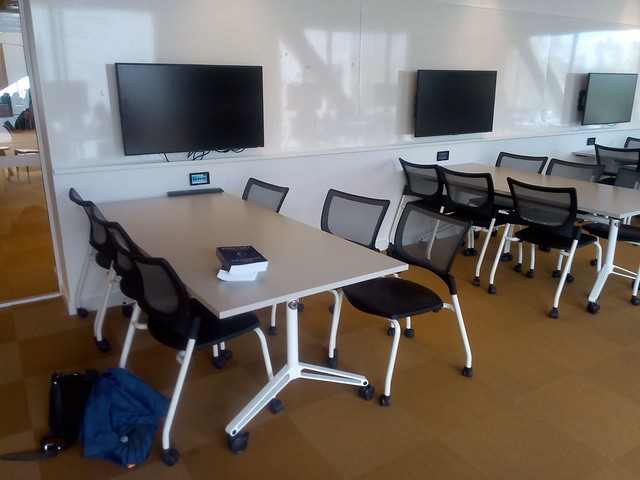
Wall mounted LCD screens and desks on wheels at ANU Marie Reay Teaching Centre
Wall mounted LCD screens
& desks on wheels at
ANU Marie Reay Teaching Centre
While the tables in the Marie Reay Teaching Centre are on wheels, one room (4.02) has five electronic screens on each side wall, spaced to allow each of five desks to have a screen (for a total of sixty students). This overcomes the problem of the desks becoming immovable, when computer screen are installed on them.

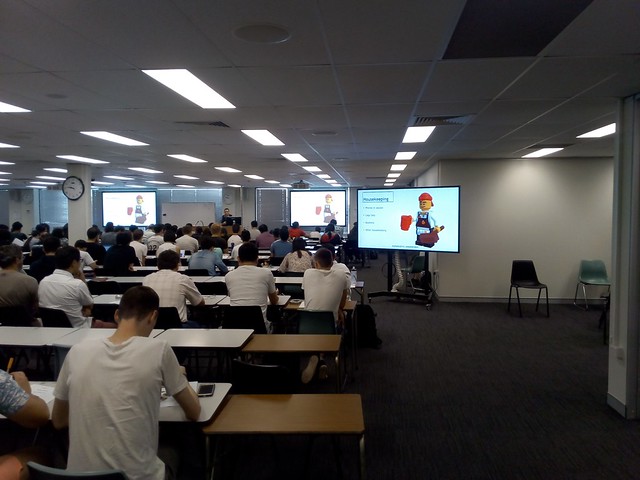
Students doing a Lego Serious Play exercise at the Australian National University in Canberra
Screen of Wheels, in use at the
ANU Barry Drive classrooms,
for ANU TechLauncher group activity
Other rooms have two projection screens for presentations. I have suggested these be supplemented with screens on wheels, which can be positioned for group work, or to display what is on the main screens. Such screens on wheels have been used at the ANU Barry Drive classrooms for an ANU TechLauncher group activity.

Top Down Course Design

My approach to course design reflects the limited flexibility of the new buildings. Flexibility is provided, but not at the expense of efficiency.

The learning is designed top down: start with the learning objectives, or externally set requirements. These set, in broad terms, the knowledge and skills the student must have on completion of the course.  Often these objectives are not provided to the educational designer, or are so vague they are of little use, so they have to be found, or invented.

For the Reflective Learning module, I first tried adapting skills definitions from the Skills Framework for the Information Age:
"Upon completion of this module, students will be able to:
  1. Determine their own learning needs and possible sources, to develop individual skills for a project and for their career development.
  2. Identify appropriate accreditation and qualification paths. 
  3. Manage the learning, and evaluate its effectiveness through through reflection."
 From the skill "Learning and Development" (ETMG), Level 6, SFIA, Version 7, 2017. As used in "Learning to Reflect" (Version 0.1), February 4, 2019.
SFIA is used by the Australian Computer Society for accreditation of Australian university degrees, and by some employers in defining jobs. It is useful to have course objectives aligned with SFIA, to make accreditation quicker, and so graduates can easily show employers they have required skills.

However, as I writing a module for use in an existing course, and that course was not aligned with SFIA, this approach did not work. In a later draft I replaced the SFIA objectives, with ones from the course definition:
"The module is aligned with two of the outcomes for the course:
3. 'learn any specific technical skills required by their topic, and apply them to project work.
4. apply and deepen skills in oral and written communication, and apply these in a project context.'
From Computing Project, Course COMP8715, ANU, 2019. URL https://programsandcourses.anu.edu.au/course/comp8715" as cited in "Introduction", of Learning to Reflect, Version 1, February 13, 2019.

Aligning Assessment with Leaning

My usual approach is to continue the top down development, by providing one major assessment task for each learning objective. However, in this case the final assessment task was already set by the existing course the module. So I have to set other assessment around this.
The main issue the module was intended to address was the difficulty Masters of Computing students had with the large assessment task at the end of semester. The obvious solution was to break this assignment into pieces delivered in sequence. However, the same assessment task is undertaken by students in multiple courses, all of whom are in the same tutorial group with the same tutor. Having different versions of the assignment for different students would be confusing for tutors and students.

Chunky Blended Learning

Designing learning takes time. I started designing the learning module in late 2018. At that time I was not sure if the new classrooms would be completed for first semester 2019. Even the week before semester started in February 2019, there was construction equipment around the building. However, this was quickly cleared away and the building opened on time, with the classroom equipped.

However, in late 2018 I could not be certain everything would be ready. So I used a conservative approach to blended course design, using what  Fleck (2012) refers to as "chunky" blended learning:
'The term "blended learning" usually refers to a mix of conventional face-to-face elements combined with on-line elements. However, this is at too general a level for in depth analysis, while the term "blend" perhaps suggests too homogeneous a mix: in practice the mix is more "lumpy", more a chunky fruit salad than a blended smoothie. At one extreme it is becoming routine for campus-based virtual learning environments (VLEs) to be used to provide additional notes and materials supporting conventional lectures.'
From Fleck (2012).
 The design is essentially a distance education course, with face-to-face workshops added. The learning management system (LMS), in this case Moodle (part of ANU's Wattle system) is used for providing students with course notes, videos, podcasts and other materials. The LMS is also used for routine announcements to the class, and individual communication with students. Small assessment tasks (quizzes and forum posts) are provided via Moodle's quiz and forum modules. Assignments are similarly done using the workshop module of Moodle.
As it was not clear what classroom would be available, the workshop design was kept general, and drawing on the preceding online activities.
  1. Announcements: General announcements while students set up the room.
  2. General Questions: Students can ask for clarification on administrative, content and assessment questions. Groups first discuss the question and if they are not  sure of the answer it can be put to the whole room.
  3. Forum Questions: Discuss your answers to this week's forum questions.
  4. Assignment Master Class: Bring along your draft assignment, ask for feedback from your group. Be prepared to put it up on the big screen for group feedback.
  5. Wrap-up: Any concluding remarks by students and instructors.
The same  format is used for all workshops, so that staff and students can become familiar with it. This avoids limited class time being taken up with explanations of complex exercise formats.

Chunky Online Learning

As well as the blended and online learning being chunky, the online component is in large chunks. The student is provided with a package of material for two weeks. This has notes, suggested readings, a quiz, discussion questions, workshop, and assignments. While the student is expected to undertake the work in this order, exactly what they do when in the two weeks is left largely to the individual.

This contrasts with tightly scripted online learning modules which give the student a few paragraphs to read and perhaps a video, then an automatically marked question they have to answer before proceeding to the next item. Such packages require considerable design and testing if they are not to hold up and frustrate students. Also these tend to require a high speed reliable network connection to function. In contrast the chunky approach allows students to download material, and use it offline.

References


Fleck, J. (2012). Blended learning and learning communities: opportunities and challenges. Journal of Management Development, 31(4), 398-411. http://dx.doi.org.virtual.anu.edu.au/10.1108/02621711211219059 
Worthington, T. My Last Lecture, Net Traveller (Blog), August 20, 2008. URL https://blog.tomw.net.au/2008/08/my-last-lecture.html 
Worthington, T., "A Green computing professional education course online: Designing and delivering a course in ICT sustainability using Internet and eBooks," Computer Science & Education (ICCSE), 2012 7th International Conference on , vol., no., pp.263,266, 14-17 July 2012 URL: http://dx.doi.org/10.1109/ICCSE.2012.6295070 Preprint available at: http://hdl.handle.net/1885/9013 
Worthington, T. Learning to Teach in the New ANU Teaching Building, Higher Education Whisperer (Blog), February 11, 2019. URL https://blog.highereducationwhisperer.com/2019/02/learning-to-teach-in-new-anu-teaching.html 
Worthington, T. Helping Computing Students Prepare a Reflective Portfolio: Parts 1 to 7, Higher Education Whisperer (Blog), November 28, 2018 to February 13, 2019. URL https://blog.highereducationwhisperer.com/search/label/Reflective%20Portfolio%20Course

Monday, September 17, 2018

Training Tech Professionals to Teach: Part 14

In Part 13 I looked at  "Guidelines for Teaching @MIT and Beyond".  But teacher training do universities require their new teachers to have? The first teaching someone is likely to do at university is tutoring. The School of Mathematics and Physics at University of Queensland require new tutors to undertake five hours of training.  However, details of what is in the training is not provided on the UQ website.

The ANU offers Principles of Tutoring and Demonstrating (PTD) for new tutors,. with ten modules:
  1. Setting the Scene Reflective Practice
  2. Student Learning
  3. Planning a Tutorial
  4. Teaching Groups & Individuals
  5. Dynamics and Diversity
  6. Peer Observation
  7. Intro to Wattle for Tutors
  8. Assessment and Marking
  9. Evaluation
  10. Troubleshooting (The Tutorial Toolkit)
Each module is two hours long, making a total of  20 hours. That is equivalent to half a week full time study and four times as long as the UQ course. The students don't get a recognized AQF qualification at the end of the program, but can apply for Associate Fellow status with the Higher Education Academy (AFHEA).

The Higher Education Academy use the UK Professional Standards Framework (UKPSF) for early career academics, higher degree students who are tutoring, part-timers, learning technologists, learning developers and  library staff.

This requires "successful engagement" with two of five Areas of Activity:
  1. Design and plan learning activities and/or programmes of study
  2. Teach and/or support learning
  3. Assess and give feedback to learners
  4. Develop effective learning environments and approaches to student support and guidance
  5. Engage in continuing professional development in subjects/disciplines and their pedagogy, incorporating
    research, scholarship and the evaluation of professional practices 
It is curious that the HEA would require any two of these for a beginner. It would be usual for a beginner to start with teaching (2), then assessment (3), and some planning (1). Only after some training and experience would it make sense to undertake design (1). Also professional development (5) is not applicable to someone who has not yet undertaken their initial training (and so is not yet a professional). But the UKPSF could still be useful for framing teaching.

For the AFHEA the applicant also requires "Core Knowledge" of the subject material they are teaching. In the case of a university teacher, this would normally be obvious from their qualifications (in this case in computing). Of more interest is the requirement for "Appropriate methods for teaching, learning and assessing in the subject area and at the level of the
academic programme" (K2). The applicant also requires "relevant professional practices, subject and pedagogic research and/or scholarship within the above activities".

Tuesday, January 2, 2018

Being a Mature Age University Student: 2011 to 2017

Tom Worthington in academic regalia with his Master of Education in Distance Education, awarded by Athabasca University (Canada), 18 January 2017
Recently I was asked about studying as a mature age student. What inspired me was that as someone teaching at a university in 2011 I was required to undertake a short free course in how to teach. After that I enrolled in the six month follow-on certificate. I ended up completing half at my campus in a classroom and half on-line through another institution.  Seeing the benefits of learning to teach (it made teaching much easier and less stressful) and because of my interest in distance education, I enrolled in Athabasca University's on-line Masters of Education in Distance Education in 2013 and completed in late 2017.  I documented the experience, starting on day 1 in 2011, up to 2017:

Thursday, November 9, 2017

Developing my Philosophy of Teaching Statement

Greetings from the Charles Sturt University Canberra Campus, where Pam Roberts from CSU and Karin Oerlemans from Kairos are running a HERDSA workshop on "Developing your Philosophy of Teaching Statement"

This is no powerpoint click and flick exercise. We started at 4:30pm and are going through until 7pm, undertaking a series of short group and individual exercises exploring how we see teaching and our role in in. The workshop is aimed at helping those applying under the HERDSA Fellowship Scheme, but is also applicable to other educational fellowships, particularly the Higher Education Academy (HEA).

One exercise was the Curriculum Ideologies Inventory from "Curriculum Theory: Conflicting Visions and Enduring Concerns" by Michael Stephen Schiro (2012).

Also I have been attending "Talk about Teaching and Learning" (TATAL) sessions at the Australian National University. These sessions take the educator through a series of exercises over several weeks to get them to think about their teaching practices (McCormack, & Kennelly, p. 8, 2009).

The reflective writing process is one now familiar to me having been through the process to be a Fellow of the Higher Education Academy (UK) and before that in a  capstone for Athabasca University's MEd. However, this is something which still does not come naturally. Having do it several times I am tempted to use shorthand:

Tom Worthington's Philosophy of Teaching Statement
A social constructionist undertaking mentored, collaborative online learning  (Lindley, 2007) for scaffolded vocational professional education. For details, see my book "Digital Teaching In Higher Education".

Reference

Lindley, D. (2007, November). Computer professional education using mentored and collaborative online learning. In SEARCC 2007, Proceedings of the South East Asia Regional Computer Conference (pp. 18-19). URL http://ijcim.th.org/SpecialEditions/v15nSP4/P09SEARCC_ComputerProfessionalEducation.pdf

McCormack, C., & Kennelly, R. (2009, February). Talking about Teaching and Learning (TATAL). In A Transition Pedagogy: The First Year Experience Curriculum Design Symposium 2009 (p. 8). URL https://www.researchgate.net/profile/Sally_Kift/publication/266461923_A_Transition_Pedagogy_The_First_Year_Experience_Curriculum_Design_Symposium_2009_Introduction_-_The_Contemporary_First_Year_Experience/links/54b5e1480cf26833efd3455e/A-Transition-Pedagogy-The-First-Year-Experience-Curriculum-Design-Symposium-2009-Introduction-The-Contemporary-First-Year-Experience.pdf#page=8

Friday, October 20, 2017

Lego Play for Higher Education Academy Recognition

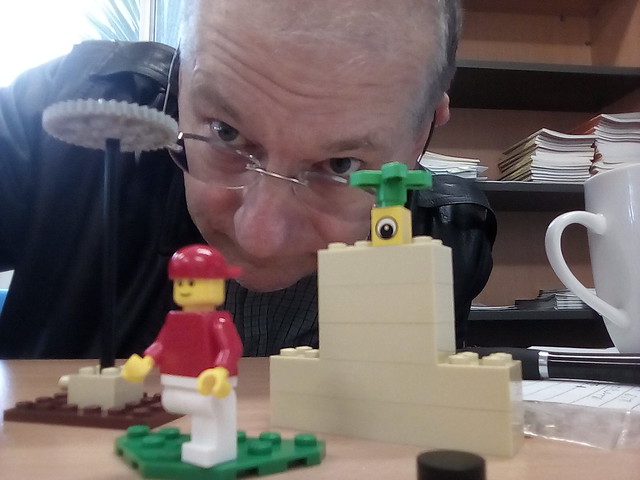
Tom Worthington taking part in Lego Serious Play session at the Australian National University, 20 October 2017 http://blog.highereducationwhisperer.com/2017/10/lego-play-for-higher-education-academy.html
My teaching philosophy,
expressed in Lego.
Today I took part in a Lego Serious Play session run for staff at the Australian National University in Canberra. This was conducted by Dr Stephen Dann, who customized the session to help those working on their Higher Education Academy Professional Recognition.


We were each provided with a pack of Lego bricks and taken through a sequence of quick exercises, where we each built something and then discussed what we had built. This was a very carefully structured process, starting with concrete exercises to get us used to working with the bricks, through increasingly abstract discussing of our teaching and supervision practices.


This may sound like a frivolous exercise of adults playing with children's blocks. However, it was a way for us to reflect and discuss what we do with teaching and research. It turned out to be a very intense and at times emotional process. In a few hours of "play" I discovered aspects of how I think about teaching which I had not realized in my previous three and a half years of formal graduate education. I am tempted to submit a Lego stop-motion movie as my HEA application, in place of the usual text document. ;-)


There is a 22 page "Introduction to LEGO ® SERIOUS PLAY ®". No fee needs to be paid to Lego to use the "Method", but obviously they would like you to buy their Starter Kits of Blocks. In addition there are are books on the method and scholarly papers

Tuesday, September 10, 2013

Evolving Practice and Expectations in Teaching and Learning

Greetings from the Australian National University in Canberra, where I am talking part in "Education Development Studio Teaching & Learning Day: Evolving practice and expectations". The event is organized by the ANU College of Arts and Social Sciences and chaired by Deborah Veness. As well as ANU staff there are educators and researchers from University of Canberra and UNSW Canberra (ADFA).

Professor Robert Fitzgerald, Inspire Centre, University of Canberra, started by describing agricultural extension projects for developing nations, using mobile phones and tablet computers. He emphasized user lead design, video and delivery when needed. He then went on to describe the Inspire Centre at University of Canberra, which is purpose designed for teaching of teaching, using a "flipped" approach. He emphasized that purpose designed spaces are needed for this.Rob also pointed out that research shows reducing class sizes does not significantly improve learning outcomes (even from 30 to 15 students), the nature of the teaching needs to change with more active student involvement. He entered a controversial issue by explaining that some University of Canberra courses are combining tutorial;s to have groups of up to 70 students. There has been controversy over similar proposals to at ANU to replace tutorials with large groups.

Evolving practice and expectations

College of Arts and Social Sciences

Education Development Studio: Teaching & Learning Day

10 September 2013 - 9am for 9:15am

Program for the day

9-9.15 Coffee and introductions
9.15-9.30 Welcome from the Dean
9.30-10.30 Keynote: Professor Robert Fitzgerald, University of Canberra, Learning in the clouds, feet on the ground
10.30-11 Amanda Burrell, Lecturing as Performance: Embodied Learning - Transformed Practice
David Meacheam
11-11.30 David Meacheam, UNSW Canberra, Turnitin's GradeMark
11.30- John Minns,
ANU College of Arts and Social SciencesCombining forms of teaching delivery
12-12.30 Maria Rost,  Rublee Student Engagement – Not Entertainment – With Theory and Policy
12.30-1 Alan Hajek, ANU School of Philosophy, Philosophy and Empathy
1-2 LIGHT LUNCH