| Marghanita da Cruz & Tom Worthington at the ANU Celebration of Giving, in the Great Hall of University House. Photo by Adam da Cruz, 24 November 2014 |
Saturday, July 25, 2026
ANU University House Reopening
Wednesday, August 20, 2025
McCusker Institute on ‘Shared Prosperity
Katherine brought the issue by pointing to University of Technology Sydney referring staff being made redundant to stress relief advice.
The solutions to some intractable problems seem so simple. We can reverse global warming with a carbon tax. Poverty can be eliminated by removing tax breaks for the rich to fund welfare. The solutions are easy but how do we incentivise to do this?
As a retirement age person who owns the home I live in, with imputed shares and a tax free super balance, I feel guilty. I understand previous governments bribed older voters, but this has reached absurdly generous levels. Couldn't we add "average" to the tax breaks? So the average home, share dividends and super balance would get tax breaks.
Katherine is presenting examples of companies with a social conscious. However, are these companies funding lobbyists to go to government and demand to pay more tax.
I suggest universities can help. However, they need to also address their internal inequalities. A meritocracy doesn't have to be winner-takes-all. Only one of Australia's universities is a foreign owned for-profit company. The rest don't need to be run like a caraciture of 19th century capitalism. There are other models which combine academic traditions and social enterprise enterpurship.
I am a member of my professional body, which employs people to get our views in front of policymakers. Many groups can't afford this, but perhaps students of politics, business and related disciplines could do this for their work experience.
Wednesday, February 12, 2025
Change processes at an Australian university
Greetings from the lawn outside the maths building at the Australian National University, where the new Provost, social scientist, is taking about how to integrate tech and people. They are qualified to talk on this, being an engineer and social scientist. This is opportune with the ANU engineering just renamed "Systems and Society".
Tuesday, October 15, 2024
What do employers want?
Greetings from the final TechLauncher workshop at the Australian National University. This is a chance for students to not only listen to potential employers but also talk to them. Of course many computer students already have jobs, as they have in demand skills. There are some extra requirements for computer people, such as a Github account to show they can code. The workshop is held in "The Hive" which is an open plan area set up to look like a typical shared office environment.
| Bianca Sawyer, Quantum Brilliance |
| Kevin Landale, Digital Atelier |
These workshops are intended to help students, but a bonus for staff, such as myself, is to meet interesting people from interesting companies. The three company representatives (who are also company founders) talked about how they ended up where they are.
| Jonathon Stapels, Overflow Solutions |
Friday, December 10, 2021
ANU DVC on the Future of Learning
"Massive digital disruption of the pace and scale we have seen was not on the agenda for our higher education system. While Australian universities have managed with varying degrees of success to deliver emergency online learning in the wake of COVID19, most of us are still processing what the last 18 months mean for the future of university learning and teaching. In this presentation I will draw on my experience managing change across this period to explore some of the opportunities offered by this new normal, reflect on the comfortable assumptions that have been shattered, and question what it might take if we are to emerge from this moment in better shape than we went in."
Friday, November 13, 2020
Designing Micro-credentials for an Australian University
Greetings from the Designing Micro-credentials and Professional Short Courses at the Marie Reay Teaching Centre at the Australian National University. This is my first time in a classroom since March, either as a teacher or student, due to COVID-19.
It was exciting to be in a room with colleagues (a very large room with a lot of space and other COVID precautions). The instructor took some time to get used to teaching in a classroom, using online terminology and techniques (which was amusing).
The ANU introduced a Micro-credentials Procedure (5 October 2019). The term has no set definition so ANU has defined the specific way it sees these short qualifications being used, for postgraduate studies which offer credit to a degree, over days or weeks, not months. ANU will be using the same Moodle platform as used for courses, by customized for micro-credentials.
A micro-credential could be delivered in a classroom, blended, or fully online. However, the assumption is that most will be at least partly, if not entirely online. The coursers will use a mix of synchronous and asynchronous approaches (that is some in real time with the students in the room or a video conference online at the same time, but mostly the student studying materials in their own time).
The key issue I see for success with micro-credentials is avoiding attempting to duplicate a traditional university campus academic experience. This is because, in part, that experience is a myth and much of that which is real is not suitable for mature students who would undertake a micro-credential. Traditional university teaching has lectures and tutorials, where the teaching staff do most of the talking and students spend their time listening (or in fact not listening). In reality most students did not attend the lectures and if required to attend tutorials do not actively participate. What a micro-credential, or any good university course, needs to do is get students working.
At the workshop we were shown several online tools designed to get studnts active and communicating with each other. Examples were a simulated posit note wall using mural.co , a quiz using kahoot.it, and voting using menti.com. I did not find any of these particularly useful or engaging. These will be particularly unappealing to more mature learners, assuming they can get the interface to work, and their poor accessibility features do not prevent use. One of the participants at my table mentioned the use of Slack.com, and I suggest that is more the type of application which will be of value for advanced learners. The emphasis should be on students interacting with each other on substantial projects over time, not quick exercises driven by an instructor.
The particular micro-credentials I have in mind are tech-teaching. This would provide an introduction to teaching for those in technology fields, such as computing. These could be university tutors, or those doing small amounts of training in a workplace. This would be aligned with the Skills Framework for the Information Age SFIA, such as Learning delivery ETDL.
One point is that with this type of educational offering meeting other course participants is as important as the content. This may require more than the usual icebreaker activities.
The ANU staff introduced aspects of the micro-credentials policy, as well as how to go about designing a course, with leaning objectives for a target audience. How to design a course I am familiar with, having been formally trained to do this. However, micro-credentials have their own requirements, being short and for a very specific audience. It occurs to me that the ideation process used in product development could be of use.
Micro-credentials introduce restrictions on the educational design and delivery process, beyond those of conventional courses. My practice has been to design pure online courses, and then add face to face elements. I will try adding a third step: first designing a set of microcredentials, which can be combined to create a conventional course, run in blended, or online mode. This should be easier than starting with a conventional course and then trying to modify it to be a set of microcredentials.
One area where I suggest more guidance is needed on micro-credentials is timing and structure. A typical Australian university student would be expected to do about 40 hours study a week for 12 weeks. Microcredentials are meant to be short, however, university lecturers have a tendency to try to cram too much into a course.
It may take several attempts for any organisation to come up with a workable strategy for micro-credential. I suggest treating the first version as a pilot.
Saturday, October 5, 2019
Report on Breech of Australian National University Systems
The Australian National University has released a 20 page "Incident Report on the Breech of the Australian National University's Administrative Systems". The supporting materials may also be of interest.
Contents of the report
- Vice-Chancellor’s Foreword
- Executive summary
- Detailed timeline of the data breach
- Figure 1: Simplified overview of actor
- Figure 2: Attack timeline
- Post notification events
- Malware and tradecraft analysis
- Lessons from the attack and follow-up actions
- Personally identifiable information
- Phishing awareness
- Table One: Issues and Remediation
- Appendix
- Appendix A: “invitation” phishing email
- Appendix B: “meeting” phishing email
- Appendix C: “planning” phishing email
"In early November 2018, a sophisticated actor gained unauthorised access to the ANU network. This attack resulted in the breach of part of the network known as the Enterprise Systems Domain (ESD), which houses our human resources, financial management, student administration and enterprise e-forms systems.
By gaining access to ESD, the actor was able to copy and steal an unknown quantity of data contained in the above systems. There is some evidence to suggest the same actor attempted to regain access to ESD during February 2019, but this second attack was ultimately unsuccessful. ...
Technical gaps aside, ANU ultimately views this breach and cybersecurity more broadly as an organisational issue, one which requires a change to the University’s security culture to adequately mitigate. It is through this lens we will undertake the next phase of our cybersecurity work – a strategic information security program. This program encompasses the modernisation of IT and security infrastructure and, more importantly, an emphasis on culture and security awareness among students, staff and researchers; and the protection of the data they entrust to ANU.
The investigation following the breach, which contributed to the contents of this report, was conducted in close cooperation with Australian Government security agencies and Northrop Grumman. ANU is grateful for their continued support."
Tuesday, August 21, 2018
Online Courses Offered by Australian Universities
- Australian National University: Evidence-Based Management
- Curtin University: Human Rights,Marketing in a Digital World, Internet of Things (IoT),
- UQ: Business Leadership, Corporate Innovation, Sustainable Energy, Leadership in Global Development
- University of Adelaide: Big Data
Australian universities also offer some online degrees and online versions of campus courses, to their own students and those of other institutions. As an example, the ANU offers twelve undergraduate language subjects through Open Universities Australia. In total ANU offers 116 online courses, of these 30 are undergraduate.
Monday, March 12, 2018
Decreasing Campus Energy Use With Flexible Classrooms and e-Learning
Use Classrooms More Intensively
One way to reduce energy use per person is by increasing the intensity of use of the buildings. Empty rooms use almost as much energy as full ones, so the more use of each room in each building, the lower per person energy use.
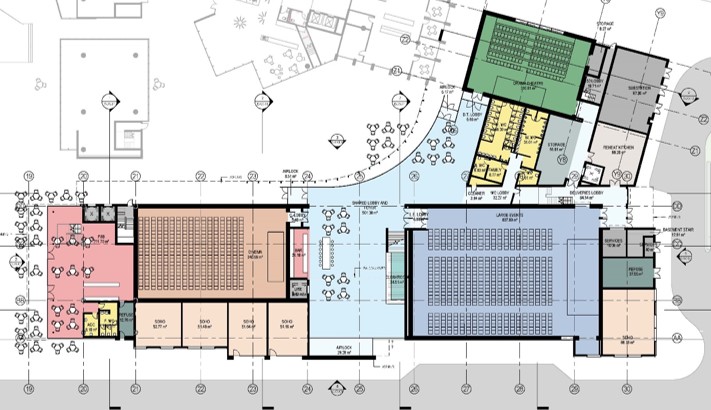
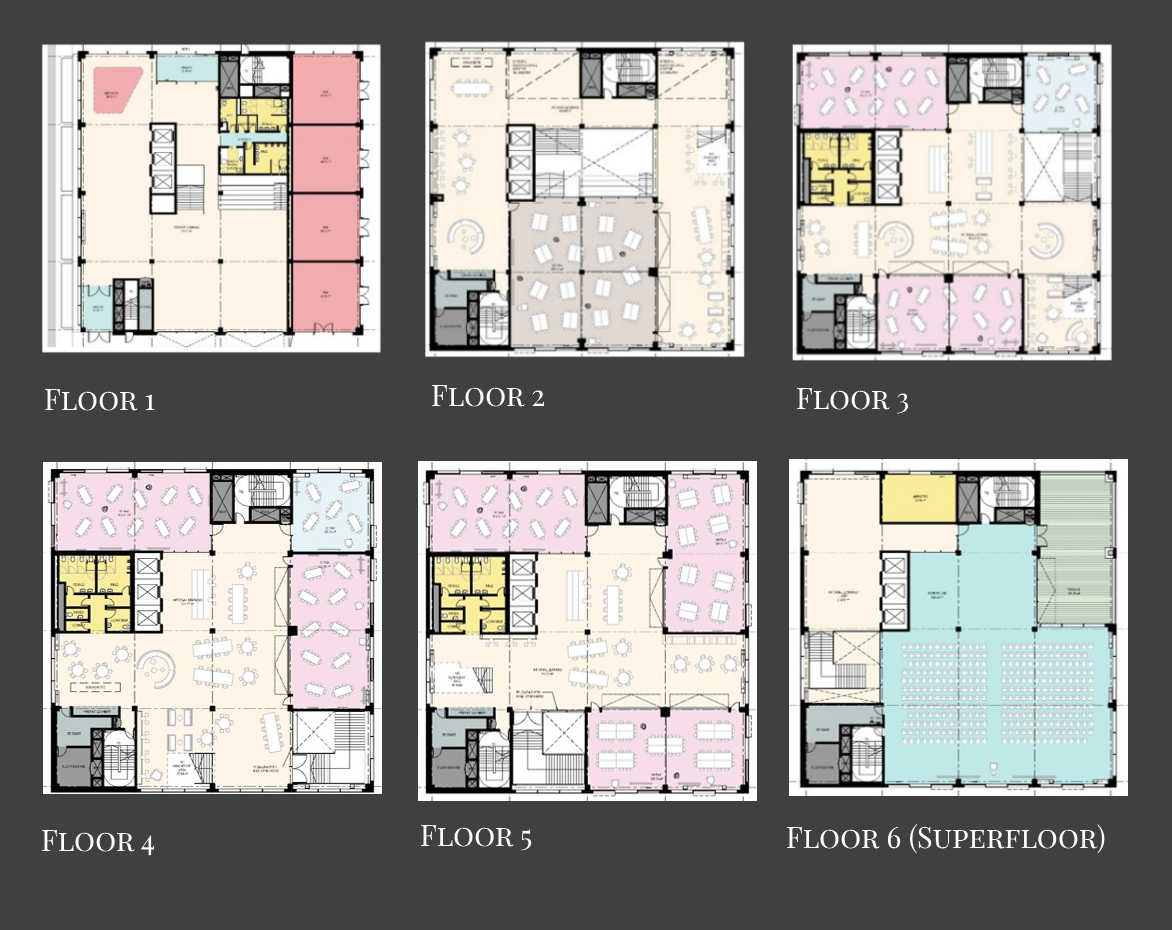
| New ANU Buildings (artists' impression). |
![]() |
| ANU Culture and Events Building |
![]() |
| ANU Collaborative Learning Building |
Flat floor classrooms are conventionally used for small groups of up to a few dozen students. However, with technology and new teaching techniques, such rooms can accommodate hundreds of students.
Training to help make use of classrooms
Training can help make flexible classrooms more efficient, in terms of teaching and energy use. Academics familiar only with conventional lectures and tutorials will tend to use the new flexible teaching spaces only for old fixed teaching formats. To use the rooms flexibly requires the staff to be training in flexible formats.As an example, an instructor used to conventional lecture driven teaching will find the idea of hundreds of students in a room working in teams a recipe for chaos. The instructor needs to be taken through the theory and practice of how this works, and ideally act as an assistant in such a class before being required to be the lead instructor.
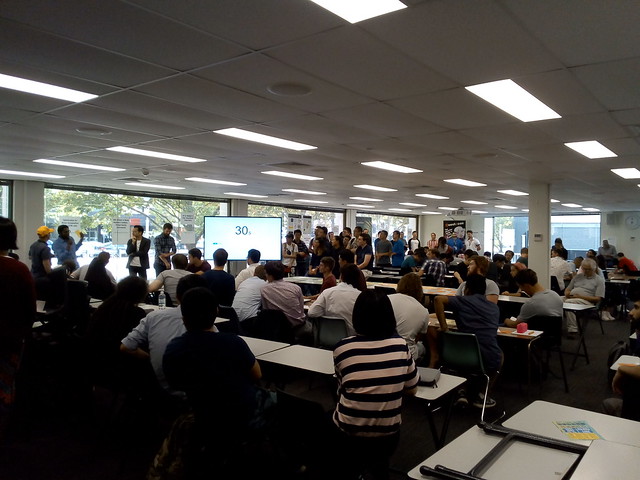
The ANU TechLauncher events for Team Formation and Bootcamp run in the ANU's large flat floor teaching rooms, at 7-11 Barry Drive, have demonstrated that group exercises with 300 students can work. By introducing academics to these techniques, they will be more confident to use them in courses.
Use e-Learning to Supplement Campus
E-learning can also be used to increase the intensity of campus use. Most courses at Australian universities are now, to some extent, "blended", with part of the tuition on-line. However, to make the best use of the technology course designers and instructors need to be trained in on-line techniques.
Academics who have only training and experience in face-to-face lectures and tutorials will tend to continue to rely on those techniques and be reluctant to try e-learning. There will be concern the students will not do the work, or will cheat, which can be the case if materials are not well designed and trained staff are not available to run on-line courses.
With the appropriate level of training it is feasible to aim for the typical university program to be a 20/80 blend: 20% in a formal classroom setting and 80% on-line outside the classroom. An example of this approach is the ANU Techlauncher program, where students undertake a group project building software for a real client, in government or industry. Students are expected to undertake 10 hours of study per week, but are only required to attend a 2 hour formal session in a typical week.
Ideally students should be on campus no more than the equivalent of one day a week. Students should be out in the real world learning and practicing their skills.
Double University Per Person Intensity of Use
Less than half of students attend a typical university class. A survey at ANU found "... attendance declines over semester to around 30% of original signup ...". This is not confined to ANU and is not a new feature of universities. However, universities still tend to allocate teaching space based on the number of students enrolled in the class at the beginning of semester. As a result the classrooms tend to be less than half full after the first few weeks. This is a waste of space and also a waste of energy needed to maintain these spaces.
One way to engage students, and thus attract them to class, is with group activities, as is done with ANU Techlauncher. This ensures almost full attendance at interactive group activities. Blends of on-line and face to face activities (so called flipped classrooms) can keep students coming to class. However, not all students need to attend every class and many classes will have one third to one half attendance. This can be incorporated into space use planning.
Students can be given the opportunity to book a seat in class a few days in advance. Classrooms can then be allocated, making use of different size rooms and flexible walls and formats, to suit. A reasonable aim would be to double the intensity of use of classrooms, thus halving the per person energy use.
Reduce Staff Campus Use
Persons use of the campus includes staff as well as students. Most teaching undertaken at a university is not by full time, permanent academics, but by graduate students and part time staff from industry. E-learning is a particularly useful way to make use of part time staff skills. Industry professionals can teach students without having to leave their workplace. Researchers in the field can teach students. However, this will require the staff to be trained in techniques for e-learning. The ideal way to conduct this training is on-line.More on:
Wednesday, January 10, 2018
Online Course for Fostering Student Wellbeing
Thursday, October 26, 2017
Student Information Sessions in India by Australian National University
Friday, October 20, 2017
Lego Play for Higher Education Academy Recognition
![]() |
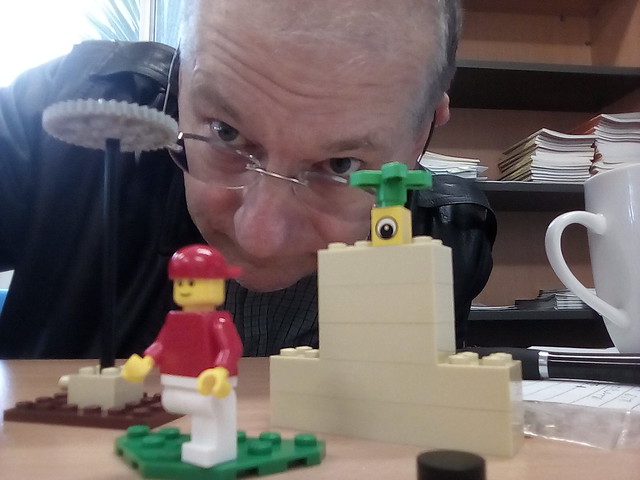
| My teaching philosophy, expressed in Lego. |
We were each provided with a pack of Lego bricks and taken through a sequence of quick exercises, where we each built something and then discussed what we had built. This was a very carefully structured process, starting with concrete exercises to get us used to working with the bricks, through increasingly abstract discussing of our teaching and supervision practices.
This may sound like a frivolous exercise of adults playing with children's blocks. However, it was a way for us to reflect and discuss what we do with teaching and research. It turned out to be a very intense and at times emotional process. In a few hours of "play" I discovered aspects of how I think about teaching which I had not realized in my previous three and a half years of formal graduate education. I am tempted to submit a Lego stop-motion movie as my HEA application, in place of the usual text document. ;-)
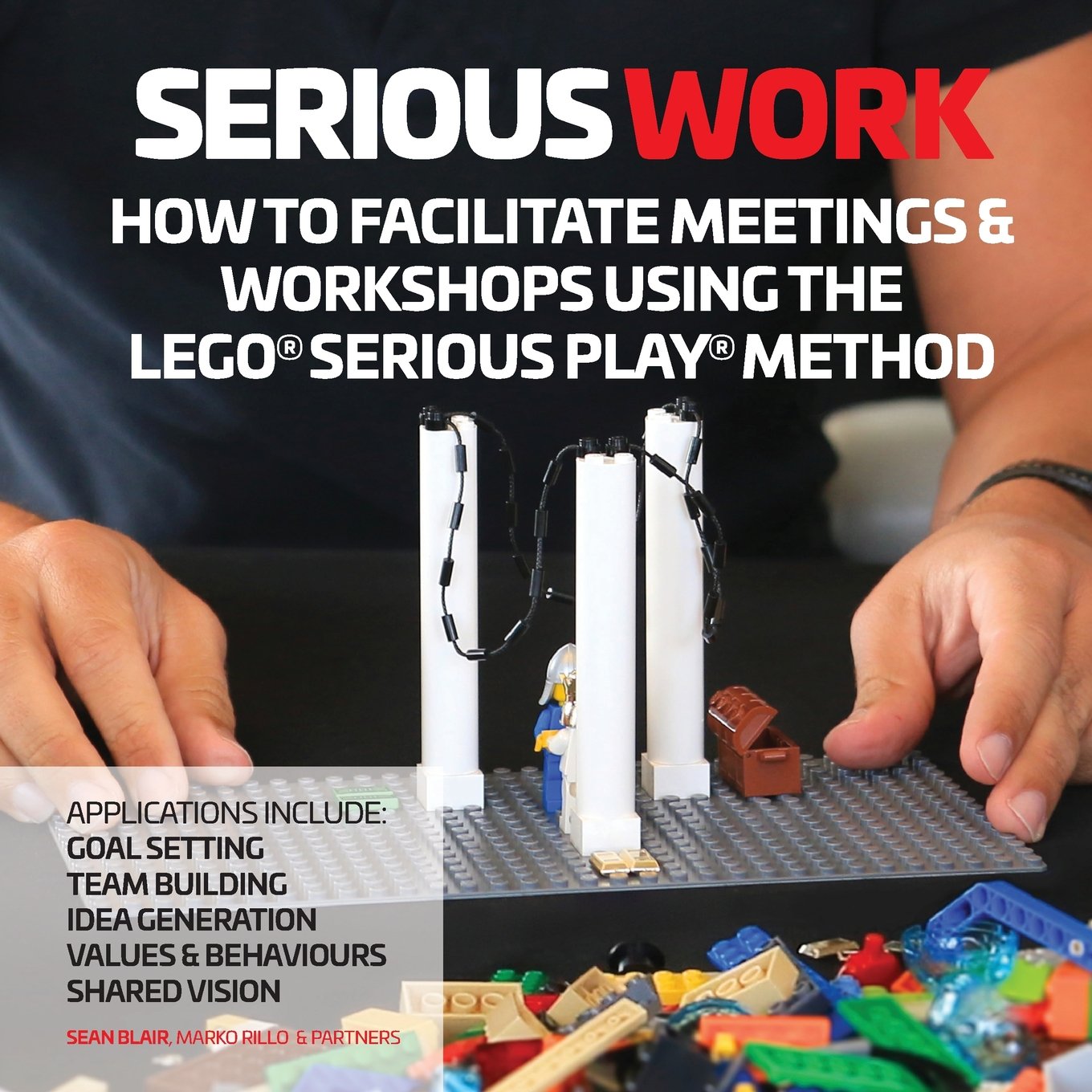
There is a 22 page "Introduction to LEGO ® SERIOUS PLAY ®". No fee needs to be paid to Lego to use the "Method", but obviously they would like you to buy their Starter Kits of Blocks. In addition there are are books on the method and scholarly papers.
Saturday, July 15, 2017
Graduation Day Pomp and Circumstance
| Tom Worthington MEd DE (Athabasca), GCertHE (ANU), CertIVT&A (CIT), FACS CP |
Here I am in full academic regalia for my Master of Education in Distance Education, awarded by Athabasca University (Canada), 18 January 2017. I was not able to attend the ceremony in Canada, but wore my new master's hood on stage as a member of faculty at the Australian National University graduation last Wednesday in Canberra (last time on this stage was to receive an ANU qualification).
You can see me in the procession onto the stage, 2 min 50 seconds into the video of the ANU ceremony. Athabasca doesn't have headgear for Masters, so I was the only one on stage without a hat. The photographer asked if I had the hood on the right way up, but I didn't know (nor did anyone else), as they had never see one from Athabasca in Canberra before.
Saturday, February 11, 2017
Digital Infrastructure in ANU Strategic Plan 2017-2021
"ANU should be known for the quality of its research and digital infrastructure, for its collections, its contemporary educational facilities and campus amenity that befits its status as the national university." (Pages 12 to 13)
Two of the key initiatives include digital aspects:
"1.8 Evidence of learning and satisfaction will drive a regeneration of our approaches to curriculum, teaching and digital and physical learning space design."
"1.11 We will revitalise our learning and teaching infrastructure, beginning with state-of-the-art facilities at Union Court and a major refresh of digital infrastructure."
In February 2007 a severe hailstorm damaged many of the buildings at ANU, causing closure of the campus for several days. However, this did not stop the university functioning. Like many other staff (and students) I was still able to work on-line from home.
The ANU will still benefit from having a campus in 2021, as will most of the world's great universities. However, a campus should be seen as a supplement to the primary way universities already carry out their mission: in the digital realm. This allows greater equity, with those of limited means able to work, research and study at university without having to leave their community. This also allows those with a disability, and work, family or cultural commitments to participate in university life, where the requirement for physical attendance would have previously excluded them.
The last century university, where students had to travel to a campus, is being transformed into one where the students learn primarily on-line, in the workplace, wherever they are in the world. This e-learning can be supplemented, when required and where convenient for the student, with campus based education.
By 2021, I suggest the typical Australian university student will still attend classes, but for only 20% of their program, with the other 80% on-line. These classes may not be at the campus of a university, but in a local community facility, wherever in the world the students are.
Some Australian universities have invested heavily in satellite campuses with conventional teaching rooms, in Australian cities and in Asia. ANU has not pursued this strategy and so does not have as large a stock of now obsolete lecture and tutorial rooms. ANU will be able to use modern teaching techniques to provide access to students on-line wherever they happen to be.
Friday, August 7, 2015
Marketing Universities
The University of Western Sydney (UWS), a vocationally orientated institution with a good reputation, is re-branding itself "Western Sydney University" (WSU or "W" for short). This seems a reasonable change to make, but there has been some criticism that a large part of the $20M marketing budget will be spent on this. See "University of Western Sydney to get new name and logo", by Melanie Kembrey, Sydney Morning Herald, August 7, 2015.
A more questionable case of re-branding is that Central Queensland University (CQU), a modest university (in, as the name suggests, central Queensland), is reported to be changing to "Australian National Regional University" (ANRU"). CQU is a regional university in Australia, but the problem is that the new name would be very close to that of the "Australian National University" (ANU), one of the country's leading research universities (where I am an Adjunct Lecturer). See "University games: protect ANU from CQU's rebranding overreach" by Ross Fitzgerald, The Age, 6 August 2015.