Showing posts with label Russia's Invasion of Ukraine. Show all posts

Tuesday, February 7, 2023

Ukraine Choosing Freedom

Greetings from the ANU Centre for European Studies, where Dr Olesya Khromeychuk, is speaking on Choosing Freedom in Ukraine. In his introduction, His Excellency Vasyl Myroshnychenko, Ambassador of Ukraine, praised the role of "citizen ambassadors", to keep his nation in the spotlight.

Dr Khromeychuk related the view from her pre-independence childhood home, with the dismal remains of the soviet system crumbling outside. She later marched in an independence parade on the same street. Dr Khromeychuk then took us back through the history of Ukraine, then forward through multiple protests for independence. This is a useful message for the rest of the world: Ukraine's current struggle is not the first time the Ukrainian people have had to put their lives on the line.

Dr Khromeychuk related how she has her first year history students will draw a map of Europe with the Russian border through the middle of Ukraine. She suggests the mental map of Europeans needs to be redrawn.

Since 2022, ANU has hosted a series of seminars on the Ukraine war. There is very much the sense of history being written as it is happening. Sitting in the front row are ambassadors of nations of eastern europe. At a previous seminar one remarked "We are at war". 

At question time one interesting point was that indepdentent Ukraine should not be referred to as "The Ukraine", as that would indicate it was still part of someone were else. I asked what Australia could do to help. Dr Khromeychuk surprised me by asking for Ukrainian studies, and cultural links, rather than guns and tanks. She made the point that universite are being destroyed. I noticed this has even stopped some Chinese students from studying. The Ambassador thanked Australia for diplomatic and material support. He pointed out they are in the middle of winter and need more coal, but did not mention tanks. He said he was also keen on academic exchanges.

Tuesday, September 6, 2022

Cyber-criminals as Modern State Sponsored Pirates

Greetings from the Australian National University where Professor Andrew Goldsmith is speaking on "Cyber-criminals as semi-state actors: weaponising ransomware and the Russia/Ukraine conflict". He pointed out that ransomware attacks thought to be originating from Russia are using software which is more normally used for extracting information from systems than simply blackmailing, suggesting a state sponsored role. Professor Goldsmith then went back to the past and pointed out that states in the past have sanctioned private for-profit military operations, in the form of piracy. He says ransomware is attractive as it is financially rewarding for private groups, while being deniable for the state and recommended Egloff (2018). 

Professor Goldsmith asserted that Australian government doesn't have cyber-security capabilities, and has to rely on companies. I suggested that perhaps we needed the equivalent of a coastguard used to combat piracy, that is a force combining the features of military and police. Professor Goldsmith responded that to combat a network, you need your own network, but that having companies conducting offensive cyber-warfare was problematic. The solution, I suggest, is to have reserve ADF personnel, who are continually trained using educational technology, working for the companies. They can look for attacks in their civilian day job, and if an offensive response is needed, put on their uniform. 

References

Egloff, F. (2018). Cybersecurity and non-state actors: a historical analogy with mercantile companies, privateers, and pirates [PhD thesis]. University of Oxford. https://ora.ox.ac.uk/objects/uuid:77eb9bad-ca00-48b3-abcf-d284c6d27571/

Wednesday, August 3, 2022

Ukraine President Address to the Australian National University

Audience in ANU Hall 
(still image from ANU TV)
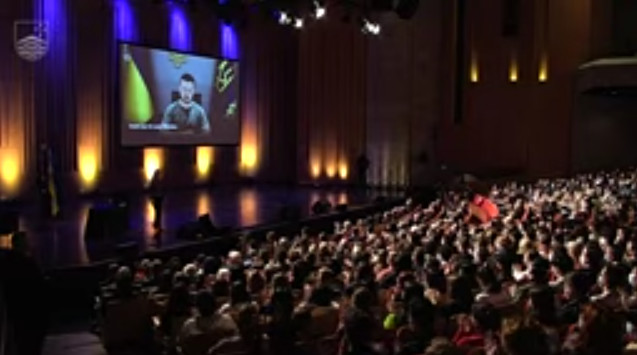
This afternoon, Volodymyr Zelenskyy, President of Ukraine, addressed staff and students of the Australian National University, via video. He acknowledged Australia's contribution as the largest non-NATO provider of military assistance.

Ukraine have run an impressive Information Warfare campaign, with subtility, and occasional humor. This is a capability Australia needs to build as part of its defence rethink.. I will be speaking on "Designing for scale: How to use mobile devices to recruit, train and equip the extra 18,500 defence personnel", at the Mobile Learning Special Interest Group meeting of the Australasian Society for Computers in Learning in Tertiary Education (ASCILITE), 10 am, Friday, August 26, 2022.
President Zelenskyy speaking to ANU 
(still image from ANU TV)

Saturday, July 30, 2022

Ukraine President to Address ANU Online Wednesday, All Welcome

Volodymyr Zelenskyy,
President of Ukraine
Volodymyr Zelenskyy, President of Ukraine, will speak via video to staff and students of the Australian National University, 5 pm AEST, Wednesday 3 August. This is booked out, but you can watch online.

The Ukraine Ambassador to Australia, who was previously the country's head of information warfare, previously talked at ANU in person. 

ps: Volodymyr Zelenskyy's comedy TV series "Servant Of The People" is available from SBS On Demand. ;-)

Tuesday, July 26, 2022

Drones and Global Order

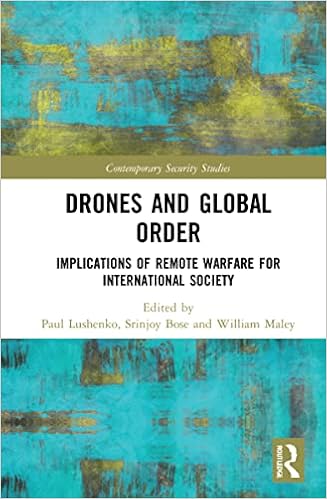
Greetings from the ANU College of Asia & the Pacific where a panel is speaking on "Drones and Global Order: Reflections on Ukraine". This is to discuss the book "Drones and Global Order: Implications of Remote Warfare for International Society" (edited by Paul Lushenko, Srinjoy Bose, William Maley). Moderator, Professor John Blaxland, Head of the ANU Strategic and Defence Studies Centre, pointed out that the book was prepared before the current conflict in Ukraine, and so is prescient. 

Lieutenant Colonel Paul Lushenko,  U.S. Army and Cornell University, mentioned that drones can be used to breech and protect national sovereignty. He nominated the General Atomics Reaper drone as the preeminent system. I suggest it is worth pointing out that the usefulness of this aircraft is reflected in its general design being widely copied by both allies and enemies.

Cecilia Jacob, Associate Professor, ANU International Relations, pointed out the dilemma that drones have been useful in response to conflicts short of war. However, the low cost of drones, and low risk for operators, may make war more likely. A positive point mentioned was using a drone to capture evidence for war crimes trials.

Emeritus Professor William Maley, ANU Diplomacy, reminded the audience that drones are not new, with the German V-1, being mass produced in 1944. As the Professor points out, the V-1 was not accurate enough, and the war did not continue long enough for its significance to be appreciated. Drones could be used for surveillance, material delivery, conventional military attack, attack on terrorist leadership, and drone swarms. On the last point I coached a team of Australian Navy, government and industry people working on swarm defence. Media reports suggest Ukraine used drones to distract the defenders of a Russian warship

Professor Maley commented that "Most people think of drones for delivering pizza, not bombs". This made me wonder what will be the effect of low cost mass-produced drones. Will this be like the effect smart anti-tank weapons have had in the Ukraine? What if both sides are supplied with thousands of small, disposable armed drones, which can loiter over a battlefield? I suggest a drone packaged in a disposable  larch tube similar in size and operation to an anti-tank missile would prove a popular product. This would be larger than the AeroVironment Switchblade, with a battery motor for loitering, and a rocket motor for attack.


Wednesday, March 30, 2022

Ukraine Destroyed the Myth of Russian Invincibility Says Ambassador Designate to Australia

Mr Myroshnychenko,
speaking in the ANU Moot Court.
Photo by Tom Worthington, CC-BY 30 March 2022

Greetings from the Moot Court at the ANU, where  Ukraine's Ambassador Designate to Australia is making an unscheduled speech, opening day two of
 "Russia's Invasion of Ukraine: A Colloquium". He said that the Ukraine destroyed the myth of Russian invincibility. Mr Myroshnychenko pointed out he doesn't have a background in diplomacy, but is a businessperson. However, his biography shows he is a specialist in strategic communications, and co-founded Ukraine Crisis MediaMr Myroshnychenko will become the ambassador to Australia officially on Friday.

In answer to a question Mr Myroshnychenko said that the US Starlink satellite communications system had been useful for both civilian and military communications in the Ukraine. He also pointed out how Russia sought manipulate public opinion using messages different for internal and external audiences.

Mr Myroshnychenko referred to the use of talk shows by Russia, 
which manipulate emotions, modeled on those popularized in the USA. He then looked ahead to how difficult it will be to reeducate the people influenced by Russian messages. He pointed out how difficult this was, with people in Germany after WWII. But perhaps a better analogy today would be with those convinced by QAnon conspiracy theories.

Information Warfare Division
Australian Department of Defence
The Australian Government yesterday announced a doubling of the staff of the Australian Signals Directorate, and expansion of offensive cyber operations. As well as technical operations, to hack into enemies computers, I suggest it would be prudent to spend some of this money on the softer side of cyber operations, with information warfare. Australian personnel have been assisting Ukraine with cyber-security training, but I suggest there is much Australia could learn from Ukraine about information warfare.

In the Q&A I asked if Australian could learn from the information warfare situation in Europe. Mr Myroshnychenko replied that Australia could play a useful role countering Russian propaganda in the Pacific. Also Dr Robert Horvath, La Trobe University, suggested Australia could learn from Estonia's experience countering cyber attacks.

Monday, March 28, 2022

European Ambassadors Discuss Russia in Ukraine in Canberra

 Chancellor Bishop opening the
Greetings from "Russia's Invasion of Ukraine: A Colloquium", at the Moot Court of the Australian National University in Canberra. Chancellor Bishop is opening the colloquium. With a row of distinguished European ambassadors, flags, and a judges bench behind, it is perhaps a foretaste of the war crimes tribunals to come. But those are likely years away.  

The colloquium is an example of one of the uses of a research university. Whatever the topic,  you can likely find an expert on it at a major university. This event has the ambassadors today, and the the ANU's strategic experts give their views Wednesday. 

One ambassador, mentioned the effect of cyber attacks on European countries, another the unexpected unity, but this will be tested as sanctions harm European economies, as well as Russia. Unexpected unity was mentioned again. The claim was made the war was "unprecedented", which seems at odds with Europe's bloody history. The prospect of chemical, biological and "other" (ie: Nuclear) weapons were mentioned, with the suggestion European countries needed to be ready with a response. Option may be limited as US doctrine call for a response in kind, if a weapon of mass destruction is used against it. So what happens if a stray chemical, biological, or nuclear weapon which causes mass causalities of US personnel deployed to a European ally? Also it was chilling to hear ambassador's saying their countries were preparing for war, and that under the NATO alliance, an attack on one country is an attack on all. In particular the representatives of the smaller European countries on the western edge of the EU think of themselves as already at war, by proxy. 

In his response Mr Kyle Wilson, Visiting Fellow,  ANU Centre for European Studies, suggested that the conflict started with a cyber attack on Estonia in 2007.

"Day 1: A diplomatic perspective from Europe

Panel 1: Collective responses to shared challenges

  • H.E. Dr Michael Pulch, Ambassador of the European Union
  • H.E. Mr MichaÅ‚ KoÅ‚odziejski, Ambassador of the Republic of Poland
  • H.E. Ms Satu Mattila-Budich, Ambassador of the Republic of Finland
  • H.E. Ms Kersti Eesmaa, Ambassador of the Republic of Estonia

Panel 2: The future of Europe’s security architecture

  • H.E. Mr Jean-Pierre Thébault, Ambassador of the French Republic
  • H.E. Ms Pernille Dahler Kardel, Ambassador of the Kingdom of Denmark
  • H.E. Dr Thomas Fitschen, Ambassador of the Federal Republic of Germany
  • H.E. Ms Betty Bernardica Pavelich, Ambassador of the Republic of Croatia

Day 2: Liberal democracies and threats to the rules-based international order

Date and time: 30 March, 9.30am-4.30pm

Australia’s leading authorities on Eastern Europe will examine Russia’s invasion of Ukraine from political, strategic, historical and cultural angles, and will reflect on the possible threat the conflict poses to the rules-based international order.

The speakers include Dr Robert Horvath (La Trobe University), Prof Paul Dibb (ANU), A/Prof William Partlett (The University of Melbourne), Dr Stephen Fortescue (UNSW), Mr Petr Kuzmin (President of Svoboda Alliance VIC), Mr Bertil Wenger (Konrad Adenauer Stiftung), Dr Matthew Sussex (Australian Defence College), Dr Sonia Mycak (ANU), Dr Elena Govor (ANU).

See the program and speakers here."