Showing posts with label Second Life. Show all posts

Thursday, January 26, 2023

Metaverse will Fail

Trying HoloLens
at LinkedIn Sydney
I am not a believer in the Metaverse, and doubt I ever will be. The same claims were made for previous generations of VR, and Iwas proven right to doubt them. Metaverse is too much like Second Life, Google Glass, and real life, so will fail.

The hype over Metaverse sounds all too familiar, and the reality far short of what is claimed for the technology. It is not that I am particularly skeptical of this form of VR, but when there have been so many waves of hype, making the same claims, and producing the same disappointment, it is hard not to have skepticism as your default position.


I recall eight years ago when we were all going to be wearing Google Glass. I sat in one presentation where I was the only one not wearing some sort of gadget. Google Glass went the way of the Apple Newton: the subject of ridicule.


There is a role for VT (or more likely AR) in education, and particuarly training. This especially applies to hands-on training. It also has potential in language learning. However, VR may not be needed for this. Dr Jinghong Zhang pointed to grass roots use of TikTok for language learning in her seminar at ANU yesterday.


Building an online campus has advantages. But that has been done for decades, very successfully, without VR. Attempts to add VR have failed, not due to a lack of the technology, but because it was missing the point. Virtual campuses work not by emulating physical ones, but by getting rid of the physical limitations.


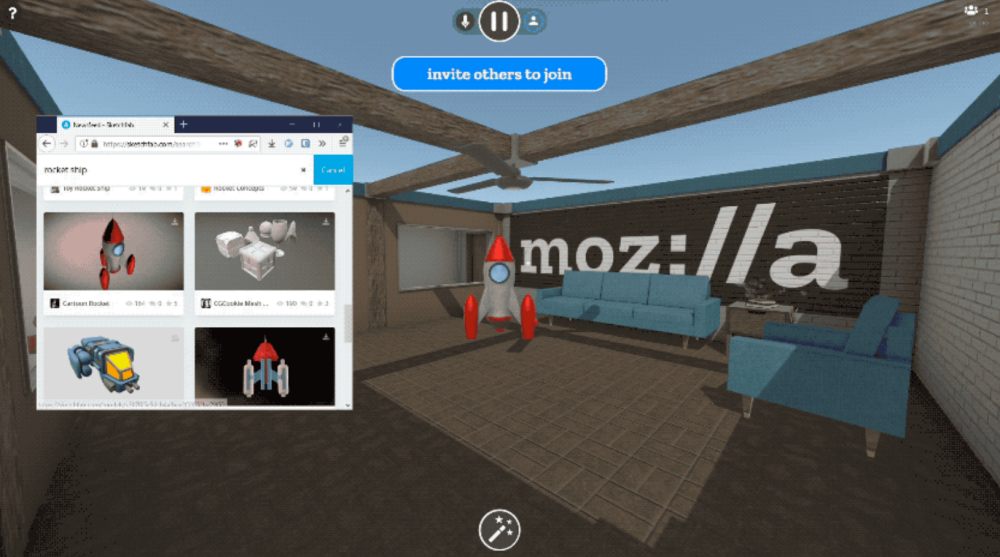
For the last ten years people have been showing me demonstrations of how Second Life, Mozilla Hubs and other assorted VR could emulate a university campus. Apart from being clunky implementations these all seemed to be missing the point. Virtual universities work by not emulating the features of a real campus. The silliest implementation I saw was of a library in a virtual university, complete with a virtual card catalog (real libraries no longer have card catalogs). A virtual lecture theatre showing rows of avatars perhaps makes an out of date lecturer feel good, but is emulating a poor learning experience.


This is not to say some form of VR/AR will not work, just as the Apple iPhone succeeded where the Newton failed. But it will take some inspired design to make the Meta-verse more than just another clunky old VR application. As an example, I found Microsoft HoloLens much better than Google Glass, despite having a much bulkier headset.

Friday, August 21, 2020

Mozilla Hubs is Too Much Like Life

Mozilla Hubs Example
Greetings from the


Wednesday, October 17, 2018

3D for Education

Greetings from the Research School of Computer Science at the Australian National University, where Peter Baranyi, of Szechenyi Istvan University, is speaking on Cognitive infocommunications (CogInfoCom). He started by comparing a DOS character based computer interface with a Microsoft Windows interface. At the time the desktop metaphor was popularized by Microsoft many said that this interface was either trivial like a computer game, or much too complex to be usable. However, it turned out to be wildly popular.

Professor Baranyi argues the GUI works well because the visual centers of the brain came can process it. He compared this to the whiteboard wall in the computer science building, which can be written on, from wall to wall, uninterrupted. He then showed several command center designs with multiple screens for each operator and wall-to-wall display screens.

Professor Baranyithen pointed out that we don't all have the luxury of the space for displays there are in a purpose designed command center. Instead this can be emulated in virtual reality. The VR space can be populated with with windows showing separate projects. This can be enhanced using a 3D effect.

However, I have some doubts about the value of emulating a real space in VR. If emulating a real world situation, this may make sense, but for more abstract representation may be better. As an example, Professor Baranyi showed an animation of a chemical plant. However, the operators of such a plant use a simplified schematic diagram. Another example is the London Underground map, which doesn't accurately reflect the location of stations, but is easier to use.

Professor Baranyi showed the results of an experiment (Lampert and others, 2018), where subjects were given a series of documents to ope. The documents were first provided as attachments to an email, then as hypertext links, then using the Moodle  Learning management System and lastly using a 3D interface. The result was that the 3D interface was much faster. He argued that this was because the 3D interface supplied the documents in the order required and were grouped.

I did not find this experiment very convincing. In designing e-learning using Moodle I provide a documents as hypertext links in the text, then three or four grouped as a reading list in the order I want them to read them. In addition I provide a bibliography in alphabetical order.

Like many new university lecturers I started by providing dozens of documents for students to read. In part through experience of teaching, but more so as a student of education, I learned that providing dozens of readings just confuses students. Now I provide three or four, in the order I want them read. Also I "chunk" what I want students to do, so they are not exposed to too many steps at once.

Currently I have a student working on a way to insert quizzes and discussions into a video. The idea is that the video will stop, the student do a quiz and the video restarts. This doesn't need a 3D interface and such an interface would be difficult to use if, for example, the student is sitting on a bus.

The us of 3D interfaces may well suit very complex tasks. But such interfaces do not suit users under stress, be they airline pilots or students. Pilots are given simple checklists and are trained to do each step in the same order every time. The checklists my be chunked, so that they do not have to go back to the start when they miss a step. Similarly a student under stress, wanting to know what to do for an assignment needs a series of simple steps. 

There was a fashion for the use of Second Life for education some years ago. However, there are now many abandoned college campuses in Second Life (Patrick Hogan', 13 August 2015). The problem was, I suggest, these were too accurate reproductions of the real campus. This is not to say a 3D interface cannot be useful, but it needs to be a bit more creative than just a rendering of the real world.

Reference


Lampert, B., Pongracz, A., Sipos, J., Vehrer, A., & Horvath, I. (2018). MaxWhere VR-Learning Improves Effectiveness over Clasiccal Tools of e-learning. Acta Polytechnica Hungarica, 15(3). url: https://www.uni-obuda.hu/journal/Lampert_Pongracz_Sipos_Vehrer_Horvath_82.pdf