Greetings from the ASCILITE MLSIG weekly online meeting, where convenor Thomas Cochrane (University of Melbourne) just reminded us about the "SoTEL 2025—Call for Participation" for 9th of May. This will use the rapid-fire Pecha Kucha presentation technique. Topics are Scholarly Practice, learning innovations, professional development innovations, and outcomes of communities of practice: if it is using a gadget for teaching, it is on topic.
Showing posts with label ASCILITE MLSIG. Show all posts
Showing posts with label ASCILITE MLSIG. Show all posts
Friday, March 14, 2025

Tuesday, December 3, 2024
Mobile Learning Post COVID-19 in the GenAI Era

Greetings from ASCILITE 2024 where Vickel Narayan, Massey University, New Zealand, is speaking on "Navigating the Terrain:Emerging Frontiers in Learning Spaces, Pedagogies, and Technologies". I am one of the authors on this short paper, along with others in the ASCILITE Mobile Learning Special Interest Group and got to say a few words about it. The challenge is to take learning out of the hands of the teacher and out of the classroom into the real world, of a facsimile of it. Perhaps we need GenAIGogy.
Tuesday, November 19, 2024
Best of ASCILITE 2024

I have booked to attend the ASCILITE 2024 computers and education conference at the University of Melbourne, 1 to 4 December (being a joint author on one paper). But conferences with multiple streams can be a bewildering experience, so I like to do a best of, in advance. Here are my picks:
Sunday December 1, 2024 09:00
Third Space Symposium: Working well in tertiary education
Dark Green Room B101 (512 capacity) - 2.12.24 December 2, 2024 15:30
David Parsons et al - What does the Ideal Postgraduate Micro-Credential Look Like? A Student Perspective
Pink Room 153 (150 capacity) - 2.12.24 December 2, 2024 11:00
Ekaterina Pechenkina - Navigating the complex terrain of online professional learning
December 2, 2024 12:00
Taneile Kitchingman et al - Implementing an interactive oral task to assess undergraduate psychology students’ attainment of pre-professional competencies
December 2, 2024 15:30
Amanda Samson et al - From Campus to Career: Leveraging Technology to Improve Work Readiness and Industry Engagement
White Room 453 (60 capacity) - 2.12.24 December 2, 2024 14:10
Mehrasa Alizadeh et al - Investigating the impact of online learning platforms on student engagement and learning outcomes: Comparing Zoom with VR
Light Blue Room 253 Tuesday 3rd December
11:00 - 12:00 Scaling-up technology-enhanced authentic learning across a university-wide curriculum innovation program Presented by Elisa Bone
Dark Blue Room 456
14:10 - 14:30 Navigating the terrain of academic publishing in educational technology Presented by Linda Corrin et al
Wednesday 4th December Light Blue Room 253
11:00 - 12:00 Navigating the Generative AI Response: Reflections from Four Universities Presented by Tania Broadley
Friday, July 19, 2024
Chatbots for More Rounded Employable Graduates?
Greetings from the weekly ASCILITE MLSIG webinar. One of the members had a positive report on using Cogniti (developed at University of Sydney), to build chatbots to help students. With this, the software simulates a patient in conversation with the student acting as a therapist. The chat-bot then switches to tutor more and provides feedback and advice to the student. It occurred to me the same would be useful for students "soft" skills.
Many STEM students have difficulty with the part of the job where they have to talk to people, especially non-technical clients. This also creates problems when talking to potential employers. It may seem odd to suggest the students talk to a machine to imp[rove personal communication skills. However, this way students can get a lot of practice with an infinitely patient tutor. Also client and work communication is increasingly using digital technology. In a way reality s becoming more like the simulation: you apply for a job not by writing a letter but via a web form, do online tests & get interviewed via Zoom. The graduate will likely communicate with their client, and perhaps colleagues, mostly online. So talking to a chat-bot online will be a more realistic simulation of the workplace, than talking face to face in a classroom.
Friday, June 28, 2024
Impact of Digital Technology on Children Webinar 5 July
 |
| Dr. John Worthington, Educational and Developmental Psychologist |
MLSIG Webinar: Discussions and Case studies of the Impact of Digital Technology on Children and Teenagers, a Clinicians Perspective
Title: Discussions and Case studies of the Impact of Digital Technology on Children and Teenagers, a Clinicians Perspective
Speaker: Dr. John Worthington, Educational and Developmental Psychologist
Date: 10am, 5 July 2024 Via Zoom
Abstract: The three case studies drawn from clinical cases. While occasionally, the leading concern may be to do with the child’s use of or interaction with devices, typically the technology concern is a secondary, or even a non-issue until revealed by the history provided and or the assessment itself. Often, when the issue is exposed, the impact is not only on the child but can be wide ranging, and involve parents, siblings, peers, teachers, relatives etc.
About the speaker: Dr. John Worthington provides independent clinical, school and home based assessment and consultation services to support individuals aged 3 years through to adults. http://www.jweducation.com/
ps: Dr Worthington is my brother.
Wednesday, May 15, 2024
Nurturing an Academic Community Online

Reference
Narayan, V., Cochrane, T., Stretton, T., Chanane, N., Alizadeh, M., Birt, J., … Vanderburg, R. (2024). A model for nurturing a networked academic community: #ASCILITEMLSIG mobile learning special interest group. International Journal for Academic Development, 1–16. https://doi.org/10.1080/1360144X.2024.2349930
Friday, June 16, 2023
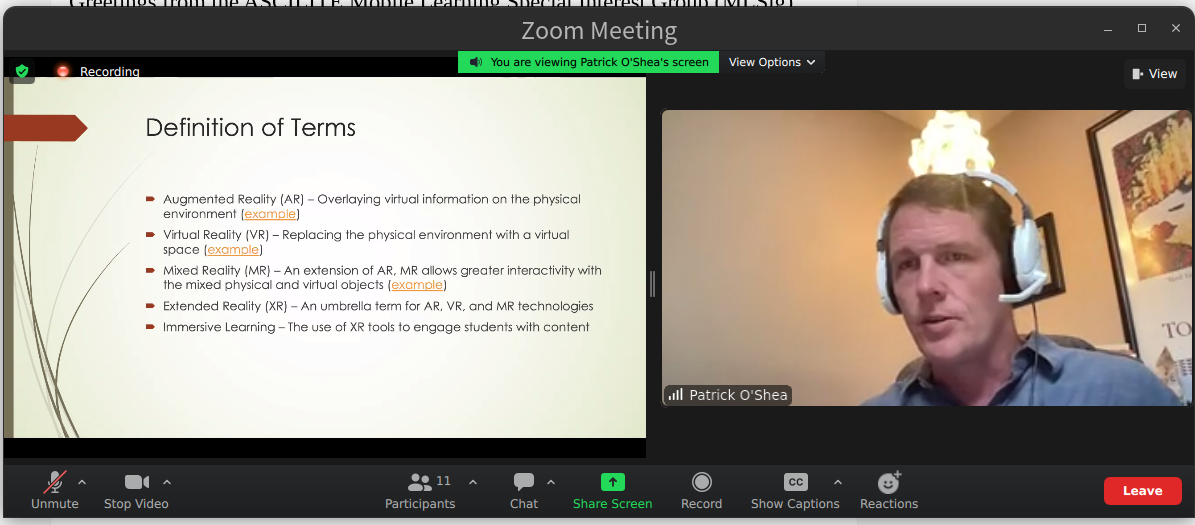
What to do and not do with Augmented Reality for Education
Tuesday, December 13, 2022
Designing for online, blended and synchronous learning for computing students
My notes on "Designing for online, blended and synchronous learning for computing students" are available.
The talk gave me a needed confidence boost, as I was writing Some Thoughts on the Future of Australian Higher Education, and thinking: "What do I know about higher education?". After the talk, I realised "I know something about it", as Dr McCoy would say. ;-)
Reference
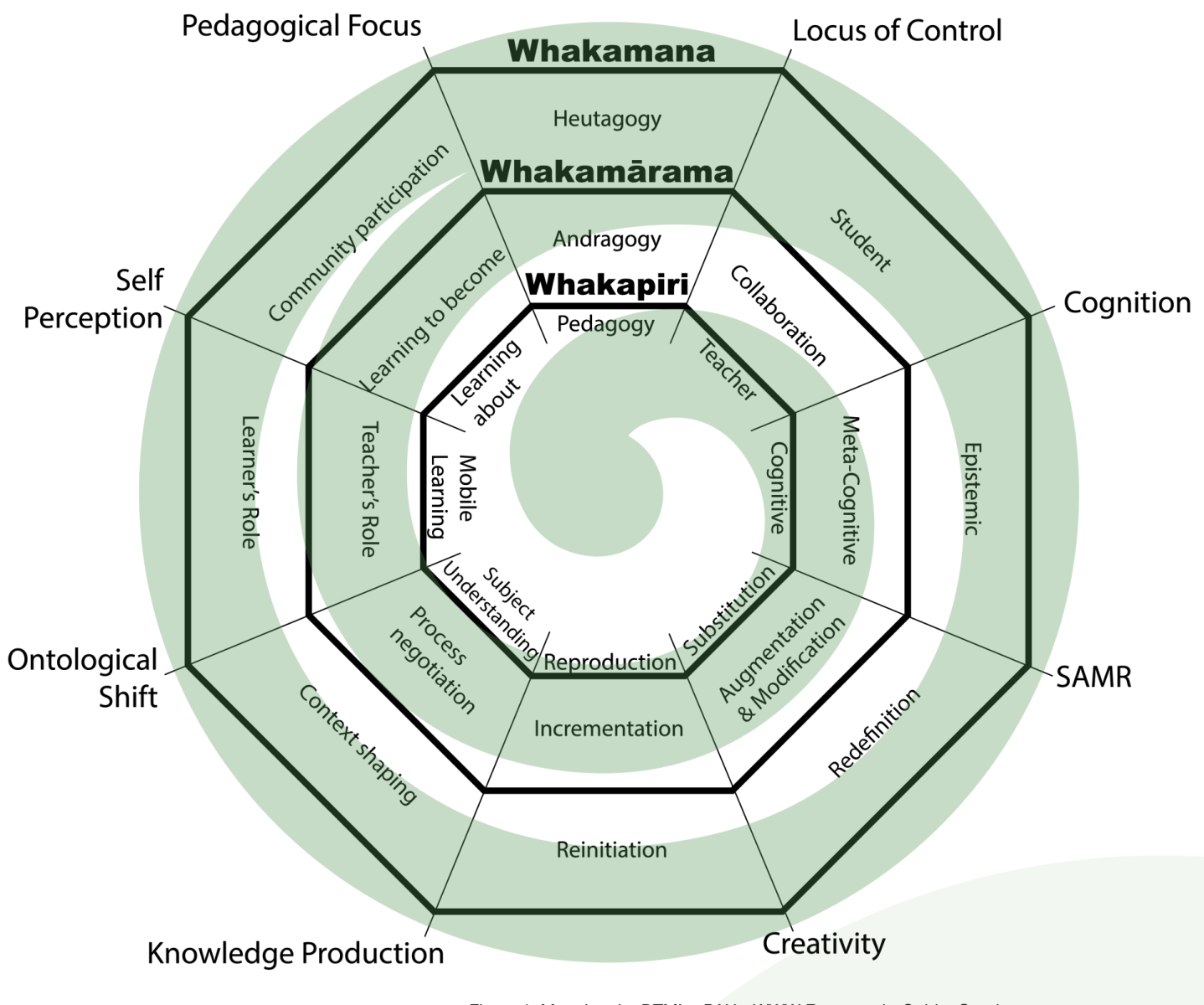
Cochrane, T. D., Narayan, V., Aiello, S., Alizadeh, M., Birt, J., Bone, E., Cowie, N., Cowling, M., Deneen, C., Goldacre, P., Sinfield, D., Stretton, T., & Worthington, T. (2022). Analysing mobile learning designs: A framework for transforming learning post-COVID. Australasian Journal of Educational Technology, 38(4), 1–21. https://doi.org/10.14742/ajet.7997
Friday, October 21, 2022
GPT3 + AI: What is the human value in light of AI developments?
Next week I am helping with a webinar on AI and education (announcement below). AI has the potential to help students, by providing very dedicated personal tutoring, but risks making plagiarism much worse. In 2018 I took part in a workshop were participants built a tutor chatbot. Even in this primitive form it had potential for answering routine questions from students. However, that for of AI required the knowledge to be manually encoded by an expert. Much attention in recent years has been on AI which learns for itself. The OpenAI research laboratory, with for-profit and non-profit arms has come to prominence with AI trained using material on the Internet. Best known is GPT3, which can answer questions and write text. The Openai beta provide a simple question and answer demonstration. I had fun asking the algorithm some questions:
Q: How can we stop students cheating?
A: There is no one answer to this question as the reasons why students cheat vary. Some possible solutions include increasing the consequences for cheating, providing more opportunities for academic help, and increasing the difficulty of assignments.
A very plausible answer, although the first sentence could apply to anything. As one person at the seminar commented, it is the sort of answer a politician gives: vague on details.
Q. How successful was Online Learning during the COVID-19 Pandemic?
A: There is no one-size-fits-all answer to this question, as the success of online learning during the COVID-19 pandemic depends on a variety of factors, including the type of online learning platform used, the quality of the online learning content, the students' prior experience with online learning, and the students' level of motivation. However, overall, online learning appears to have been successful for many students during the COVID-19 pandemic.
The start of this answer seems to use the same formula as thew previous one, to say there are many factors. It has that same vague quality to the balance of the answer.
Q: Who is Tom Worthington?
A; Tom Worthington is an Australian information technology academic, consultant and commentator. He is a Fellow of the Australian Computer Society and a Visiting Fellow in the Research School of Computer Science at the Australian National University.
A bit out of date: I am now an Honorary Senior Lecturer, and the School is now just "Computing".
What is more worrying is that AI has reached the point where it could write a plausible student paper. One way to address this is to use AI to look for the characteristics of AI written work. Another is to teach students about AI, and where it can be legitimately used.
GPT3 + AI: What is the human value in light of AI developments?
presented by The ASCILITE Mobile Learning SIG
28 October @ 10:00 am - 11:00 am AEST Free
In this presentation, the ASCILITE Mobile Learning Special Interest Group members will explore the implications of Artificial Intelligence for higher education. The panel will demo some of the current possibilities with AI generators for Art, Text, Video and Assessment. This will be followed by a discussion of the state of the art of AI and implications.
Friday, September 16, 2022
Language Teaching Tech Innovation

An import point Paul made was that web based products need to have a source of revenue. Edmodo recently shut down due to a lack of advertising revenue.
Paul suggested you don't have to throw away the Learning Management System investment, such as in Moodle, but can add new functions, for example language learning.
Paul is getting into the theory, with Vygotsky's Zone of Proximal Development (ZPD). The practical implications of this is that students need help to learn, step by step.
Friday, July 15, 2022
Virtual Reality for Language Teaching
 |
| Neil Cowie |
 |
| Mehrasa Alizadeh |
Friday, June 3, 2022
ASCILITE Mobile Learning SIG 2022
 |
| MLSIG presentation at ASCILITE 2021 |
Greetings from the weekly ASCILITE Mobile Learning SIG meeting. Last week we had an introductory session for new members, and to my surprise this has been recorded, archived, and formally referenced* as a scholarly work.
Upcoming webinars are:
- June 24, Dr David Sinfield, Where Art Meets Science: How I use mobile technology in the field for research documentation (preview).
- July 22, Mehrasa Alizedah and Neil Cowie, The Affordances and Challenges of Virtual Reality for Language Teaching
- August 26, Tom Worthington, Designing for scale: How to use mobile devices to recruit, train and equip the extra 18,500 defence personnel
The Sig members have also worked together on projects during the pandemic. This week we are looking at how to do a systematic meta-analysis of mobile learning and the pandemic. The meta-analysis process is not just a matter of reading a few papers, it requires a carefully designed search, then analysis. Get it wrong and you end up with no papers, or tens of thousands of irrelevant ones. This is something I am not familiar with, and having to learn quickly from others.
* Reference
Cochrane, Thomas; Narayan, Vickel; Cowie, Neil; Birt, James; Alizadeh, Mehrasa; Ransom, Lisa; et al. (2022): Introductory Webinar to the ASCILITE Mobile Learning SIG 2022. University of Melbourne. Media. https://doi.org/10.26188/6295b6b7690a6
Friday, May 20, 2022
A Day in the Life of the MLSig
|
| MLSIG presentation at ASCILITE 2021 |
Members of the Australasian Society for Computers in Learning in Tertiary Education (ASCILITE) Mobile Learning Special Interest Group (ML-SIG) are going to do a Zoom introduction. What would you like to know?
Wednesday, November 24, 2021
Mobile and Socially Constructed Blended Learning with Activity Theory a Response to COVID-19
Next Tuesday at ASCILITE 2021, I have sixty seconds to speak on "Mobile learning and socially constructed blended learning through the lens of Activity Theory". The reason I have only a minute is that there are nine authors for the paper (Vickel Narayan, Thom Cochrane, Neil Cowie, Paul Goldacre, James Birt, David Sinfield, Alizadeh Mehrasa, Tom Worthington and Stephen Aiello). That might sound an impossible task, but we managed it last year at ASCILITE 2020. This is much easier to do online, than with a crowd of people on a stage.
I am not much of a theory person, and the idea of applying Activity Theory comes from my coauthors. All I am doing is describing how I modified my teaching slightly last year for COVID-19. But the point we are collectively making I suggest is an important one. Mobile devices and collaborative tools were effective by connecting students with each other, and with their teachers. This I suggest has been far more important than replicating old fashioned lectures and examinations online. As an online student myself for years, I felt the loneliness of long distance study. With the pandemic behind us, it is important for Australian universities to engage students and not slip back into lazy habits of offering dull lectures and then blaming students for not attending.
Our paper differs from many recent ones which describe heroic and radical changes which had to be made to teaching practice to move from classroom based to online. The difference was that as tech literate educators we had less to do to move our teaching online.
I moved to pure online teaching ten years ago, then in the last few years had been incorporating some classroom elements. As someone with a background in dealing with emergencies using tech, my teaching was designed with an online contingency, so that if an emergency kept students from campus, it could all be done online. That is what happened with COVID-19.
Friday, June 18, 2021
Coordinating Reviews of Scientific Research

The review process in medicine it appears to be a far more systematic process, using tools to search for articles, recording which were considered relevant, but also which were not.
Tuesday, December 1, 2020
Live Discussion on Hybrid Learning at ASCILITE 2020 Conference
Greetings from the ASCILITE 2020 Conference, where I am participating in the presentation of the second of two of two joint papers I helped with. This has moved into an interview mode, where the MC is asking the authors questions.
The papers:
- A collaborative design model to support hybrid learning environments during COVID19 by Cochrane, Birt, Cowie, Deneen, Goldacre, Narayan, Ransom, Sinfield & Worthington (Day 2, Session 4, Stream A, 11:30AM).
- A mobile ecology of resources for Covid-19 learning by Narayan, Cochrane, Cowie, Birt, Hinze, Goldacre, Deneen, Ransom, Sinfield and Worthington (Day 2, Session 4, Stream C, 11:30AM).
Learning to Work Online for the Long Term

I suggest university staff need to get used to researching and teaching online. This should not be treated as a short term emergency measure and we will all go back to the meeting room and lecture theater soon. Even if all goes well with COVID-19 measures, as they are in Australia, NZ and a few countries in the region, things will not be back to "normal" before the end of 2021. Also the deteriorating geopolitical situation for Australia may see international students unable to get to campus, without warning, again. This is something I warned about in 2017. So I suggested we design work and study to be online, with face to face, where possible.
The papers:
- A collaborative design model to support hybrid learning environments during COVID19 by Cochrane, Birt, Cowie, Deneen, Goldacre, Narayan, Ransom, Sinfield & Worthington (Day 2, Session 4, Stream A, 11:30AM).
- A mobile ecology of resources for Covid-19 learning by Narayan, Cochrane, Cowie, Birt, Hinze, Goldacre, Deneen, Ransom, Sinfield and Worthington (Day 2, Session 4, Stream C, 11:30AM).
Saturday, November 28, 2020
Mobile Learning Special Interest Group
The ASCILITE Mobile Learning Special Interest Group has produced an eight minute video to explain what they do for the ASCILITE 2020 Conference next week. This was made in one take via Zoom. It is a bit more lively that the version I made by pasting the text from the website into a text to speech system:
Friday, November 20, 2020
ASCILITE 2020 Conference Online 30 November

- A collaborative design model to support hybrid learning environments during COVID19 by Cochrane, Birt, Cowie, Deneen, Goldacre, Narayan, Ransom, Sinfield & Worthington (Day 2, Session 4, Stream A, 11:30AM).
- A mobile ecology of resources for Covid-19 learning by Narayan, Cochrane, Cowie, Birt, Hinze, Goldacre, Deneen, Ransom, Sinfield and Worthington (Day 2, Session 4, Stream C, 11:30AM).
These have been scheduled for parallel sessions at the same time at the conference. Normally this would involve a sprint down the corridor (in some conference centers this might be half a kilometre and up several floors). Online it should be a couple of clicks, or as there are so many authors we can just divide up).
This is my first ASCILITE (I did attend a concurrent program at ASCILITE 2019 Singapore). The one and only time I submitted a paper previously, the reviews were so witheringly condescending that I gave up the whole idea of submitting a paper, or attending. The reviews of the joint papers this time were much more positive, indicating the fault was not with the reviewers, but my previous authorship. ;-)
The practice at face to face conferences is to keep on to time, not start early, so people can catch a specific presentation. However, I like the idea that you pick a session and have to stick with it. With four parallel steams this can be difficult. Here are my picks:
1:30 — 3:00 pm Breakout Zoom Session 1
3:00 — 3:30 pm— Break —3:30 — 5:00 pmBreakout Session 2
Session 1 - Stream A Bend me, stretch me: connecting learning design to choice - Carmen Vallis and Courtney Shalavin Rising to the occasion: Exploring the changing emphasis on educational design during COVID-19 - Amanda Bellaby, Michael Sankey and Louis Albert Excellence in design for online business - Annora Eyt-Dessus and Leonard Houx | Session 1 - Stream B A spectrum of assessments - Rina Shvartsman and Stephen Abblitt Learning from COVID-19 to futureproof assessment in Business Education - Sandra Barker, Harsh Suri, Brent Gregory, Audrea Warner, Amanda White, Vivek Venkiteswaran and Una Lightfoot Modelling the impact of alternative educational qualifications on the New Zealand higher education system - Stephen Marshall | Session 1 - Stream C Dealing with Diversity: Factors discouraging participation of Māori and Pacifica females in ICT education - Scott Morton, Petrea Redmond and Peter Albion Active learning in the time of the pandemic: Report from the eye of the storm - Iwona Czaplinski, Christine Devine, Martin Sillence, Andrew Fielding, Oliver Gaede and Christoph Schrank Investigating links between students’ agency experiences in digital educational interactions, participation and academic performance - Maria Hvid Stenalt | Session 1 - Stream D Pecha Kucha D1 3 Alagu Sundaram Nurturing Self-Directedness in Learners in a Fully Online Module |
Session 2 - Stream A Reimagining IL teaching and learning during the COVID-19 pandemic: Research and evidence-based practice skills training redesigned for online delivery. - Fiona Jones, Abigail Baker, Raymond A'Court and Jo Hardy Learning from a rapid transition to emergency remote teaching: Developing a typology of online business education designs - Elaine Huber, Celina McEwen, Peter Bryant, Matthew Taylor, Natasha Arthars and Henry Boateng Promoting student engagement and preparation in flipped learning’s pre-class activities – A systematic review - Jessica Shan Mei Yang | Session 2 - Stream B The benefits of creating open educational resources as assessment in an online education course - Eseta Tualaulelei (e)Portfolio: a history - Orna Farrell Assessing esport candidacy for critical thinking education - Ger Post and James Birt Collaborative approach and lessons learnt from transitioning to remotely invigilated online examinations - Vinh Tran, Justin Chu and Jasmine Cheng | Session 2 - Stream C A rationale for using interactive and immersive technology to support practical skill development of online OHS education - Elise Crawford, Frank Bogna, Aldo Raineri and Ryan L. Kift The post-pandemic blended university in the time of digitisation - Philip Uys and Mike Douse Predictors of students’ perceived learning in off-campus learning environment: Online interactions are not enough - David Kwok Emergency responses to teaching, assessment and student support during the COVID-19 pandemic - Alison Reedy, Kalie Carmichael and Oriel Kelly | Session 2 - Stream D Pecha Kucha For a full list of Pecha Kucha presentations click here |
| |||||
| 11:00 — 11:30 am | — Break — | ||||
| 11:30 — 1:00 pm | Breakout Zoom Session 4 | ||||
| |||||
| 1:00 — 2:30 pm | — Lunch + extra activities (SIGs - Special Interest Groups and Zoomba) — Read extra activity information here | ||||
| 2:30 — 4:00 pm | Breakout Zoom Session 5 | ||||
| |||||
Subscribe to:
Posts (Atom)