Woke up feeling a little unwell. My intimidate thought was COVID-19, but test results were negative. So I probably have a cold. I have been vaccinated for COVID-19 and flu, so I should be okay, but what about those around me?
Employers are now encouraging their staff to return to work, unless they have a medical certificate. Organizers of seminars, and conferences, are discontinuing the online/hybrid option. Is this a signal to that society is willing to accept the level of disease, and death, which will result?
I suggest organisations continue to offer an online option for staff, and clients, where possible. This will have minimal expense (perhaps save money). As well as allowing those mildly ill to still participate, it will also provide for people with a disability, or with family, cultural and community obligations.
This is a plea, and a warning, to academic conference organizers to retain an online option for events post-pandemic. As Skiles, Yang, Reshef et al. (2021) report, virtual conferences forced on organizers by the COVID-19 pandemic have improved diversity, equity and inclusion in science and engineering conferences. Regrettably this may be a temporary, with some organizers I have contacted indicating they will only provide online access for those unable to get to the venue due to the pandemic.
Where pandemic restrictions are lifted, some delegates may no longer be permitted to attend online. That this will exclude most of those who could previously attend, either is of no interest to the organizers, or seen as a a positive. The organizers want high quality delegates who can pay a high price to attend. Those who are from low income countries, or institutions which cannot subsidize high fees are not wanted. People who may not be able to attend due to child mining duties are similarly considered not worth having at the conference. The ideal delegate is a white, western, male from a wealthy university in the first world, with a wife to look after the children.
In the past there have been online conferences, but these were fringe events. The pandemic has shown an online event can be mainstream. Given this has shown to be the case, is it ethical and lawful to deny access to disadvantaged groups by removing the online option? I suggest not.
Reference
Skiles, M., Yang, E., Reshef, O. et al. Conference demographics and footprint changed by virtual platforms. Nat Sustain (2021). https://doi.org/10.1038/s41893-021-00823-2
I took part in my first hybrid lecture at The Australian National University, for computing students yesterday. This went okay with 10 students in the room, and 70 online. It was a bit tricky with four presenters, three in the room and one remote, for two hours. A further complication was that the resolution of the laptop used for Zoom was too high to connect to the room projector. You would think a stack of computer people would be able to sort that out, but by the time we realized what the problem was it was too late to change the setup. So we had one slide show for people in the room using the built in computer and the same slides on the laptop for those on Zoom.
The Zoom meeting format was used, rather than a webinar. There was only one instance of an open microphone disturbing the presentation, and the students policed that themselves with someone asked everyone to "mute you mic" in the chat forum. One of the staff monitored the audio quality and the chat questions, via another laptop. Students were invited to ask questions live by audio and that worked fine.
One problem was that because the students in the room were not watching the Zoom session, they could see the remote presenter's slides, but not the presenter. So in that way the remote students had a better experience than those in the room.
The Zoom session was left open after the presentations for further student questions, while other staff handled questions in the room. There were mostly of the "can I still enroll, get into a tutorial group, resister for a project" type.
This was my first hybrid presentation for some time and I had forgotten how stressful it is, but how rewarding it is to be in a room with students and colleagues. Added to the stress of talking to a very bright and demanding audience, is added the complication of making sure you remain in the field of view of the camera, and ensure the slides are working for two audiences. It worked okay, but I still provided students with a recorded video version in advance, in case something went wrong live.
Naaman Zhou and Soofia Tariq have reported that hybrid learning will double the workload of academic staff (Australian universities ramping up ‘hybrid’ learning means double the work for same pay, staff say, The Guardian, 20 July 2021). Also known as "dual delivery", hybrid is where the instructor(s) and some students are in a classroom on campus, while others are remote using a video-conference system such as Zoom. This will take some increased staffing and new skills, but not many or much. An instructor who has a well designed lesson plan and engages with students will have few difficulties. Unfortunately many Australian academics lack these skills, even for classroom teaching. One solution is to keep the hybrid short, simple, and as much like classroom teaching as possible.
Having to do hybrid teaching is a good problem to have. The low prevalence of COVID-19 in Australia allows a return to the classroom. However, not everyone, particularly some international students, can get to an Australian classroom. So there is still a need for remote education. Also, some students will never be able to get to a classroom due to disabilities, work and family commitments. So remote provision of edition is something which should be routinely provided by all universities permanently.
Alternatives to Hybrid
Hybrid mode is not the only option. Universities could decide for some courses that face-to-face classes are not needed. I designed a course in ICT Sustainability for online delivery in 2008. This course has been run each year for a decade, without ever having a classroom component.
Later I completed a whole degree online in another country, without setting foot on campus, or getting a student visa. However, there are many students and topics which would benefit from face to face activities with other students. Direct contact with a teacher is less important, but also useful. While I was already an experienced online learner, and was studying how to teach online, I still yearned to be in a room with my fellow students and lecturers.
Another alternative to hybrid mode is to offer separate on campus and online classes. This is simpler to deliver, as the instructor doesn't have to keep switching their attention from the local and remote students. However, it requires almost twice as much staff time, as classes have to be delivered twice. Almost twice as much, as the preparation time can be shared by using the same lesson plan for both online and face to face. Also hybrid mode may require more staff for the live delivery, due to the added workload.
Teaching Techniques for Hybrid
The Australian National University has been equipping what it calls Dual Delivery rooms since 2020. However, as the ANU Centre for Learning and Teaching points out, much depends on the way the learning is designed, not the hardware setup. However, I suggest there is little difference between a class in a large room and a hybrid class: both require preparation and techniques to get students to actively participate.
A major challenge is to get students to attend class at all. Before COVID-19, students would typically attend only about one third of lectures. Of those who did attend, it was difficult to determine how many were actively engaged. The solutions for a room, online, or both, are much the same. Lecturers need to give students a good reason to attend class, such as by linking it to assessment (but not giving marks just for attendance). Students should be given something to do in class, not just listen to a slide show, which could have been prerecorded.
In 2019 I redesigned my learning delivery to allow for face to face, online or hybrid modes. As the design was already blended (a mix of online and face to face components), this was not difficult. This is an approach I suggest is simplest for academics to implement.
With this online plus approach you design for online asynchronous delivery, then add synchronous or classroom components, as required and where possible. This is essentially an adaption of pre-Internet distance education. With this approach you do not have to change any materials or plans, or divide students into different categories, to change modes.
This approach requires a level of discipline. Course materials need to be produced well in advance of when they are needed. This does not require everything to be pre-scripted. There can be placeholders with just a topic and some general preparatory materials for when the lecturer was to ad-lib. Obviously the recording of what they did say needs to be made available after the live to air event.
Lecturers also need to avoid the temptation to produce broadcast quality video. The quality makes no difference to student's learning. There is no need to edit live presentations.
MidFlex Minimal Hybrid Format
The minimal format for a hybrid version of a "lecture", I suggest is to have the lecturer present from the lectern. Their voice can be captured both by the room audio system and the videoconferencing system. These systems may be linked, requiring just one microphone. The visuals on the lecturers computer will be display on a room screen and sent out. The lecturer will also see text comments from students on their console.
What is not needed in the minimal format is vision of the lecturer for remote participants. A still image of them at the beginning of the lecture is sufficient. Also, while desirable, the lecturer does not need to see the remote students, and the students do not need to hear or see each other. This minimal hybrid format could be called MidFlex, in contrast to the HyFlex approach (Beatty, 2007).
If there is the capability a hand held or ceiling mounted microphones can be used for student questions to be heard both by those in the room and remotely. However, this requires a well setup audio system, to prevent feedback. Even if the sound is working well the lecturer should still summarize the question or comment, as they would do in a conventional lecture
If possible remote participants should ask questions with audio. Otherwise the lecturer reads out the comment from the text chat. However, this can be very distracting and ideally there will be another staff member, or a student, monitoring the chat and relaying questions.
When it comes time for group discussion, those in the room should be formed into groups separate from those online. Quizzes and polls can be conducted using the same online system for those in the room using their smartphones and those remote.
Much more sophisticated setups are possible, if equipment and trained staff are available. At the ACT TAFE (now Canberra Institute of Technology) I learned to direct live-to-air TV productions. These had at least three cameras, each with an operator, in touch with a director who would be setting up the shots. However, a university needs to have many hundreds of students enrolled in a class to be worth using this approach. Professor Samuel Richards used it to good effect at Penn State University for his large scale, lively, sociology lectures.
The invitation to the event contain a brief summary of the topics to be covered, a link to the speakers lab, a photo and biography. The latter two are often forgotten for regular universality lecturers, with it assumed the students know who the lecturer is. However, students need reminding that lecturers are not just teachers, and are experienced professionals worth listening to.
The event was held in Seminar Room 1.33 in the Hanna Neumann Building (145 Science Road). This was equipped for videoconferencing when built. That hardware has now been integrated so it can be used with Zoom and Microsoft Teams.
The room has multiple cameras, but only one is normally used, showing the lectern and space between it and the projection screen. This allows the presenter some space to walk around, while still being in shot. Otherwise not much of the presenter can be seen over the lectern and presentations become very static.
The room's audio system has been integrated with video conferencing, so the lectern microphone and handheld microphones can be used both for sound enforcement in the room and for remote participants. There is a computer monitor on the lectern to display what the audience sees.
The master of ceremonies for the event, Professor Steve Blackburn, welcomed the local and remote attendees, gave a rundown of what would happen when. He also explained he would be monitoring the text chat from remote participants and would verbalize questions for the speaker. Steve sat in the front row right in front of the speaker, so he could easily get their attention. He sat a laptop on an empty chair next to him, so he could occasionally glance down to check for questions (a smart phone or tablet would be easier to hold but less capable).
At the end of the presentation, Professor Blackburn reminded participants in the room to wait to be handed the microphone, so everyone could hear.
The microphone has an on/off switch, so that there is a way to mute extraneous sounds. However, apart from that all the controls for the A/V are on or near the lectern, which is ideal for just a face to face presentation, but a problem for hybrid mode, where a second person will be assisting.
Flip Your Thinking
Before COVID-19, about 30% of Australian university students attended lectures. With online learning now proven at scale, and universities set up to provide it, the proportion of students attending on campus could be expected to drop to around 20%. This is not to say that for the 20% students attending on campus this is not important, it will be more so. But universities and academics need to flip their thinking: normal learning is online, and in a classroom is something different.
It is a waste of resources for universities to routinely book a room for 100 students knowing that about 20 will turn up. It would be far better to accept this reality and provide correctly sized rooms, well equipped for online delivery (where most of the students will be) and a comfortable space for those who can get to campus.
Reference
Beatty, B. J. (2007). Hybrid classes with flexible participation options–If you build it, how will they come. 2007 Annual Proceedings-Anaheim: Volume, 15. http://citeseerx.ist.psu.edu/viewdoc/download?doi=10.1.1.903.8934&rep=rep1&type=pdf#page=24
Greetings from the ASCILITE 2020 Conference, where I am participating in the presentation of the second of two of two joint papers I helped with. This has moved into an interview mode, where the MC is asking the authors questions.
The papers:
A collaborative design model to support hybrid learning environments during COVID19 byCochrane, Birt, Cowie, Deneen, Goldacre, Narayan, Ransom, Sinfield & Worthington (Day 2, Session 4, Stream A, 11:30AM).
A mobile ecology of resources for Covid-19 learning by Narayan, Cochrane, Cowie, Birt, Hinze, Goldacre, Deneen, Ransom, Sinfield and Worthington (Day 2, Session 4, Stream C, 11:30AM).
Greetings from the Super-floor of the Marie Reay Teaching Centre at the Australian National University. I am taking part in a Carbon Energy for the Asia-Pacific Project Workshop. This is my first time at a face to face activity on campus for months, due to COVID-19. The workshop is in hybrid mode, with some people in the room and some remote, via Zoom video conference. I had the option of participating from home (appropriately I am classified as one of the "cloud" participants in the project). But I have not seen my colleagues for months and I wanted to come in. So far the technology has worked fine.
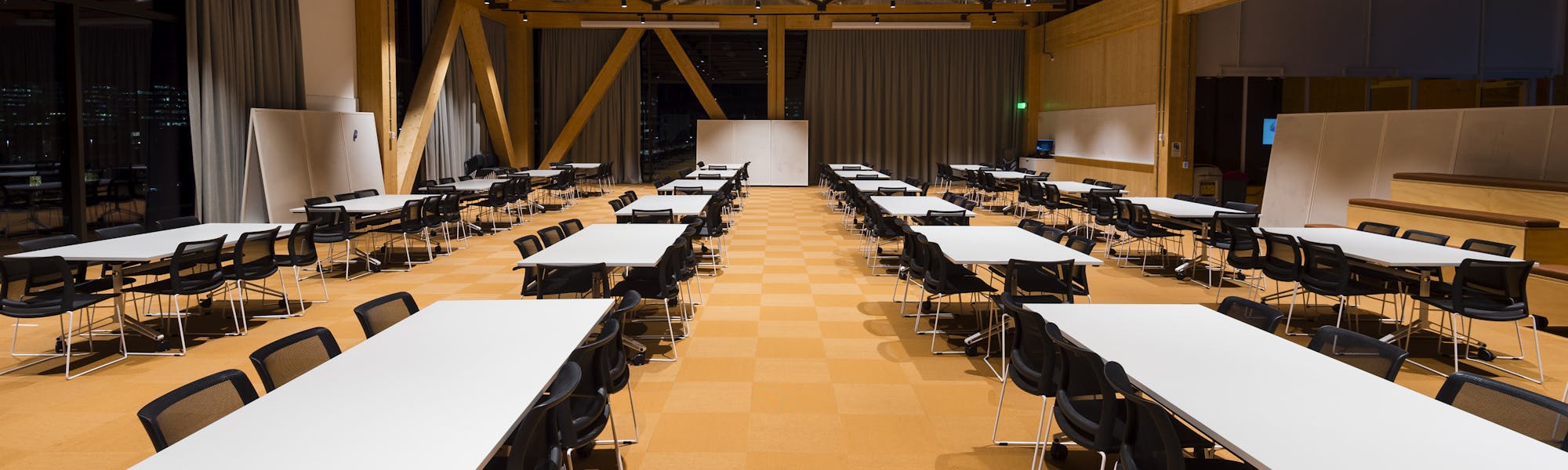
The Marie Reay building is suited to social distancing, as the floors are flat and the furniture is movable. The superfloor has been set out with tables which normally accommodate seven people (as shown in the stock image). Today each two rectangular tables have been pushed together to a make large square one, with one or two people on each side. This reduces the room's capacity in the already low density cabaret format by half.
A hand held microphone was used for audience input. This presented the problem of sterilizing the microphone between users. Microphone on a stands at fixed location would be an alternative (with an optional foot switch). A telepresence robot would be a more complex option.
This workshop is using the traditional format with a series of speakers with slides, each followed by questions from the audience. There is a slight modification, with the MC inviting remote participants to turn on their microphone to ask a question, or post it to the chat. The image of the speaker is not being transmitted, just slides. Switching from a presenter in the room to a remote one required some verbal negotiation, much like using a two-way radio. This slowed down proceedings a little, but is perhaps a good thing as it can at times be difficult for the audience to keep up with highly technical presenters.
As for the content of the workshop, one point of interest is that large renewable energy projects on indigenous land will, ironically, be unable to provide power to the local community. There will be mega watts of power being exported, but none can be provided from the large systems for the locals. The obvious solution is to require those putting in large projects to provide small independent local systems. The problem then is how are these systems maintained?
Conference organizers, both academic and commercial, have been hit hard by COVID-19, with local, national and international conferences postponed or cancelled. One response is to offer events online, or both online and in person. But how much will delegates be willing to pay?
For the last few years I have attended, and spoken at, events in Sydney and Singapore under the EduTech brand. EduTECH 2020 Sydney is planned for 9 - 10 November at the International Convention Centre in Sydney. But in the interim a Sydney Mini Virtual Summit on Adaption of Education is planned for Wednesday, 29 July 2020 4.00pm AEST. This is four speakers over two hours, plus thirty minutes for questions. The fee is $20 for early bird, $25 standard, and $30 for last minute registration. It will be interesting to see how many people are willing to pay for an online symposium, after months of free presentations.
Meanwhile, EduTECH Asia 2020 is planned for 11 - 12 November at the Marina Bay Sands Singapore. There was a very interesting EduTech Asia Virtual conference, 23 - 26 June. This was free, presumably to promote the full face to face conference.
It is not clear if these events in Sydney and Singapore have parallel online versions planned, for those who cannot, or do not wish to meet in a conference center. This would be using what is called in the education field hybrid mode: some people together at the conference venue and others joining in by video conference. The problem for educational institutions, and for conference organizers, is how to offer an online product without lowering the perceived quality of their face to face offering. Also if a lower price is offered online, then how low can this be to attract delegates, without undercutting face to face attendance? Australian universities typically charge the same amount, for face to face and online courses. But will an online conference delegate pay a thousand dollars, or more, for a conference?
Last year the ASCILITE conference fee was about AU$900 face to face. This year the virtual conference fee is $100 for members and $250 for non-members presenting papers. The fee for some delegates is as low as $25.