Recently I was delighted to be interviewed for a podcast by Kristina Hoeppner on the use of e-portfolios in Mahara's 'Create. Share. Engage' series. We talked about how these are used in the ANU Techlauncher program, using techniques I learned as a student of Debra Hoven at Athabasca University. With this approach the student is guided through the development of the portfolio, including peer feedback, and as part of their coursework, rather than being left as something extracurricular to complete later.
A slight variation on this, is to have the student prepare the portfolio in the form of an application for a real job which they would like on graduation. This makes sense as a capstone exercise, at the end of a program of study, as many students are then looking for jobs. This transforms the portfolio from something which might be of use to the student one day, to something of vital importance right now. At the moment I am overseeing the assessment of 400 student portfolios by a dozen tutors.
These are the notes for the second of four webinars on"Engaging students in the online environment", Wednesday, 27 January at 11 am AEDT Sydney time (Tuesday, 26th, 5 pm MST in Edmonton). Please register now for the webinar and send your suggestions.
Show-Your-Work to Discourage Students Cheating Online
These are the notes to accompany the Powerpoint/PDF presentation:
How do we keep students engaged with their major assessment tasks all the way through a course? I propose to have students record their notes and work for assignments, both to keep them engaged and make cheating harder. Be ready to contribute your ideas and experience of having students show their work.
Professionals working in academia, research, industry and government document their work. This is to protect their own intellectual property and that of their employers and clients. It is also a way to record what has been done, so they, or others can build on the work. It is a way to plan what might be done next, as well as what has been done. For students this is also a good way to learn, by reviewing what they have learned, and planning what they need to learn next.
As with working professionals, students can use their logbook to provide evidence that their work is there own. It is much easier to defend a charge of plagiarism if you have a timestamped record of everything you did for a project, from the time it was conceived.
Lieutenant James Cook wrote a detailed 354 page logbook as a "... trusted and coherently authored account with which to convince his backers in London" (Eóin Phillips, History and Philosophy of Science, University of Cambridge).
Traditional records are on paper. As a public servant, I was trained in how to make these harder to tamper with. Official files were kept in secure storage, administered by specialist staff who recorded who had which file out, when. Pages were required to be numbered and destroying a record without authorization was (and is) a crime. Professionals can use use this paper trail to protect the public interest, and themselves, by making it clear, who did what when. The advent of electronic documents has made it harder for the record keeper, as electron ic documents can be easily altered or deleted. However, it has also made it harder for the fraudster, as it can be hard to track down every copy and every log of changes.
Student Logbook For Work Notes
Web Social Science, Ackland, 2013
'I found Robert Ackland's "Web Social Science: Concepts, Data and Tools for Social Scientists in the Digital Age" (SAGE Publications, 2013), on the new books stand at the ANU Library. This is very relevant ... Ackland discusses how a "community" develops "common beliefs, norms and shared understandings. ...' From Web Social Science: Concepts, Data and Tools for Social Scientists in the Digital Age, Posted by Tom Worthington on 19 January 2014, 9:31 PM
As an international online graduate student from 2013 to 2016, I kept a private electronic journal. In addition, I created one for each course. These were stored on the university's electronic portfolio system. By the end of three years study, each journal had about one hundred postings (1,200 postings in total, made up of about 100,000 words). This was useful to keep notes for later use in assessed work. I would jot notes as topics came up and was careful to include a full reference to the source, so I could use these later.
Student Logbook for Reflection
Vancouver from 17th floor, UBC Walter Gage Student Residence, 2014.
"It is four days before I start as an on-line student ... So I am checking I have access to the course materials. So far everything looks very familiar... The one worry is a group "presentation". I am worried about how I am going to work in a group on-line internationally (there appear to be no other Australian students). Also there are some syncronous (real-time) activities, which I will be unlikley to attend due to the time differece. These are listed under assesment as not complusory, but in that case why are they listed?" From
Starting as a Student at University, Posted by Tom Worthington on 07 January 2014, 4:17 PM
Another use for the journals was to make notes about my reaction to the course. Being a student, and particularly an online student can be a lonely, frustrating experience. Through the journals I in effect had a conversation with myself about what I was doing and why I was doing it.
Student Logbook as Evidence of Having Done the Work
"I have not had a reply from the tutor about my selected paper, but another student replied saying it looked okay. The instructions said to post to the forum in preference to emailing the tutor, so I guess this is okay (otherwise the tutor would have said). So far I have 450 words, but these seem to be more about me than the paper. ;-)
Attached files ... Assignment1...doc - [22.5KB]" From: Assignment 1: First Attempt, Posted by Tom Worthington on 29 January 2014, 12:05 AM
Another reason to keep a journal was as a defense against plagiarism. At any time anyone, however senior, can be accused of using someone else's work without acknowledgment. If an examiner asked "where did this come from?", I had a day by day, draft by draft, timestamped audit trail of my work on the topic, back to when I started. This not only included the what, but the why. As an international student this was particularly important, as the norms could be different, and even down to the page size.
What Technology to Use for an Electronic Student Logbook?
"It appears to me that students can "game" assignment deadlines by creating incomplete Journal entries before the assignment deadline, then editing them after the deadline, since the Journal entry time stamps don't update after editing..." From: Journal entry time stamps - not updated when edited...?, by Robert Lyon, Mahara Forums, 30 September 2014: https://mahara.org/interaction/forum/topic.php?id=6470&offset=0&limit=10
The best tech to use is whatever you already have. I have been fortunate as a post-graduate student, in that the three institutions where I studied, all used the same electronic portfolio (Mahara), teamed with the same Learning Management System (Moodle). This made it very easy for me to create Journals in Mahara and keep them secure.
One problem, was that Mahara did not record when a student updated a journal entry, so they could game the system by creating a empty entry, then updating it later. This was later fixed, with each journal entry displayed showing both a "Posted on" and "Last updated" timestamp. I tried this out on Mahara and it seems to work. But is anyone using this?
However, if students are not using Mahara, or another journalist system already, then asking them to do this is a burden. This is also a burden for the teacher who has to learn to use just another product.. Also Mahara is much more than the student needs for a simple logbook.
"Write a paragraph about a ... goal you would like to reach. Explain why you want to reach that goal.
Write a paragraph about what you did today that helped you to be successful in today's activities.
Write a paragraph about your ... behavior for the day. What things might you do to demonstrate more sporting behavior in the future?
What was the hardest thing for you to do today? Why was it hard?
Write a paragraph that includes the cues of striking that we learned today. What will you do outside of school to practice these cues?
Write a paragraph that includes the main aspects one should consider when developing a fitness program. Hint: Remember the FIT principle
Write a paragraph that describes activities that you can do in your community that promote cardiovascular endurance .
Write a paragraph that explains the difference between verbal and nonverbal communication. Why is it important to use both in cooperative activities? Be sure to give specific examples of both verbal and nonverbal communication." From p.43, James, Alisa, "Journaling as an Assessment Option" (2005). Kinesiology, Sport Studies and Physical Education Faculty Publications. 78. (numbering added) https://digitalcommons.brockport.edu/pes_facpub/78
There has been much written about the use of reflective e-portfolios for assessment. I have been trained to write, teach and assess reflectively. However this is something the average STEM student and teacher finds very difficult. James (2005) sets out how to guide physical educations students through preparing an assessed journal.
Writing prompts are more important for an e-journal used with an online course, than for the face to face classes James (2005) discusses. As the student will be mostly studying asynchronously, the teacher is not there to be saying "put a copy of that in your journal now". This has to be explicitly stated in course materials, ideally as part of a assessed task, so the student has an incentive. This can also be a good point. I suggest to mark a point in the course, an approach of synchronization of asynchronous learning (Worthington, 2013).
James' prompts are ordered from more to less reflective. The first four are about the individual student goals, success, behavior, difficulties. The next three are about future plans of the student to learn skills. The last is a more traditional study question about the course material. These questions are not that different to ones which might be asked as study aids in any course. One of my frustrations as a student was that my answers to such questions were never looked at by anyone, let alone count towards assessment. In theory they help with learning, but in practice, like any student, I would tend to focus on what got looked at and especially marked. The e-journal gets around this problem by having answers go somewhere, perhaps be looked at and help me at least pass the course.
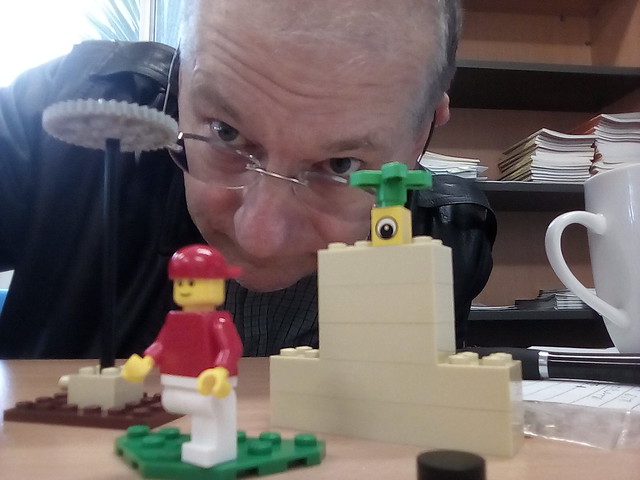
Logbook entries need not be just text, there can be diagrams, photographs, and with an electronic journal, video. Dr Stephen Dann, has adapted theLego Serious Play technique for reflection workshops. In 2017 Dr Dann ran a workshop for ANU staff working on their reflective e-portfolio for theHigher Education Academy Fellowship. In 2018 he ran a similar exercise for ANU Techlauncher students to consider their role in a group project. In each case the student is asked to make something with building blocks representing the topic and then talk about it. By talking about it, the students are encouraged to talk about themselves. They are also encouraged to take a photograph of their work.
Moodle Wiki for a Student Logbook
The Mahara Journal looked promising, especially as it is usually installed alongside Moodle. However, this would still be an additional tool students and staff would have to become familiar with. An alternative which looks promising is the Moodle Wiki. This can be set up so each student gets their own. I have created a logbook template which can be provided in the Wiki.
My template has a paragraph of explanatory text, then sections for the student to fill in. The student could create extra pages if they have a lot of content. But I expect one page will do for a typical student. They just click on "edit" the heading for a week, and put in some content.
The fill in the blanks sentences are adapted from James (p.43, 2005). The topics for each week are from the Australian National University's Techlauncher program (Awasthy, Flint, and Sankaranarayana, 2017). Questions for the Work Portfolio (Weeks 4 and 8) were suggested by Tempe Archer, ANU Careers. The idea here is to provide a prompt for the student each week to start writing and avoid presenting then with a confronting blank page. The students are asked to write about the activity set for that week and a specific aspect of it.
Jacques, Ouahabi and Lequeu (2020) refer to the use of logbooks in Google Drive for French first year first year engineering students learning online, but unfortunately give no more details. Kumar, Silva and Prelath, R. (2020) mention not having a project logbook as a problem for studio based learning in a Malaysian course, but again provide no more details.
Reference
Awasthy, R., Flint, S., & Sankaranarayana, R. (2017, April). Lifting the constraints—Closing the skills gap with authentic student projects. In 2017 IEEE Global Engineering Education Conference (EDUCON) (pp. 955-960). IEEE. URL https://doi.org/10.1109/EDUCON.2017.7942964
James, Alisa, "Journaling as an Assessment Option" (2005). Kinesiology, Sport Studies and Physical Education Faculty Publications. 78. https://digitalcommons.brockport.edu/pes_facpub/78
Jacques, S., Ouahabi, A., & Lequeu, T. (2020). Remote Knowledge Acquisition and Assessment During the COVID-19 Pandemic. International Journal of Engineering Pedagogy (iJEP), 10. URL https://www.thierry-lequeu.fr/data/JACQUES-04.pdf
Kumar, J. A., Silva, P. A., & Prelath, R. (2020). Implementing studio-based learning for design education: a study on the perception and challenges of Malaysian undergraduates. International Journal of Technology and Design Education, 1-21. URL https://link.springer.com/content/pdf/10.1007/s10798-020-09566-1.pdf
Professor Rory McGreal, who taught me open educational resources (OER) at Athabasca University, has proposed the use of blockchain for their dissemination. While most OER are free and authors are happy to see their work widely, they still want to be acknowledged for their work.
The Creative Commons licenses, commonly used for open materials, all have a "by attribution" requirement: "... the original creator (and any other nominated parties) must be credited and the source linked to". However, this is only a legal and moral requirement, the technology doesn't enforce it. Professor McGreal proposes to go a step further and use a blockchain to securely record who first created the work, and all the changes made and by whom.
While technically feasible, using block chain would throw up some challenges. As an example, nothing can ever be deleted from the blockchain, so if there was something which was incorrect, or harmful, or illegal, it would be there in perpetuity.
The idea of using blockchain in academia might have other uses. Recently I have been considering how students could record their progress with assessed work, such as assignments. One problem is to find an easy way for students to record what they did, but not be able to falsify the record. I have been looking at using some form of electronic logbook stored on the educational institution's system, so the student can't tamper with it. An alternative would be a blockchain.
Reference
McGreal, Rory. (January 20, 2021) How blockchain could help the world meet the UN’s global goals in higher The Conversation. URL https://theconversation.com/how-blockchain-could-help-the-world-meet-the-uns-global-goals-in-higher-education-152885
The video presentation contains images that were used under a Creative Commons License. Click here to see the full list of images and attributions:
"Tom teaches university computing students how to undertake real
projects for real clients. This has included an artifact mapping tool
for the Plain of Jars in Laos and test software for the radars on
Australian warships. These real-world projects require real-world
assessment techniques, including e-portfolios. In this presentation he discusses:
Innovative education techniques to teach students how to better communicate with employers and people
How to build students confidence and capture their skills set to become more job ready
How to provide formal postgraduate education to students in their workplaces via mobile devices"
I will be speaking on "Using an ePortfolio to capture students’ skill sets to align to workplace" at the Higher Education Leaders Congress, as part of Edutech 2018, in Sydney, 2pm, 8 June in Sydney:
"Discover innovative education techniques to teach students how to better communicate with employers and people
Learn how to build your students confidence and capture their skills set to become more job ready
Discover how to provide formal postgraduate education to students in their workplaces via mobile devices"
Teaching students to communicate with employers
There is one simple way to teach students to communicate with employers: get them to practice communicating with employers and assess them on this. Students can practice with written and face-to-face presentations. One overlooked aspect is remote communications. Recently one of my teams said their client would be overseas, so the could not have meetings only email. I pointed out that it was possible to have a "meeting", by email, providing the discussion was suitably structured and documented. The documentation is not just a copy of all the emails, but an agenda beforehand and a set of minutes with what was discussed and what was decided after.
Build your students confidence
Confidence comes from practicing a skill, under more difficult and realistic circumstances. With one team of students I had only just met I warned them they had to be ready to pitch at any time. A few minutes later a venture capitalist came up and said "tell me about your project". The team got through this encounter and that built their confidence.
Capture their skills set to become more job ready
The student has decide what would be of interest to a prospective employer. The more relevant and real-world the better.
Formal postgraduate education in the workplace
Once academics get used to the idea that they don't have to give "lectures", delivering university education on-line becomes relatively simple. Postgraduate education to students who have jobs is even easier. Graduate students have more maturity and are focused on achieving results at university. Courses can be redesigned to first identify what knowledge and skills the student has to demonstrate, then provide ways they can do that through practical exercises, ideally involving they day job. Lastly the student can be provided with course notes, videos\, quizzes and the rest of the educational paraphernalia, to support the leaning.
via mobile devices
Educational applications, including e-portfolio tools and learning management systems, now support mobile devices. The course designer doesn't have to use any special software, they just have to remember to divide the content into reasonably small chunks for the mobile user. Keep in mind the student will not be sitting in a silent room for an hour or more, they will be on a noisy bus with a few minutes to spare.
More Thoughts
The idea of a portfolio, being acollection of samples of work by an artist is not a new one.
An e-portfolio is just an electronic version of this: being a collection
of digital artifacts from the student to show an examiner and
prospective employers.
There are specialized
applications to help with producing a portfolio, such as Mahara. These
are especially useful where a student uses the portfolio as part of
showing evidence of skills and knowledge as part of a formal program.
The software to help ensure that the student has met all requirements.
This may be also useful where an employer has very detailed job
requirements.
However, what is of interest to a
university examiner is unlikely to be of much interest to an employer.
What an employer wants to know is if the applicant can do the job. This
is best demonstrated by evidence of the applicant having already done
the job, or something similar.
As an example, in the
ANU Techlauncher program I tutor teams of students who have to produce
something (usually software) for a client. The client may be a start-up,
a government agency or a company. The last assessment task for the
program is an application for a job, which details how what the student
did for the project is relevant to that job.
The Australian National University (ANU) launched its e-Portfolio system yesterday. E-portfolios have been in use in Australian universities for at least a decade, but are still not easy to use. QUT lead the Australian ePortfolio Project, which produced a 175
page report in 2008. QUT also produced a 41 page report in 2008 on what they were implementing at
their own institution, which remains a useful guide for others to
follow.
QUT identified three styles of student ePortfolios:
Structured: predetermined framework of objectives to meet external / internal needs
Learning / Dynamic: opportunity for self-audit, recording, reflection, feedback and on-going development
Showcase: collect together, organise and present accomplishments...
The type of e-portfolio I am most interested in is Structured, where the student can be guided through the requirements of a course, degree program, or professional certification, without being limited to completing fixed coursework or tests. Mahara's SmartEvidence may make this easier. This and could be used for courses, or whole bachelors, masters and professional doctorate degrees.
Problems occur with e-portfolios when the purpose is not clear. In particular a structured or learning e-portfolio is unlikely to be suitable as a showcase. The student's detailed work and reflections are unlikely to be of interest to a prospective employer, and may not be suitable for public release.
One problem is where the student is undertaking professional practice work in a real commercial or government workplace. The student's work can contain sensitive commercial or government information, which instructors are permitted to see, but cannot be made public.In reflections, students can reveal much personal information, including mental illness, personal and family relationship difficulties, which are not suitable for release.
Also I don't agree with QUT's claim that "Writing reflectively is easy". Providing the digital tool is easy, but getting people to use it effectively is
very, very, hard. In particular, reflective writing is not something which comes easily to STEM students, who have been trained to write in the third person from a neutral "objective" point of view. Reflection is something the students need to be trained to do, supported by a qualified teacher.
Athabasca University introduced an ePortfolio
for MEd students in 2012. However, this was modified a few years later, in part due to the difficulties the students had in completing a portfolio (Hoven, 2015). It should be noted these portfolios were for students of education, well versed in writing. If anyone should be able to do an e-portfolio, it is an education student.
I was
one of the cohort of students during the transition to the new Athabasca MEd e-portfolio process. We were given to choice of the old process, or the new and I chose the new. Rather than the e-portfolio being appended after then end of coursework, it was a capstone course. An instructor took students through stages of work, with peer feedback. However, even with this additional support, the e-portfolio process was not easy. Based on that experience, I hope to help avoid some of the problems with e-portfolios at ANU.
Greetings from the Australian National University (ANU) in Canberra, where the new e-Portfolio is being launched. The software product being used is Mahara and it has been piloted extensively at ANU.
The choice of this product is a safe choice as it is typically installed alongside Moodle (which ANU already has). I have used Mahara in the ANU Techlauncher program, with computer science students. Previously I have used Moodle/Mahara at ACS, USQ and Athabasca University. Professor Paul Maharg is providing an overview of how he has used e-portfolios for training lawyers. This was not about a box ticking exercise, but helping a student understand what it is to be a lawyer. He pointed out that "e-portfolios and reflection go really, really well together".
Professor Maharg also pointed out the difficulty getting students to work cooperatively together and to have curricula changed to incorporate it.He then got a little allegorical, likening an e-portfolio to the journal of early explorers, in how they explain not only what they have learned in an objective sense but as something they need to integrate with what they know.
In his presentation used the term "curriculum is technology" and asked where it was from. I traced it to a JISC report (Hughes, Gould, McKellar & Maharg, 2008, p. 40).
Last year I had to use Mahara as a graduate student to prepare a portfolio. This involved reflection and peer work with other students. My hope is that the SmartEvidence function of Mahara will take much of the tedium of the process, for students and supervisors.
Reference
Hughes, M., Gould, H., McKellar, P., & Maharg, P. (2008) SIMulated Professional Learning Environment (SIMPLE). URL http://simplecommunity.org/wp-content/uploads/2010/11/SIMPLE-FINAL-report.pdf
The final assessment item for Computing and engineering students undertaking group projects in the TechLauncher Program at the Australian National University is a Personal Development Review (PDR). Last year this was a reflective portfolio prepared by the student using the Mahara e-Portfolio tool and worth 30% of the total course assessment. This year the exercise has been halved to 15% and recast as an a job application (1,000 to 1,250 words) against five selection criteria:
Students will be assessed against these criteria. The use of Mahara is no longer suggested, with the student simply submitting a word processing document via the Moodle Learning Management System.
As I discovered myself, having to complete a reflective portfolio last year for a MEd, this is a particularly difficult task for a STEM student. Having been trained to always emphasize hard facts and write in the third person, it is difficult to suddenly write about myself and my personal relationship to the work. Treating the task like a job application should provide more focus for the students. However, this is still difficult where students have been undertaking teamwork and trained to be "team players" but then asked to write about what they, individually, accomplished.
Recently I agreed to tutor some student groups in an innovative new program. The catch is that as well as the usual tools (Moodle and Mahara), this is also using piazza.com for student communications and a Bitnami based Wiki for course materials. It is taking some time to work out how to use each tool and work out what goes where.
When I undertook the Certificate IV in Training and Assessment (TAE40110) in 2013, the Canberra Institute of Technology (CIT) used a multi-page paper based form, with a long list of competences. For each competency there would be a page or two of evidence required. Where multiple competences were from the same evidence, there was a
cross reference notation needed and much flipping back and forwards
between pages. This resulted in a folder full of paper, which is presumably stored in a basement at CIT.
At the moment I am preparing my own e-Portfolio for my Master of Education in Distance Education, using Mahara. I was going to list the competences on the front page and then provide the assessor with a hypertext link to the page with the evidence. But this will require me to manually hypertext each competency to the relevant
artifact page. This will be tedious to do and to maintain. The annotation feature
seems to be intended to do this automatically. But I am not sure there is enough implemented yet to be usable.
Mahara Version 15 implemented basic annotations. You add an annotation box
to each artificat. This is just a text box, where you type in what competencies you
are claiming. The assesor then comments and when it is approved the
page is locked. There are also tags, which might be useful. More features are planned for release in October.
As it is the annotation tool might be used by tagging each annotation
with the relevant competencies. The tag cloud generated by Mahara would
then supply a cross reference of which pieces of evidence are relevant
to which competences.
Moodle 3 Competencies
Moodle 3's Competencies may help. But appear more suited to Vocational Education and Training (VET) than university assessment. With the VET approach the student is presented with a long list of small tests: do a quiz, or submit some evidence. The assessor then gives each a tick, one after another in sequence (I had to do this for the Cert IV in Training and Assessment).
But what you will typically have with university is a small number of large pieces of evidence to support a large number of competences. As an example the capstone for the Master of Education I am doing requires 5 artifacts to support 47 competencies.
Taking the VET approach I would end up with 47 competences to fill in, submitting the same 5 artifacts on average 10 times each. The alternative is that I list the 5 artifacts, then each competency it covers. But then I have to manually provide a cross-reference table to show all competences in order and where they are covered in the e-portfolio.
What it would be useful for Mahara/Moodle to do that cross reference automatically. The student would put the e-portfolio in Mahara, with competences claimed for each artifact. A tool would then scan the eportfolio and place the cross-referenced list of competences in Moodle.
Learning reflective writing
As well as the mechanics of using an e-portfolio, there is the larger problem of learning what to write. Many courses and programs just seem to give the students a tool like Mahara, perhaps with some training on how to use the tool, but no training in reflective writing. This is something which students need to practice all the way through a course or program.
Zawacki-Richter, Baecker and
Hanft (2010) divide a sample of e-portfolios into four competence classes:
SCC (socio-communicative competence),
MPC (methods and professional competence),
PLC (personal competence), and
AAC (activity and action competence).
I suspect I fall into the MPC class and was a little offended, on behalf of my class, by the way we are described.
MPCs are characterized as seeing group work as a “means to an end” and not crediting other group members in their e-portfolio. These comments appear to be meant as criticisms. However, group work is a means to an end, otherwise why would any rational person do it? Also I avoid mentioning others by name in e-portfolio entries (using *fellow student* and *instructor*), as otherwise it would be a breech of privacy.
Reference
Zawacki-Richter, O., Baecker, E., & Hanft, A. (2010). Validation of competencies in e-portfolios: A qualitative analysis. The International Review Of Research In Open And Distributed Learning, 12(1), 42-60. Retrieved from http://www.irrodl.org/index.php/irrodl/article/view/893/1671
The default user interface for the Moodle learning management system (Version 2.9.2+) is called "Clean" theme . This is a responsive web design, which will automatically adjust from the usual three column layout used for Moodle on a desktop computer, to a one column design for a mobile device. This is triggered not by detecting a mobile device, but purely from the width (in Pixels) of the display screen. If the screen is less than 768 pixels wide, the Clean theme displays only one column of text.
The figure of 768 pixels is commonly used for what is called in web design a "breakpoint", where the layout is changed from desktop to mobile format (Natda, 2013).
You can try this with the Moodle Demo using the Mobile Browser Emulator extension for Google Chrome, or simply by making the width of your web browser window smaller until the columns disappear. Try your own installation of Moodle and see if you get the same result (there are many non-responsive Moodle themes still in use).
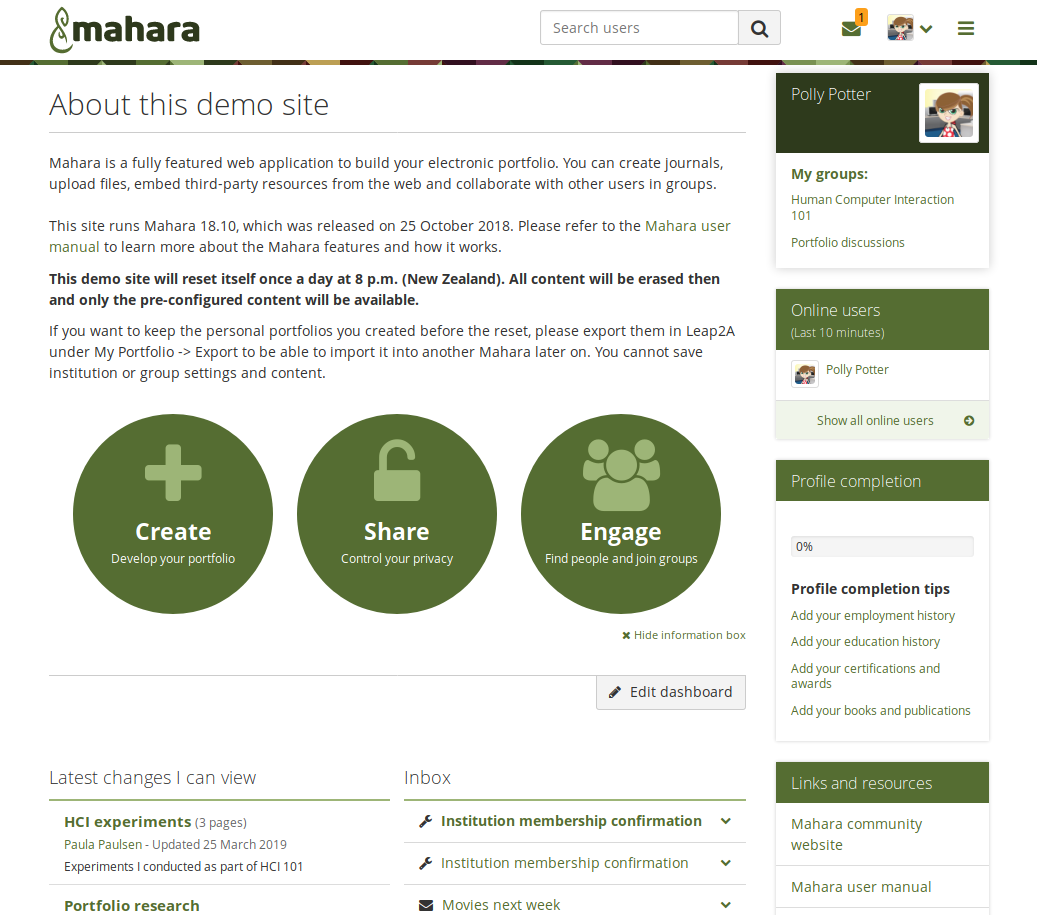
The Mahara e-Portfolio has a similar responsive design by default, you can try this with the Mahara Demonstration.