Showing posts with label constructivist. Show all posts

Tuesday, September 3, 2019

Teaching and Learning at Australia's Newest University College

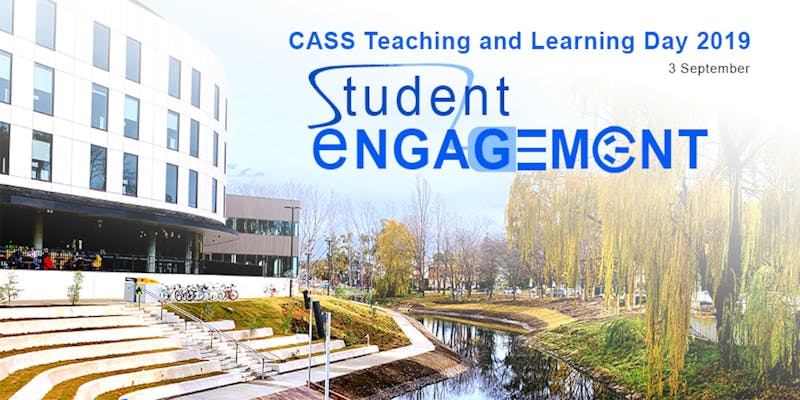
Greetings from the the Australian Nation University in Canberra, where the  CASS Teaching and Learning Day, just started. The theme is student engagement, with  interactive learning strategies and technologies. The event is being held on the "super-floor" at the top of the Marie Reay Teaching Centre. I will be using this for large format workshops later in the semester.

The keynote is by Professor Maria Northcote, Director of Higher Research Degrees at Avondale College of Higher Education. Beforehand, Maria mentioned she reads this blog, so I thought I should blog. Professor Northcote started by saying she was a constructivist in educational terms. Yesterday TEQSA approved Avondale to be an Australian University College (one step down from being a university).

Professor Northcote raised the topic of student involvement in educational design. She proposed to go beyond simply asking for feedback after the course, to negotiate what should be in it, beforehand. Also Professor Northcote discussed having advanced students teaching.

One research project Professor Northcote  described was "But when do I get my mark?".  With this the students were given qualitative feedback on their assignments, but then there was a delay before they got the mark. The idea was to get them to focus on the feedback, but in line with the title of the work, this was frustrating for the students. What surprised me was that there was no step built into the process to at least justify the delay. An obvious step would be to allow the students to revise their work, based on the feedback, before they get their mark. That would give them a positive reason for the delay.
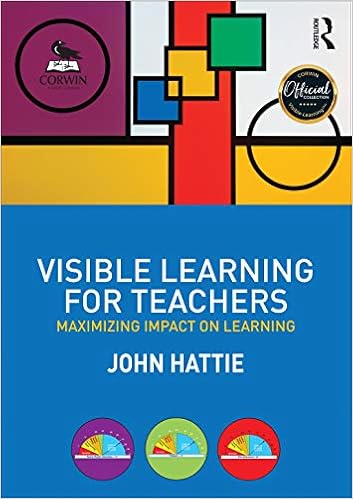
Professor Northcote  recommended the book "Visible Learning for Teachers"  by John Hattie (2012).

Coming up are:

11.00am – 1pm: Designing Interactive Learning Space – MARKETPLACE (Morning Tea through Lunch)

5 stations:
Station 1Flexible Studio Recording and Green Screen: Tips & Practices
Station 2How to Design Interactive Learning Contents using H5P
Station 3Virtual Reality in Education
Station 4Examples of good Wattle pages
Station 5Examples of Successful Innovation in Teaching at the College of Arts and Social Sciences
1pm – 3pm: Principles and Examples of Student Engagement
3 speakers:
  • Mr Eamonn McNamara, (School of History) – 2019 Vice Chancellor’s Awards for Excellence in Tutoring or Demonstrating
  • Dr Kate Flaherty, (School of Literature, Languages and Linguistics) – 2019 Vice Chancellor’s Awards for Teaching Excellence
  • Dr Kim Cunio, (School of Music) – Advocate of emerging cultures, indigenous Australians and women

Friday, October 19, 2018

ANU Course on Key Concepts for University Teaching

The Australian National University is offering a free online short course "Seven Key Concepts for University Teaching and Learning",  14 to 20 November 2018. This is part of the ANU Coffee Course series, where the student spends only about as much time it takes to have a coffee break studying each day. You read a brief summary, watch a video, answer some questions and discuss in an online forum. ANU staff can obtain formal professional development recognition, but teaching staff at any institution are welcome to take part. This will be the sixteenth coffee course I have been a student in.
"Have you ever wondered about concepts like 'constructivist learning' and what this approach means in practice?  How relevant are these ideas to everyday teaching at university? This fully online, self-paced coffee course will provide an opportunity to unpack this and related concepts in five quick snapshots over your daily coffee breaks!
Course outline:
  • Day 1 – Why learning theory?  How will this help my daily work as a university teacher?
  • Day 2 – Surface versus Deep Learning.  How deep do your students dive?
  • Day 3 – Taxonomies of learning and knowledge – are they useful?
  • Day 4 – Adult learning theory.  Do adults learn differently?
  • Day 5 – Constructivism and some other ‘isms.’  What do they  mean? "

Sunday, April 9, 2017

Four Steps to Digital Teaching


Pictographs by
Carlos Sarmento

from the Noun Project
(CC BY 3.0 US).
To help with the change in teaching techniques at ANU, I have set out Four Steps to Digital Teaching. These are illustrated on the cover of my book "Digital Teaching In Higher Education". The idea is to provide some quick and easy to understand steps to help academics to adapt existing courses and materials, not to turn them into educational designers or technology specialists. My approach, the educational jargon, is constructivist, collaborative and experiential.
Provide ebooks and other curated content on the topic
  1. eBooks: Provide ebooks and other curated content on the topic. Finding what they should read, and do, when can be confusing for a student. The course materials should be laid out like a book, with a table of contents, providing an overview, the course materials and activities in the order in which the student should undertake them and at the end any additional material. There should be an introduction, and a list of all the assessment the student is to undertake.

    The electronic format used for the course materials and the providing it is not so important. However, using many different systems and formats can be confusing for the student.
  2. Facilitate discussion between the students;
    Discussion: Facilitate discussion between the students. Discussion is not only a useful way for the student to learn, but is a valuable graduate skill in itself. At least on asynchronous text based forum should be provided.

    Synchronous text, audio and video "webinars" may also be used, but students may not be able to all attend at the same time, so multiple sessions and asynchronous alternatives should be provided.

    Students need to be told in advance what the purpose of the discussion is, how they are expected to participate and how the discussion will be assessed. The discussion must be assessed in some way, to provide the student with an incentive to participate and to make it educationally relevant.
  3. Provide tools and techniques for the student to explore the topic; andeTools: Provide tools and techniques for the student to explore the topic. The basic tools used for a course will be the provision of reading materials, discussion questions and a forum to answer the questions in.

    Quizzes may be provided to help students with surface knowledge. There may be more specialized tools which emulate those of the discipline on-line or are actual on-line tools.
  4. assessment, including formative feedback, to help them learn.Assessment, including formative feedback, to help them learn. Whenever a student is asked to do something, there should be some form of assessment to check how well they did it.

    For a standard twelve week course, there should be some form of assessment at least every week, making up about one to two percent of the total assessment per week. To improve learning and reduce the instructor burden, most of this assessment can be automated quizzes and peer assessment. The assessment scheme can be set so that this progressive assessment does not count for high grades (above a "Credit").

    Assessment is stressful for the student and time consuming for the instructor. Stress and time can be reduced by using rubrics, to clearly set out what is required. Also firm deadlines with no extensions can help reduce stress and time: student then know when assessment is due and that missed deadlines result in zero marks. To make this less stressful small progressive assessment items can be on a "best of" basis, such as the best ten out of twelve weeks being counted.