Showing posts with label teaching. Show all posts

Thursday, August 13, 2020

Answers for Teaching in a Time of Transition

The ANU Lunch Vox is a webinar series on teaching and learning. The first is Radical Shifts: Teaching in a Time of Transition, 20 August. Participants have been asked four questions and invited to produce 30 second video answers, so here are mine, all together, or one at a time:
  1. What is one activity/teaching strategy that you will continue to use once we return to face to face learning?
  2. How have your colleagues helped you through the transition to online learning?
  3. What are the key differences in teaching online and teaching remotely that an educator should be aware of?
  4. What is one positive message you think all ANU educators should hear in a time of transition? (CC)
The videos were made using Vidnami and contains images under a Creative Commons License.

What I normally do is produce the slideshow videos with synthetic voice for a course in advance. Then, if there is a live presentation, in a classroom or online, record that as well and prove that recording to the students after the presentation. The synthetic voice has the advantage of being precisely the same as the script and can be easily changed without the need to rerecord or edit. Also I suspect it is easier for those with English as a second language to understand the synthetic voice than my voice. However, while synthetic voices have got much better they are still mechanical sounding. On the other hand a live performer can sound wooden, as I do there, without an audience to respond to:


Part One: A Strategy Back to the Classroom.


"I plan to use hybrid mode: with some students in the classroom, linked to those on-line.

But we must be ready to abandon the classroom, without warning, due to COVID-19 outbreaks.

I stopped "lecturing" ten years ago and moved my teaching online.

Most students had already abandoned lectures, years before COVID-19.

Last year I supplemented my on-line teaching with some classroom based workshops.

But many of the students were international and a regional crisis could keep them away.

So I planned an online alternative, just in case.

That plan worked when COVID-19 struck."

Part Two, How Colleagues helped?


"During this difficult time of COVID-19 I have found the informal online events run by colleagues very useful to stay in touch.

Especially useful have been the Australian National University's weekly virtual morning teas, for early career academics.

Also Friday mornings with the Mobile Learning Special Interest Group of the Australasian Society for Computers in Learning in Tertiary Education have been productive.

We wrote a joint paper for the Society's upcoming national conference.

The Australian National University's Coffee Courses have been thought provoking, as well as useful for e-learning tips. "


Part Three: Differences teaching on-line?


'It is the similarities which are key, not the differences.

Teaching is teaching, whatever the medium.

Most importantly, educators should be trained to design and deliver education.

Teachers should learn using the techniques we want them to use, firstly online.

An approach called "dogfooding".

With training it is possible to design for online delivery and blend in classroom teaching, as required. '

Part Four: One positive message?


'At an Australian National University staff COVID-19 meeting early in 2020, I found myself saying to my colleagues:

    "We can do this".

Staff have been provided extensive training and support to teach under these difficult circumstances. That support will continue as we establish new ways of teaching for the long term.

The university supported and encouraged me over several years to learn how to teach online.

One reason was in case students were kept from class by an international crisis.

I was able to trial those techniques last year, so they were ready, when needed this year, for COVID-19.

With the support of our colleagues we can transition to blended and hybrid education, incorporating classroom teaching.'

Wednesday, June 10, 2020

Request LinkedIn Recommendation for the Higher Education Whisperer

My Honorary lecturer status is up for renewal at the end of this month. Following the example of Dr Mewburn (The Thesis Whisperer), I would like to include testimonials. If have helped your work, I would appreciate a recommendation.

As it happens, this semester I have been teaching 153 computer project students how to write a job application*. As I explained to the students, I know how hard it is to write a resume, as I was doing it myself, for real. ;-)

* The students are really preparing an e-portfolio where they reflect on their learning and prepare for life-long learning. But that is a bit "soft" for STEM students. So as they are about to graduate, they do it as a job application.

Thursday, December 12, 2019

Design Thinking for Higher Educaiton

The final speaker at at the IEEE TALE 2019 engineering education conference, was Chathura K. Sooriya-Arachchi, Institute of Information Technology, Sri Lanka on Design Thinking Approach to Higher Educaiton Teaching and Learning.
"We live in a world that demands creative problem solvers, creative thinkers who can come up with innovative ideas and solutions to situations. However many believe that creativity is a trait one needs to be born with, whereas creativity is a muscle that needs training. There is great potential to incorporate creativity in teaching and learning. This interactive workshop aims in sharing a number of Creativity and Design
Thinking methods, tools and techniques that can facilitate teaching and learning, along with inspirational examples/case-studies from the real-world."

This was a useful overview of applying design thinking to creating better education.  However, I suggest that those teaching at university require basic training in how to teach, assess and design courses. Otherwise university academics waste a lot of time reinventing well established patterns of learning, or worse still training out approaches which are known not to work. I suggest the level of training which vocational education and training teachers are required to have, would be a good place to start (I noticed that Chathura is a Certified Trainer).

Tuesday, September 3, 2019

Teaching and Learning at Australia's Newest University College

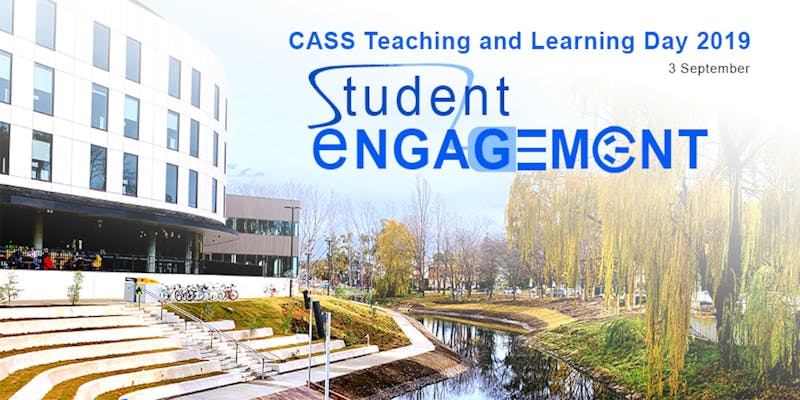
Greetings from the the Australian Nation University in Canberra, where the  CASS Teaching and Learning Day, just started. The theme is student engagement, with  interactive learning strategies and technologies. The event is being held on the "super-floor" at the top of the Marie Reay Teaching Centre. I will be using this for large format workshops later in the semester.

The keynote is by Professor Maria Northcote, Director of Higher Research Degrees at Avondale College of Higher Education. Beforehand, Maria mentioned she reads this blog, so I thought I should blog. Professor Northcote started by saying she was a constructivist in educational terms. Yesterday TEQSA approved Avondale to be an Australian University College (one step down from being a university).

Professor Northcote raised the topic of student involvement in educational design. She proposed to go beyond simply asking for feedback after the course, to negotiate what should be in it, beforehand. Also Professor Northcote discussed having advanced students teaching.

One research project Professor Northcote  described was "But when do I get my mark?".  With this the students were given qualitative feedback on their assignments, but then there was a delay before they got the mark. The idea was to get them to focus on the feedback, but in line with the title of the work, this was frustrating for the students. What surprised me was that there was no step built into the process to at least justify the delay. An obvious step would be to allow the students to revise their work, based on the feedback, before they get their mark. That would give them a positive reason for the delay.

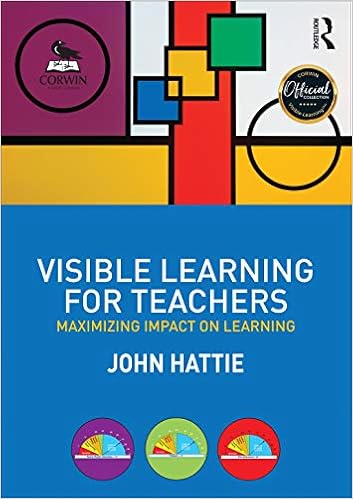
Professor Northcote  recommended the book "Visible Learning for Teachers"  by John Hattie (2012).

Coming up are:

11.00am – 1pm: Designing Interactive Learning Space – MARKETPLACE (Morning Tea through Lunch)

5 stations:
Station 1Flexible Studio Recording and Green Screen: Tips & Practices
Station 2How to Design Interactive Learning Contents using H5P
Station 3Virtual Reality in Education
Station 4Examples of good Wattle pages
Station 5Examples of Successful Innovation in Teaching at the College of Arts and Social Sciences
1pm – 3pm: Principles and Examples of Student Engagement
3 speakers:
  • Mr Eamonn McNamara, (School of History) – 2019 Vice Chancellor’s Awards for Excellence in Tutoring or Demonstrating
  • Dr Kate Flaherty, (School of Literature, Languages and Linguistics) – 2019 Vice Chancellor’s Awards for Teaching Excellence
  • Dr Kim Cunio, (School of Music) – Advocate of emerging cultures, indigenous Australians and women

Sunday, July 28, 2019

Free Teaching and Learning Day at ANU 3 Sep

The ANU College of Arts & Social Sciences (CASS) is holding a Teaching and Learning Day, in Canberra, 3 September 2019 from 9:00 am to 3:00 pm. This is free and open to anyone interested in higher education (not just ANU staff). The theme is student engagement, with  interactive learning strategies and technologies.

PROGRAM 9.00am – 9.30am: Registration
9.30am – 11.00am:
  • Welcome Address – Professor Rae Frances, Dean of College of Arts and Social Sciences (CASS), ANU
  • Opening - Professor Grady Venville, Deputy Vice-Chancellor (Academic), ANU
  • Keynote - Professor Maria Northcote, Director of Higher Research Degrees at Avondale College of Higher Education
11.00am – 1pm: Designing Interactive Learning Space – MARKETPLACE (Morning Tea through Lunch)
5 stations:
Station 1Flexible Studio Recording and Green Screen: Tips & Practices
Station 2How to Design Interactive Learning Contents using H5P
Station 3Virtual Reality in Education
Station 4Examples of good Wattle pages
Station 5Examples of Successful Innovation in Teaching at the College of Arts and Social Sciences

1pm – 3pm: Principles and Examples of Student Engagement
3 speakers:
  • Mr Eamonn McNamara, (School of History) – 2019 Vice Chancellor’s Awards for Excellence in Tutoring or Demonstrating
  • Dr Kate Flaherty, (School of Literature, Languages and Linguistics) – 2019 Vice Chancellor’s Awards for Teaching Excellence
  • Dr Kim Cunio, (School of Music) – Advocate of emerging cultures, indigenous Australians and women

Tuesday, June 12, 2018

Artificial Intelligence will take over most teaching

Professor Neil Selwyn,
Monash University
Professor Neil Selwyn, of Monash University, argues Artificial Intelligence (AI) will never take over from human teachers (2018). I suggest AI will never take over completely from human teachers, but it will supplement their role for many routine tasks. At the Australian Senate Committee hearing on the Future of Work and Workers last week, I was asked what proportion of jobs AI would replace. I suggested more like 40% than 10% but no one really knows.

The teaching profession doesn't "face" an impending change, that change has already started happening. University teaching has already flipped from being campus based to mostly online. However, most university lecturers will not admit this to themselves or to others. The higher levels of school will follow over the next few years. This is without AI, just using decades old e-learning technology.

Much of education can already be reliably provided by machines. This requires fewer, but more highly trained, teachers. What AI will not be able to do, at lest not well, is handle the exceptional situations.

Like human teachers, AI learns (that is why it is called "artificial intelligence"). Software is used to mimic human learning. Unlike a human, AI can learn from millions of cases very quickly. However, the results still need to be checked by a human as they can be unpredictable.

AI can minimc a human very effectively. The ELIZA natural language program of the 1960s was able to mimic a human in a conversation. It does not take much to do this, if the topic is limited to a narrow field, such as a course.

Like human teachers, some AI can explain its chain of reasoning, allowing the student to learn not just what to think, but how to.

AI can use a virtual face and body on screen, but in most cases this is not necessary. Most university students now learn online using text based materials. Where there are videos they watch them at high speed so any person visible is little more than a blur.

This is not to say AI will, or should, replace all human teachers. But AI will be used alongside other tools, such as writing and books, for teaching. It is a long time since anyone argued seriously that students should not write notes as they would then not be able to memorize, or that students should not read books, only listen to the teacher. In a few years time arguments against AI will seem as quaint as those against writing and books.

References

Neil Selwyn  (201, June 12). Six reasons Artificial Intelligence technology will never take over from human teachers, Edu Research Matters (Blog). Australia Association for Research in Education. URL http://www.aare.edu.au/blog/?p=2948

Friday, July 28, 2017

Extend Teaching Skills for IT Profession

The SFIA Foundation has invited suggestions for enhancements to the Skills Framework for the Information Age (SFIA). I suggest defining learning and teaching skills at levels 3 and perhaps also at level 2.

As part of my Master of Education studies I did a quick analysis of education skills for IT professionals. SFIA was very useful for this, providing a concise set of IT teaching skills:

SFIA Category Skills and ACS Membership Level
Subcategory Skill Code Levels
* SFIA Version 6 definitions from ACS (2015)
Skill management Learning and development management ETMG --34567

Learning assessment and evaluation LEDA --3456-

Learning design and development TMCR ---456-

Learning delivery ETDL --3456-

Teaching and subject formation TEAC ----56-
People management Professional development PDSV ---456-
However, some skills are only defined at higher levels.  ETMG, LEDA and ETDL start at level 3, but TMCR and PDSV start at 4 and TEAC at 5.

The entry level vocational qualification for the IT profession in Australia is "Diploma" in the Australian Qualifications Framework (AQF Level 5). The Australian Computer Society has identified this as being SFIA Level 3. It would therefore be useful to have the SFIA learning/teaching skills defined at SFIA Level 3.

The entry level qualification for those conducting training in Australia is a Certificate IV in Training and Assessment at AQF Level 4. So it may be useful to also have the training skills defined at SFIA Level 2.

It should be noted that the qualifications required for those teaching in Australia are inversely related to the level at which they teach: the higher the level of the teaching, the lower the qualification required. School teachers are required to have a degree (soon to be masters), vocational teachers only a certificate and university lecturing requires no teaching qualification at all.

ps: The SFIA Foundation are one of the more responsive standards setting bodies. In 2008 I was commissioned by the ACS to design a course in Green IT. There were no SFIA skills defined for this at the time, so I sent my draft course to the SFIA Foundation. Skills in sustainability were subsequently added to SFIA and matched my course syllabus reasonably well. I later changed the course descriptions to reference SFIA. The course is currently offered by Athabasca University (Canada).

Wednesday, December 28, 2016

Gates Foundation report on Student Data for Personalized Learning

The Bill & Melinda Gates Foundation has released the 36 page report "Teachers Know Best" along with a two page summary "How Teachers Approach Data". The report advocates the use of "... student data to tailor and improve instruction for individual students..." (p. cov2). Such an approach, I suggest, may do more harm than good, by diverting resources away from the design of quality instructional materials and by setting unrealistic expectation as to the level of tailoring possible with the resources available to teachers.

The report divided teachers into Data Marvens 28%, Growth Seekers 20%, Aspirational users 17%, Scorekeepers 11 %, Perceptives 14 %, and Traditionalistss 10%. The report's authors clearly believe that the marven's data-driven personalized instruction is preferable. However, where are teachers going to get the data and will they be given the time to personalize student's instruction? Assuming no more resources are provided, the funding to provide data analysis tools will come from the education budget and reduce resources for course materials. Similarly, more time by teachers taken on a personalized approach will result in lass time for class teaching.

I suggest what is instead required is instructional design, which individual teachers do not have the time or  resources to do. Statistical analysis can be used to crunch the numbers on large numbers of students to see what educationally works and what does not work and what aspects of subjects students have difficulty with. These insights can be built into the educational materials and teacher training. Teaching can be given help in identifying what students will have difficulty with and how to help them. But each teacher does not need to become a statistician to do this.

There are ways to use personalized learning to help students. However, it also has to be done in a way which helps teachers and is affordable. As an example, last year I used peer assessment in my ICT Sustainability course. This helps students, as by having to assess their peer's work, students gain insight about their own work. As a by-product this reduces the assessment load of the teacher (and also reduces student appeals, as students are less likely to object to the marks their peers give).

Friday, April 15, 2016

e-Leanring is Like an Automatic Toaster

E-learning is a like a modern toaster: remove the "e" parts and what you are left with is education as it was 100 years ago.

Recently my electric toaster stopped browning one side of the bread. This is the "bagel" function on advanced toasters, but I want toast. When the toaster tripped the earth leakage detector, shutting off power to my apartment, it was time for a new one. But what to do with the old toaster?

Canberra has no toaster recycling service and I did not want it to end up in landfill. So I disassembled the toaster (after ensuring it was unplugged), putting the metal and plastic parts in the household recycling bin. What I noticed was than under the large sleek modern stainless steel outer shell was a lot of empty space and a small old fashioned looking toaster, with a small electronic circuit board attached.

The toaster mechanism was an assemblage of folded steel, springs, wire and a large brass knife-switch, which would have been familiar to someone one hundred years ago. The circuit board adds a timer to the toaster to make it "automatic". Remove the timer, outer case, lights and buttons and you have an old fashioned toaster. Similarly, a modern car, without the streamlined panels and computer controls, is a steel chassis with an internal combustion engine (or electric engine) and would be familiar to a mechanic from 100 years ago.

This got me thinking that e-learning is a like a modern toaster: remove the "e" parts and what you are left with is education as it was 100 years ago. Education still consists of first working out what the student needs to know, then how to test it and then how to teach it. E-books can replace books, on-line tests replace paper tests, videos replace lectures, but underneath all this window dressing are the same basic educational techniques.

Friday, December 18, 2015

Twenty Years of Professional On-line Conversations by Teachers

Lloyd, Skyring and Nykvist (2015) have written a history of the oz-Teachers mailing list. This electronic mailing list for Australian teachers was started at the Queensland University of Technology in 1995 and has been used for daily discussions and a source of inspiration for research over 20 years. The mailing list continues today, hosted on Google groups: http://groups.google.com/group/ozteachers/

Perhaps a researcher would like to carry out a similar analysis of the "Link list on Australian network policy and communication", which has been running at ANU since February 1995 (the month after oz-teachers started).

References


Lloyd, M., Skyring, C., & Nykvist, S. (2015). Teacher professional conversations – the oz-Teachers story. Australian Educational Computing, 30(2). Retrieved from http://journal.acce.edu.au/index.php/AEC/article/view/72

Monday, April 20, 2015

Teaching is a profession and a Calling

Jemma Ward writes "Teaching is a profession, not a calling" (The Forum, 14 April 2015). She suggests that teaching portrayed as a "calling" and therefore teachers are expected to work long hours for low pay. But I suggest their problem is of the teachers own making and they have the means to fix it.

Many teachers are devoted to teaching and that may be the problem with education. Teachers would do better, for their students and themselves, taking a hard-headed approach. The "educator martyr complex" exists even in higher education, where the pay is better than schools. What lecturers and teachers should be focusing on is making teaching more efficient, effective and so less frustrating for them.

After giving guest lectures at university I became fascinated and frustrated by the teaching process, with its lack of rigor and efficiency. Then I discovered the e-learning/distance education revolution. Being able to teach from home, or the other side of the world, is only part of it. The real revolution is in designing education to use student and teacher time efficiently, in the classroom, or on the Internet.

As an adjunct lecturer, I can't sit around complaining of not being paid much, as when not teaching I am not paid. So I spent years (and $10,000) learning to teach efficiently.

Talking at students for an hour is not efficient. So modern teaching uses presentations broken up into segments of six to twenty minutes. It makes no difference if these presentations are live or recorded.

Students learn better when tested regularly. So I have started using short weekly automated quizzes (chosen at random for each student, to stop them cheating). Students learn well when explaining to others, so I also have students discuss topics in an on-line forum.

Ultimately the student must be tested with a large item of work. Marking such assignments can be done much more quickly using "rubrics" (detailed marking tables). Getting stuff to and from students is easier using Learning Management System (LMS) software (I use "Moodle", a free Australian product).

This is not to say I still don't grumble about teaching, but I don't grumble as much. ;-)

For more on the future of education see my Higher Education Whisperer blog: http://blog.highereducationwhisperer.com/

Monday, March 9, 2015

Rate University Teaching Quality On-line

In "The hunt for Australia's best teaching uni" (The Age, 9 March 2015), Gary Newman asks how to rank the quality of teaching at universities. Using the measures which have been used he lists Australia's top universities for teaching as: Victoria, Griffith, Deakin, Central Queensland, Tasmania, Edith Cowan, Canberra, Federation, Bond, Notre Dame, Sunshine Coast, New England and Western Sydney. That seems a reasonable list, with the regional universities not known for research having to focus on teaching. Also many of these institutions started as technical and teachers colleges devoted to education and now have an emphasis on e-learning (which requires a more professional approach to teaching).

As he points out the current ranking systems are based largely on research quality which is not necessarily related to the quality of teaching. He says a 2013 study provides some data (this appears to be "Factors Associated with Job Satisfaction Amongst Australian University Academics and Future Workforce Implications" by Peter Bentley, Hamish Coates, Ian Dobson, Leo Goedegebuure and Lynn Meek).

One interesting variation in rankings is the Ranking Web of Universities (Webometrics Ranking), which bases it assessment on the university's web presence. This produces a result similar to other measures but is easier to compile. Perhaps that could be applied to provide a measure of teaching quality, not just for Australian institutions, but world wide.
This, of course assumes that students are interested in teaching quality. It may be that students select a university based on its research reputation, as that is how the quality of their qualification will be seen.

Sunday, March 1, 2015

Debate over minimally guided instruction of minimal value

Much of the debate over minimally guided instruction is of minimal value, due to a lack of precision on what is being discussed. Kirschner, Sweller, and Clark (2006) explain minimally guided instruction as "one in which learners, rather than being presented with essential information, must discover or construct essential information for themselves". This has an obvious appeal, in terms of student engagement and saving in teacher time, but without more details as to what the student has to discover and how much help the student is given, this is a pointless argument.

It would not be practical to give physics students some light spectra data and expect them to discover the special theory of relativity. Medical students, given some patient data could not be expected to discover that stomach ulcers are cased by one particular bacteria. These are discoveries which came only after years of work by people of exceptional talent.

Kirschner, Sweller, and Clark (2006) cite research to show that experts draw on their experience. However, this hardly seems a startling revelation. The obvious question, which Kirschner, Sweller, and Clark (2006) don't seem to ask, is what is the most efficient way to get beginners that experience? At the extreme you could just tell the student to learn "something" on a topic and to submit to testing when they feel they have accomplished it. This is what PHD students do and we provide even them with some help.

The way the discoverer of new knowledge expresses what they have found is rarely an efficient way to understand their discovery. Later researchers will create simpler explanations, of more practical value. It is not feasible to expect very student to undertake this work.

In addition Kirschner, Sweller, and Clark (2006) do not discuss the different aims of learning. Someone undertaking a PHD in order to be able to do fundamental research may be justified in spending years investigating their own theory in a very narrow area of a discipline. However, for someone learning to be a practitioner in industry, this is not a good way to get trained up.

Reference

Kirschner, P. A., Sweller, J., & Clark, R. E. (2006). Why minimal guidance during instruction does not work: An analysis of the failure of constructivist, discovery, problem-based, experiential, and inquiry-based teaching. Educational psychologist, 41(2), 75-86. Retrieved from http://www.tandfonline.com/doi/pdf/10.1207/s15326985ep4102_1