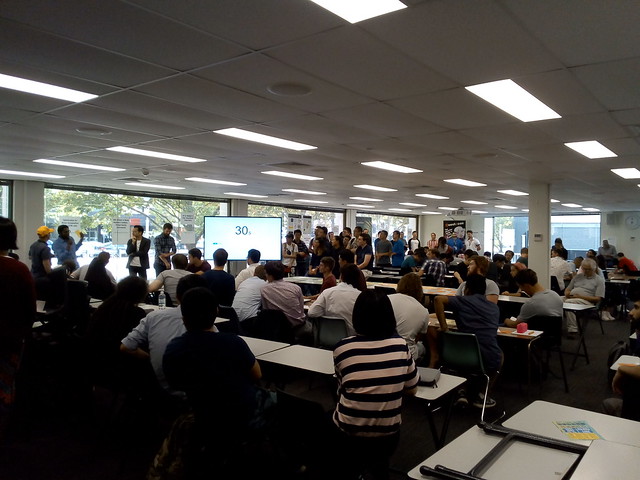
Greetings from the the Australian Nation University in Canberra, where the CASS Teaching and Learning Day, just started. The
theme is student engagement, with interactive learning strategies and
technologies.
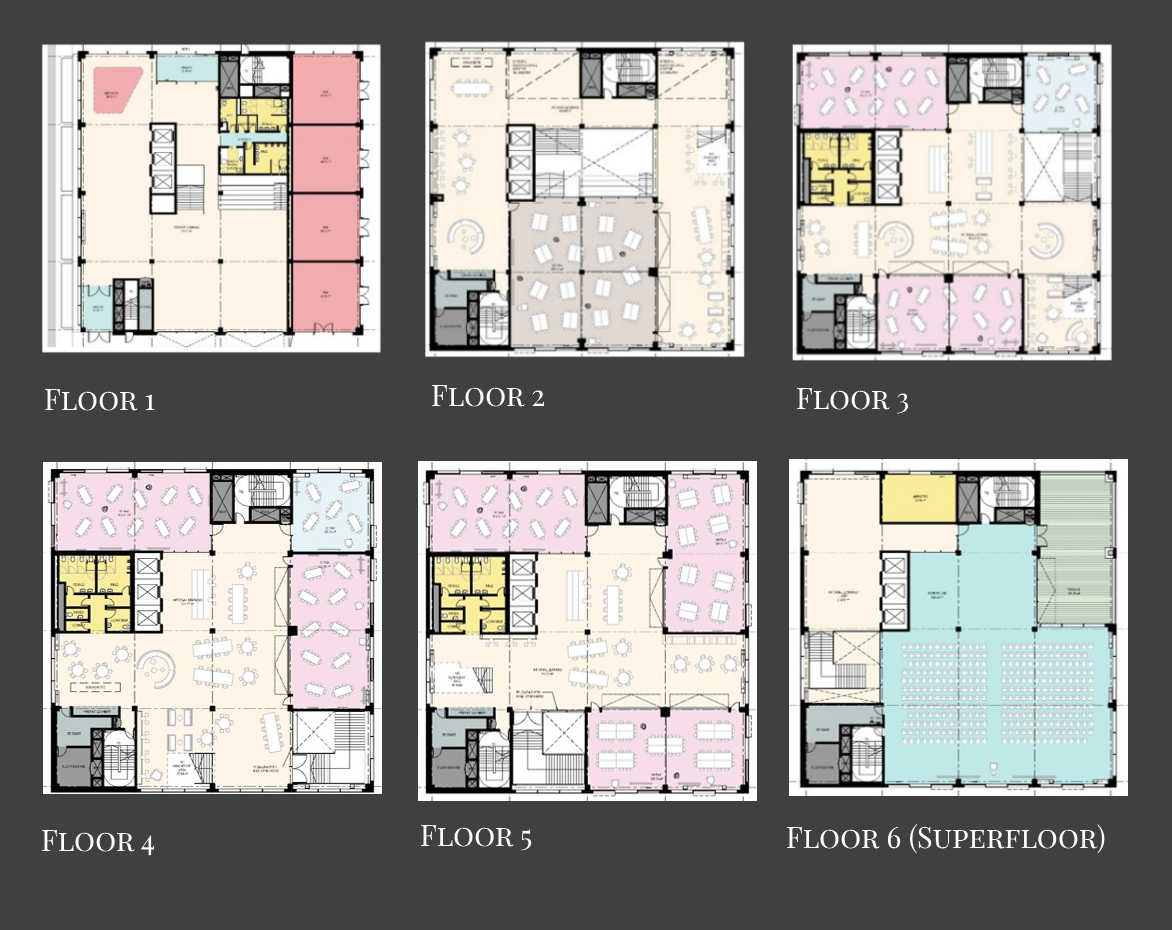
The event is being held on the "super-floor" at the top of the Marie Reay Teaching Centre. I will be using this for large format workshops later in the semester.
The keynote is by Professor Maria Northcote, Director of Higher Research Degrees at Avondale College of Higher Education. Beforehand, Maria mentioned she reads this blog, so I thought I should blog. Professor Northcote started by saying she was a constructivist in educational terms. Yesterday TEQSA approved Avondale to be an Australian University College (one step down from being a university).
Professor Northcote raised the topic of student involvement in educational design. She proposed to go beyond simply asking for feedback after the course, to negotiate what should be in it, beforehand. Also Professor Northcote discussed having advanced students teaching.
One research project Professor Northcote described was "But when do I get my mark?". With this the students were given qualitative feedback on their assignments, but then there was a delay before they got the mark. The idea was to get them to focus on the feedback, but in line with the title of the work, this was frustrating for the students. What surprised me was that there was no step built into the process to at least justify the delay. An obvious step would be to allow the students to revise their work, based on the feedback, before they get their mark. That would give them a positive reason for the delay.
The ANU College of Arts & Social Sciences
(CASS) is holding a Teaching and Learning Day, in Canberra, 3 September 2019 from 9:00 am to 3:00 pm. This is free and open to anyone interested in higher education (not just ANU staff). The theme is student engagement, with interactive learning strategies and technologies.
PROGRAM
9.00am – 9.30am: Registration 9.30am – 11.00am:
Welcome Address – Professor Rae Frances, Dean of College of Arts and Social Sciences (CASS), ANU
Opening - Professor Grady Venville, Deputy Vice-Chancellor (Academic), ANU
Keynote - Professor Maria Northcote, Director of Higher Research Degrees at Avondale College of Higher Education
11.00am – 1pm: Designing Interactive Learning Space – MARKETPLACE (Morning Tea through Lunch)
5 stations:
Station 1 – Flexible Studio Recording and Green Screen: Tips & Practices
Station 2 – How to Design Interactive Learning Contents using H5P
Station 3 – Virtual Reality in Education
Station 4 – Examples of good Wattle pages
Station 5 – Examples of Successful Innovation in Teaching at the College of Arts and Social Sciences
1pm – 3pm: Principles and Examples of Student Engagement
3 speakers:
Mr Eamonn McNamara, (School of History) – 2019 Vice Chancellor’s Awards for Excellence in Tutoring or Demonstrating
Dr Kate Flaherty, (School of Literature, Languages and Linguistics) – 2019 Vice Chancellor’s Awards for Teaching Excellence
Dr Kim Cunio, (School of Music) – Advocate of emerging cultures, indigenous Australians and women
The Australian National University is preparing an Energy Master Plan. The aim is "... to create an Australian
world class energy efficient, low-carbon, least-cost campus ...". One target in the existingANU Environmental Management Plan 2017-2021 is to "Reduce energy use per person by 20 per cent by 2021". New forms of education can help, by using the buildings more efficiently and moving some education online. I suggest these techniques can be used to reduce energy use per person. In particular, teaching staff can be trained to teach in flexible and online mods. Also, a system can be used for students to book a seat.
Use Classrooms More Intensively
One way to reduce energy use per person is by increasing the intensity of use of
the buildings. Empty rooms use almost as much energy as
full ones, so the more use of each room in each building, the lower per
person energy use.
One way to increase the use of classrooms is to make them more flexible. The ANU Union Court redevelopment is a prime
example of this. Two new buildings will allow forms of education beyond conventional lectures and tutorials.
ANU Culture and Events Building
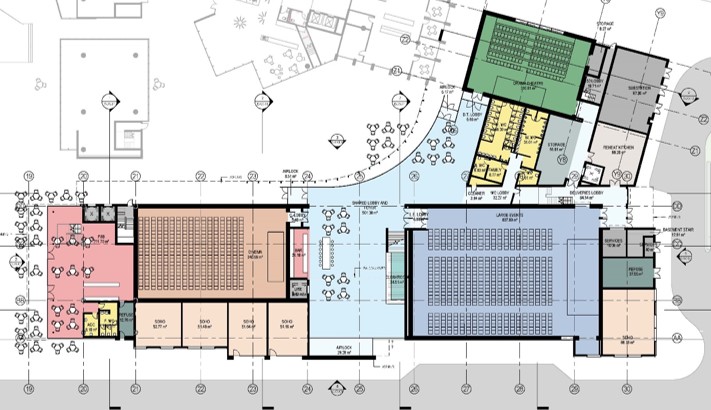
The ANU Culture and Events Building will have rooms with retractable seating. At the press of a button, the room can be changed from a flat floor for a conference, to theater format, with tiered seating for a lecture.
ANU Collaborative Learning Building
The ANU Collaborative Learning Building will have flat floor rooms with movable furniture and walls. This enables the same space to be used for different size and format classes. Walls can be folded back for a large class or moved in form more smaller ones. Desks can be in straight rows for a more conventional eyes-front classroom, or in circles for a more collaborative approach.
Flat floor classrooms are conventionally used for small groups of up to a few dozen students. However, with technology and new teaching techniques, such rooms can accommodate hundreds of students.
Training to help make use of classrooms
Training can help make flexible classrooms more efficient, in terms of teaching and energy use. Academics familiar only with conventional lectures and tutorials will tend to use the new flexible teaching spaces only for old fixed teaching formats. To use the rooms flexibly requires the staff to be training in flexible formats.
As an example, an instructor used to conventional lecture driven teaching will find the idea of hundreds of students in a room working in teams a recipe for chaos. The instructor needs to be taken through the theory and practice of how this works, and ideally act as an assistant in such a class before being required to be the lead instructor.
The ANU TechLauncher events for Team Formation and Bootcamp run in the ANU's large flat floor teaching rooms, at 7-11 Barry Drive, have demonstrated that group exercises with 300 students can work. By introducing academics to these techniques, they will be more confident to use them in courses.
Use e-Learning to Supplement Campus
E-learning can also be used to increase the intensity of campus use. Most
courses at Australian universities are now, to some extent, "blended", with part of the
tuition on-line. However, to make the best use of the technology course designers and instructors need to be trained in on-line techniques.
Academics who have only training and experience in face-to-face lectures and tutorials will tend to continue to rely on those techniques and be reluctant to try e-learning. There will be concern the students will not do the work, or will cheat, which can be the case if materials are not well designed and trained staff are not available to run on-line courses.
As an example, the ANU course COMP7310 "ICT Sustainability"
is run entirely on-line, with no lectures and no examinations. This course runs alongside ANU's face-to-face courses, with the same status and meeting the same quality standards. However, design of this award winning course required the assistance of specialist e-leaning professionals. It also helped to have undertaken graduate education training at ANU and other institutions, focused on in e-learning.
With the appropriate level of training it is feasible to aim for the typical university program to be a 20/80 blend: 20% in a formal classroom setting and 80% on-line outside the classroom. An example of this approach is the ANU Techlauncher program, where students undertake a group project building software for a real client, in government or industry. Students are expected to undertake 10 hours of study per week, but are only required to attend a 2 hour formal session in a typical week.
Ideally students should be on campus no more than the equivalent of one day a week. Students should be out in the real world learning and practicing their skills.
Double University Per Person Intensity of Use
Less than half of students attend a typical university class. A survey at ANU
found "... attendance declines over
semester to around 30% of original signup ...". This is not confined to ANU and is not a new feature of universities. However, universities still tend to allocate teaching space based on the number of students enrolled in the class at the beginning of semester. As a result the classrooms tend to be less than half full after the first few weeks. This is a waste of space and also a waste of energy needed to maintain these spaces.
One way to engage
students, and thus attract them to class, is with group activities, as is done with ANU Techlauncher.
This ensures almost full attendance at interactive group activities. Blends of on-line and face to face activities (so called
flipped classrooms) can keep students coming to class. However, not all students need to attend every class and many classes will have one third to one half attendance. This can be incorporated into space use planning.
Students can
be given the opportunity to book a seat in class a few days in advance. Classrooms can then be allocated, making use of different size rooms and flexible walls and formats, to suit. A
reasonable aim would be to double the intensity of use of classrooms,
thus halving the per person energy use.
Reduce Staff Campus Use
Persons use of the campus includes staff as well as students. Most teaching undertaken at a university is not by full time, permanent academics, but by graduate students and part time staff from industry. E-learning is a particularly useful way to make use of part time staff skills. Industry professionals can teach students without having to leave their workplace. Researchers in the field can teach students. However, this will require the staff to be trained in techniques for e-learning. The ideal way to conduct this training is on-line.
John Hattie (2015) argues that most teaching techniques work, but what works best is "visible learning": seeing learning from the students point of view, so they learn to learn. In this updated meta-meta-analysis it is easy to get lost ion the detail. But there are some useful, practical points for school and higher education teaching:
Minimal effects of class size: Reducing class size only makes a small improvement in student's learning (Hattie mentions classes of 600 to 15). It occurs to me that the cost of staff is a large part of the education budget, so the way to improve the quality of education may be to increase class sizes. The staff time saved can be devoted to helping students.
Student preparation is important: Flipped classrooms work where students actually do the preparatory work and are aware of what they have learned. As an example, I have students in my "ICT Sustainability Course" undertake a automated on-line quiz after each module.
Reviewing increases learning dramatically: Hattie finds that taking notes does not help learning much, but reviewing the notes does. Also students learn from each other. As an example, I have my ICT Sustainability students answer two or three questions after each module, discuss it and them peer assess each other's contribution.
Problem Based Learning (PBL) later: Hattie suggests that PBL has not been show to be effective as it has been used for first-year students who do not yet have the basic knowledge required. They argue this will be more effective for later years. In my teaching of students in the ANU TechLauncher program, this seems to be the case. Teams of third year and graduate computing and engineering students work on real projects for real clients.
E-learning is just as effective as a classroom: Hattie points out that online and distance courses are just as effective as on campus learning. This has been well established in the research as the so called "No Significant Difference Phenomenon". However, many academics find it difficult to accept that their live lectures make no difference to student learning: live video, recorded video and no video at all is just as effective.
Training university academics to teach: Hattie argues that training university academics to be effective
teachers improves student learning. This may seem obvious, but university academics still resist the idea that they need to be trained to actually teach. Particularly at research orientated universities the emphasis is on academics conducting research on teaching, but not undertaking the type of basic learning of teaching techniques which school and vocational college teachers are required to undertake as a condition of employment.
Alignment of Assessment and Course Aims: Hattie points out that students use the assessment as a guide to what is important in a course. As a recent graduate student myself, I found this very much the case. It was frustrating when the instructor had us study what was not assessed, then assessed us on something only briefly touched on in the course.
There seems to be an article of faith amongst some in academia that students should not be driven by assessment and marks. Curiously, when it comes to rewards in the form of research grants and promotions, these same academics are very much directly driven by short term concrete rewards, not the esoteric pursuit of knowledge. ;-)
In my own course design, I am careful to show the students the
explicit link from the skills demanded by industry, the course learning
objectives derived from those skills and the assessment items supporting
the learning outcomes. For each module of a course the student can see
there is some assessment at the end, with a deadline.
Hattie, J. (2015). The applicability of Visible Learning to higher education. Scholarship of Teaching and Learning in Psychology, 1(1), 79. retrieved from http://psycnet.apa.org/doi/10.1037/stl0000021
Dr Eric McCreath, Research School of Computer Science, will speak on "Flipping Your Class - Without Flipping Out" at the Australian National University in Canberra, 1pm 13 August 2015:
"The traditional approach to teaching has the teacher deliver core content as lectures, after which students go off and complete exercises, labs, assignment, etc. with often little help from, or interaction with, teaching staff or other students. The idea of "flip teaching" is that lecture material is recorded and listened to outside of class. This frees up class time to focus on the more interactive aspects of education.
Given dwindling lecture attendance (students where just watching the lectures at home anyway), in 2013 and 2014, I flipped my Introduction to Computer Systems class, providing students with pre-recorded lecture content and reorganised class time. This talk will summarise the changes I made to the course, overview the tools used, and reflect on the educational outcomes. Overall this has been a positive experience and I plan to refine and continue this teaching approach in coming years."
It seems to me that Eric's approach can be used not only to address dwindling lecture attendance but also issess of students cheating.
If students are required to be active and involved in class, then it is
more likely they will learn and so have less incentive to cheat on
assessment. Also if they are required to do many small tasks spread over
a whole semester it will be much harder to carry out the mechanics of
cheating than for one large assignment or examination.
Paul Johnson, Vice-Chancellor of the University of Western Australia (UWA) issued "UWA Futures: White Paper" in August 2012. There were responses from UWA academics over the next few months, UWA Academic Staff Association (March 2013). In November 2012, the UWA Vice-Chancellor issued "UWA Futures: The Response". This appeared a useful, if somewhat limited exercise in consulting the university community on a difficult issue, of what a university is. The ANU embarked on a consultation process in mid 2013, but this concentrated on possible budget cuts, rather than the nature of a university.
The original white paper suggested that Massive Open Online Courses (MOOCs) from new commercial and not-for-profit organizations will compete with universities for students. The paper argued that UWA should seize these opportunities which result. However that was the only mention of MOOCs in the white paper, so it was not clear what it is proposed to do. The responses discussed MOOCs and the issues with e-learning and provision of technology to students in more details.
The paper argued there will be negligible growth in student numbers for the remainder the decade, which seems to me be at odds with the rapid growth in the middle class in developing nations, who can now afford university education. However, UWA proposes to increase its student fees, which could price it out of this growing market.
Under "Proposal 1" UWA would "... conduct a full review of pedagogic purpose and practice in 2013, with the aim of introducing new pedagogies from the beginning of 2015". This would appear to be essentially about the role of e-learning, but the large scale Interactive Engagement being introduced at ANU could also be an option. Some of the responses discussed this, with approaches such as the flipped classroom. The UWA Academic Staff Association went further, proposing that MOOCs could be used for teaching, complementing a Humboldtian model of the university, where students are not locked into a rigid program.
Proposal 3 envisaged "... personalised mentoring and academic support for all... students...". However, there was no mention of the new skills which staff will need to provide this support, not how they will acquire it. Some responses asked about training for faculty in mentoring.
ps: I will be in Perth, WA, 23 September to 18 October 2013.
The Sahana Foundation, which I am a member of, provides free open spruce software for use in disaster management. The software is maintained and deployed by volunteers who are trained at "SahanaCamp". These events are run around the world for the volunteers. An interesting option now being considered is the use of flip classroom teaching and e-learning, with some form of certificate for attendees.
The topic for the next ANU Collegiate Lunch in Canberra on 7 August 2013, is What can the 'social media' do for us?", with myself leading the discussion. The "us" in this case is academia. For those at university, the idea of virtual communities should not be a new one.
Academia is a Virtual Community
Academics have used publications, correspondence and meetings to keep in touch with remote colleagues. Use of the Internet and the web has made this scholarly communication easier. At the same time the cheaper and easier access to information has challenged the role of the university and of the academic.
In the past academics were rated on their ability to get information published, but now anyone can publish and read for almost free on-line. You don't have to visit a university to read a journal and don't have to have the institution behind you to have your work published.
Creating and maintaining virtual communities still required effort and also new skills. I am frequently asked how "young people", "students" and "early career academics" can be encouraged to take part in events. The concern is that these people are not coming to old fashioned lectures, seminars, symposium, meetings and conferences.
Flip the Symposium
My preferred solution to the problem of a lack of attendance is to "flip" the event. The term comes from the "flipped classroom", where students study the material on their own and then get together in a classroom for group activities. The idea is that group time is too valuable to be wasted on everyone just passively listening to one person talking.
Research shows that student learn much better when actively engaged in doing something. Presumably this also applies to academic discourse. Rather than just sitting in the conference listening, they can be doing something active.
A new mode for conferences is to provide the papers and presentations in advance. The face-to-face time of the conference (if there is one) can then be mostly devoted to discussion. An example of this is the "Global Conference on Research Integration and Implementation". This will be held at the ANU in Canberra, 8 to 11 September 2013, but posters for the event are already up on-line.
Even when there is a formal presentation, the audience can be discussing the topic on-line at the same time. Some of the "Bar Camp" style events I attend have a twitter hash tag for the conference and encourage delegates to use it during presentations. This can be confronting for the presenter, who may have a display of the stream of discussion appearing behind them, as they speak. But this does make for a more lively format.
Social Media is a Skill to be Learned
It need to be kept in mind that using social media requires some practice and considerable effort. It is a mistake to assume you can simply create a Twitter hash-tag and the job is done. Also the aim and measures of success need to be adjusted. Having an on-line discussion may attract people to a face-to-face event, but some will be happy with just the on-line component and not turn up.
The rapid pace of on-line discussion can be frightening for those used to the leisurely pace of paper correspondence and annual conferences. If you advise something is available on-line, you had better make sure it is, or there will be complaints. It is very easy to leave the discussion on a Friday afternoon and find on Monday morning that chaos has broken out over the weekend.
The use of social media is something that university students should learn, along with how to write a paper, as part of their basic degree education. Those intending to have a career in research, university teaching or industry will need to know how to collaborate and mentor on-line. For that I have proposed “Incorporating Professional Skills in the ANU Master of Computing” and this could be extended to all ANU degree programs.
Current Use of Social Media at ANU
Keep in mind that using "social media" does not necessarily require the use of Twitter, Facebook, or some other commercial product. You might want to have your students in a "walled garden" where their information is confined to the institution or just the class.
ANU Alliance is a forum for ANU staff and students implemented using Sakai open source software. Also forums are provided in the Moodle Learning Management system for students to discuss course topics. For more general discussion Yammer is used by staff.
Social media can be used to help run a university, as well as in teaching. Universities have a tradition of consulting their staff, students and the community on what they do and how they do it. However, as universities get larger this consultation becomes more difficult. The ANU Vice Chancellor, Professor Ian Young, is reported to have recently said:
"The University has hundreds of policies, and to create a formal
consultation process in the development of such policies would be a huge
administrative overhead that would slow down the process and add
significant cost." From: ANU revises investment policy, Matthew Raggatt, Canberra Times, 18
However, I suggest the use of social media would allow staff, students and the community to be consulted with minimal administrative overhead, quickly and at low cost. In this way policy can be in part "crowd-sourced".
This is not to say that every decision will be put to a public vote, but as was done recently over budget cuts, the wider university community can be consulted. Rather than set up an ad-hoc process for each consultation, the ANU could implement a system for routine and ongoing consultation, via the Internet.
An example of where such consultation would be useful is the contentious issue of ANU's investment policy.The group Fossil Free ANU proposes a move away from investing in fossil fuel. However, more would be needed for a ethical investment policy and corporate social responsibility.
Pia Waugh at the Department of
Finance initiated two short courses for public servants on "Online engagement".
I talked at one of these and the same tools and techniques are
applicable to universities.