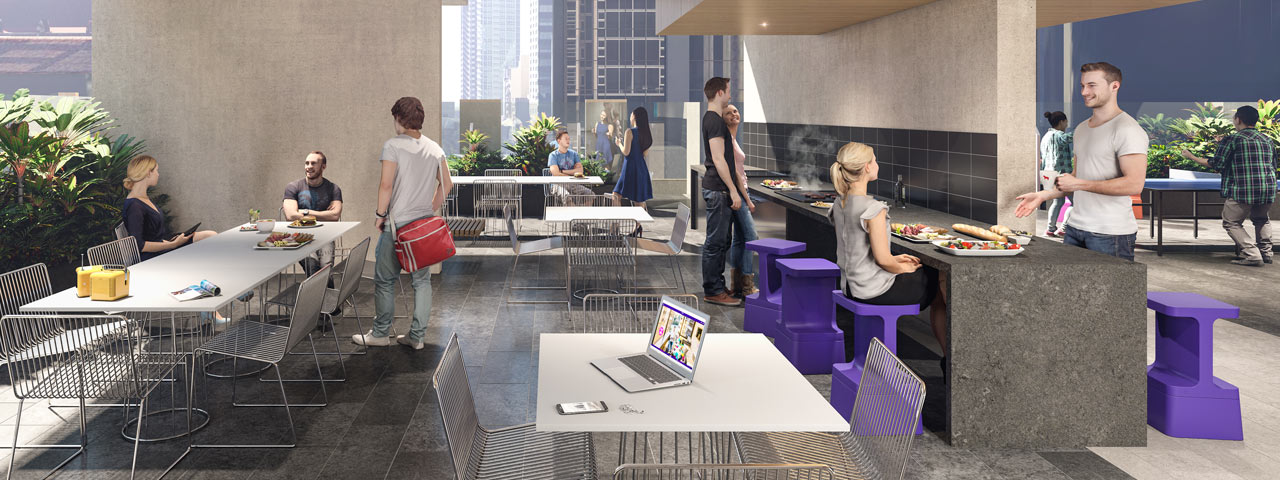
Student One Wharf Street is offering what is claimed to be the "... world’s tallest purpose-built student accommodation building" in Brisbane. Built for 753 residents on 41 floors, there are from single apartments, up to five bedrooms, plus communal facilities. Architect Arkhefield, included terraces, pool,meeting
rooms and laundry facilities.
Student One has three student buildings in the Brisbane CBD. If there is a reduction in demand for international student places (I expect this to drop over the next few years as China builds its university sector), these could provide low cost accommodation for non-students looking for a semi-communal lifestyle.
Showing posts with label student accommodation. Show all posts
Tuesday, January 2, 2018
Wednesday, March 18, 2015
How Small Can Student Accommodation Be?
Universities have the perennial problem of providing enough affordable accommodation for the students. There are examples of high quality on-campus accommodation, such as the new wing of St Catherine’s College at UWA and the University of Canberra UniLodge. But in a way these are a little too glossy for real living, a but like up-market hotel.
Perhaps some of the grunge shipping container look of ‘Westside @ Acton Park’ could be used. This might be done somewhat like Laurus Wing of Ursula Hall, with a conventional base to the building and shipping containers stacked on top. This could have more industrial aesthetic than Laurus Wing which hides its shipping container origins.
Also perhaps universities should look at more affordable accommodation. While the apartments and rooms of the current accommodation are conformable, they are not necessarily affordable for students. The students then end up stacked in bunk beds in run down homes.
Universities could have some rooms which are more like a capsule hotel. The most generously sized of these would still be only be just big enough to fit a single bed, with room to stand. Storage would be provided above the bed, which would fold up to make room for the student to sit. Four such rooms would fit in one 20ft shipping container. However, this may require a change to legislation. For example Victoria requires rooming house rooms to be at least 7.5m2 and only two of these could be accommodated in one shipping container. It could be argued that students have extensive additional space in their accommodation and so such rules could be relaxed.
Perhaps some of the grunge shipping container look of ‘Westside @ Acton Park’ could be used. This might be done somewhat like Laurus Wing of Ursula Hall, with a conventional base to the building and shipping containers stacked on top. This could have more industrial aesthetic than Laurus Wing which hides its shipping container origins.
Also perhaps universities should look at more affordable accommodation. While the apartments and rooms of the current accommodation are conformable, they are not necessarily affordable for students. The students then end up stacked in bunk beds in run down homes.
Universities could have some rooms which are more like a capsule hotel. The most generously sized of these would still be only be just big enough to fit a single bed, with room to stand. Storage would be provided above the bed, which would fold up to make room for the student to sit. Four such rooms would fit in one 20ft shipping container. However, this may require a change to legislation. For example Victoria requires rooming house rooms to be at least 7.5m2 and only two of these could be accommodated in one shipping container. It could be argued that students have extensive additional space in their accommodation and so such rules could be relaxed.
Wednesday, October 16, 2013
End of an Era for All Women University College
This week I had the pleasure of dining at St Catherine’s College in Perth. This is a small college just across the road from University of Western Australia (UWA). The college is expanding its facilities with several new wings and invited the local community to see the work and as a "thank you" for putting up with the building works. We looked at a mock-up of the new rooms, had drinks in the courtyard and then dinner in the hall.
This was an informal event without academic gowns (which is good as I did not bring mine), a minimum of speeches and without the use of "high table". Being one of a handful of males (the college has some male "visitors") surrounded by hundred of young women was a little intimidating, but pleasent.
Next year the college will be opening up to more male students in the new accommodation. The change is being made in stages, I suspect so that the new male students can be socialized to the college life.
The new accommodation consists of one person studio apartments, each with a bathroom and cooking facilities. The rooms have been cleverly designed to fit everything in a small space. Designs and sizes will vary.
The display room has the cooking facilities in the passageway to the left as you enter, with the bathroom on the right. Having the kitchen next to the bathroom has drawbacks, but makes the plumbing easier to install and also keeps dirty pots and pans out of sight of the main living area. Smaller rooms will have double beds and larger ones queen size. The St Catchs rooms seem to be slightly wider than those of other accommodation I have seen, making them seem spacious in comparison.
There are large fridges in each room. When I asked about using a small fridge I was told that residents from the country like to have plenty of the food they are used to on hand. It seem that St Cath's primarily caters to rural WA students. There was also some mention of minimum accommodation standards required by some government scheme.
There are also common rooms in the new buildings to get the students out of their rooms and socializing. However, unlike the new UniLodge at University of Canberra, there are no multi-person apartments (UoC has five bedroom apartments with shared kitchen and bathroom). Also unlike shipping container apartments at ANU Ursula Hall there are no apartments for couples.
It should be kept in mind that a university college provides more than accommodation and St Caths has tutorials and other activities for and by students.
The UniLodge multi-bedroom apartments provide a good model. Some of these could be produced with smaller (therefore cheaper) rooms using half the sapce. Essentially a student needs their own bed to sleep in, some storage space and a desk to study at. They do not need more than a single bed, a desk big enough for a computer and a textbook. The student can use the common areas for socializing, cooking, eating and washing.
The practical minimum size for a dwelling in Australia is about 15 square meters (the area of a shipping container). But this is for a standalone, fully self contained home, whereas a student can use shared facilities for washing and cooking.
The reasonable smallest space for a student might be 5 square meters. This would provide enough space for a single bed, a desk and storage. Another 5 square meters would be needed per student for shared space. This might need some changes to government regulations.
This was an informal event without academic gowns (which is good as I did not bring mine), a minimum of speeches and without the use of "high table". Being one of a handful of males (the college has some male "visitors") surrounded by hundred of young women was a little intimidating, but pleasent.
Next year the college will be opening up to more male students in the new accommodation. The change is being made in stages, I suspect so that the new male students can be socialized to the college life.
New Accommodation
The new accommodation consists of one person studio apartments, each with a bathroom and cooking facilities. The rooms have been cleverly designed to fit everything in a small space. Designs and sizes will vary.
The display room has the cooking facilities in the passageway to the left as you enter, with the bathroom on the right. Having the kitchen next to the bathroom has drawbacks, but makes the plumbing easier to install and also keeps dirty pots and pans out of sight of the main living area. Smaller rooms will have double beds and larger ones queen size. The St Catchs rooms seem to be slightly wider than those of other accommodation I have seen, making them seem spacious in comparison.
There are large fridges in each room. When I asked about using a small fridge I was told that residents from the country like to have plenty of the food they are used to on hand. It seem that St Cath's primarily caters to rural WA students. There was also some mention of minimum accommodation standards required by some government scheme.
There are also common rooms in the new buildings to get the students out of their rooms and socializing. However, unlike the new UniLodge at University of Canberra, there are no multi-person apartments (UoC has five bedroom apartments with shared kitchen and bathroom). Also unlike shipping container apartments at ANU Ursula Hall there are no apartments for couples.
It should be kept in mind that a university college provides more than accommodation and St Caths has tutorials and other activities for and by students.
Small Cheaper Student Accommodation Needed
The new St Caths and other new facilities at Australian universities provide an impressive level of accommodation but at a cost. Not all students can afford their own fully equipped apartment. I suggest that smaller, lower cost facilities need to also be provided, at about half the floor area (and cost).The UniLodge multi-bedroom apartments provide a good model. Some of these could be produced with smaller (therefore cheaper) rooms using half the sapce. Essentially a student needs their own bed to sleep in, some storage space and a desk to study at. They do not need more than a single bed, a desk big enough for a computer and a textbook. The student can use the common areas for socializing, cooking, eating and washing.
The practical minimum size for a dwelling in Australia is about 15 square meters (the area of a shipping container). But this is for a standalone, fully self contained home, whereas a student can use shared facilities for washing and cooking.
The reasonable smallest space for a student might be 5 square meters. This would provide enough space for a single bed, a desk and storage. Another 5 square meters would be needed per student for shared space. This might need some changes to government regulations.
Sunday, September 1, 2013
Old and New University Student Accommodation in Canberra
The latest UniLodge has small and larger studio apartments. These each have a bathroom with shower, a kitchen with two element electric stove, microwave oven and fridge, a single bed, desk and TV. The larger apartments (called "deluxe" studios) are slightly longer, with room for an armchair in front of the window. There are also double double studios and 1 bedroom apartments for couples. Of most interest for the student lifestyle are five bedroom apartments, which have a spacious lounge/kitchen, two showers and two toilets. All the rooms have wireless card activated locks, hydronic heating and fans for cooling. The rooms also have opening windows, which is a luxury for those who are cooped up in air conditioned building all day.
The single apartments are a little narrow, reminding me of the shipping container apartments at ANU Ursula Hall. The five bedroom apartments appear to have been designed based on extensive research and practical experience of how many students can cope with living with each other. UniLodge allocate students to shared apartments based on gender, age, nationality and other factors to promote domestic harmony.
Subscribe to:
Posts (Atom)
