Showing posts with label EduTech 2019. Show all posts

Friday, June 7, 2019

EduTECH Sydney on Now

Tom Worthington presenting on microcredentials at EduTECH 2019 Australia. Photo by CAPA President
Photo by CAPA President
Greetings from EduTECH in Sydney. Yesterday I talked on Mobile Learning with Micro-Credentials for International Students, and today chaired three round-table discussions on the topic.
It was exciting to be presenting on the main expo stage, in the middle of the exhibition.  This has the noise and distraction of people walking past, but is much more lively that a conventional presentation room.At one stage I had not had any questions, so did what I do in workshops with students: sprang down from the stage and up to one of the audience who looked like the wanted to ask a question, which they then did, into my microphone.

The Council of Australian Postgraduate Associations (CAPA) President took a couple of photos and tweeted about my having graduate students respond to a real job ad, and suggesting applying vocational "TAFE-like" approaches for university micro-credentials.

The round-table discussions were also lively, with about seven people who are actively involved and engaged, around the table for half an hour. The round tables attracted about one third people from schools, a third from universities and the remainder from government agencies, vocational education, professional bodies and consultancies.  This made for a lively discussion. I was surprised at the interest in micro-credentials for schools, having assumed it is a higher education issue. Teachers wanted to provide students with more vocationally relevant qualifications, but which were not labeled "VET". Universities, accreditation agencies and professional bodies were all struggling with what micro-credentials are, and how they fit with traditional degrees. The VET people said "we already do this stuff".

Compared to the expo and round-tables, unfortunately the conventional presentations at EduTECH, especially those from senior people, were a bit dull. These were made even less exciting by the lack of question time. The important person would come in, give a canned talk, and leave.

I suggest that the EduTECH organizers, and others running similar industry events, should encourage questions. A tradition which the ACS Canberra Branch has with its annual conference is to take questions from delegates, even for keynotes. It can be a shock for a senior government minister, or industry leader, to be asked a detailed question by a relatively junior professional, but they rise to the challenge and find it refreshing. This takes the presentation to a new level, like good teaching, from one way communication, to interaction.

A format which worked very well at EduTECH Asia 2018, was an online, mobile-enabled system, where the audience could propose questions, and then vote on which should be asked. It was useful in overcoming the embarrassment of asking someone "important" a question.

Sunday, May 5, 2019

My Picks for EduTECH Sydney

EduTECH is on in Sydney, 6 to 7 June. Here are my selections from the program. I will be speaking 4pm the first day, and chairing a round-table the next day, so I have to go to those. ;-)

ps: Use the code: TomWorthington20 for 20% off registration fee.


Building a Smarter Learning Ecosystem

Workplace Learning/AITD Conference Jd Dillon L&D doesn’t own workplace learning. WHAT?!?! Every organization is a complex ecosystem with a multitude of elements. Unfortunately, many L&D teams fail to take a holistic approach. Instead, they focus on their sphere of influence, which often revolves around formal training. ... Jd Dillon, Founder, LearnGeek Jun 6 09:25

New Era, Same Spirit

Workplace Learning/AITD Conference Roslyn ColagrossiHow did Qantas prepare their cabin crew for an aircraft yet to be built? Three simulations and a great project team later, the dream of the 787 Dreamliner came to life. ... Roslyn Colagrossi, Manager Service Development, Qantas Jun 6 11:30

3x30 minute Learning Lab – Google for Education

Breakouts - Seminars Jun 6 11:30

Planning for the future – trends and key issues

Build/Design
    Gary White
  • Global drives influencing the future of our urban areas and cities
  • A strategic planning approach to managing change and growth across NSW
  • The implications for the provision of educational facilities and services in the context of significant change.
Gary White, Chief Planner, Department of Planning
Jun 6 13:00

Masterplanning - more than just architecture

Build/Design Matthew GreenePaynter Dixon will share their considerable experience in the process of masterplanning schools to explain thatit's more than just architecture. Using real examples this presentation will explore the importance of getting your staff on board, linking your master plan to your pedagogical approach ... Matthew Greene, Head Of Education, Paynter Dixon Constructions Pty Limited Jun 6 13:20
Natasha Abraham

The changing face of postgraduate education

Higher Education
  • Postgraduate study is becoming increasingly common, with over 400,000 postgraduate students now at Australian universities.
  • 30 years ago, postgrad coursework students were usually older, established in their careers, and more financially secure. Now, many are doing postgrad study straight after finishing their first degree.
  • With this many students, how is the value and experience of postgraduate study changing over time?
Natasha Abraham, National President, Council of Australian Postgraduate Associations
Jun 6 13:30

Overcoming the training transfer problem with the 70:20:10 framework

Workplace Learning/AITD Conference
    Charles Jennings
  • Training has only a limited role in creating high performance in organisations
  • The training transfer problem has been created because we haven’t been using optimal approaches for solving performance problems
  • Frameworks such as the 70:20:10 model can help rectify this issue by bringing learning and working closer together.
Charles Jennings, Leading Thinker On Workplace Learning And Author, 70 20 10 Institute Jun 6 14:00

A Chatbot Case Study - Creating Impact with Learning Transfer

Workplace Learning/AITD Conference Marie DanielsCreating behavioural change is key to any learning initiative. It's proven that following up learning with a coaching-based methodology will deliver far superior results than training alone. Could chatbot technology be utilised to solve the age-old problem of transfer?

The presenters will share all from a case study that used an AI chatbot to drive behavioural change. ... Marie Daniels, ANZ Pharmaceuticals Commercial Learning Lead, Bayer Jun 6 14:20
Sascha Ogilvy

Team teaching

Expo Mainstage (Free)
  • What is team teaching and why it’s so important in schools
  • The purpose of team teaching
  • Case study of the team teaching program at Fairfield High School
Sascha Ogilvy, Head Teacher Eal/D, Fairfield High School Jun 6 14:40

The Art and Science of Teaching at Scale

Schools
    Manisha Gazula
  • The Marsden Way - focusing on explicit and direct instruction
  • The art and the science of teaching
Manisha Gazula, Principal, Marsden Road Public School Jun 6 15:20


Using mobile technology to achieve Professional and Vocational Currency within the VET sector

Vanessa MarshHigher Education
  • How Chisholm developed a process for educators to maintain educator currency while assisting the Institute to achieve its teaching and learning goals...
Vanessa Marsh, Team Leader, Operations, Chisholm Institute of Tafe Jun 6 15:20

Train to Fight and Win at Sea

Workplace Learning/AITD Conference Justin JonesNavy training and education is a key enabler in the achievement of navy’s mission ‘to fight and win at sea’. Navy training is expansive. It is conducted at multiple disparate locations across Australia and overseas, with an annual trainee throughput of approximately 80,000. ... Justin Jones, Commodore Training, Royal Australian Navy - Training Force Jun 6 16:00

Mobile Learning with Micro-Credentials for International Students

Expo Mainstage (Free)
    Tom Worthington
  • Design courses to be mobile ready, while campus compatible
  • Micro-credentials delivered off-shore
  • Blockchain for degree credit onshore
Tom Worthington, Honorary Senior Lecturer, The Australian National University Jun 6 16:20
Jun 709:00 Conference pass

Cool Schools: smart, sustainable strategies to beat the heat

Build/Design
    Sebastian Pfautsch
  • The importance of thermal comfort for student health, wellbeing and learning
  • Strategies for managing heat in existing and new schools
  • Research gaps in relation to thermal comfort for children in schools
Sebastian Pfautsch, Senior Research Fellow, University of Western Sydney Jun 7 09:40

Roundtable 12) Is it time for Micro-Credentials and Mobile Learning for International Students?

Breakouts - Roundtables Tom WorthingtonJoin Tom worthington at this roundtable to discuss the importance of connecting with international students through effective and classroom compatable courses. Host: Tom Worthington, Honorary Senior Lecturer, The Australian National University Jun 7 11:00

90 minute Workshop – Lego Education

Breakouts - Seminars Prof. Chris RogersPlaces at this workshop are limited and will sell out fast. Join now to get familiar with LEGO bricks, software, teaching guide and lesson plans

Accelerate STEAM learning with LEGO Education hands-on solutions Learn how to engage your students with playful learning tools around STEAM!LEGO® Education offers hands-on experiences that stimulate communication, creativity, collaboration, and critical thinking skills — so that students can succeed in their STEAM classes today and realize their full potential as digital citizens and leaders tomorrow.

Who should attend? School teachers and principals – Years 5-8 Prof. Chris Rogers, Professor And Chair, Department Of Mechanical Engineering, tufts university Jun 7 11:30

Wednesday, May 1, 2019

Mobile Learning with Micro-Credentials for International Students


I will be speaking on "Mobile Learning with Micro-Credentials for International Students", at EduTECH in Sydney, 4pm 6 June 2019. The next day I am chairing a round-table on the same topic. My talk is on the Expo Main Stage and is free, whereas the roundtable discussions are for delegates only  (use the code: TomWorthington20 for 20% off the registration fee.)
Just finalizing my presentation: suggestions welcome. Last year I attended EduTech Sydney, and Singapore, which were good. 
"Mobile Learning with Micro-Credentials for International Students
4pm, 6 June 2019
  • Design courses to be mobile ready, while campus compatible
  • Micro-credentials delivered off-shore
  • Blockchain for degree credit onshore

Roundtable: Is it time for Micro-Credentials and Mobile Learning for International Students?

3 discussions, from 11 am, 7 June 2019 Join Tom Worthington at this roundtable to discuss the importance of connecting with international students through effective and classroom compatible courses." 
From: "Speakers", EduTECH 2019.


Some notes for the presentation:


1. Mobile ready, campus compatible


ANU Marie Reay Teaching Centre

First design your course for online delivery. Use course software, with a responsive web interface, such as Moodle. This will then work on a mobile device, a conventional computer, oreven on paper.

Add campus based activities for students, where appropriate. Keep the campus activities flexible.
This is flipped, blended learning. It helps to have a purpose designed building, like the  ANU Marie Reay Teaching Centre opened March 2019, by Architects BVN. The Centre has only flat floor classrooms, for 30, 60, or 120 students. The flexibility here is provided by retractable walls, furniture on wheels, and electronic screens on multiple walls.

Learning to Reflect

Flipped module for teaching international masters students to write a job application:
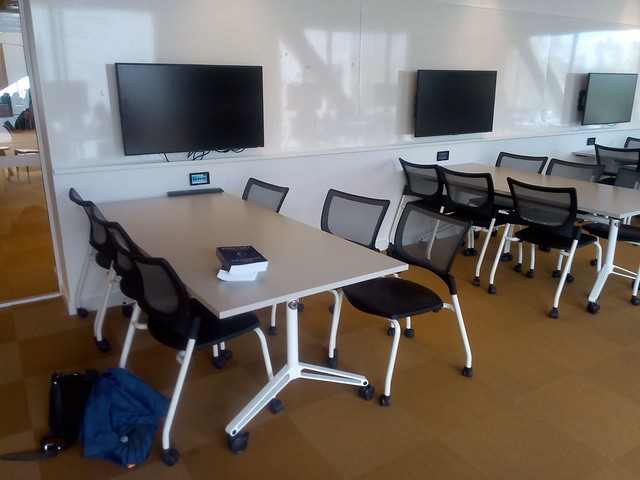

Wall mounted LCD screens and desks on wheels at ANU Marie Reay Teaching Centre
Wall mounted LCD screens
& desks on wheels at
ANU Marie Reay Teaching Centre

  1. Online notes
  2. Videos
  3. Quizzes
  4. Peer assessed online forums
  5. Peer assessed assignments
  6. Classroom discussion in flat floor room


The module is designed to help students to develop capabilities expected of working professionals to identify their development needs, how they will acquire these and to reflect on what they have learned.

An overview of the development of the module, and an open access version of the notes are available.


2. Micro-credentials delivered off-shore

NZQA micro-credentials: 1 to 8 weeks study
AQF Review: considering micro-credentials
Attractive for international and STEM students.
3 x 1 week study modules = 1 semester course?


M-learning can be over shorter periods and targeted at specific skills. The New Zealand government is recognizing micro-credentials from tertiary education organizations as of 22 August 2018. The NZ credentials can be the equivalent of 1 to 8 weeks study. The shortest qualification typically issued by Australian universities is a 12 week graduate certificate.

An AQF Review: considering micro-credentials. This could allow much shorter, and more flexible, credentials. These would particularly appeal to international students, and those in STEM areas.

Even in advance of any official recognition of micro-credentials, institutions can create smaller units of instruction, for example, dividing a semester course which is notionally three weeks full time study into three one week units. Students could undertake the three units separately, or as part of a qualification.

3. Blockchain for degree credit onshore

Lifelong learning and micro-credentials will result in worker having several hundred qualifications. This would be unmanageable with paper certificates and even with web based e-certificates, such as those issued by "My eQuals" in Australia (the image shows my Graduate Certificate in Higher Education, issued by ANU). Employers will want to be able to automatically check qualifications against job requirements, to ensure they are genuine (the other image shows one of the many web advertisements for fake qualifications). One technology which may be used is block-chain. There is an ACS Blockchain technical committee looking at this, as one use for the technology.


Why worry about this?


China's Belt & Road Education Plan


  1. Two-Way Student Exchange
  2. Co-Operation in Running Educational Institutions
  3. Teacher Training
  4. Joint Education and Training
China Ministry of Education. Education Action Plan for the Belt and Road Initiative, 2016. URL https://eng.yidaiyilu.gov.cn/zchj/qwfb/30277.htm


China's Belt and Road Education Plan envisages students from the Indo-Pacific region studying at campuses in China, and also on regional joint venture campuses. Australian institutions will have difficulty competing for international students with these campuses. However, the plan appears to cover only on-campus face-to-face education. This provides the opportunity for Australian institutions to offer online learning using mobile devices, supplemented with on-campus education. This could complement, rather than seek to directly compete with, China's Initiative.

See also: Australian Department of Education. China's Belt and Road Initiative – Education, 2017.


More Information