Showing posts with label EduTech Asia 2018. Show all posts

Thursday, April 16, 2020

EduTech Asia with Avatars

Eric Hawkinson's avatar
In 2018 I talked on flexible classrooms and energy use at EduTech Asia in Singapore. It is not certain when the next face to face event will be held due to COVID-19. But a series of free video conference based sessions are being held. At the moment there is one on immersive technology (also known as eXtended Reality), combining augmented, virtual reality. Eric Hawkinson got my attention. After talking about avatars, Eric's  live video image was suddenly replaced by an animated cartoon character, who's month moved to match what he was saying.

Something I did not expect is that EduTech sent me a signed certificate of attendance.  I guess I can use this towards the 30 hours Certified Professional Development I have to do to keep my Australian Computer Society status.

ps: I prepared a talk for EduTech 2020, but don't know when, where, or how, I will get to present it:

Coronavirus Response with Flexible Learning


Images used under a Creative Commons License.

In 2016, as part of research on higher education, Tom Worthington identified the risk to Australian universities from a sudden disruption of the flow of international students to Australia. To mitigate this risk, he developed an approach combining blending e-learning with flexible classrooms. This was trialed during 2019 in the new Marie Reay Teaching Centre at the Australian National University, and is now being implemented in response to the COVID-19 Coronavirus. All students access the same e-learning materials, including e-books, videos, quizzes, and discussion forums. There are then on-campus workshops in classrooms which can be quickly reconfigured for different teaching formats. Students who are unable to get tho the workshops in person, have the option of participating online. This approach allows one course design and one building design to be used for classes mixing on-campus and remote students.
pps: This also allows  for a gradual return to the classroom after a COVID-19 outbreak. It is not feasible to set a deadline when all classes return to "normal" campus-based teaching. Rather than having all students stop online learning at once and return to campus on the same day. On-campus components can be gradually added. However, the online components can be retained, in case of future emergencies, and to cater for individual student needs.

Thursday, October 18, 2018

Bring Your Own Ethernet?

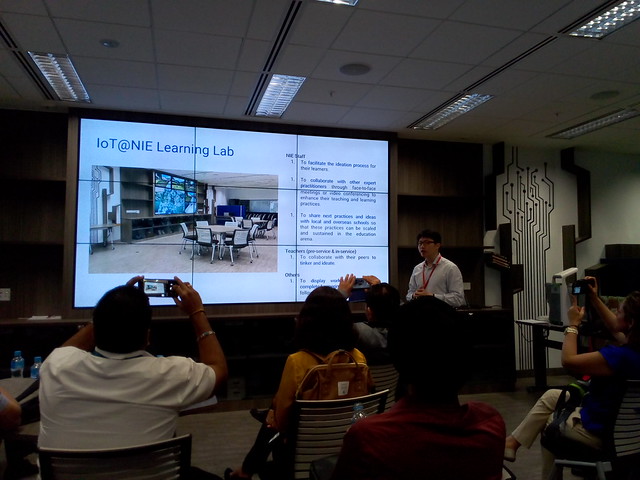
Back from a tour of high-tech university campuses in Singapore (at EduTech Asia 2018), I was reading an sales promotion from one vendor on the benefits of a smart campus. However, the smartest classroom I saw in Singapore was the IoT@NIE Learning Lab at Nanyang Technological University was smart without having the tech overwhelm the learning.

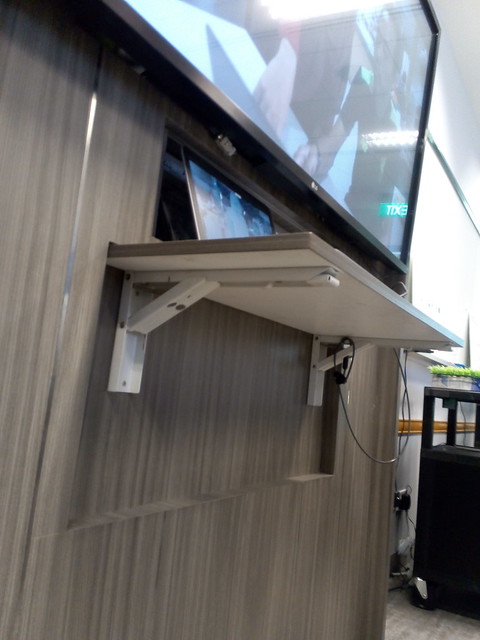
Flip-up shelf for laptop at the IoT@NIE Learning Lab at National Institute of Education, Nanyang Technological University
Display in IoT@NIE NTU
The IoT@NIE lab has tables on wheels and screens on the walls. The screens can be plugged into laptop computers on flip up shelves, built into the walls. The beauty of this arrangement is that while the room is intended for teach IoT, there is not too much fixed tech in the room, getting in the way of the learning.

Display explaining the IoT@NIE Learning Lab at National Institute of Education, Nanyang Technological University
 Flip-up shelf for laptop
at IoT@NIE NTU
Previously desktop computers were provided for students at university. This meant having mains power and data cabling to each desk, requiring the furniture to be fixed in place. But now students can BYOD (Bring Your Own Device) and connect to the campus WiFi, eliminating the cabling to desks. The furniture can be freely moved around and pushed aside. The only fixed devices are attached to the walls and on the instructor's console.

Perhaps we have reached the point where there could be BYOE (Bring Your Own Ethernet). Students would use the  wireless Internet on their mobile devices, instead of a campus network. WiFi might still be provided in classrooms, where the network is needed to support the room equipment, or staff might use their own BYOE.

Friday, October 12, 2018

Martin Dougiamas at EduTech Asia 2018

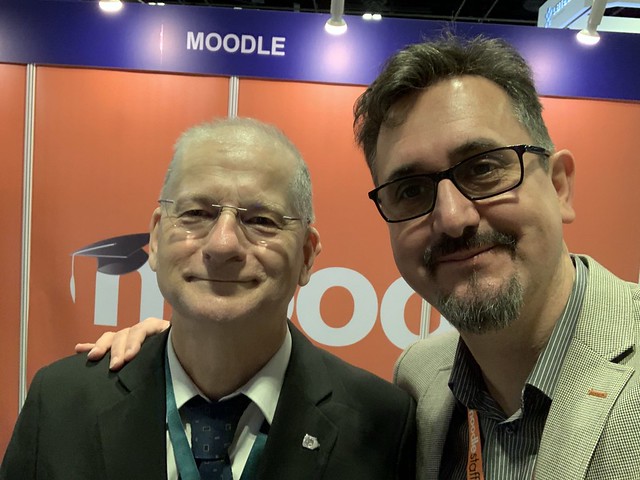
Tom Worthington and Martin Dougiamas at EduTech Asia 2018
It was a delight to bump into Martin Dougiamas, founder and CEO of Moodle Pty Ltd, at EduTech Asia 2018 in Singapore this week. Martin gave a presentation "Moodle the world’s most widely used LMS". This is also a product I have used day in and day out since 2009, as a graduate course designer, on-line instructor at two tertiary institutions and as student at four.

I will be demonstrating some of my use of Moodle at Edtechposium, 29 October, and Telfest, 5 November, in Canberra.

Monday, October 8, 2018

Cameras for Blackboards?

Greetings from EduTech Asia 2018 at the SunTec Conference Center in Singapore. I will be speaking tomorrow on flexible classrooms and energy use. But the organizers invited me to sit on one of the pre-conference workshops today. Muhammad Farhan from Crestron is speaking on audiovisual systems for new teaching techniques.

One point made was about the complexity of presenting where there are different information sources, remote presenters and remote students. It can be very difficult to manage this technology when trying to present as well (teachers usually do not get tech assistants).

For those with less complex AV requirements, your webinar system may be sufficient. Universities now routinely offer students the ability to take part in a seminar remotely. For this video-conference system tailored to educational use is provided and usually called a "webinar" system. While intended for remote students, the same system can be used to transmit the presentation to an overflow classroom in the same building or at a remote campus. Students in the main room could use the webinar system to display the presentation on their mobile deice and respond.

One of the devices on display, the "AirBoard", was deceptively simple. This is a document camera which clips onto a whiteboard. There was a fashion for interactive whiteboards, which detect the location of a special pen and convert this to a digital image projected onto the broad. However, these can be hard to use and expensive to buy.

The alternative to a smart-board is a camera which relays what is written on an ordinary white-board with an ordinary marker. This image can then be transmitted to a non-interactive screen and to the student's devices.

One limitation is that the camera has been designed for whiteboards, but ANU mathematicians still like to use blackboards. I have suggested Crestron add a feature to have the camera to work with blackboards.

Another limitation with this camera is that the image processing eliminates the image of the presenter's hand. This has the advantage that the student can see the text uncluttered. But the presenter can't point at what they have written, for emphasis. Perhaps the system could be programmed to recognize a gesture of the presenter pointing and display either their actual hand or a pointer.

Friday, August 31, 2018

Decreasing Campus Energy Use With Flexible Classrooms and e-Learning

I will be speaking on "Decreasing Campus Energy Use With Flexible Classrooms and e-Learning" at EduBuild 2018 in Singapore, 9 October, 5:20pm. This is a new part of the annual EduTech conference, focusing on classroom design and use.
  1. Energy use and Carbon Emissions
  2. New Flexible Classrooms
  3. E-learning
ps: The next day at EduBuild I will be taking part in a discussion of "Learning to use new  tech-infused teaching spaces".

Wednesday, August 8, 2018

Learning to use new tech-infused teaching spaces

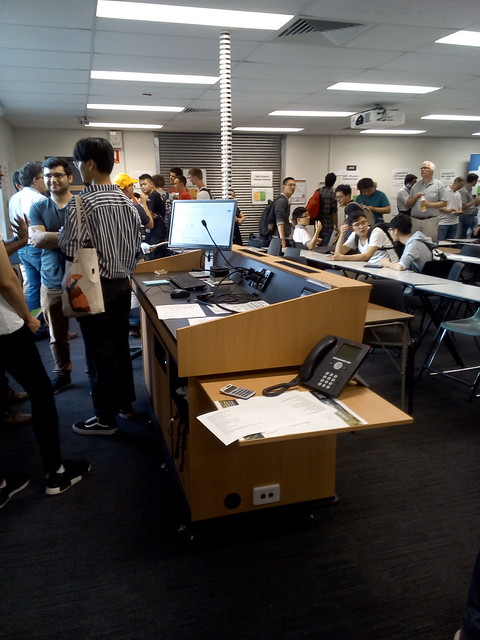
The control console for an Australian National University flat floor classroom.
ANU "TechLauncher"
in flat floor classroom.
I will be taking part in a discussion of "Learning to use new  tech-infused teaching spaces" at EduBuild 2018 in Singapore, 10 October, 11:10 am and 11:55 am. This is a new part of the annual EduTech conference, focusing on classroom design and use. For this I will relate my ANU experience.
"Teachers and students will need to learn to use new flexible classrooms.

This will require blending the physical spaces with online tools and techniques. Both staff and students will need to work together, with team teaching and group learning.
  1. How do we get teachers to use these new spaces for more than old fashioned "chalk and talk"
  2. How can physical spaces be integrated with flipped, blended and online courses?
  3. How can these spaces fostering student engagement?
  4. How do these spaces promote collaborative and peer learning?
  5. What curriculum changes are needed to promote effective use of new teaching spaces?
  6. Can the new teaching spaces also be innovation centers?
  7. Do teachers, and university academics, need new formal qualifications to teach in these spaces?"
ps: The day before at EduBuild I will be speaking on "Decreasing Campus Energy Use With Flexible Classrooms and e-Learning".