
Showing posts with label Indonesia. Show all posts
Showing posts with label Indonesia. Show all posts
Wednesday, March 26, 2025
Indonesia’s EV Policy an Opportunity for Australian Higher Education

Friday, July 22, 2022
Alternatives to Chinese technology training for the Indo-Pacific
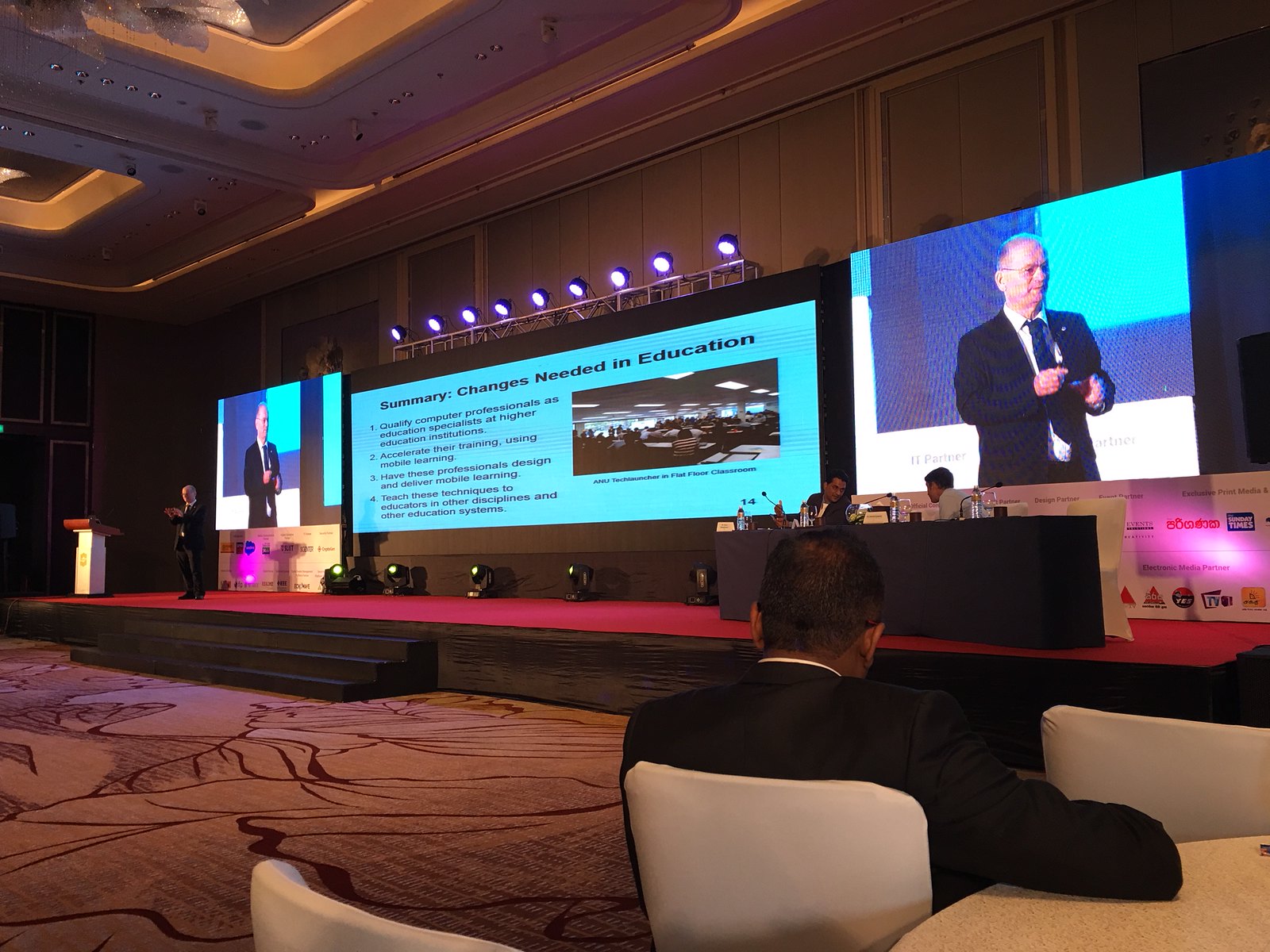 |
| Presenting on M-learing for the Indo-Pacific, 2018. |
In "China Inc. and Indonesia’s Technology Future", van der Kley, Herscovitch, and Priyandita (ANU National Security College, 2022), suggest Australia and its allies should provide tech training in Indonesia, to counter China's influence. This is a viable idea, from geopolitical, developmental, and market development perspectives. However, Indonesia has excellent tech educators (I have met many), and so this would be better done by assisting them, rather than being imposed from outside. In 2018 I suggested countries of the Indo-Pacific could jointly educate professionals using mobile devices, in to counter the influence of China's Belt and Road Education Plan.
Rather than creating free courses, dependent on intermittent foreign aid programs. I suggest that allied educational institutions, and entrepreneurs, could be assisted to set up not-for-profit, and for-profit programs, which will be able to be self funding. This can be done using standard start-up techniques, and Indonesia's exceptionally vibrant commercial sector.
Friday, February 5, 2021
Blend of Onshore, Offshore and Online to Save Ten Australian Universities at Risk
 |
| Gwilym Croucher, University of Melbourne |
However, I could find no mention of China's Belt and Road Education Plan, in the report. More recently with COVID-19 there is more emphasis on delivering courses online by China. This could prove attractive for students wanting a low cost education, which is aligned with the region's dominant economy.
Also, the authors don't mention a third form of TNE, a blended model using an onshore campus in Australia, plus online study in the student's nation. I suggest this could prove an attractive option for students and is, in effect, what many international students have been forced to do, due to COVID-19. It is also cost-effective and logistically easier for universities, as they do not have to maintain overseas campuses.
Australian universities already enhance their online courses through partnerships with universities in other countries. I saw this in action at the Sri Lanka Institute of Information Technology (SLIIT). This approach can be combined with the option of onshore study, so students undertake introductory studies online and at a campus of a local institution, and then travel to Australia for advanced studies.
 |
| James Guthrie, Macquarie University |
References
Gwilym Croucher, Kristine Elliott, William Locke and Edward Yencken (0 Mar 2020) Australia’s higher education delivery offshore and online – trends, barriers and opportunities, Melbourne Centre for the Study of Higher Education. URL https://melbourne-cshe.unimelb.edu.au/__data/assets/pdf_file/0009/3568275/Australias-higher-education-delivery-offshore-and-online.pdf
James Guthrie, Martina K Linnenluecke, Ann Martin-Sardesai, Yun Shen, and Tom Smith (January 2020). On the resilience of Australian public universities: Why our institutions may fail unless Vice-Chancellors rethink broken business models, Macquarie University Business School working paper. URL https://www.dropbox.com/sh/f3idf8xogq5r8rj/AAA35NWKaxYTmR2DF3V0FcFIa?dl=0
Tuesday, May 26, 2020
Blend and Flip for Teaching Indonesian Students

"Some institutions and businesses have seen an opportunity and patiently created a presence offshore, including in Indonesia. So how can Indonesia be part of the sector’s recovery? What are the key challenges faced in capturing opportunities in the country? Will the impact of COVID19 force a re-think in a sector that has been struggling with market diversity? How can successfully navigate those challenges?" From Indonesia’s international education potential, AIC, 2020As it happens I spoke at an international education conference in Yogyakarta, last December about one way Austrlaian higher educiaon instutions could provide training in Indonesia, do this, with blended leanring. The idea is internional students work in cross-cultural teams online and in person, as is already done at ANU in Canberra:
Blend and Flip for Teaching Communication Skills to Final Year International Computer Science Students, Tom Worthington, 2018 IEEE International Conference on Teaching, Assessment, and Learning for Engineering (TALE). In Press. Preprint and Presentation notes available.
Saturday, March 28, 2020
Free open source alternatives to Zoom for Videoconferences

There are also some open source video conference products. Hamza Mu has detailed 15 of them in "Top 15 Open source Video conference and Team Communication Solutions for Windows, Linux, Mac OSX and Phones (Medevel.com, 30 Mar 2019). The only one of these open source products I have used is BigBlueButton, which is commonly teamed with the Moodle learning management system. However, Apache OpenMeetings looks interesting.
However, these video conference tools have not changed much, from the user's point of video, for decades. The quality of the video has improved, but that is about all, and that is about the least important aspect of a video conference. These events should really be called audio conferences with a shared screen and optional video.
Wednesday, March 25, 2020
Tuning Zoom Videoconferencing
Today was my third video conference for the week, Reading the Corona: extraordinary responses during an extraordinary time, hosted by the ANU Indonesia Project. Chatib Basri and Rizki Siregar discussed policy options for dealing with the the COVID-19 Coronavirus in Indonesia.
With 300 participant, this Zoom video conference had many more than those yesterday, but worked much better. This is a good way to keep in touch, but I am worried about the amount of bandwidth which might be used. So I tried shaping (limiting) my network connection.
Shape Your Video Conference
I am using 4g wireless broadband, with two out of five bars of signal strength, running at 2.63 Mbps download, 1.54 Mbps upload and a ping speed of 34 ms from Canberra to Sydney (at other times it has been 9.1 Mbps download, 12.8 Mbps upload and pink speed of 29 ms). That is modest by current standards, but adequate for attending, and presenting at a Zoom video conference.
Yesterday I was using video conferencing via the Australian National University's very high speed network. I discovered I could reduce the data requirements for Zoom by keeping the video window small. Today I am using a much slower cellular modem wireless connection. But with the bandwidth shaped, and resulting lower resolution video, the experience is much better than on the higher bandwidth connection.
I used the Linux tool Wondershaper to slow down my network connection, but there are similar tools for other operating systems (and using routers). Wondershaper is not ideal, as it slows down everything, not just Zoom (other tools can select just one application to shape). Of course it would be better to tell Zoom to use less bandwidth, but I have not been able to find a way to do that.
Flip your Video Event
Keep in mind that glitches happen with video conferences. Yesterday I had four scheduled Zoom meetings. The first two worked flawlessly. The third had some glitches, and the last did not work at all.
I suggest 'flipping' the format for online events. That is, provide the presentation slides and, if possible, a short recorded video by each speaker beforehand. That way, if there are intermittent problems, the presenters can skip the full presentation and go straight to questions. Also I suggest reducing the length of events, and break them up into segments of no more than ten minutes. For example, instead of an hour long seminar, make it 15 minutes, including 5 minutes for questions.
Organizers need to be ready to switch off the video, leaving just slides and audio, if there are bandwidth problems. Also the organizers should have copies of slides and be ready to manually change them, if the presenter has difficulty doing that at their location. They should be ready to just talk, with no slides, as I have told ANU TechLauncher students.
Saturday, September 17, 2016
Socializing Indonesian Terrorists
The "Digital Indonesia" conference concluded today at the Australian National University in Canberra. The standout presentation today was Nava Nuraniyah from the Institute for Policy Analysis of Conflict on "Online extremism: the advent of private chat groups and its policy implications". Terrorism is a serious business, but those frequenting extremist chat groups also share interests with the rest of us, including gossip, recipes and shopping.
Friday, September 16, 2016
Digital Indonesia
Greetings from the Australian National University in Canberra, where the Vice Chancellor opened the "Digital Indonesia" conference (being live streamed). The first presentation by Eve Warburton (ANU) is giving a detailed
forensic analysis of corruption and incompetence of Indonesia's
politicians. It will be interesting to see how the Indonesian delegates
react to this.
Program
Day 1, Friday 16 September
8.30am Registration
9am Welcoming remarks: Vice-Chancellor Brian Schmidt, The Australian National University
POLITICAL AND ECONOMIC UPDATE
9.05am Political update
Chair: Greg Fealy, The Australian National University
Eve Warburton, The Australian National University
Discussant: Bayu Dardias, The Australian National University
10.20am Morning tea
10.40am Economic update
Chair: Paul Burke, The Australian National University
Günther Schulze, University of Freiburg
Discussant: Muhamad Chatib Basri, University of Indonesia
12pm Lunch
1pm DIGITAL POLITICS AND GOVERNANCE
Chair: Edward Aspinall, The Australian National University
E-governance under the Jokowi administration: political promise or
technocratic vision?, Yanuar Nugroho
Executive Office of the President of the Republic of Indonesia
Digital transparency: the Kawal Pemilu story, Ainun Najib (via video recording), Kawal Pemilu
Digital Indonesia in comparison, John Postill, RMIT University
2pm COMMUNICATIONS INFRASTRUCTURE
Chair: Eleanor Lawson, Australian Government Department of Foreign Affairs and Trade
Mobile telephony, Emma Baulch, Queensland University of Technology
Bridging ‘the digital divide’, Onno W Purbo, Surya University
Harnessing new data sources for policy development in Indonesia, Diastika Rahwidiati, Pulse Lab Jakarta
3.30pm Afternoon tea
3.50pm DIGITAL HUMANITIES
Chair: Amrih Widodo, The Australian National University
Social media and Islamic practice online/offline
Martin Slama, Austrian Academy of Sciences, Digitalising knowledge: education, libraries, archives
Kathleen Azali, ISEAS–Yusof Ishak Institute, Hacking culture: between art, technology and science, Edwin Jurriëns, University of Melbourne
5.20pm Close of sessions, day one
6.30pm Conference dinner
Day 2, Saturday 17 September
9am THE DIGITAL ECONOMY
Chair: Stephen Howes, The Australian National University
Digital economy and Indonesia: a look at the potential of creative destruction and the emerging opportunities, Mari Pangestu, University of Indonesia
The digital economy: a start-up approach, Bede Moore, Lazada Indonesia
The Go-Jek effect, Michele Ford, University of Sydney
10.30am Morning tea
11am DIGITAL MEDIA
Chair: Marcus Mietzner, The Australian National University
The media industry, Ross Tapsell, The Australian National University
State crackdowns online, Usman Hamid, The Australian National University
12pm SECURITY
Chair: Ken Setiawan, University of Melbourne
Online extremism: the advent of private chat groups and its policy implications, Nava Nuraniyah, Institute for Policy Analysis of Conflict
Cybersecurity, Budi Rahardjo, Bandung Institute of Technology
1pm Lunch
2pm End of conference
Program
Day 1, Friday 16 September
8.30am Registration
9am Welcoming remarks: Vice-Chancellor Brian Schmidt, The Australian National University
POLITICAL AND ECONOMIC UPDATE
9.05am Political update
Chair: Greg Fealy, The Australian National University
Eve Warburton, The Australian National University
Discussant: Bayu Dardias, The Australian National University
10.20am Morning tea
10.40am Economic update
Chair: Paul Burke, The Australian National University
Günther Schulze, University of Freiburg
Discussant: Muhamad Chatib Basri, University of Indonesia
12pm Lunch
1pm DIGITAL POLITICS AND GOVERNANCE
Chair: Edward Aspinall, The Australian National University
E-governance under the Jokowi administration: political promise or
technocratic vision?, Yanuar Nugroho
Executive Office of the President of the Republic of Indonesia
Digital transparency: the Kawal Pemilu story, Ainun Najib (via video recording), Kawal Pemilu
Digital Indonesia in comparison, John Postill, RMIT University
2pm COMMUNICATIONS INFRASTRUCTURE
Chair: Eleanor Lawson, Australian Government Department of Foreign Affairs and Trade
Mobile telephony, Emma Baulch, Queensland University of Technology
Bridging ‘the digital divide’, Onno W Purbo, Surya University
Harnessing new data sources for policy development in Indonesia, Diastika Rahwidiati, Pulse Lab Jakarta
3.30pm Afternoon tea
3.50pm DIGITAL HUMANITIES
Chair: Amrih Widodo, The Australian National University
Social media and Islamic practice online/offline
Martin Slama, Austrian Academy of Sciences, Digitalising knowledge: education, libraries, archives
Kathleen Azali, ISEAS–Yusof Ishak Institute, Hacking culture: between art, technology and science, Edwin Jurriëns, University of Melbourne
5.20pm Close of sessions, day one
6.30pm Conference dinner
Day 2, Saturday 17 September
9am THE DIGITAL ECONOMY
Chair: Stephen Howes, The Australian National University
Digital economy and Indonesia: a look at the potential of creative destruction and the emerging opportunities, Mari Pangestu, University of Indonesia
The digital economy: a start-up approach, Bede Moore, Lazada Indonesia
The Go-Jek effect, Michele Ford, University of Sydney
10.30am Morning tea
11am DIGITAL MEDIA
Chair: Marcus Mietzner, The Australian National University
The media industry, Ross Tapsell, The Australian National University
State crackdowns online, Usman Hamid, The Australian National University
12pm SECURITY
Chair: Ken Setiawan, University of Melbourne
Online extremism: the advent of private chat groups and its policy implications, Nava Nuraniyah, Institute for Policy Analysis of Conflict
Cybersecurity, Budi Rahardjo, Bandung Institute of Technology
1pm Lunch
2pm End of conference
Monday, July 4, 2016
Digital Indonesia Conference in Canberra

- Digital economy: opportunities, Mari Pangestu, The University of Indonesia
- Mobile telephony, Emma Baulch, Queensland University of Technology
- The digital economy: challenges, Bede Moore, Digital entrepreneur
- Internet and overcoming ‘the digital divide’, Onno W Purbo, Surya University
- Hacking culture: between art, technology and science, Edwin Jurriens, The University of Melbourne
- ‘Disruptive’ technologies and labour: the Go-Jek debate, Michele Ford, The University of Sydney
- Social media and Islamic practice online/offline, Martin Slama, Austrian Academy of Sciences
- Using ‘Big data’, Diastika Rahwidiati and Jonggun Lee, UN Pulse Lab Jakarta
- Digitalising knowledge: education, libraries, archives, Kathleen Azali, Institute of Southeast Asian Studies
- State crackdown online, Usman Hamid, The Australian National University
- Online counter-terrorism, Nava Nuraniyah, Institute for Policy Analysis of Conflict
Tuesday, June 28, 2016
Bridging the Digital Divide in Indonesia
"Indonesia's internet penetration is only around 20%, far below other countries in Southeast Asia including Malaysia (68%), Vietnam (52%) and the Philippines (44%). This presentation will review the predicament Indonesia faces, which is poor Internet access to rural areas and villages. For many years, the Indonesian government has tried to rectify this problem. In this presentation I will examine 'top-down' government approaches, as well as 'bottom up' community-based self-financing approaches. ...
I will argue that the simplest option to increase internet penetration in Indonesia is to improve the empowerment processes of citizens, and conduct larger surveys before infrastructure deployment is implemented by the government. This is essential to ensure that future 'top-down' policies do not follow the path of their predecessors." From "Bridging the 'digital divide' in Indonesia", Onno Purbo.
Tuesday, February 9, 2016
E-Sabak: Indonesian Educational Tablet Computer with e-Books
News reports indicate that the Indonesian government is planning to introduce an "E-Sabak" (e-Slate) tablet computer for education. There have been questions asked about how well this will go, compared to Indian tablet initiatives. However, the most interesting aspect for me was mention of providing e-books for free with the computer. Azmil Tayeb recently presented a seminar at ANU on "The State and Management of Islamic Education in Indonesia and Malaysia".
Azmil's research looks at the centralization and decentralization of education in these countries. It occurs to me that a government could take the opportunity of replacing textbooks with e-books to centralize education control further.
Azmil's research looks at the centralization and decentralization of education in these countries. It occurs to me that a government could take the opportunity of replacing textbooks with e-books to centralize education control further.
Tuesday, September 15, 2015
Microgrids Powering Australia and Indonesia
A microgrid has small electricity generators connected to a local load. The microgrid can be connected to a larger national grid, or operate autonomously. In my graduate course "ICT Sustainability" I teach how to estimate the energy used by computers and telecommunication and, more importantly for micro-grids, how to reduce energy consumption by using ICT. Micro-grids depend on having computer systems to ensure the production and consumption of power are balanced. I will be looking at how to keep and analyze the large amounts of data needed to do this for Indonesia and Australia.
One option I have suggested is displaying energy data using mobile phone compatible web pages. Some buildings have flat screen displays dedicated to energy monitoring, but these are rarely looked at and themselves consume energy (and cost money). A small simple web page can be displayed on a smart phone. To check it is compatible you can use the
W3C mobileOK Checker (the Australian W3C Office is at ANU).
Some work has been done in the USA on energy data analysis:
- Energy DataBus: From the US National Renewable Energy Laboratory (NREL). They provide free software to collect and report energy-related data.
- Standard Energy Efficiency Data (SEED) Platform: Open source software for managing data on building energy performance.
- Building Energy Management Open Source Software: BEMOSS is US Government funded and from Virginia Polytechnic. There is a paper describing the project (Khamphanchai et al, 2014), which includes a section on Data Management. The authors selected the Simple Measurement and Actuation Profile (sMAP) for time-series data.
ps: It is an interesting time to be doing this, as Australia has a new government today, which may have new policies on climate change and energy use.
References
Khamphanchai, W., Saha, A., Rathinavel, K., Kuzlu, M., Pipattanasomporn, M., Rahman, S., ... & Haack, J. (2014, October). Conceptual architecture of building energy management open source software (BEMOSS). In Innovative Smart Grid Technologies Conference Europe (ISGT-Europe), 2014 IEEE PES (pp. 1-6). IEEE. http://dx.doi.org/10.1109/ISGTEurope.2014.7028784
Subscribe to:
Posts (Atom)