Computers are part of the problem of global warming,
Computers > electricity > fossil fuel > CO2 > global warming.
photo by Marcus Wong Wongm, CC BY-SA, 18 August 2007
Computers, and the Internet, run on electricity. Most electricity today is generated by burning fossil fuel, which releases carbon dioxide (CO2) into the atmosphere. The CO2 is a greenhouse gas, which traps sunlight, causing global warming. These facts have been clear since 2007, when the Australian Computer Society (ACS) release a world first study. The study estimated 1.52% of Australian carbon emissions were attributable to computers and telecommunications. There have been later more detailed studies around the world, but these produce similar estimates of around 2%. This is a significant source of pollution, being around the same as from the airline industry.
Reference
Audit of Carbon Emissions resulting from ICT usage by Australia Business,
by Shadi Haddad, Ethan Group Pty Limited, for the Australian Computer Society, August 2007. URL https://web.archive.org/web/20070907015722if_/http://www.acs.org.au/acs_policies/docs/2007/greenictaudit.pdf
Computers can be part of the solution to climate change
Big Efficient Data Centers Linked to Handheld Devices
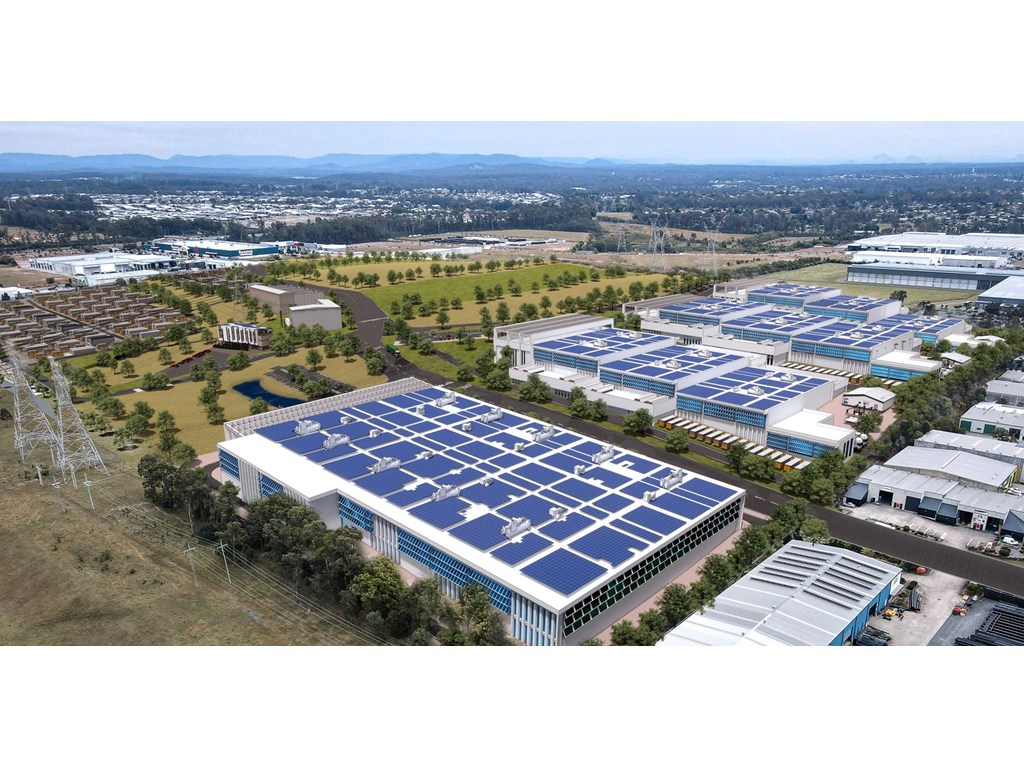 |
Brendale Supernode, Queensland,
by Quinbrook Infrastructure Partners, 8 July, 2022 |
Consolidating computing into large data centers, collocated with renewable energy storage, as is being done at the Berndale Supernode in Queensland, provides the opportunity to reduce carbon emissions from computing. These systems can also be used to replace activities which are carbon emitting. As an example, the recent COVID-19 pandemic has shown that much business travel can be replaced with video conferences. However this requires learning new skills, and habits.
Reference
Supernode set for Moreton Bay, Steven Miles, Deputy Premier of Queensland, 8 July, 2022. URL https://statements.qld.gov.au/statements/95682
We can teach how to measure and reduce emissions, with a smart phone
Small Chunks of Learning Delivered to Handheld Devices
 |
ICT Sustainability Course on a desktop computer,
by Tom Worthington, CC-BY, 2007 |
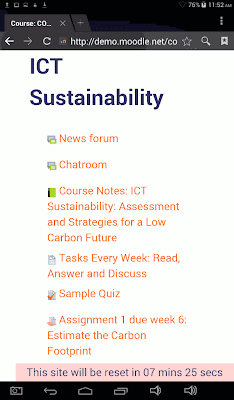 |
ICT Sustainability Course on a phone,
by Tom Worthington, CC-BY, 2007 |
Vocational education at TAFE, and courses at university are now routinely provided online. What is not generally appreciated is that students don't have to sit down at a desk-top computer, to learn. The learning management systems used for teaching TAFE and university students automatically adjust to smart phone screens. It takes a little more work to design the course content for this mode, and to allow students to study while working.
In 2008, the Australian Computer Society commissioned me to design an online course to teach how to estimate and reduce carbon emissions from computers. This was implemented using the Australian developed Moodle Learning Management System, and has been running at Australian and North American universities since 2009.
Reference
Worthington, T., "A Green computing professional education course online: Designing and delivering a course in ICT sustainability using Internet and eBooks," Computer Science & Education (ICCSE), 2012 7th International Conference on , vol., no., pp.263,266, 14-17 July 2012 URL: http://dx.doi.org/10.1109/ICCSE.2012.6295070
Same Approach, Other Challenges
Needed Tech Skills for Defence by Smartphone
 |
Event canvas from Navy Warfare Innovation
Workshop (NWIW), by Paul Telling, 2020 |
Australian government face the challenge of recruiting and training sufficient personnel for technical roles. Training using mobile devices can assist with this, by allowing in service professional development in new and interesting ways. One example are the hackerthons which I have assisted with in the last few years. Two were hosted by the Australian Computer Society, for the ADF & NZDF, and one by the Australian Navy. These helped participants learn to collaborate online rapidly in a high stress environment.
Reference