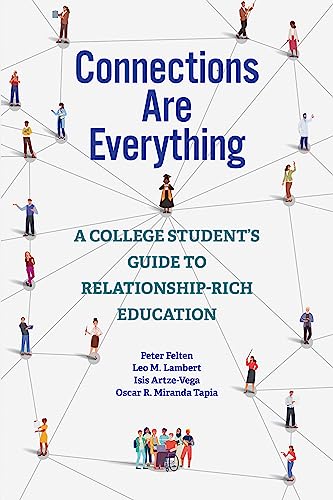
The authors suggest that "Connections are everything" is good advice for new students. If that is the case, why don;t introductory courses devote more time to making connections? Perhaps the reason is that the experience of today's students differs from that of their professors. University marketing shows happy carefree studnts sitting around chatting in a leafy environment. Perhaps that was the case in the professor's day, but today's student is more likely to be rushing from their job to the classroom, then out to pick up their children.
The Conversation article accompanies the publication of a book by many of the same authors (Felten, Lambert, Artze-Vega, and Tapia, 2023). Whhile titled "Connections Are Everything: A College Student's Guide to Relationship-Rich Education", I couldn't help thinking a better tile would be "Education for the Rich: Time to Make Connections to Stay Rich". That may sound harsh, but the advice given will be hard for a low SES student from a disadvantaged background to follow:
1. Talk to a professor
If there is a professor for 200 , or more students, exactly when and how long do you talk to them for? As a student if you focus is on passing, as quickly as possible, any interaction with staff has to focus on that. You need exemptions, and extensions. There is no time for an idle chat.
2. Make a friend in class
University is a lonely, frightening experience, and not just for young undergraduates. As a graduate student I had a decade of experience teaching at a university, and was an adult, but even so the old nightmares about assessment returned, and I found I had little in common with the rest of the class. What helped me was where there were class activities devoted to meeting other studnts, and group projects. But even so study was still a frightening, agonizingly lonely experience.
3. Use the resources that are there for you
Universities do have staff and resources to support student learning. But unless you are introduced to these in a course, and told to use them, students are unlikely to do so. As a student you are focused on studying enough to do the assessment. So the use of these resources have to be built into your assessed coursework to be useful. An example of this is the Techlauncher program at the ANU. Rather than suggest students go to see a career councilor before they graduate, the councilor are brought into the classroom to teach the students. In conjunction with the councilors, academic staff administer assessment which requires students to look at what they have learned, and possible futures. This empowers the time poor student to do what would otherwise be an option extra-curricular activity, which they therefore would not do. I will be talking about this at EduTech 2023.
4. Participate in a ‘relationship accelerator’
Internships, undergraduate research, writing-intensive seminars, study abroad, and campus employment are all good, but only if they are for credit. If they are not compulsory, or provide credit to the student's degree, there is little point in providing them.
5. Connect with yourself
Imposter syndrome is a real thing at university. Telling students who feel anxious to talk to a professor will compound the problem, not solve it. Professors are not trained in student counselling, and likely to make the student more anxious, not less. The first step I suggest is to admit that study is a stress inducing experience, not the happy go lucky one depicted in university marketing. This is hard surprising as most of the staff the student interacts with are casual, or on short term contracts. The staff are constantly anxious about their jobs. What can be done is help students cope with the anxiety, or at least understand this is a normal part of the university experience.
Reference
Leo M. Lambert, Isis Artze-Vega, & Oscar Miranda Tapia. "Building relationships is key for first-year college students – here are 5 easy ways to meet new friends and mentors", The Conversation, August 11, 2023 10.37pm AES.
Felten, P., Lambert, L. M., Artze-Vega, I., & Tapia, O. R. M. (2023). Connections Are Everything: A College Student's Guide to Relationship-Rich Education. JHU Press.

