Showing posts with label Student Attrition. Show all posts

Saturday, August 12, 2023

Designing Relationship Building Into University Programs

Lambert, Artze-Vega, and Tapia (2023) suggest five ways for college students (what in Australia are university undergraduates), to meet new friends and mentors. They suggest this is important to student success. I agree this is important, so important it should not be left as an ad-hoc extra curricular activity, it should be built into the core compulsory program. Rather than design courses and assessment where students learn alone, and are then punished for collaboration, instead teach studnts to work together, and reward them with grades for doing so. Delete technical content from the curriculum and replace it with vital teamwork skills.

The authors suggest that "Connections are everything" is good advice for new students. If that is the case, why don;t introductory courses devote more time to making connections? Perhaps the reason is that the experience of today's students differs from that of their professors. University marketing shows happy carefree studnts sitting around chatting in a leafy environment. Perhaps that was the case in the professor's day, but today's student is more likely to be rushing from their job to the classroom, then out to pick up their children.

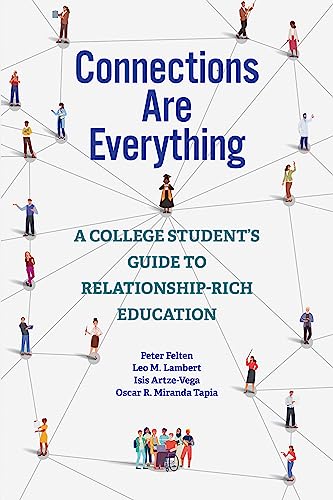
The Conversation article accompanies the publication of a book by many of the same authors (Felten, Lambert, Artze-Vega, and Tapia, 2023). Whhile titled "Connections Are Everything: A College Student's Guide to Relationship-Rich Education", I couldn't help thinking a better tile would be "Education for the Rich: Time to Make Connections to Stay Rich". That may sound harsh, but the advice given will be hard for a low SES student from a disadvantaged background to follow:

1. Talk to a professor

If there is a professor for 200 , or more students, exactly when and how long do you talk to them for? As a student if you focus is on passing, as quickly as possible, any interaction with staff has to focus on that. You need exemptions, and extensions. There is no time for an idle chat. 

2. Make a friend in class

University is a lonely, frightening experience, and not just for young undergraduates. As a graduate student I had a decade of experience teaching at a university, and was an adult, but even so the old nightmares about assessment returned, and I found I had little in common with the rest of the class. What helped me was where there were class activities devoted to meeting other studnts, and group projects. But even so study was still a frightening, agonizingly lonely experience.

3. Use the resources that are there for you

Universities do have staff and resources to support student learning. But unless you are introduced to these in a course, and told to use them, students are unlikely to do so. As a student you are focused on studying enough to do the assessment. So the use of these resources have to be built into your assessed coursework to be useful. An example of this is the Techlauncher program at the ANU. Rather than suggest students go to see a career councilor before they graduate, the councilor are brought into the classroom to teach the students. In conjunction with the councilors, academic staff administer assessment which requires students to look at what they have learned, and possible futures. This empowers the time poor student to do what would otherwise be an option extra-curricular activity, which they therefore would not do. I will be talking about this at EduTech 2023.

4. Participate in a ‘relationship accelerator’

Internships, undergraduate research, writing-intensive seminars, study abroad, and campus employment are all good, but only if they are for credit. If they are not compulsory, or provide credit to the student's degree, there is little point in providing them.

5. Connect with yourself

Imposter syndrome is a real thing at university. Telling students who feel anxious to talk to a professor will compound the problem, not solve it. Professors are not trained in student counselling, and likely to make the student more anxious, not less. The first step I suggest is to admit that study is a stress inducing experience, not the happy go lucky one depicted in university marketing. This is hard surprising as most of the staff the student interacts with are casual, or on short term contracts. The staff are constantly anxious about their jobs. What can be done is help students cope with the anxiety, or at least understand this is a normal part of the university experience.

Reference

Leo M. Lambert, Isis Artze-Vega, & Oscar Miranda Tapia. "Building relationships is key for first-year college students – here are 5 easy ways to meet new friends and mentors", The Conversation, August 11, 2023 10.37pm AES. 

Felten, P., Lambert, L. M., Artze-Vega, I., & Tapia, O. R. M. (2023). Connections Are Everything: A College Student's Guide to Relationship-Rich Education. JHU Press.

Tuesday, November 25, 2014

Attrition and Completion in Doctoral Education: A Wicked Problem?

Greetings from the Australian National University in Canberra, where Nigel Palmer, honorary research fellow with the Centre for the Study of Higher Education at the University of Melbourne is speaking on "Attrition and Completion in Doctoral Education: A Wicked Problem?". He has been researching completion rates for doctoral candidates by international/domestic status and gender (and produced papers on education). He is looking at how to better support candidates, to improve completion times and rates completion of their degree.

Nigel argued that even if universities are full fee paying, students dropping out is still a problem. He then discussed if it was a wicked problem. He suggests it is because of the difficulty of measuring attrition as well as the management of attrition itself.

One reason for worrying about attrition is equity of access to education.  Nigel showed a graph showed the increasing number of women commencing a doctoral program over time. However, he then had a second graph showing that women were over represented in educaiton and helath, but many fewer in IT and Engineering.  One interesting trend was that in education and health participation was higher in undergraduate degrees than postgraduate ones, while it was revered in IT and engineering.

Nigel then showed a series of graphs showing international versus domestic students for the group of eight universities. Unfortunately all the colored likes look blue to me, so I could not see what the graphs were showing.

Nigel suggested that some measures to lessen attrition, such as research methods courses,  will also improve the graduate outcomes (courses for doctoral students is a hot topic at ANU at present). 

Nigel described a "crude" research doctoral degree completion rates, stupid statistic. This is calculated from the number of students completing in one year divided by the number there were the year before. This is not a very useful statistic because students normally take longer than a year to complete a degree. There have been attempts to come up with better measures, using longer periods and techniques such as a three year moving average (three years being more typical for degree completion). Unfortunately as Nigel points out such calculations are skewed by recent growth of international enrolments in Australia, which makes the relative competion rate look low.

The US PHD  Completion project found completion rates of 49% for humanities to 65% for engineering. Similar studies for ANU showed a completion rate of about 80% for full time students. Niegl's research is showing a similar high completion rate, but it is too early to report definitive results. The figures show an interesting S curve, with the rate of completions increasing rapidly for about the first five years and then tapering off. Nigel pointed out that there were a significant number of completions from five to ten years.

It is surprising how difficult it is to get an agreed measure and then actual statistics for completion rates for degrees. Universities are in the business of producing graduates (and this is a very large export industry for Australia). It would seem reasonable to have agreed measures for university output.

If there were more reliable statistics, it would be possible to consider measures to aid completion rates. But will this really have a useful effect on measures. As an example, if domestic male students complete at a lower rate than international female students, would it be appropriate to set a higher entry standard, or resources provided, on the basis of gender?

Nigel concluded that doctoral attrition was not a wicked problem and this this might engender a sense of helplessness.

I suggest some easy measures to address attrition would be to provide more flexible programs. As an example, Australian postgraduate students could be offered programs which allow for a mix of coursework and research. As is usual in North America, students would start with coursework and then, depending on their interests and aptitudes, focus on coursework or research. Also the option of the student completing a qualification lower than a doctorate, without feeling they have in some way failed, would be useful. In addition it would be useful to have accessible support services, which are available on and off campus, would be useful. Also services for monitoring supervisors in the way teachers are, would be useful.