Showing posts with label Doctoral Education. Show all posts

Monday, May 9, 2022

Australian University Staff Shedding During Pandemic

In "Australian University Staff Job Losses Exceed Pandemic Financial Outcomes" (09 May 2022), Frank Larkins from University of Melbourne carries out an analysis of job shedding during COVID-19. He concludes that "... staff losses were greater than warranted based solely on 2020 financial results ...". Of course, universities may have been anticipating an uncertain future, and so making cuts in anticipation of further problems. 

Not surprisingly, Larkins found that casual staff were most impacted, being the full time equivalent of two-thirds of cuts. However, if universities were making long term structural changes, reducing casual staff didn't make a lot of sense. Casuals have a low separation cost, not receiving the benefits permanent staff do. So if long term change to respond to an uncertain future, it would have made sense for universities to reduce permanent staff, particularly non-academic professional staff. The casual workforce could be retained in the knowledge it could be quickly reduced, if required.

The underlying cause of the changes might be the artificially high casual academic staff pool available. Universities have to compete with other industries for professional administrators, HR, computing, marketing and accounting staff. If offered a low pay casual job, potential employees could choose to not work at a university. However, in contrast academics have only a very limited range of non-university employers (some research organisations and government). Those wishing to be academics therefore have a choice between a low pay casual employment, or none at all. Universities were then able to discard casuals, knowing a pool would be available if need increased.

From an economic and human welfare point of view, having a large pool of underemployed academics is not good. The solution, for government, would be to end preferential subsiding of research doctoral degrees, to reduce the excess supply of PhD graduates. 

Thursday, April 7, 2022

Presenting from a Campervan

Natalie Lloyd, on screen from her camper-van,
in Teaching Lab 1.08, Birch Building, ANU.
Photo by Tom Worthington, CC-BY 7 April 2022 
Greetings from Teaching Lab 1.08 in the refurbished Birch Building at ANU. This the first time, in along time, the research students have been able to get together in person. A panel of experts is answering questions about research in Engineering and Computer Science. Most are in the room, but Natalie Lloyd has turned her camper-van into a mobile office* to take part from WA. Another online panelist, but from a conventional office, is noted Linux guru Kathy Reid.

The New teaching lab

Teaching Lab 1.08, as seen from the window
in the foyer of the ANU Birch Building.
Photo by Tom Worthington, CC-BY 7 April 2022
This is in a general purpose dry lab. There are 20 benches on wheels, each seating  seven students. There is a power board for each bench, on a retractable reel from the ceiling. One wall has six large flat panel displays.  There is a folding wall to divide the room in half. The folding panels are covered with white board material (the end panel can be used when the wall is retracted). 

There are two presenter's stations between the screens. There are two  eyewash  stations at the back of the room. There are windows on three sides, two with views of the garden and one into the foyer. There are adjustable stools on wheels with backrests, although when used for a lab many people will be on their feet.

This is a simple usable space, with none of the gimmicks that many flexible teaching spaces suffer from, such as matrix displays (they break), and benches with power built in (they can't be moved).

Not the First Mobile Office

George Bray, on the TechTrek
In 2001, George Bray, roving ambassador for the Internet Industry Association set out on an Australia wide TechTrek, in a campervan to showcase the Internet to regional Australia. With the popularity of Zoom today, perhaps there should be a green screen option for camper-vans. ;-)

Tuesday, April 27, 2021

Skill-up to escape the academic treadmill

Linus Tan
The Research Whisperer has a helpful article on "Starting a consultancy can be like finding a date" (by Linus Tan, 27 April 2021). As they point out, universities are laying off academic staff and not renewing contracts. This most effects casual staff and those on short contracts. So many are looking for non university work, some as consultants. Suggestions provided are: 1. Let people know you are available, 2. Make yourself presentable, 3. Don't do it alone, 4. Select the right area, 5. Select the right project, 6. Keep working part time at university. This is all good advice, but I have a few more suggestions, from 20 years as a freelance consultant and part time academic. After all, as the saying goes: Those who can't research, teach; those who can't teach, become consultants. ;-)

More suggestions:

1. Job skill-up at your university

If you are considering work outside academia, I suggest taking advantage of the training and support provided to university staff and students. Universities provide detailed training and tools for students in how to work out what sort of job you might get and to apply. I work with people at ANU Careers teaching computing students how to think about a job, as their last assignment before graduating. 

2. Business skill-up at your local start-up center

Universities also provide training in business skills. Don't dismiss entrepreneurial training at start-up centers around the universities. Even if you don't want to set up your own business, the training in how to plan, budget and present is valuable. I have taken part in the workshops at the Canberra Innovation Network (CBRIN). 

3. Get training and insurance cover from your professional body

Also I suggest looking to your professional body for training and assistance. As an example, the Australian Computer Society provides training and also low cost liability insurance . Keep in mind that if you are going to be a consultant, you or the company you work through, will need to have insurance, which can cost thousands of dollars a year. 

4. Teach your students to be professionals, not just academics

In the longer term, as I suggested before COVID-19, universities and supervisors should start educating graduate students first of all for jobs outside academia, as there are very few secure well paid ones in it. If you are supervising a student, I suggest you have an obligation to make it clear to them that they have next to no chance of a secure, well paid job at a university. So encourage your student to first get skills and qualifications for work outside academia. If they are exceptionally gifted in research, they may then consider that, after they have ensured they will not be trapped in the academic system.

Wednesday, September 2, 2020

Doctorial Students Should Plan for a Non-academic Job

The Thesis Whisperer, Professor Inger Mewburn, has suggested that "... for the next 18 months at least, academic jobs will be scarce – at least in English speaking countries where universities are exposed to the international student market" (September 2, 2020). As a result she suggests that academic staff will need to look for jobs outside academia. I agree with this advice, but suggest it should be the default for doctoral students in all disciplines, all the time: doctoral students should be trained, like all students, to look for a job outside academia.

The Thesis Whisperer suggests most academic supervisors are not good at providing career advice, which is a little unfair, as that is not their role and they are not trained for it. As it happens I do help provide students with career advice, but this is as part of a team, after training and with specialist career advisors employed by the university. As someone who has worked outside academia, I can add my own direct experience to this. The clients for student projects and many of the tutors I work with are also from industry and provide an outside perspective.

As the Thesis Whisperer points out, there is a myth of academia as being a secure and harmonious career. But this, I suggest has never been true. Academics have always had to compete for resources, both within their institution, and externally. Since the foundation of Australia's first university, academics have had to make close contacts with industry, form partnerships, obtain research funding and scholarships. Our universities were created to provide trained professionals to work outside the universities and a pool of research talent to solve real world problems, not as isolated ivory towers. Those academics who train people for jobs in demand and solve real world problems will continue to prosper.

Australian universities may have less money from international tuition fees to subsidize research in the next few years. However, that should not come as a surprise to anyone in the Australian university system. Regular warnings having been issued over the last few years as the international student numbers grew. To reduce the risk, Australian universities engaged casual staff for teaching, as well as academics on short term contracts. Without the fees from international students these staff can no longer be engaged. However, those on longer contracts and "tenure" cannot relax.

Those research and teach at Australian universities need new skills. Online working and teaching is not a passing fad. Academics who are waiting to return to a golden age of sitting in the lab waiting for students to turn up will find themselves unemployed and unemployable. Academics need to be actively engaged on research projects of relevance to the Australian community and industry, otherwise no one will pay for that research. Academics must be ready to teach students who are out in the field, or a job, most of the time, as that is the most useful form of education.

This morning I delivered the last of my six part weekly webinar series on Higher Education After COVID-19 as part of the Microlearning Series curated by Manisha Khetarpal at Maskwacis Cultural College in Canada.  In this I suggested that education should be designed like the flexible platforms now used for making cars globally and the student should learn primarily on the job or at a campus which looks like a workplace, not a campus.

Tuesday, August 11, 2020

To Win the Academic Hunger Games Don't Play by the Rules

In Rich academic, poor academic? Making an academic living in Covid times (5 August 2020), Dr Inger Mewburn, The Thesis Whisperer, discusses how to craft a career in higher education. With dark humor Dr Mewburn characterizes the challenges of working in the university sector as being the Academic Hunger Games. Many academics are working casual rates, or short contracts, and research work dependent on getting the next grant in competition with their peers. This is at a time when several universities have been found to have systematically underpaid academics for decades and some engaged in unconscionable practices, such as allowing only three minutes to mark an assignment. 

Dr Mewburn points to increased numbers of students without corresponding increases in staff to teach them, due to inadequate public funding. She then discusses what the individual can do: leave academia, supplement income with ‘non-academic’ sources, have a mission focus, provide free material online to promote yourself and be cautious "side hustles" don't damage your reputation.

This is all good advice, but I suggest academics can take a lesson from the Hunger Games by working with their students to reform the system. In The Hunger Games (Suzanne Collins, 2008) a dictatorship selects children at random to be trained to fight each other to the death: the one remaining wins. But a small group of contestants, and their teachers, decide to work together to change this and ultimately come out alive. I don't suggest firing flaming arrows at the chancellery, but teachers can help students to be better equipped for academia, and by doing so improve conditions for everyone.

The first way teachers can help their students is by equipping them with skills, knowledge and qualifications suitable for a career outside academia. Otherwise Dr Mewbur's first option: leave academia may not be possible. Only after equipping themselves to work in industry, should students be encouraged to consider additional studies for academia.

To be able to promote themselves, have a focus, and not be burnt by side hustles, I suggest students should be encouraged (or required), to undertake entrepreneurial training. If students aspire to a career in academia they will have to develop entrepreneurial skills of working out what the customer (grant bodies) want, and promoting a product (themselves and their project) to obtain funds. They also need to learn to work cooperatively with others, while looking after their own individual interests.

Also students who aspire to work in academia need to learn to cope with the inevitable failure of most of their projects. Most research proposals are not funded, not because of a lack of funds, but because this is a competitive process. Of those few projects funded, most do not produce a significant result. In the start-up world, entrepreneurs are trained to cope with repeated failure, and to try to turn it to their advantage with techniques such as pivoting

Teachers should also encourage (or require) students who aspire to academia to learn to teach. Teaching is not just giving lectures (in fact this is the least useful form of teaching). It includes how to estimate the resources required to design a course, deliver it and assess students. Along with the entrepreneurial training, this will lessen the risk of falling into the trap of being overloaded with students and assessment. When presented with an offer to teach, the properly trained educator can work if the hours and remuneration offered are adequate. If not, they can propose an alternative, such as different teaching and assessment, present a credible proposal for more resources, or confidently decline the offer, falling back on their in-demand skills outside academia.

This is not to say that efforts should not be made to lobby for increased funding for research and education at universities. Or that the wrongs done, particularly to early career academics, should not be righted. As well as financial compensation to victims of wage theft, senior university executives should be investigated to see if they should be dismissed for improper conduct, and charged with a crime. However, it is not within the power of individual academics to ensure that increased funding, or legal remedies, happen. Academics who are teaching students can, through their own efforts, provide an education which prepares their students for the competitive world in, and outside, academia.

Thursday, July 23, 2020

Train PhD Students as Enterpreneurs

This week I attended a presentation from an early career academic on the challenges of having a family and a research career, even before COVID-19 made it much harder. Also this week I was welcomed to the Canberra Innovation Network's Virtual Co-workingonline community. It occurred to me that the approach which the entrepreneur/startup community takes to mutual support may be of use for training doctoral students and supporting early career academics.

From one point of view entrepreneurs are business people all competing with each other, but on the other hand there is a lot of sharing and support. There is also an emphasis on learning from failure, as at least 90% of startups fold. With the usual face to face events closed, this support has moved online.

Part of the stress and frustration for new researchers may come from too high expectations during their training. If they do well, they hope to be funded as a post-doctoral researcher and then, in time, a secure tenured position. However, there are far fewer post doctoral positions and even fewer tenured positions, than PhD graduates.

Even a supposedly permanent university position is dependent on funding from student fees, research grants and other variable sources to pay a salary. This can come as a shock to a new graduate who has worked for years in the expectation of a career in research. PhD students could be instead encouraged to think of themselves as entrepreneurs, with conducting research being just one skill they need to succeed.

Doctoral training could be changed to incorporate features of that provided for entrepreneurs. This emphasizes any one project has only a very slim chance of success and you should be prepared to learn from repeated failed projects. Skills in identifying what makes a project appealing to funding bodies can be taught. Also the ability to "pivot" can be nurtured: take a small sliver of potential from a failing project and run with that. Lastly, students can be provided with a broad set of skills useful for industry, as that is where 90% of them will end up working, not in research.

Wednesday, May 13, 2020

Making Doctoral Degrees More Useful

Professor Inger Mewburn, The Thesis Whisperer,  has warned of a imminent economic crisis in higher education and called on those involved with doctoral education to change what they do now, before the crisis hits. While I agree we need doctoral degree graduates, changing the PhD is not the only way to do it. We need more Professional Doctorates, which are specifically designed to train people with the highest skills for industry.

Professor  Mewburn suggests more time be spent on students "developing their full professional selves". Students need to learn to present in public and be more outward looking, as they are unlikely to find a job in the department where they trained, or in any university department, anywhere.  While I agree with all of this, Professor  Mewburn has overlooked the Professional Doctorate. This is a degree at the same level as a PhD, but focused on the needs of professionals working in industry.

In a way it does not much matter if PhDs are reformulated to be professional doctorates in all but name, or genuine professional doctorate programs are introduced alongside PhDs. In either case, universities , need to make some hard decisions to make this happen, quickly. Otherwise economic conditions will make the decisions for them.

Monday, February 3, 2020

The Role of the PhD in the Modern World

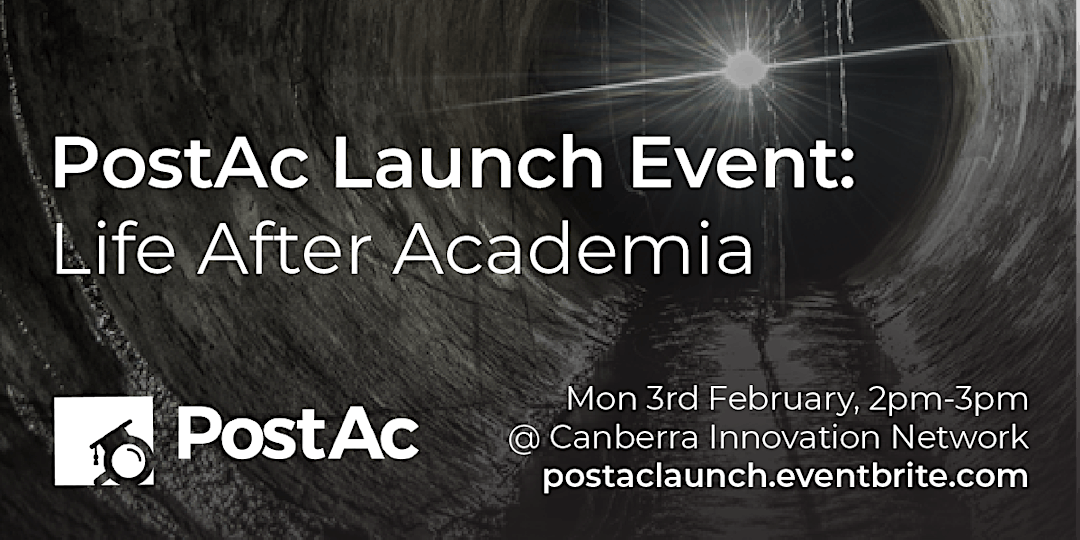
Greetings from the Canberra Innovation Network for the launch of
"PostAc", to help PhD students into non-academic research careers. Professor Keith Nugent ANU Deputy Vice-Chancellor for Research and Innovation, explained that the ANU was redefining the PhD for wider roles outside academia. Professor Elanor Huntington, ANU Dean of Engineering and Computer Science, pointed out she had a Masters of Computer Science as well as a PhD in the more esoteric area of physics. Also she pointed out that the PostAc service will also collect information on PhDs and jobs. Dr Mewburn mentioned they were open to offers from companies, such as LinkedIn, to purchase PostAc.

One option I suggested to Dr Mewburn that PostAc might consider is auto searches. The student may not know what to search for.  Perhaps the tool could read the student's thesis and suggest a job based on that, and whatever else is publicly available on them. This might include hobbies: an academic in a job interview once told me that had no leadership skills, but then mentioned the lead the university alpine climbing team (if you can get people up a mountain, that shows leadership).

PostAcc is a clever hack to overcome a public policy failure. Unfortunately none of the speakers directly addressed this policy failing: universities produce many more PhDs than there are research jobs for. While someone who has an advanced research degree might be able to find a non-research job with PostAcc, it would be better if they enrolled in a degree which suited those jobs. In most cases a coursework masters is a suitable postgraduate qualification for a job. If more specialized skills are needed, then there is the option of a professional doctorate. These are at the same academic level as a PhD (with the title "Doctor"), but the focus is on skills for industry, rather than just research. PostAcc can provide a palliative for the failure to direct students to these more useful degrees, but not cure it.

Reference


Pitt, R., & Mewburn, I. (2016). Academic superheroes? A critical analysis of academic job descriptions. Journal of Higher Education Policy and Management, 38(1), 88-101. URL https://www.tandfonline.com/doi/pdf/10.1080/1360080X.2015.1126896

Thursday, January 16, 2020

PostAc Helping PhDs Escape Academia

The app "PostAc" has been developed to help PhD students into non-academic research careers. This is by Dr Inger Mewburn, director of research training at The Australian National University, better known as "The Thesis Whisperer". There will be a launch at CBRIN in Canberra, 2pm, 3 February.

PostAc could be useful not so much in getting PhD students jobs, but  getting them thinking about jobs outside academia. At PhD final seminars I routinely ask students how they will apply the results of their research. In the past many would have not thought beyond publishing their work. They had a vague idea that as they had a PhD they would be able to get a university job. They had not yet faced the fact that their chances of getting a secure job at a university were minimal, and they needed to look father afield. About the only doctoral graduates not in this situation are those who do a professional doctorate related to a profession, where there is a demand for graduates. But a doctoral education for most is a PhD, and not a guarantee of a job.

Sunday, April 22, 2018

Post-ac: Career Outside Academia for Graduate Students

The Australian National University(ANU) was awarded a Trade Mark for the word POSTAC (Number 1872576) on
19 April 2018). This comes out of research by Mewburn, Suominen and Grant (2017) on using Artificial Intelligence to read job ads and look for those requiring high level research skills.

The term post-ac is defined by Struve (2017) as an abbreviation for post-academic career: "any career outside of academia altogether" (citing Sayre, Brunner, Croxall & McGinn, 2015). Struve (2017) contrasts this with alt-ac: alternative academic careers in higher education, outside the traditional tenure-track teaching and research. Struve (p. 192, 2017) note:
"Most faculty members are ill-equipped to advise on alt-ac or post-ac career paths, assuming they are open to the possibility of their students pursuing a career other than a typical tenure-track position."
Higgins and Daniels (p. 238, 2015) attributes the popular use of the hastag "#postac" to a blog by Pan and Roberts started in 2011 (and that is the oldest reference to the term I could find in the literature). Pan and Roberts refer to "... practical ways the skills we gained as underpaid, overeducated academics might translate to other professions".

However, I suggest this, and most discussion of the relevance of a research degree to non-academic employment, suffers from a fundamental flaw. Discussion of the suitability of doctoral degrees for employment assume that the student is undertaking a research degree (commonly referred to as a "PhD"). It is also assumed that such students should reasonably expect to find long term employment in academia, or in a research position in industry.

However, not all doctoral degrees are focused on training research specialists. Australia recognizes this by having a second form of Doctoral Degree: Professional (commonly referred to as a "Doctor of discipline"). This requires research skills, but is intended for more practical application outside academia and research organizations. Also there is plenty of literature making it abundantly clear to doctoral students that, outside a few areas, their chances of employment in academia or research are minimal.

Encouraging students to undertake a Professional Degree, in preference to a PhD, would solve many of the problems around employment of graduates. The student would receive an education designed to provide skills and knowledge relevant to a job in a discipline. 

However, I suggest even those few undertaking a PhD and destined for a career in academia need more than just research training. University academics will spend a considerable part of their time teaching, supervising staff, making presentations to funders and administration. These are all skills not normally covered in a PhD, especially if the student spends their days working alone in the lab and only occasionally seeing their supervisor. I suggest that these skills should be included in the PhD curriculum, assessed by an e-portfolio and with formal coursework offered to the student. It should not be assumed the student will pick up these skills somehow thought extra-curricular activities.

This will result in a PhD looking not that much different to a professional doctorate. The PhD will learn in a group of students, not alone and have a team of instructors with qualifications in communications, teaching and project management, to work alongside the discipline supervisors. A benefit of this approach will be that the high rates of stress and mental illness amongst PhD students should be able to be addressed. It should also lessen the frustration and stress for PhD supervisors.

References

Higgins, S. C., & Daniels, M. (2015). Alternative Academics: Moving beyond the Academy. Journal of Eastern Mediterranean Archaeology & Heritage Studies, 3(3), 238-246. URL http://www.jstor.org/stable/10.5325/jeasmedarcherstu.3.3.0238
Mewburn, I., Suominen, H. & Grant, W. (2017, August). Tracking Trends in Industry Demand for Australia's Advanced Research Workforce, Australian National Centre for the Public Awareness of Science (CPAS), ANU. URL http://cpas.anu.edu.au/files/Mewburn%2C%20Suominen%20and%20Grant%202017%20Tracking%20Trends%20in%20Industry%20Demand%20for%20Australia%27s%20Advanced%20Research%20Workforce.pdf?lipi=urn%3Ali%3Apage%3Ad_flagship3_detail_base%3BHIDfXv5tQAiEIkfPicniBQ%3D%3D

Struve, L. E. (2017). Tenure-track, alt-ac, or post-ac: understanding career choice for women doctoral students in the social sciences (Doctoral dissertation). https://repositories.lib.utexas.edu/bitstream/handle/2152/60415/STRUVE-DISSERTATION-2017.pdf?sequence=1&isAllowed=y

Friday, December 8, 2017

Hidden job market for higher degree graduates in Australia

Mewburn, Suominen and Grant (2017) report on research which used Artificial Intelligence to read job ads and look for those requiring high level research skills. They conclude there is a hidden job market for PhD graduates in Australia. However, the authors' assumption that these skills are indicative of a PhD is flawed. Australia has two forms of Doctoral Degree: Research and Professional. The former is commonly referred to as a PhD, the latter as a "Doctor of discipline". Both forms of doctorate require research skills, but the latter is intended for more practical application outside universities and research organizations. It is likely that almost all the hidden job demand the report found suits professional doctorates, not PhDs. In addition, for most jobs a Masters, not Doctorate, would be sufficient.

A more refined version of the AI might be able to distinguish between real PhD jobs in university and research organizations, those in industry requiring Professional Doctoral level skills and those where a Masters would be sufficient, but this would be difficult.
"There is a large ‘hidden job market’ for PhD graduates in the Australian workforce. Only 20.7 per cent of non-academic job ads (2,770 of 13,379 unique job titles) in our dataset asked for a PhD qualification, yet as many as 43 per cent (210 of 483) of the unique job ads that were analysed 3 required a high level of research skills and capabilities, indicative of a PhD. ...

The Machine revealed some interesting
patterns regarding demand for research skills, particularly in industries traditionally assumed to have low demand for PhD graduates, such as manufacturing, transport, logistics, marketing and communication. In addition, other industry sectors were shown as potentially ready to embrace more graduates with research skills, echoing the thinking of the innovation agenda."


From Mewburn, Suominen and Grant, p2, 2017

Reference


Mewburn, I., Suominen, H. & Grant, W. (2017, August). Tracking Trends in Industry Demand for Australia's Advanced Research Workforce, Australian National Centre for the Public Awareness of Science (CPAS), ANU. URL http://cpas.anu.edu.au/files/Mewburn%2C%20Suominen%20and%20Grant%202017%20Tracking%20Trends%20in%20Industry%20Demand%20for%20Australia%27s%20Advanced%20Research%20Workforce.pdf?lipi=urn%3Ali%3Apage%3Ad_flagship3_detail_base%3BHIDfXv5tQAiEIkfPicniBQ%3D%3D

Wednesday, October 11, 2017

Improving Australian Doctoral Programs

Recently I was asked how Ph.D. programs at Australian universities could be improved, so the graduates had better real-world skills, for jobs outside research. But this is the wrong question, and once you know what the right question is, the answer is easy.

As Carr, Evans, and Hornby (2017) point out, an Australian Ph.D. (they use the example of Monash University) follows an apprenticeship model for teaching research. An Australian Ph.D. is not intended to provide a broad range of skills for industry, or to train educators: it is to produce researchers. In contrast, a Ph.D. in the United States includes elements of what Carr, Evans, and Hornby (2017, p. 180) call a "taught doctorate" and a "professional doctorate".

Australian higher education regulations do not recognize a "taught doctorate", however, there is provision for a "professional doctorate", alongside a Ph.D. ("research Degree") at AQF Level 10 Doctoral Degree. The professional candidate still does research, but the emphasis is on the professional practice context.

Professional doctoral students are likely to be out and about, in the field, not on the campus. Maor and Currie (2017) looked at the use of technology for postgraduate supervision at Australian universities, noting that this will be increasingly demanded by distance and part-time students.

Margaret Kiley
Kiley (2017) examined three Australian universities which had introduced coursework for Ph.D. students, including material derived from Professional Doctorate programs. They concluded that many supervisors consider "... in Australia that the Ph.D. is an individualized learning program negotiated between candidate and supervisor". I would agree this is the view of supervisors, but will this approach achieve the best outcomes for the individual student, or for the community (who are subsidizing this education)?

Australian universities could tie themselves in administrative knots by trying to retrofit coursework requirements and non-research skills on an old fashioned Ph.D. apprenticeship model. However,  this will be frustrating for supervisors and students who actually want a Ph.D. program. Alternatively, universities could accept the reality that more than 95% of doctoral graduates are not destined for a research career and instead offer them a Professional Doctorate program, with coursework and team supervision. The other 5% of students can undertake a PHD program.

Reference


Carr, M. E. M. E., Evans, E. B. H. W. H., & Hornby, G. (2017). Comparative Review of Education Doctorates in Three Countries. The Future of Accessibility in International Higher Education, 175. 

Kiley, M. M. (2017). An emerging PhD curriculum and what this might mean for doctoral level threshold concepts. Practice and Evidence of the Scholarship of Teaching and Learning in Higher Education, 12(2), 294-312. URL http://community.dur.ac.uk/pestlhe.learning/ojs/index.php/pestlhe/article/view/173/195

 Maor, D., & Currie, J. K. (2017). The use of technology in postgraduate supervision pedagogy in two Australian universities. International Journal of Educational Technology in Higher Education, 14(1), 1. URL https://doi.org/10.1186/s41239-017-0046-1

Sunday, July 2, 2017

Redefining the Research Doctorate

Professor Imelda Whelehan, Dean of Higher Degree Research, Australian National University
Professor Imelda Whelehan, Dean of Higher Degree Research at The Australian National University (ANU) has invited staff and students to help in Redefining the ANU PhD:
  1. "What should a 21st century PhD look like?
  2. How can we ensure that the ANU secures our position as a world leader in graduate research education?
  3. What is best practice for PhD delivery worldwide?
  4. What changes can we make?"
Some of thoughts on the questions (my own, not necessarily the ANU view):

1. What should a 21st century PhD look like


The Australian Qualifications Framework (AQF) recognizes two forms of Doctoral Degree, both at Level 10 (the highest level of qualification): a Doctoral Degree (Research) and Doctoral Degree (Professional). A PhD, while clearly a research doctorate, I suggest should include elements of a professional degree. The community expects a PhD graduate to not only be able to conduct research on a very focused topic, but also to be an expert in their field, able to teach, lead and advise. Teaching, leading and advising are not skills which can be obtained just by conducting research: these require formal training and testing by staff qualified to teach and test.

Research graduates are expected to be teachers and supervisors in academia, as well as leaders industry. So I suggest that doctoral students should be required to undertake teaching and supervision of students and learn education, leaderships and communication theory, sufficient of awarding of a Graduate Certificate in Education (University Teaching and Supervision).

This education can be tailored to the needs of specific disciplines, to meet professional certification requirements. For example, the computing profession has skills definitions for computer educators.

2. How can we ensure that the ANU secures our position as a world leader in graduate research education?


ANU should reestablish formal programs in education, including a Graduate Certificate in Education (University Teaching and Supervision), Masters and a Doctoral Degree in Education. These can build on the reflective portfolio approach of the existing education fellowships, along with e-learning, supplemented with classroom based learning. This can be designed as an exemplar of a new flexible approach to non-lecture based education. The new education programs can be based at the ANU's new union court teaching building.

3. What is best practice for PhD delivery worldwide?


Dilly Fung's new book "A Connected Curriculum for Higher Education" (UCL Press, 2017), proposes a framework building on the Humboldtian teaching /research approach (full text is free on-line).

The Cambridge University Doctoral Training Centre for Social Sciences provides support for PHDs and might be a useful model for Australian universities. In 2015 I talked to Cambridge University staff on how they could use e-learning for their graduate students, the notes from the meeting are available from their Office of Scholarly Communication.

Athabasca University (Canada) offers doctorates in education, with the students required to be at the campus for only five days. This reflects a new reality of higher education, which Australian universities need to embrace, where students will be out in the field, or workplace, not on campus.

4. What changes can we make?


ANU could require research supervisors to obtain formal education in teaching at the level of at least a graduate certificate in education, in addition to any fellowships obtained.

Universities could offer doctoral students the opportunity to obtain real-world relevant qualifications and certifications, alongside their doctorate. Using the same e-portfolio evidence based techniques for the Grad Cert in Education, students could obtain certifications required for other fields by collecting evidence in a structured way.

This year I have been helping ANU TechLauncher students in computer science and engineering complete their Personal Development Review (PDR). This is a portfolio describing what skills and knowledge the students have acquired in their project work, in a format suitable for a future employer. Some of this is covered in my book "Digital Teaching In Higher Education".

Friday, November 27, 2015

Improving Professional IT Doctorate Completion Rates

Burmeister (2015) reports the results of  interviews with 44 students and staff involved in post-graduate IT education at Charles Sturt University (CSU). While focusing on professional IT doctorates, Burmeister points out that CSU has three exit points: Graduate Certificate, Masters and then the Doctorate. The program has coursework in the first two years, but students are also "guided to develop an article and
submit it to a conference or journal" in each of these two years. Other masters programs might benefit from this approach.

In the Masters of Education I have been undertaking I have been producing a conference paper each year, as a byproduct of assignments. However, I have not mentioned this to my tutors, for fear of it being seen as overly ambitious for a coursework student. This caused a problem when one conference paper was published before the assignment I had based it on had been marked and so was flagged as possible plagiarism.

Burmeister  suggests that flexible delivery can
improve work-life-study balance and so improve retention of students. However, this suggestion seems almost redundant.  Pye, Holt, Salzman, Bellucci and Lombardi (2015) found that students expect an on-line environment to be used. I suggest that it is time for Australian universities to assume their students, particularly post-graduate students, will be on-line and off-campus for most of their studies. Programs should be designed for on-line delivery, and then adaption made for on-campus components, rather than the reverse.

Burmeister  suggests that student engagement with
supervisors should be enhanced with weekly or fortnightly contact. This would result in a high workload for staff if done using conventional techniques, such as face-to-face meetings. I suggest it could be done using on-line asynchronous communication. Students don't need a supervisor taking at then for half an hour each week, then just need a couple of lines of pertinent text.

Reference


Burmeister, O. (2015). Improving professional IT doctorate completion rates. Australasian Journal Of Information Systems, 19. doi:http://dx.doi.org/10.3127/ajis.v19i0.1073

Pye, G., Holt, D., Salzman, S., Bellucci, E., & Lombardi, L. (2015). Engaging diverse student audiences in contemporary blended learning environments in Australian higher business education: Implications for Design and Practice. Australasian Journal Of Information Systems, 19. doi:http://dx.doi.org/10.3127/ajis.v19i0.1251

Thursday, August 20, 2015

Improving Doctoral Education

Greetings from the Australian National University in Canberra, where Margot Pearson is speaking on "Enhancing the experienced environment for doctoral candidates in a diverse array of settings and arrangements". She  questions the assumption that candidates will be located in a university department. Dr. Pearson points out that some research training takes place outside universities, such as hospitals, CSIRO, Cooperative Research Centres (CRC) and industry. She has produced a number of papers on doctoral education.

Dr. Pearson also pointed out that the funding available to students may depend on "where" they are. She questioned if it was possible to achieve funding equity for the students due to the diversity of funding sources. It seems to me that equity is not relevant to most research funding, as this based on the need for the research, or for trained personnel, not to provide an education, or benefit to the individual.

It might be easier to deal with the location of doctoral education by "flipping" the approach. Rather than assuming students are normally at a university department and then work out how to deal with those who are not, instead assume students could be anywhere.

One thing I have discovered with teaching is that it is easier to adapt a distance education course to on-campus use, that the other way around. Similarly it would be easier to accommodate on-campus doctoral students in a program designed for off-campus students. Most PHDs do not end up working in universities and so it would make sense if they gained experience outside the university environment. Where students must be trained at a university, it could be in a simulation of an external environment, such as a company owned by the university.

Perhaps Australian universities need to accept that only about 2,000 research doctoral graduates are required each year for the research positions available. The other 8,000 or so graduates will be working in non-research positions in government and industry. These people will need some experience with research, but not need as much as a professional researcher. It would therefore make sense for them to undertake a professional doctorate, not a PHD. These students should undertake coursework and a project relevant to their work, ideally while working in the relevant industry.

ps: However, professional doctorates are not without their own problems. In a recent paper, Burmeister (2015), discusses the low completion rates for IT professional doctorates. The causes and solutions suggested are similar to those Dr. Pearson discussed at the seminar today for research doctorates: student engagement with supervisors, feedback on progress, student engagement in the course, and student involvement in institutional communities of practice.

References

Burmeister, O. (2015). Improving professional IT doctorate completion rates. Australasian Journal Of Information Systems, 19. doi:http://dx.doi.org/10.3127/ajis.v19i0.1073

Tuesday, August 11, 2015

Doctoral Education for the Global Research Enterprise

Margot Pearson will speak on "Enhancing the experienced environment for doctoral candidates in a diverse array of settings and arrangements" at the Australian National University in Canberra, 12:30pm 20 August 2015.
"A significant feature of contemporary doctoral education is the continuing trend for research and research education to migrate beyond discipline-based institutional teaching and research structures.  As stated in a government consultation paper DIIRS 2011.

Although the majority of formal training is undertaken within a university environment, research training can also take place in a wide variety of settings. Besides university environments, research training occurs in medical research institutes and hospitals, in the CSIRO, Cooperative Research Centres (CRC) and in office and industrial settings.
The result is a diverse array of settings and arrangements for doctoral education linked to an increasingly global research enterprise.

Opportunities for funding and access to other resources including expertise can vary across doctoral programs and within them. The resulting experienced environment of doctoral candidates is one that that can afford them opportunities and challenges for completing their candidacy. Drawing on recent research it is argued that in this fluid and distributed environment attention needs to be on the individual candidate and how they negotiate their candidacy within a framework for exploring the doctoral experience that is candidate-centred; a framework that includes a focus on candidate agency, personal-academic connections, and networks."

Tuesday, November 25, 2014

Attrition and Completion in Doctoral Education: A Wicked Problem?

Greetings from the Australian National University in Canberra, where Nigel Palmer, honorary research fellow with the Centre for the Study of Higher Education at the University of Melbourne is speaking on "Attrition and Completion in Doctoral Education: A Wicked Problem?". He has been researching completion rates for doctoral candidates by international/domestic status and gender (and produced papers on education). He is looking at how to better support candidates, to improve completion times and rates completion of their degree.

Nigel argued that even if universities are full fee paying, students dropping out is still a problem. He then discussed if it was a wicked problem. He suggests it is because of the difficulty of measuring attrition as well as the management of attrition itself.

One reason for worrying about attrition is equity of access to education.  Nigel showed a graph showed the increasing number of women commencing a doctoral program over time. However, he then had a second graph showing that women were over represented in educaiton and helath, but many fewer in IT and Engineering.  One interesting trend was that in education and health participation was higher in undergraduate degrees than postgraduate ones, while it was revered in IT and engineering.

Nigel then showed a series of graphs showing international versus domestic students for the group of eight universities. Unfortunately all the colored likes look blue to me, so I could not see what the graphs were showing.

Nigel suggested that some measures to lessen attrition, such as research methods courses,  will also improve the graduate outcomes (courses for doctoral students is a hot topic at ANU at present). 

Nigel described a "crude" research doctoral degree completion rates, stupid statistic. This is calculated from the number of students completing in one year divided by the number there were the year before. This is not a very useful statistic because students normally take longer than a year to complete a degree. There have been attempts to come up with better measures, using longer periods and techniques such as a three year moving average (three years being more typical for degree completion). Unfortunately as Nigel points out such calculations are skewed by recent growth of international enrolments in Australia, which makes the relative competion rate look low.

The US PHD  Completion project found completion rates of 49% for humanities to 65% for engineering. Similar studies for ANU showed a completion rate of about 80% for full time students. Niegl's research is showing a similar high completion rate, but it is too early to report definitive results. The figures show an interesting S curve, with the rate of completions increasing rapidly for about the first five years and then tapering off. Nigel pointed out that there were a significant number of completions from five to ten years.

It is surprising how difficult it is to get an agreed measure and then actual statistics for completion rates for degrees. Universities are in the business of producing graduates (and this is a very large export industry for Australia). It would seem reasonable to have agreed measures for university output.

If there were more reliable statistics, it would be possible to consider measures to aid completion rates. But will this really have a useful effect on measures. As an example, if domestic male students complete at a lower rate than international female students, would it be appropriate to set a higher entry standard, or resources provided, on the basis of gender?

Nigel concluded that doctoral attrition was not a wicked problem and this this might engender a sense of helplessness.

I suggest some easy measures to address attrition would be to provide more flexible programs. As an example, Australian postgraduate students could be offered programs which allow for a mix of coursework and research. As is usual in North America, students would start with coursework and then, depending on their interests and aptitudes, focus on coursework or research. Also the option of the student completing a qualification lower than a doctorate, without feeling they have in some way failed, would be useful. In addition it would be useful to have accessible support services, which are available on and off campus, would be useful. Also services for monitoring supervisors in the way teachers are, would be useful.

Wednesday, October 22, 2014

Attrition and Completion in Doctoral Education: A Wicked Problem?

Nigel Palmer  will speak on "Attrition and Completion in Doctoral Education: A Wicked Problem?" at the Australian National University in Canberra, 5:00 PM 5 November 2014:
"Is doctoral attrition a wicked problem? This seminar examines time to completion and completion rates for international and domestic doctoral candidates by gender, and explores opportunities for developing better strategies for engaging and supporting candidates through to the successful completion of their degree. 
Better information on degree completions for doctoral candidates is essential if strategies for addressing student attrition are to be effective. This seminar reports findings from a scoping study supported by the Gender Institute and The Research Training unit at The Australian National University aimed at informing future research and engagement on patterns of participation and completion in doctoral degrees at the ANU, and in the Australian higher education sector more broadly. ..."
But in my view, doctoral completion rates only appear a wicked problem, if you take students ill suited to undertaking a thesis, for whom a thesis is not vocationally relevant and then have untrained supervisors attempt to supervise them.

There are well researched and proven techniques to improve doctoral completion rates. These involve having supervisors who have a formal qualifications in teaching and with training in how to supervise. The students, including research students, undertake a carefully designed program of coursework which emphasizes teamwork.

It needs to be recognized that only a small proportion of doctorates should be what the Australian Quality Framework calls "Doctoral Degree (Research)". Most doctorates should be Doctoral Degree (Professional), producing original research, but relevant to a job and with more coursework. Of the small number of research doctorates, almost all should be by "publication". The thesis should be reserved for the tiny fraction of the population who are capable of undertaking this most difficult form of education. I suggest less than 1% of directorates should be by thesis.

If doctoral degrees have well structured education programs, designed by a qualified educator and if the student has a supervisor formally trained and credentialed in how to supervise, problems are manageable.

Australia produces about 7,000 PHDs a year. Assuming 4,000 of these PHDs remain in Australia, that is about ten times the number the nation needs for research positions. 90% of the graduates will be in vocational positions and so need a professional doctorate. So a reasonable division for domestic students would be 10% Doctoral Degree Research (400 students) and 90% Doctoral Degree Professional. Of the Doctoral Degree Research students, I suggest 10% would be by a thesis (1% of the total doctoral degrees, or just 40 students).

This problem can be made even simpler by not artificially dividing students into different categories before the commence their studies. Instead of having to pick those students most suited to research in advance of seeing them do anything, the should enroll in a general postgraduate program and then discover which way their talents and interests are. In this way the less than 1% of doctoral students destined for a thesis could be identified. More importantly, the 99% of students not destined for a thesis need not feel they are failures.

Monday, March 17, 2014

Purpose of a PHD

Greetings from the Australian National University in Canberra, where Dr Margaret Kiley is talking on "Should we be worried about the PhD?". She suggested that a PHD graduate should be able to:
  1. Produce quality research
  2. Articulate knowledge and skills developed
  3. Identify how to use their education in future employment
  4. Understand the world.
Margaret related how the first Australian PHDs were women from University of Melbourne 1948 and University Sydney 1949. The programs were based on the UK model, except "oral" examinations are uncommon in Australia.

The average PHD student is 3 years old and equal males and females and 50% are part time for at least part of their studies. Most PHDs come from a job and are studying the field they previously worked in.

The number of students has doubled between 2000 and 2010. International students now make up more than one third of PHD students. Enrolment in "honours" (a program Australia adopted from Scotland) is declining. Structuring of doctorates is increasing (with professional or practice doctorate), having coursework followed by thesis.

One aspect of  Dr Kiley's analysis I did not agree with was the idea that PHD graduates should be "work ready". There are likely to be skills which graduates need which a PHD is not suited to teach or test. To take an extreme example, regardless of the quality of the graduate's thesis, they will not be employed on a mine, building or factory work-site unless they have completed mandatory health and safety training. This training is at a very low level and it does not make sense to teach it in a PHD.

 This is the first of four talks on the future of the PHD to be held at ANU. In July the topic is candidates and supervisors, November on ways of supervising with technology.

Friday, February 14, 2014

Doctoral Education Trends and Challenges

Dr Margaret Kiley, will speak on "Should we be worried about the PhD?", at the Australian National University in Canberra, 4pm, 17 March 2014. This is the first of a four part series on 'Engaging in doctoral education developments and challenges'. Participants will discuss trends and challenges in doctoral education.
Should we be worried about the PhD?
'Should we be worried about the PhD?', is part one of a four-part series titled 'Engaging in doctoral education developments and challenges'. These presentations aim to provide participants with an opportunity to discuss international, national and local trends and challenges in doctoral education and what they mean for ANU staff and candidates.

Specific aims of 'Should we be worried about the PhD?' include:

1) A brief background to the doctorate in Australia and current data
2) Perceived changes in the purpose of research education, including the increasing attention being given to employment outside the academy
3) The impact of globalisation and internationalisation on research education, and
4) Increases in accountability and quality assurance in doctoral education.


Following the presentation, light refreshments will be served, and there will be opportunities to engage in discussion with one another, and the Pro Vice-Chancellor (Research and Research Training), Professor Jenny Corbett, regarding ANU’s responses to these trends and challenges.


Part two of the series, to be held in June, will focus on alternative approaches to doctoral education, including coursework and structuring the curriculum. Part three, earmarked for July, will examine the variation in candidates and supervisors e.g. age, gender, motivation ethic and language background and what this means for practice. Part four, the final session in November, will look at alternatives in supervisory practice.


The presentations will be given by Dr Margaret Kiley, a Visiting Fellow in the ANU Research School of Humanities and the Arts. Margaret’s research and teaching interests have been in the area of research education including: the examination of doctoral theses; candidates' and supervisors' conceptions of research; and the introduction of coursework into the Australian PhD. Margaret has worked in Further/Higher Education in Australia, Indonesia and the UK and has presented workshops on research supervision in Australia, New Zealand, the UK, Malaysia, Canada and the USA. She has a conjoint position at Newcastle University, Australia, and is a Visiting Professor at Universiti Putra Malaysia.