The Thesis Whisperer, Professor Inger Mewburn, has suggested that "... for the next 18 months at least, academic jobs will
be scarce – at least in English speaking countries where universities
are exposed to the international student market" (September 2, 2020). As a result she suggests that academic staff will need to look for jobs outside academia. I agree with this advice, but suggest it should be the default for doctoral students in all disciplines, all the time: doctoral students should be trained, like all students, to look for a job outside academia.
The Thesis Whisperer suggests most academic supervisors are not good at providing career advice, which is a little unfair, as that is not their role and they are not trained for it. As it happens I do help provide students with career advice, but this is as part of a team, after training and with specialist career advisors employed by the university. As someone who has worked outside academia, I can add my own direct experience to this. The clients for student projects and many of the tutors I work with are also from industry and provide an outside perspective.
As the Thesis Whisperer points out, there is a myth of academia as being a secure and harmonious career. But this, I suggest has never been true. Academics have always had to compete for resources, both within their institution, and externally. Since the foundation of Australia's first university, academics have had to make close contacts with industry, form partnerships, obtain research funding and scholarships. Our universities were created to provide trained professionals to work outside the universities and a pool of research talent to solve real world problems, not as isolated ivory towers. Those academics who train people for jobs in demand and solve real world problems will continue to prosper.
Australian universities may have less money from international tuition fees to subsidize research in the next few years. However, that should not come as a surprise to anyone in the Australian university system. Regular warnings having been issued over the last few years as the international student numbers grew. To reduce the risk, Australian universities engaged casual staff for teaching, as well as academics on short term contracts. Without the fees from international students these staff can no longer be engaged. However, those on longer contracts and "tenure" cannot relax.
Those research and teach at Australian universities need new skills. Online working and teaching is not a passing fad. Academics who are waiting to return to a golden age of sitting in the lab waiting for students to turn up will find themselves unemployed and unemployable. Academics need to be actively engaged on research projects of relevance to the Australian community and industry, otherwise no one will pay for that research. Academics must be ready to teach students who are out in the field, or a job, most of the time, as that is the most useful form of education.
This morning I delivered the last of my six part weekly webinar series on Higher Education After COVID-19 as part
of the Microlearning Series curated by Manisha Khetarpal at Maskwacis Cultural College in Canada. In this I suggested that education should be designed like the flexible platforms now used for making cars globally and the student should learn primarily on the job or at a campus which looks like a workplace, not a campus.
Showing posts with label Thesis Whisperer. Show all posts
Showing posts with label Thesis Whisperer. Show all posts
Wednesday, September 2, 2020

Tuesday, August 11, 2020
To Win the Academic Hunger Games Don't Play by the Rules
In Rich academic, poor academic? Making an academic living in Covid times (5 August 2020), Dr Inger Mewburn, The Thesis Whisperer, discusses how to craft a career in higher education. With dark humor Dr Mewburn characterizes the challenges of working in the university sector as being the Academic Hunger Games. Many academics are working casual rates, or short contracts, and research work dependent on getting the next grant in competition with their peers. This is at a time when several universities have been found to have systematically underpaid academics for decades and some engaged in unconscionable practices, such as allowing only three minutes to mark an assignment.
Dr Mewburn points to increased numbers of students without corresponding increases in staff to teach them, due to inadequate public funding. She then discusses what the individual can do: leave academia, supplement income with ‘non-academic’ sources, have a mission focus, provide free material online to promote yourself and be cautious "side hustles" don't damage your reputation.
This is all good advice, but I suggest academics can take a lesson from the Hunger Games by working with their students to reform the system. In The Hunger Games (Suzanne Collins, 2008) a dictatorship selects children at random to be trained to fight each other to the death: the one remaining wins. But a small group of contestants, and their teachers, decide to work together to change this and ultimately come out alive. I don't suggest firing flaming arrows at the chancellery, but teachers can help students to be better equipped for academia, and by doing so improve conditions for everyone.
The first way teachers can help their students is by equipping them with skills, knowledge and qualifications suitable for a career outside academia. Otherwise Dr Mewbur's first option: leave academia may not be possible. Only after equipping themselves to work in industry, should students be encouraged to consider additional studies for academia.
To be able to promote themselves, have a focus, and not be burnt by side hustles, I suggest students should be encouraged (or required), to undertake entrepreneurial training. If students aspire to a career in academia they will have to develop entrepreneurial skills of working out what the customer (grant bodies) want, and promoting a product (themselves and their project) to obtain funds. They also need to learn to work cooperatively with others, while looking after their own individual interests.
Also students who aspire to work in academia need to learn to cope with the inevitable failure of most of their projects. Most research proposals are not funded, not because of a lack of funds, but because this is a competitive process. Of those few projects funded, most do not produce a significant result. In the start-up world, entrepreneurs are trained to cope with repeated failure, and to try to turn it to their advantage with techniques such as pivoting.
Teachers should also encourage (or require) students who aspire to academia to learn to teach. Teaching is not just giving lectures (in fact this is the least useful form of teaching). It includes how to estimate the resources required to design a course, deliver it and assess students. Along with the entrepreneurial training, this will lessen the risk of falling into the trap of being overloaded with students and assessment. When presented with an offer to teach, the properly trained educator can work if the hours and remuneration offered are adequate. If not, they can propose an alternative, such as different teaching and assessment, present a credible proposal for more resources, or confidently decline the offer, falling back on their in-demand skills outside academia.
This is not to say that efforts should not be made to lobby for increased funding for research and education at universities. Or that the wrongs done, particularly to early career academics, should not be righted. As well as financial compensation to victims of wage theft, senior university executives should be investigated to see if they should be dismissed for improper conduct, and charged with a crime. However, it is not within the power of individual academics to ensure that increased funding, or legal remedies, happen. Academics who are teaching students can, through their own efforts, provide an education which prepares their students for the competitive world in, and outside, academia.
Dr Mewburn points to increased numbers of students without corresponding increases in staff to teach them, due to inadequate public funding. She then discusses what the individual can do: leave academia, supplement income with ‘non-academic’ sources, have a mission focus, provide free material online to promote yourself and be cautious "side hustles" don't damage your reputation.
This is all good advice, but I suggest academics can take a lesson from the Hunger Games by working with their students to reform the system. In The Hunger Games (Suzanne Collins, 2008) a dictatorship selects children at random to be trained to fight each other to the death: the one remaining wins. But a small group of contestants, and their teachers, decide to work together to change this and ultimately come out alive. I don't suggest firing flaming arrows at the chancellery, but teachers can help students to be better equipped for academia, and by doing so improve conditions for everyone.
The first way teachers can help their students is by equipping them with skills, knowledge and qualifications suitable for a career outside academia. Otherwise Dr Mewbur's first option: leave academia may not be possible. Only after equipping themselves to work in industry, should students be encouraged to consider additional studies for academia.
To be able to promote themselves, have a focus, and not be burnt by side hustles, I suggest students should be encouraged (or required), to undertake entrepreneurial training. If students aspire to a career in academia they will have to develop entrepreneurial skills of working out what the customer (grant bodies) want, and promoting a product (themselves and their project) to obtain funds. They also need to learn to work cooperatively with others, while looking after their own individual interests.
Also students who aspire to work in academia need to learn to cope with the inevitable failure of most of their projects. Most research proposals are not funded, not because of a lack of funds, but because this is a competitive process. Of those few projects funded, most do not produce a significant result. In the start-up world, entrepreneurs are trained to cope with repeated failure, and to try to turn it to their advantage with techniques such as pivoting.
Teachers should also encourage (or require) students who aspire to academia to learn to teach. Teaching is not just giving lectures (in fact this is the least useful form of teaching). It includes how to estimate the resources required to design a course, deliver it and assess students. Along with the entrepreneurial training, this will lessen the risk of falling into the trap of being overloaded with students and assessment. When presented with an offer to teach, the properly trained educator can work if the hours and remuneration offered are adequate. If not, they can propose an alternative, such as different teaching and assessment, present a credible proposal for more resources, or confidently decline the offer, falling back on their in-demand skills outside academia.
This is not to say that efforts should not be made to lobby for increased funding for research and education at universities. Or that the wrongs done, particularly to early career academics, should not be righted. As well as financial compensation to victims of wage theft, senior university executives should be investigated to see if they should be dismissed for improper conduct, and charged with a crime. However, it is not within the power of individual academics to ensure that increased funding, or legal remedies, happen. Academics who are teaching students can, through their own efforts, provide an education which prepares their students for the competitive world in, and outside, academia.
Wednesday, May 13, 2020
Making Doctoral Degrees More Useful
Professor Inger Mewburn, The Thesis Whisperer, has warned of a imminent economic crisis in higher education and called on those involved with doctoral education to change what they do now, before the crisis hits. While I agree we need doctoral degree graduates, changing the PhD is not the only way to do it. We need more Professional Doctorates, which are specifically designed to train people with the highest skills for industry.
Professor Mewburn suggests more time be spent on students "developing their full professional selves". Students need to learn to present in public and be more outward looking, as they are unlikely to find a job in the department where they trained, or in any university department, anywhere. While I agree with all of this, Professor Mewburn has overlooked the Professional Doctorate. This is a degree at the same level as a PhD, but focused on the needs of professionals working in industry.
In a way it does not much matter if PhDs are reformulated to be professional doctorates in all but name, or genuine professional doctorate programs are introduced alongside PhDs. In either case, universities , need to make some hard decisions to make this happen, quickly. Otherwise economic conditions will make the decisions for them.
Professor Mewburn suggests more time be spent on students "developing their full professional selves". Students need to learn to present in public and be more outward looking, as they are unlikely to find a job in the department where they trained, or in any university department, anywhere. While I agree with all of this, Professor Mewburn has overlooked the Professional Doctorate. This is a degree at the same level as a PhD, but focused on the needs of professionals working in industry.
In a way it does not much matter if PhDs are reformulated to be professional doctorates in all but name, or genuine professional doctorate programs are introduced alongside PhDs. In either case, universities , need to make some hard decisions to make this happen, quickly. Otherwise economic conditions will make the decisions for them.
Monday, February 3, 2020
The Role of the PhD in the Modern World
Greetings from the Canberra Innovation Network for the launch of
"PostAc", to help PhD students into non-academic
research careers. Professor Keith Nugent ANU Deputy Vice-Chancellor for Research and Innovation, explained that the ANU was redefining the PhD for wider roles outside academia. Professor Elanor Huntington, ANU Dean of Engineering and Computer
Science, pointed out she had a Masters of Computer Science as well as a PhD in the more esoteric area of physics. Also she pointed out that the PostAc service will also collect information on PhDs and jobs. Dr Mewburn mentioned they were open to offers from companies, such as LinkedIn, to purchase PostAc.
One option I suggested to Dr Mewburn that PostAc might consider is auto searches. The student may not know what to search for. Perhaps the tool could read the student's thesis and suggest a job based on that, and whatever else is publicly available on them. This might include hobbies: an academic in a job interview once told me that had no leadership skills, but then mentioned the lead the university alpine climbing team (if you can get people up a mountain, that shows leadership).
One option I suggested to Dr Mewburn that PostAc might consider is auto searches. The student may not know what to search for. Perhaps the tool could read the student's thesis and suggest a job based on that, and whatever else is publicly available on them. This might include hobbies: an academic in a job interview once told me that had no leadership skills, but then mentioned the lead the university alpine climbing team (if you can get people up a mountain, that shows leadership).
PostAcc is a clever hack to overcome a public policy failure. Unfortunately none of the speakers directly addressed this policy failing: universities produce many more PhDs than there are research jobs for. While someone who has an advanced research degree might be able to find a non-research job with PostAcc, it would be better if they enrolled in a degree which suited those jobs. In most cases a coursework masters is a suitable postgraduate qualification for a job. If more specialized skills are needed, then there is the option of a professional doctorate. These are at the same academic level as a PhD (with the title "Doctor"), but the focus is on skills for industry, rather than just research. PostAcc can provide a palliative for the failure to direct students to these more useful degrees, but not cure it.
Reference
Pitt, R., & Mewburn, I. (2016). Academic superheroes? A critical analysis of academic job descriptions. Journal of Higher Education Policy and Management, 38(1), 88-101. URL https://www.tandfonline.com/doi/pdf/10.1080/1360080X.2015.1126896
Thursday, January 16, 2020
PostAc Helping PhDs Escape Academia
The app "PostAc" has been developed to help PhD students into non-academic
research careers. This is by Dr Inger Mewburn, director of research training at The Australian
National University, better known as "The Thesis Whisperer". There will be a launch at CBRIN in Canberra, 2pm, 3 February.
PostAc could be useful not so much in getting PhD students jobs, but getting them thinking about jobs outside academia. At PhD final seminars I routinely ask students how they will apply the results of their research. In the past many would have not thought beyond publishing their work. They had a vague idea that as they had a PhD they would be able to get a university job. They had not yet faced the fact that their chances of getting a secure job at a university were minimal, and they needed to look father afield. About the only doctoral graduates not in this situation are those who do a professional doctorate related to a profession, where there is a demand for graduates. But a doctoral education for most is a PhD, and not a guarantee of a job.
PostAc could be useful not so much in getting PhD students jobs, but getting them thinking about jobs outside academia. At PhD final seminars I routinely ask students how they will apply the results of their research. In the past many would have not thought beyond publishing their work. They had a vague idea that as they had a PhD they would be able to get a university job. They had not yet faced the fact that their chances of getting a secure job at a university were minimal, and they needed to look father afield. About the only doctoral graduates not in this situation are those who do a professional doctorate related to a profession, where there is a demand for graduates. But a doctoral education for most is a PhD, and not a guarantee of a job.
Saturday, February 2, 2019
Thesis Whisperer
Dr Mewburn, raises the issue of the high workloads in academia. The problem with "Less", I suggest, is that there will always be more demands on the time of an effective person, than there are hours in the day to do them, and "Care" can result in being emotionally blackmailed. Being more efficient will not help, as that will just increase the demands on your time. What I suggest is a conscious choice as to what to do, and more importantly, what not to do.
Dr Mewburn, discusses the stresses of attending an international conference on a limited budget. Each year I try to attend one international conference. I mostly have to pay my own airfares, conference fees and accommodation. One way I have found to get the most from this expensive and time consuming experience is to squeeze in another conference, and talks, on the way. There are few direct flights from Australia, so I look for another conference wherever the plane stops. Often conferences are happy to have someone chair a session, or give a talk, to make up for a last minute cancellation.
This year I was invited to speak at the Computer Society of Sri Lanka National IT Conference (NITC 2018).
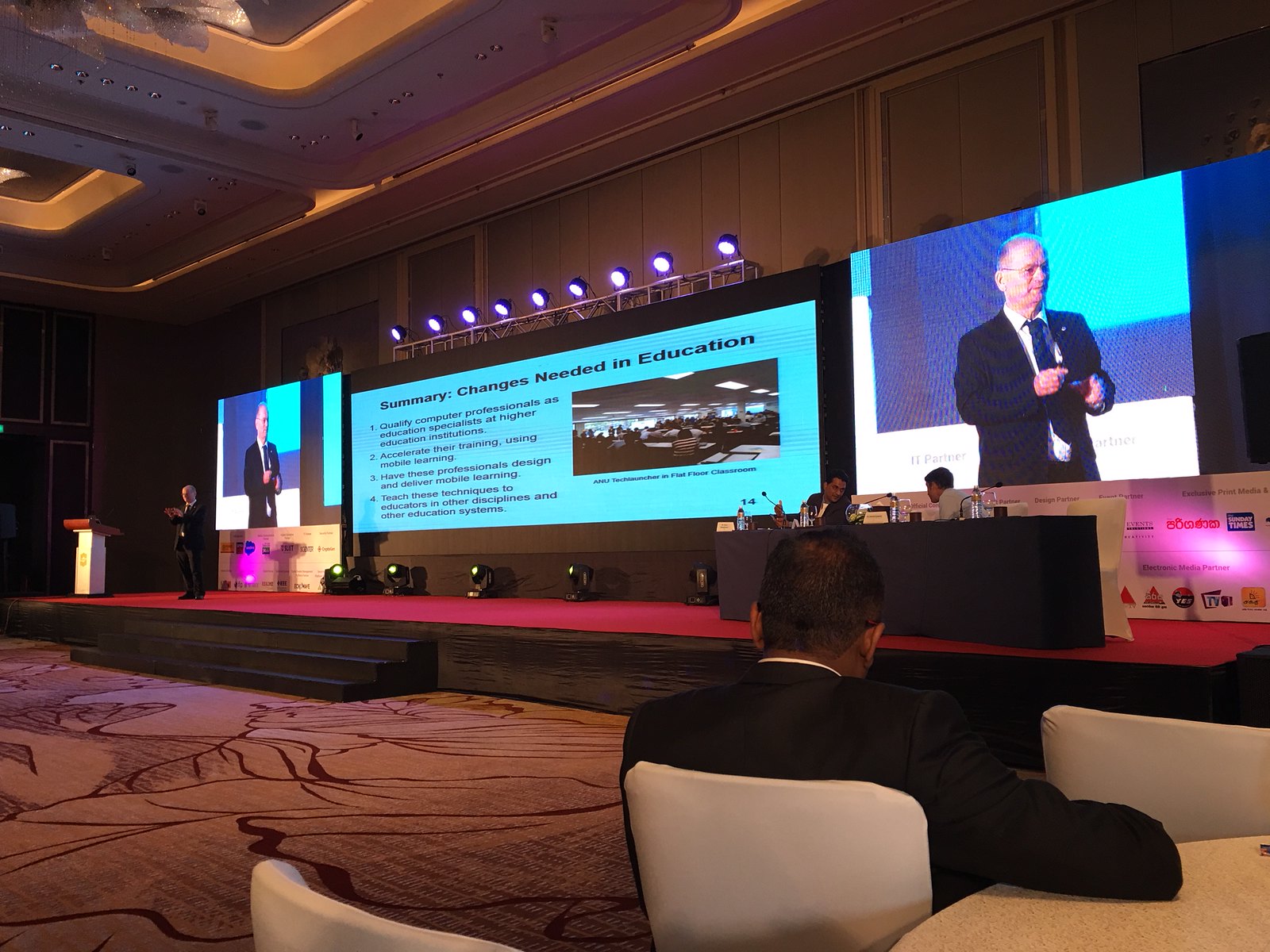 Flights were via KL or Singapore,
so I looked for conferences there. I found EduTech Asia 2018 was on and the organizers
responded with a speaking slot, and free registration.
Flights were via KL or Singapore,
so I looked for conferences there. I found EduTech Asia 2018 was on and the organizers
responded with a speaking slot, and free registration.Another way to reduce the stress when traveling for conferences is to use public transport. This may take more time, but imposes a timetable which makes it easier to refuse requests to squeeze extra work into your schedule. One tip is to use overground transport, avoiding the subway. Singapore, HK, and London have very efficient subways, but they also have excellent double deck buses, which provide a view, if you are not in a hurry.
 |
| View from 17th floor UBC Walter Gage Student Residence |
Dr Mewburn, expresses concern over the stress from working in academia. She suggests an emphasis on being "resilient", transfers the problem from the system to the individual, and instead calls for a "better, fairer, more humane system in academia". While I support this, I suggest we need to also train our students, be they destined for academia, or for industry, to be "professional".
The academic system is not the only one to exploit its workers. Where you have people who love what they do, there can be a tendency to take advantage of them. I suggest that academics need to consider themselves professionals, and that they are training professionals. A professional looks after not only the interests of their clients, and their employer, but their own interests as well.
For several years I gave lectures to ANU's computer students on "Professional Ethics". This is a compulsory subject for all degree programs accredited by professional bodies. Professionalism is, in part, about the obligations of the individual to their staff. However, it is also about their obligations to themselves. Professionals are required to take time to keep up withe skills, and are obliged not to take on more work than they can do. These obligations are so the professional can do a good job for their client, but a byproduct is to avoid overwork.
Dr Mewburn, voices the dilemma all academics face, where they are encouraged to look after students and engage in activities which impact the wider world, but tend to only be promoted for publishing peer reviewed journal papers. I suggest it is possible to find a comfortable mix. Bogs, videos and book can be sued to promote journal papers. Hopefully we are reaching the point where more than just formal papers will will be counted as serious work output.
What I do each year is choose a theme, or a theme chooses me. I plan to prepare a paper on the theme for formal presentation at a conference. Along the way there might also be a book. Also I will present to parliamentary committees on the topic, and talk to the media. What I always do is to make a point of explaining to my institution how this helps promote their courses.
Sometimes these themes just evolve. Last year it was "Blended Learning for the Indo-Pacific", presented in Canberra to my professional body, then in Colombo, a formal paper at an international conference in Woolongong (and to be repeated at USyd on Monday). Along the way I presented a version to a Senate committee (the previous witness was the ANU VC, who asked "Tom what are you doing here?"). It happened then that DFAT were looking for ideas, so I pitched my paper to them, slightly modified, for $250,000 in funding. Along the way I spent a delightful few days in Singapore, at a conference meeting up with acquaintances from around the world.
This year's theme will probably be about peer assessment for blended learning of professional skills. I offered to help with professional skills, and now find myself with 60 masters students to teach in ANU's new flexible building. I started by blogging what I might teach, now I am finalizing the formal learning design. Next I will teach. That will likely result in a conference paper, perhaps a book, later in the year, or next. As professional skills and blended learning are hot topics, there will likely be conference invitations and media interest.
ps: The inspiration for my Higher Education Whisperer blog, came from Dr Mewburn's Thesis Whisperer.
Subscribe to:
Posts (Atom)