I have decided to stop reviewing papers for academic journals (I will still do for conferences I am involved with). The reason is that the academic publishing system is exploitative. Reviewers don't get paid, or any other form of compensation, for reviewing. In theory this is something you do, as you will then have your papers reviewed. But in practice there are many free riders. My gesture is a tiny one, but then I remember when I decided to stop giving lectures and that gained traction.
Authors submit papers and expect others to review them, but are not required to review. The authors receive a benefit from published papers, and a financial benefit when this results in a job, or research grant. Some publications are for profit and the published receives revenue from subscribers. The ones missing out from this are reviewers, who get no credit, or payment. So I will stop doing this.
The system could be easily fixed. Reviewers could receive a voucher for each four papers they review, entitling them to priority processing for one paper submitted. For for-profit publications, they could simply be paid.
Publications could also invest in automated tools to take some of the drudgery out of reviewing. This would check for plagiarism (especially self plagiarism, where autoes submit the same paper, or ones with just a few changes, to multiple publications). Systems could also check references in papers.
Showing posts with label academic publishing. Show all posts
Showing posts with label academic publishing. Show all posts
Monday, April 14, 2025
My Last Review

Thursday, March 6, 2025
Accelerating and Democratizing Scientific Research Lifecycle

Greetings from the ANU School of Computing, where Qingyun Wang from University of Illinois Urbana-Champaign is speaking on Accelerating and Democratizing Scientific Research Lifecycle. Much has been written about more research of lower quality being published. Rather than bemoaning the role of AI in making this worse, here the idea is to use "AI for Scientists" (AI4Scientist) to address it. The first part of this is to automatically analyze papers to provide structured data. This can be used to explain the paper to the reader and also fact check it.
This can be taken further to expand the generation of hypotheses, but so far in very restricted well defined fields, such as biomedical. AI could also be used to seek out "hidden treasures" in the scientific literature. This would be a boon, as there is a lot of papers which simply repeat previous research, with slight variations.
What I find most interesting is the possibility to use this to teach students to write better papers. It could also be used to help working researchers write more readable papers, with fewer errors. It would be interesting to see how well this would work for non-STEM disciplines where the format of papers is not so constrained. A particular problem for human readers, and likely for AI, are interdisciplinary research.
Tuesday, October 15, 2019
Monday, July 1, 2019
Latex: a heavy duty publishing tool for serious academic publishing

The problem was that every time I made a small edit to my document, I had to tinker with the layout. Each time I added a reference I had to change the referencing list. In the past I made do with things by hand for APA references, but IEEE style references required renumbering each time. Over the years I had tried various bibliographic plugins, but none worked well with Libre Office.
In 1999 and 2000, I used Latex to produce two books: Net Traveler, and Universal service? (by Michael Bourk). LaTex is a tool developed for complex academic works. While Latex worked well for the books, it was cumbersome to use for small projects. Latex works a bit like writing web pages with HTML, or writing a computer program. You include commands in your text for the formatting and images. You then have to have this rendered to see what it looks like.
After a computer upgrade in the late 2000s, I did not bother reinstalling Latex. The next time I was preparing a book, this was done as a byproduct of a website. It was easier to import the HTML files into Open Office, and use that for the typesetting (Open Office, and its successor Libre Office can work directly with HTML files). There were not many references, so I did them manually.
I then spent about seven years as a graduate student. I had to write a lot of assignments, and a large e-portfolio. However, as this was in the social sciences (teaching), the APA format was used, which is easy enough to do with a word processor. My Masters capstone was a web based e-portfolio, so a conventional publishing system was not needed (although I did produce a book from this with Libre Office).
Decades years later, I was sitting in a tedious academic meeting, fiddling with my draft of a paper for a conference. I decided I should give Latex another go (my colleagues had been telling me this for decades). I looked at versions of Latex for Linux, but there were so many to choose from, this was too hard. So instead I tried a few of the web hosed implementations, and settled on Overleaf, which is free for casual users.
Overleaf, like many Latex systems, presents a text editor on one side of the screen, and shows your formatted document on the other. You edit the text, then push a button to see what it will look like. Learning Latex is a major undertaking, and it took me some hours to remember how to do it. However, once that was done, there were the delights of entering a reference in a bibliography file, and having it correctly formatted automatically, and entering a code to say put the figure at the top or bottom of the nearest column of text. Also it was a great relief to have my document pass the conference submission system's automated format checks at the first attempt.
Using Latex is as much about unlearning things, as learning them. You need to forget about the fonts and where things go on the page, and let the software worry about that. This especially the case when preparing a paper for a conference. You load the conference template and fill in your text, letting the system do the details.
Saturday, February 2, 2019
Thesis Whisperer
Dr Mewburn, raises the issue of the high workloads in academia. The problem with "Less", I suggest, is that there will always be more demands on the time of an effective person, than there are hours in the day to do them, and "Care" can result in being emotionally blackmailed. Being more efficient will not help, as that will just increase the demands on your time. What I suggest is a conscious choice as to what to do, and more importantly, what not to do.
Dr Mewburn, discusses the stresses of attending an international conference on a limited budget. Each year I try to attend one international conference. I mostly have to pay my own airfares, conference fees and accommodation. One way I have found to get the most from this expensive and time consuming experience is to squeeze in another conference, and talks, on the way. There are few direct flights from Australia, so I look for another conference wherever the plane stops. Often conferences are happy to have someone chair a session, or give a talk, to make up for a last minute cancellation.
This year I was invited to speak at the Computer Society of Sri Lanka National IT Conference (NITC 2018).
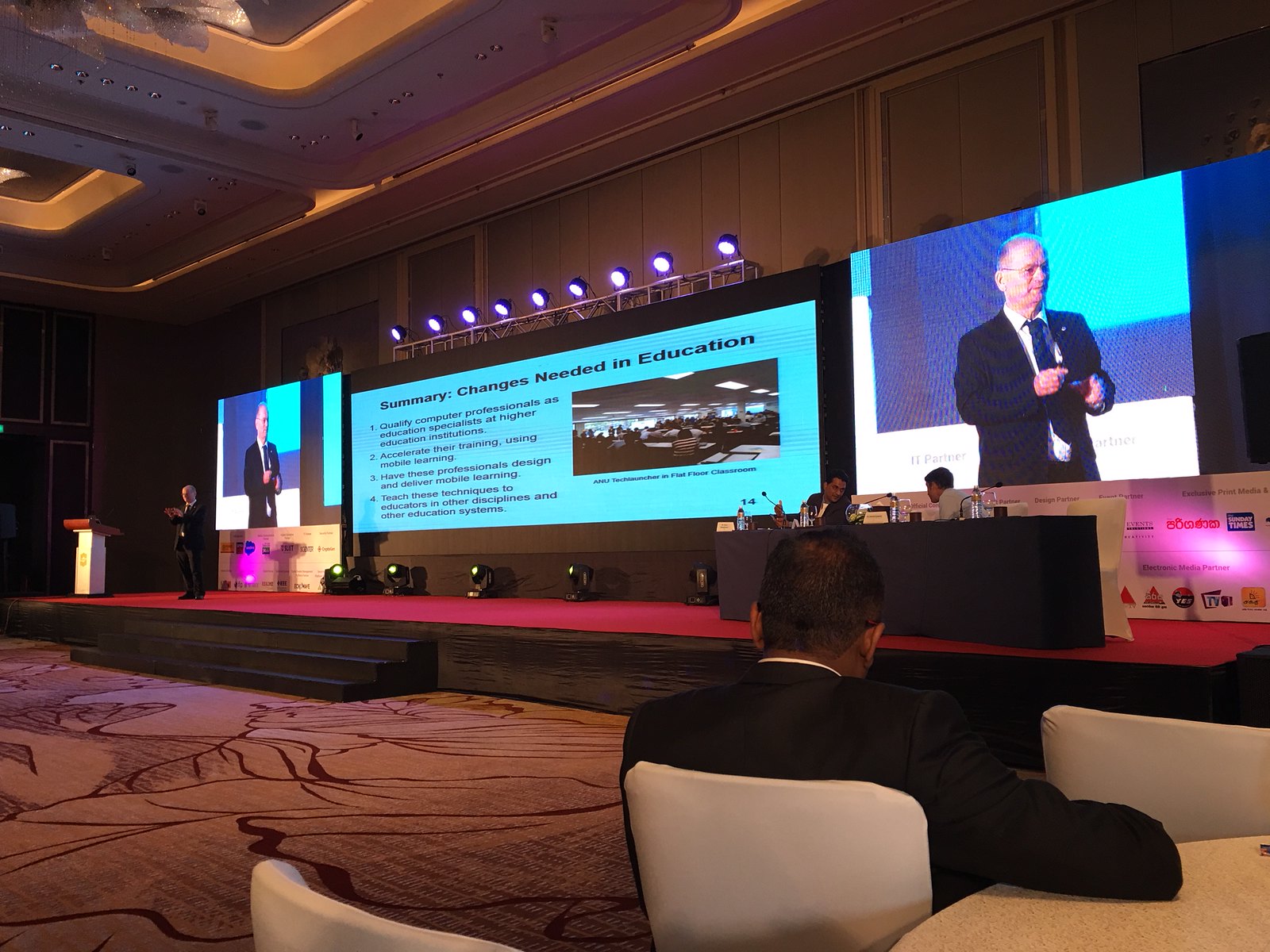 Flights were via KL or Singapore,
so I looked for conferences there. I found EduTech Asia 2018 was on and the organizers
responded with a speaking slot, and free registration.
Flights were via KL or Singapore,
so I looked for conferences there. I found EduTech Asia 2018 was on and the organizers
responded with a speaking slot, and free registration.Another way to reduce the stress when traveling for conferences is to use public transport. This may take more time, but imposes a timetable which makes it easier to refuse requests to squeeze extra work into your schedule. One tip is to use overground transport, avoiding the subway. Singapore, HK, and London have very efficient subways, but they also have excellent double deck buses, which provide a view, if you are not in a hurry.
 |
| View from 17th floor UBC Walter Gage Student Residence |
Dr Mewburn, expresses concern over the stress from working in academia. She suggests an emphasis on being "resilient", transfers the problem from the system to the individual, and instead calls for a "better, fairer, more humane system in academia". While I support this, I suggest we need to also train our students, be they destined for academia, or for industry, to be "professional".
The academic system is not the only one to exploit its workers. Where you have people who love what they do, there can be a tendency to take advantage of them. I suggest that academics need to consider themselves professionals, and that they are training professionals. A professional looks after not only the interests of their clients, and their employer, but their own interests as well.
For several years I gave lectures to ANU's computer students on "Professional Ethics". This is a compulsory subject for all degree programs accredited by professional bodies. Professionalism is, in part, about the obligations of the individual to their staff. However, it is also about their obligations to themselves. Professionals are required to take time to keep up withe skills, and are obliged not to take on more work than they can do. These obligations are so the professional can do a good job for their client, but a byproduct is to avoid overwork.
Dr Mewburn, voices the dilemma all academics face, where they are encouraged to look after students and engage in activities which impact the wider world, but tend to only be promoted for publishing peer reviewed journal papers. I suggest it is possible to find a comfortable mix. Bogs, videos and book can be sued to promote journal papers. Hopefully we are reaching the point where more than just formal papers will will be counted as serious work output.
What I do each year is choose a theme, or a theme chooses me. I plan to prepare a paper on the theme for formal presentation at a conference. Along the way there might also be a book. Also I will present to parliamentary committees on the topic, and talk to the media. What I always do is to make a point of explaining to my institution how this helps promote their courses.
Sometimes these themes just evolve. Last year it was "Blended Learning for the Indo-Pacific", presented in Canberra to my professional body, then in Colombo, a formal paper at an international conference in Woolongong (and to be repeated at USyd on Monday). Along the way I presented a version to a Senate committee (the previous witness was the ANU VC, who asked "Tom what are you doing here?"). It happened then that DFAT were looking for ideas, so I pitched my paper to them, slightly modified, for $250,000 in funding. Along the way I spent a delightful few days in Singapore, at a conference meeting up with acquaintances from around the world.
This year's theme will probably be about peer assessment for blended learning of professional skills. I offered to help with professional skills, and now find myself with 60 masters students to teach in ANU's new flexible building. I started by blogging what I might teach, now I am finalizing the formal learning design. Next I will teach. That will likely result in a conference paper, perhaps a book, later in the year, or next. As professional skills and blended learning are hot topics, there will likely be conference invitations and media interest.
ps: The inspiration for my Higher Education Whisperer blog, came from Dr Mewburn's Thesis Whisperer.
Friday, September 7, 2018
Academic Open Access Publishing Needs Education and Auditing
A move to open access research publishing will need, I suggest, a well
resourced information campaign, and a well staffed anti-fraud unit.
European and UK research funding bodies have decided to move to open access publishing by 2020. As a condition of receiving funding researchers will be required to publish papers from that research where they are available free. The researchers will be provided with finding to pay for publication. However, it is likely that some academics and publishers will attempt to game the new
system, placing public money and the integrity of research at risk.
In 2014 the Australian Government expanded student loans from universities to non-government vocational and educational training (VET) colleges. A 2015 Parliamentary inquiry heard "... harrowing and concerning evidence of misconduct by private VET providers ...". Education providers, and brokers, offered students inducements such as laptops to sign up for courses. This came at a cost of hundreds of millions of dollars to the Australian community and harmed the reputation of Australian vocational education.
Similar scams are likely with open access publishing, unless controls are in place from the start of the scheme. Academics are under pressure to publish and will be tempted to accept inducements from publishers and brokers, to place their business with them. We will likely see offers of free equipment and trips in return for publishing. We are also likely to see offers to the heads of research organizations for all research by their staff to be directed to one publisher in return for favorable treatment.
It should be made clear to publishers and researchers from the outset that offering, or accepting, cash and gifts in return for publishing is a crime. It should be made clear there are trained criminal investigators looking for such behavior and those responsible with be prosecuted.
In 2014 the Australian Government expanded student loans from universities to non-government vocational and educational training (VET) colleges. A 2015 Parliamentary inquiry heard "... harrowing and concerning evidence of misconduct by private VET providers ...". Education providers, and brokers, offered students inducements such as laptops to sign up for courses. This came at a cost of hundreds of millions of dollars to the Australian community and harmed the reputation of Australian vocational education.
Similar scams are likely with open access publishing, unless controls are in place from the start of the scheme. Academics are under pressure to publish and will be tempted to accept inducements from publishers and brokers, to place their business with them. We will likely see offers of free equipment and trips in return for publishing. We are also likely to see offers to the heads of research organizations for all research by their staff to be directed to one publisher in return for favorable treatment.
It should be made clear to publishers and researchers from the outset that offering, or accepting, cash and gifts in return for publishing is a crime. It should be made clear there are trained criminal investigators looking for such behavior and those responsible with be prosecuted.
Wednesday, June 13, 2018
SIGPLAN Empirical Evaluation Checklist
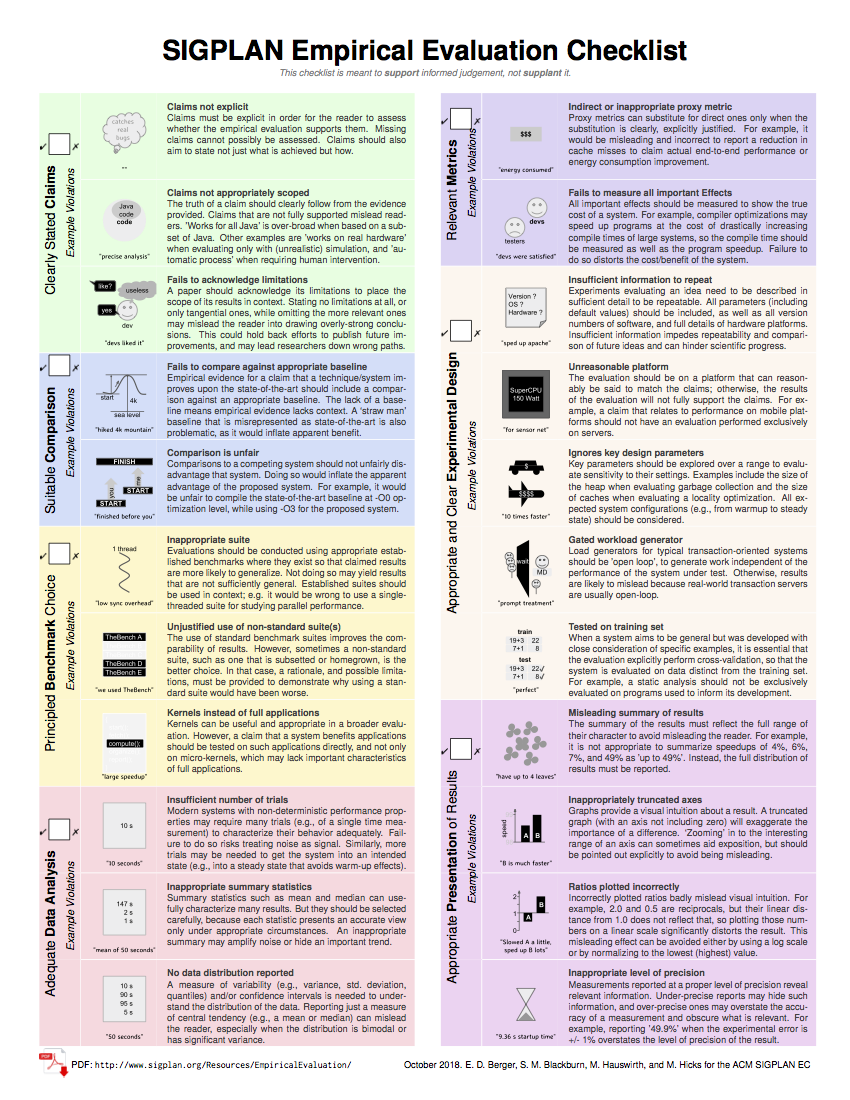
Here are the criteria by Berger, Blackburn, Hauswirth, and Hicks (2018):
Clearly stated claimsAdapted from Berger, Blackburn, Hauswirth, and Hicks (2018).
Suitable Comparison
- Explicit Claims
- Appropriately-Scoped Claims
- Acknowledges Limitations
Principled Benchmark Choice
- Appropriate Baseline for Comparison
- Fair Comparison
Adequate Data Analysis
- Appropriate Suite
- Non-Standard Suite(s) Justified
- Applications, Not (Just) Kernels
Relevant Metrics
- Sufficient Number of Trials
- Appropriate Summary Statistics
- Report Data Distribution
Appropriate and Clear Experimental Design
- Direct or Appropriate Proxy Metric
- Measures All Important Effects
Presentation of Results
- Sufficient Information to Repeat
- Reasonable Platform
- Explores Key Design Parameters
- Open Loop in Workload Generator
- Cross-Validation Where Needed
- Comprehensive Summary Results
- Axes Include Zero
- Ratios Plotted Correctly
- Appropriate Level of Precision
References
E. D. Berger, S. M. Blackburn, M. Hauswirth, and M. Hicks (June 2018). SIGPLAN Empirical Evaluation Checklist, ACM SIGPLAN. URL https://raw.githubusercontent.com/SIGPLAN/empirical-evaluation/master/checklist/checklist.pdfSunday, December 10, 2017
Failure of UK Research Open Access Policy

I was intrigued by Danny's inclusion of "scheduled tweets" to accompany the presentation.
To answer the question at the end of the presentation "How do we get out of this mess?", I suggest a modestly funded initiative to encourage new Open Access publishers. This could use the start-up infrastructure already established around universities, such as Cambridge.
Academic staff and students could be trained and funded to set up new companies to provide OA publishing in competition with existing closed-access ones. These new companies would aim to be profitable, in the long term, while providing publications without a fee to the subscriber. The main question to be answered by any such start-up would not be publishing infrastructure (which there is plenty of free-open-access software for), or revenue streams (which are feasible), but what incentives could be provided to induce academics to choose a new, unproven publisher.
Reference
(2017). So did it work? Considering the impact of Finch 5 years on [Presentation file]. https://www.repository.cam.ac.uk/handle/1810/269913
Monday, January 2, 2017
Some Recent Open Access Books on Higher Education
A search for book on Higher Education returned 48, of which here are a few recent ones which look interesting:

Becoming a World-Class University: The case of King Abdulaziz University
Authors:
Osama Tayeb
---
Adnan Zahed
---
Jozef Ritzen
ISBN: 9783319263793 9783319263809 Year: 2016 Pages: 190 Language: English
Publisher: Springer
Subject: Education
ISBN: 9783319263793 9783319263809 Year: 2016 Pages: 190 Language: English
Publisher: Springer
Subject: Education

The Dream Is Over: The Crisis of Clark Kerr’s California Idea of Higher Education
Author: Marginson ,Simon
ISBN: 9780520292840 9780520966208 Year: 2016 Pages: 260 Language: English
Publisher: University of California Press
Subject: Education
ISBN: 9780520292840 9780520966208 Year: 2016 Pages: 260 Language: English
Publisher: University of California Press
Subject: Education
Open Education: International Perspectives in Higher Education
Author: Blessinger , Patrick (Editor); Bliss, TJ (Editor)
ISBN: 9781783742783/9781783742806 Year: 2016 Volume: 1 Pages: 378 Language: English
Publisher: Open Book Publishers
Subject: Education
ISBN: 9781783742783/9781783742806 Year: 2016 Volume: 1 Pages: 378 Language: English
Publisher: Open Book Publishers
Subject: Education
Higher Education Reforms in Romania: Between the Bologna Process and National Challenges
Authors:
Adrian Curaj
---
Ligia Deca
---
Eva Egron-Polak
---
Jamil Salmi
ISBN: 9783319080536 9783319080543 Year: 2015 Pages: 226 Language: English
Publisher: Springer
Subject: Education
ISBN: 9783319080536 9783319080543 Year: 2015 Pages: 226 Language: English
Publisher: Springer
Subject: Education

Knowledge Production and Contradictory Functions in African Higher Education
Authors:
Nico Cloete
---
Peter Maassen
---
Tracy Bailey
Book Series: African Higher Education Dynamics Series ISBN: 9781920677855 Year: 2015 Volume: 1 Pages: 310 Language: English
Publisher: African Minds
Subject: Education
Book Series: African Higher Education Dynamics Series ISBN: 9781920677855 Year: 2015 Volume: 1 Pages: 310 Language: English
Publisher: African Minds
Subject: Education

Mergers and Alliances in Higher Education: International Practice and Emerging Opportunities
Authors:
Adrian Curaj
---
Luke Georghiou
---
Jennifer Casenga Harper
---
Eva Egron-Polak
ISBN: 9783319131344 9783319131351 Year: 2015 Pages: 307 Language: English
Publisher: Springer
Subject: Education
ISBN: 9783319131344 9783319131351 Year: 2015 Pages: 307 Language: English
Publisher: Springer
Subject: Education

Talent Development in European Higher Education: Honors Programs in the Benelux, Nordic and German-Speaking Countries
Author: Dr. Marca V.C. Wolfensberger
ISBN: 9783319129181 9783319129198 Year: 2015 Pages: 335 Language: English
Publisher: Springer
Subject: Education
ISBN: 9783319129181 9783319129198 Year: 2015 Pages: 335 Language: English
Publisher: Springer
Subject: Education
Thursday, August 25, 2016
Publish and prosper: Boldly Publish Where No Students Have Before
Roxanne Missingham, ANU Librarian, opened a face to face session on "Publish and prosper" with: "Its a flipped Classroom World". The ANU Library is creating a Small Private Online Course (SPOC), to help students with publishing. The module "Finding my publisher" I found very useful. It is very easy to be tricked into submitting to a non-reputable publisher.
Monday, July 18, 2016
Online Paper Submission Systems
Submitting papers through on-line systems can be intensely frustrating. After working your way through the conference requirements, you are then handed over to some third party system and have to create (or remember) your user0-id and password, then find the conference (I tend to end up at last year's conference). Then you have to enter your details, the paper's details and upload the PDF. At this point the system gets pedantic about punctuation in keywords and the like.
One system which works better than most is Easy Chair. A feature I particularly like is that when I upload a paper, the system looks for keyphrases itself, in addition to those I entered. As an example, I have finally gotten around to writing the formal paper proposing an "Online Colombo Plan", which I discussed at Unconference Canberra in April. This proposes training Australian and Indian teachers jointly on-line in digital technology and entrepreneurship. Here are the keyphrases Easy Chair came up with:
One system which works better than most is Easy Chair. A feature I particularly like is that when I upload a paper, the system looks for keyphrases itself, in addition to those I entered. As an example, I have finally gotten around to writing the formal paper proposing an "Online Colombo Plan", which I discussed at Unconference Canberra in April. This proposes training Australian and Indian teachers jointly on-line in digital technology and entrepreneurship. Here are the keyphrases Easy Chair came up with:
colombo plan (226), higher education (150), international education (120), australian curriculum (80), australian government (80), international student (80), australian university (70), vocational education (70), student experience survey (63), digital colombo plan (63), virtual colombo plan (63), digital technology (60), sub degree (55), developing nation (50), distance education (50), draft national strategy (47), sub degree program (47), sustainable development goal (47), australian international education (47), australian government strategy (47), australian india education council (40), regional student (40), education exporter (40), massive open online course (40), australian strategy (40), professional development (40), open university (40), world bank (40)
Thursday, December 31, 2015
Service for Citing Scholarly Blogs

Here is an example citation (embarrassingly, I misspelled "education" in the title of the post):
Worthington,
T. (2015, December 29). Technical Educaiton is as Important As Business
Skills [Weblog post]. Retrieved December 31, 2015, from
http://blog.highereducationwhisperer.com/2015/12/technical-educaiton-is-as-important-as.html.
Retrieved from ACI Scholarly Blog Index.
Subscribe to:
Posts (Atom)