Showing posts with label Student Experience. Show all posts

Saturday, August 12, 2023

Designing Relationship Building Into University Programs

Lambert, Artze-Vega, and Tapia (2023) suggest five ways for college students (what in Australia are university undergraduates), to meet new friends and mentors. They suggest this is important to student success. I agree this is important, so important it should not be left as an ad-hoc extra curricular activity, it should be built into the core compulsory program. Rather than design courses and assessment where students learn alone, and are then punished for collaboration, instead teach studnts to work together, and reward them with grades for doing so. Delete technical content from the curriculum and replace it with vital teamwork skills.

The authors suggest that "Connections are everything" is good advice for new students. If that is the case, why don;t introductory courses devote more time to making connections? Perhaps the reason is that the experience of today's students differs from that of their professors. University marketing shows happy carefree studnts sitting around chatting in a leafy environment. Perhaps that was the case in the professor's day, but today's student is more likely to be rushing from their job to the classroom, then out to pick up their children.

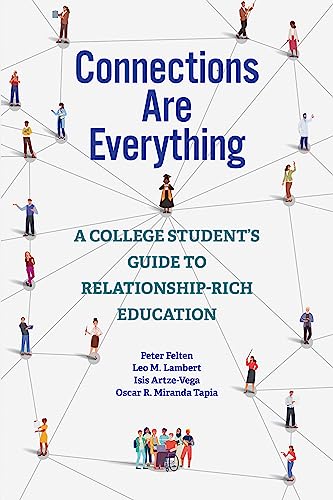
The Conversation article accompanies the publication of a book by many of the same authors (Felten, Lambert, Artze-Vega, and Tapia, 2023). Whhile titled "Connections Are Everything: A College Student's Guide to Relationship-Rich Education", I couldn't help thinking a better tile would be "Education for the Rich: Time to Make Connections to Stay Rich". That may sound harsh, but the advice given will be hard for a low SES student from a disadvantaged background to follow:

1. Talk to a professor

If there is a professor for 200 , or more students, exactly when and how long do you talk to them for? As a student if you focus is on passing, as quickly as possible, any interaction with staff has to focus on that. You need exemptions, and extensions. There is no time for an idle chat. 

2. Make a friend in class

University is a lonely, frightening experience, and not just for young undergraduates. As a graduate student I had a decade of experience teaching at a university, and was an adult, but even so the old nightmares about assessment returned, and I found I had little in common with the rest of the class. What helped me was where there were class activities devoted to meeting other studnts, and group projects. But even so study was still a frightening, agonizingly lonely experience.

3. Use the resources that are there for you

Universities do have staff and resources to support student learning. But unless you are introduced to these in a course, and told to use them, students are unlikely to do so. As a student you are focused on studying enough to do the assessment. So the use of these resources have to be built into your assessed coursework to be useful. An example of this is the Techlauncher program at the ANU. Rather than suggest students go to see a career councilor before they graduate, the councilor are brought into the classroom to teach the students. In conjunction with the councilors, academic staff administer assessment which requires students to look at what they have learned, and possible futures. This empowers the time poor student to do what would otherwise be an option extra-curricular activity, which they therefore would not do. I will be talking about this at EduTech 2023.

4. Participate in a ‘relationship accelerator’

Internships, undergraduate research, writing-intensive seminars, study abroad, and campus employment are all good, but only if they are for credit. If they are not compulsory, or provide credit to the student's degree, there is little point in providing them.

5. Connect with yourself

Imposter syndrome is a real thing at university. Telling students who feel anxious to talk to a professor will compound the problem, not solve it. Professors are not trained in student counselling, and likely to make the student more anxious, not less. The first step I suggest is to admit that study is a stress inducing experience, not the happy go lucky one depicted in university marketing. This is hard surprising as most of the staff the student interacts with are casual, or on short term contracts. The staff are constantly anxious about their jobs. What can be done is help students cope with the anxiety, or at least understand this is a normal part of the university experience.

Reference

Leo M. Lambert, Isis Artze-Vega, & Oscar Miranda Tapia. "Building relationships is key for first-year college students – here are 5 easy ways to meet new friends and mentors", The Conversation, August 11, 2023 10.37pm AES. 

Felten, P., Lambert, L. M., Artze-Vega, I., & Tapia, O. R. M. (2023). Connections Are Everything: A College Student's Guide to Relationship-Rich Education. JHU Press.

Monday, March 7, 2022

What we know about student evaluations is reassuring

Katharine Gelber
University of Queensland
In "What we now know about student evaluations is much more depressing than you thought", Katharine Gelber (University of Queensland), reports that research confirms a gender bias in Students Evaluations of Teaching (SETs). Their research was of University of Queensland student surveys over three years from 2015 (Gelber, Brennan,  Duriesmith, & Fenton, 2022). The good news is that the numeric scores did not show gender bias, but the text comments did. Male and female identifying students evaluated teachers in some stereotypical gendered ways. This means that SETs may be rewarding female and male staff for behaviours that conform to gender stereotypes. It also may mean that female and male staff are rewarded for behaviours that have differentiated impacts on the amount of time and energy they have available for other activities, including of course research. 

The author's conclusion is that "These results on student evaluations are only depressing if you thought they were an objective measure of teaching quality". But who in any service delivery industry would think a consumer survey is an objective measure? Like any consumer survey, the results will reflect the biases of those surveyed. That the quantitative results are consistent is a positive result, and should be enough to use the surveys as a early warning indicator of a problem with a course or teachers.

If the numbers for one course or teacher is very low, then there is a reason to check why. But sifting through what students write on surveys to decide if one teacher is slightly better than another is nuts. Also such a survey should have nothing to do with the amount of time a teacher spends teaching. They should spend the time needed to meet learning outcomes for students, which have nothing to do with a popularity poll. 


Reference

  1. Katharine Gelber, Katie Brennan, David Duriesmith & Ellyse Fenton (2022) Gendered mundanities: gender bias in student evaluations of teaching in political science, Australian Journal of Political Science, DOI: 10.1080/10361146.2022.2043241

Friday, July 16, 2021

Insights into the Student Experience in the Novel Life After Truth by Ceridwen Dovey

"Life After Truth", by Ceridwen Dovey
After reading "Life After Truth", by Ceridwen Dovey (2020) I understand a little better why North American students appear obsessed by Grade Point Averages (GPA). The novel is about a reunion of students at Harvard University. While fictional, Dovey studied at Harvard after completing school in Australia. The work ranges over the issues someone fifteen years out of university faces, in terms of life choices made, when confronted by those who made different choices at the reunion. At one point a character who decided to take a socially worthy, but low paying job, reflects on how top NY firms would headhunt Harvard graduates, based solely on their high GPAs. The novel is at times wistful about college life, at times savage about human vanities.

My experience of university is not quite on par with Dovey. But I did complete school in Australia and eventually studied in North America. My study was at a much less prestigious institution, but even so there seemed an unhealthy obsession with grades and GPAs. I understood I needed a specific minimum grade in each course to be able to graduate, but beyond that, what did it matter? Out in the real world, no one looks at grades you got in specific courses, they just check you have the appropriate qualification for the job. There are other measures of how good you are at some task. Perhaps it is different for recruiting by NY headhunters, but none of them is ever going to look at me anyway, so why worry?

But even now, today, during a pandemic and a North American heat wave, I am reading heart wrenching social media posts from students worrying about getting high grades. Why worry about this, when viruses, and the planet itself, is trying to kill you? Perhaps educators are at fault for part of this, by focusing students on grades. Perhaps I am guilty of that myself.

I recommend Dovey's "Life After Truth". But it does get a bit slow in the middle, with a bit more on child rearing and the problems of couples than I really wanted to know. Also the death of a character briefly mentioned at the beginning is too hastily resolved at the end.

I never went to university with anyone rich, famous, or infamous, as Dovey apparently has. I did not live on campus and was not part of a student club. For that I am grateful, as it all sounds an awful experience.

Thursday, April 13, 2017

The Australian Student Experience

The Australian Student Experience Survey 2016 has been published by the Australian Government on the Quality Indicators for Learning and Teaching (QILT) website. Overall the news is good, with a Teaching Quality rating of 81% overall. The result which the media has focused on is that the Group of Eight leading universities scored below average for student satisfaction. However, these are leading universities based on the quality of their research. If students want a better educational experience they should choose an institution which has education as the priority, not research. However, contrary to the advertising by universities, study is not fun, it is very hard work, stressful and frustrating.

One other finding is that the percentage of higher education students who considered dropping out is higher for External/Distance students is 17% higher than for other students (21% versus 18%). This is also not a surprise, as it is more difficult for distance students to remain engaged. But what is surprising is that overall at all times about one in five students are considering dropping out. Last month Dr Cathy Stone produced National Guidelines for Improving Student Outcomes in Online Learning. While intended for e-learning, these measures be applied to improving retention of on-campus students as well.

The reason for  41% of those considering withdrawing is health or stress. Course designers can assist this by reducing the stress caused, especially by assessment. I suggest the use of early and frequent progressive assessment.

A surprising result is the percentage of students with low grades who had considered quiting. The higher the grade the fewer students consider quitting. However, about 45% of students with a grade of 49% or lower consider quitting. This seems a low figure and I would have thought more students would consider withdrawing. While universities should have measures for retaining students, they should also be encouraged to withdraw where the course does not suit them.

Friday, March 3, 2017

Improving Student Success

Greetings from the National Convention Center in Canberra, where I am attending an "Improving Student Success" workshop, hosted by the  Learning and Teaching Support Unit, of the Australian Government Department of Education and Training. This is held in conjunction with the Universities Australia national conference.

The first speaker, Professor Deborah West, Charles Darwin University (CDU), discussed "Learning Analytics" (LA), that is carrying out an analysis of data about how students learn, usually from the learning management system. One issue was concern that the results of the LA would be used to replace staff with recommender systems, which automatically provide students with advice. It seemed to me that LA is only a small part of recommender systems, artificial intelligence (AI) can provide such systems using other techniques. Also many of the insights claimed for LA are already known by educators and part of routine teacher training. The problem is that academics are not trained to teach.

If conventional courses are being delivered, then there is little scope for use of LA after the course has been designed. As an example, if a problem with literacy is identified, then a course can be redesigned, and the prerequisites can be changed. However, once the course has started there is little that can be done.

One interesting point was that about 70% of CDU's student load is on-line, with 30% classroom based. This is close to my prediction for Australian universities generally, being 80% on-line by the end of the decade. Current Australasian universities are about 40% to 50% online (as most students not attending lectures for supposed face-to-face courses).

Professor West cited: Siemens, G., & Long, P. (2011). Penetrating the fog: Analytics in learning and education. EDUCAUSE review, 46(5), 30. Retrieved from https://net.educause.edu/ir/library/pdf/ERM1151.pdf

Next was Professor Sally Varnham, UTS, chaired a panel of students on the "Student Engagement Partnership" (TSEP) project. What I found lacking from th discussion was on-line student representation and integration into the curriculum. For the last five years I have been a part-time on-line postgraduate student. I felt disenfranchised as most actives and representation structures assumed I was on campus and had spare time to be engaged in extra-curricular activities. I was more than a thousand kilometers from the campus and when not studying I had paid work to do.

Next was Professor Karen Nelson, University of the Sunshine Coast, Queensland. Professor Nelson pointed out that research shows that even those students who do not complete a degree receive significant benefit from higher education. However, I suggest that those students would benefit more if the institution was to award them a sub-degree qualification.  Professor Nelson also pointed out that the usual parameters for students (full/part time, age, previous education and so on) accounts for only about 12% of the variation in student outcomes.

Professor Nelson pointed out that regional students are moving to capital city universities.  Yesterday an review into regional, rural and remote education was announced by the Australian Government. One way regional universities can compete, I suggest, is to provide quality on-line, vocationally relevant, VET articulated, nested programs.

The Australian Computer Society (ACS) announced yesterday the first advanced professional accreditation for an ICT degree, awarded to the University of Wollongong (UOW) Master of Information and Communication Technology (Advanced). The accreditation requires students to have skills in leadership and management,beyond what is expected in the usual degree. I suggest this will aid completion and engagement of students, as they will be working on work-relevant skills and realistic projects.

Associate Professor Sarah O'Shea, University of Wollongong, talked on first-in-family students. She pointed out this is an imprecise measure, however the research literature did have some useful pointers. Professor O'Shea, cited her research indicating that a large proportion of first in family students consider withdrawing. However, I would like to a statistical analysis to check that this is not a correlation, rather than a causal relationship. That is, it may be that first-in-family students have difficulties for the same reasons of disadvantage which prevented others in their family. If a family has not been wealthy enough in the past to support a university student, they are not likely to be able to do so in the future. Also it would seem that the Vocational Education and Training sector should provide a useful transition from school to university.

Professor O'Shea, quoted one student how felt an impostor at university and they did not really belong. This is curious as that is how I have always felt at university, even after teaching at one for eighteen years. As a graduate student I found it interesting to read the reflective portfolios of other mature students and find they felt the same. One of the things I learned being a student again was that I still was a student with all the usual fears, uncertainties and loneliness. 

O'Shea (2016) notes the "... students reported a sense of bewilderment in the initial weeks caused by fundamental institutional processes for example, enrollment procedures, financial requirements and timetabling". These are things which I struggled with, even as an experienced student studying how to design education programs. These are problems I suggest could be addressed partly by reassuring students that these are normal concerns common to students, but also by addressing these concerns.

Friday, March 4, 2016

Australian Universities Need to Learn from VET Sector to Improve Student Satisfaction

The 2015 Student Experience Survey National Report (QILT, 16 February 2016) shows no improvement in Australian University teaching over the previous year and a lower score than for US institutions. Australian higher education students scored the Quality of their entire educational experience at 80% for 2015, the same as 2014 (p. iv). This is much lower than for the USA and UK. I suggest that Australian universities need to learn from the VET sector the importance of trained teachers and systematic course design.

The survey includes Non-University Higher Education Institutions (NUHEIs), which are government TAFEs and private for-profit Registered Training Organizations (RTOs). Interestingly, the NUHEIs scored higher than universities on four out of five focus areas: Skills Development, Learner Engagement, Teaching Quality and Student Support. However, NUHEIs scored very much lower on the one other area, "Learning Resources" at 74%, compared to 86% for universities. This brought the NUHEIs overall score down to 78%, slightly lower than universities at 80% (p. v).

If universities were able to learn from NUHEIs, they could improve their student satisfaction above that of the USA and UK. Unfortunately university staff tend to not be able to accept that they can learn from TAFEs and private providers. This is most evident from the projects funded by the Office of Learning and Teaching (OLT), where funding is provided for universities to research areas of teaching. Unfortunately this "research" duplicates results already well know in the education literature and routinely applied in the vocational sector.

Wednesday, August 12, 2015

Viewbooks for Australian Universities

Apparently "viewbook" is the US term for: "a promotional booklet with pictures that is published by a college or university and used especially for recruiting students; also: an online version of such a booklet" (Merriam-Webster Dictionary, 2015).

It might be worth Australian universities having the word "viewbook" on their web pages, so that international students using US term can find it. Some Australian universities, such as UoW, do use the term. However, just using that term it could be confusing for students who are not familiar with it. I suggest including the term, but not making it too prominent.

I came across the term in a posting on an EDUCAUSE mailing list.

Tuesday, August 12, 2014

Nexus Notes Website Selling Lecture Notes

The website "Nexus Notes" is selling notes prepared by students about their university lectures. This is reported to have come in for criticism from New Zealand universities (Unis frown on note-sharing website as bright students cash in, Nicholas Jones, New Zealand Herald, Aug 12, 2014). But if the notes don't breech copyright and don't reveal the results of assessment questions, I can't see there is a problem.

I budget the amount of reading and other work I ask my students to do, to fit within the time allocated for the course. Also I provide them with notes (of about eight to ten pages a week) summarising the material. In addition I don't require they attend lectures. However, the assessment is designed to test their knowledge of the subject matter and if they have not done the readings and exercises, they are unlikely to be able to do the assessed work.

One problem is that some students are undertaking full time work and full time study at the same time. University courses are designed on the assumption that a full time student will spend around 40 hours per week on study. If the student also has a full time job, they will be unable to do the required study as well.

International students are limited by their student visa to working 40 hours per fortnight. The maximum weekly hours of work in Australia are 38. This would make for a working week, study and paid employment of 78 hours. Some Australian shift workers may work for 12 hours per day, seven days a week (84 hours a week). But these workers then receive the equivalent days off to reduce the total hours worked. The student's 78 hour week for 12 weeks of a semester would not meet Australian working conditions.

As a working student myself, the alternative I prefer is more terms per year, so I can do fewer courses at once. Australian universities have traditional had two semesters per year with long breaks. This would suit students who can find full time work in the breaks (this is allowed for international students). However, this would not suit students who have regular work. An alternative would be four terms per year, with minimal breaks. A student could then undertake just two courses at a time (20 hours a week) , allowing time for paid work. (Open Universities Australia uses this four term format. Some universities have special summer terms to add extra courses to their two semester format, but these are not seen as the norm.

Wednesday, May 21, 2014

First Year Student Expectations and Experiences

Greetings from the Australian National University in Canberra, where researchers are reporting on "First Year Student Expectations and Experiences". This was to address a problem where students have difficulty adjusting from school to university. Surveys were conducted of students at universities in South Australia. There is a detailed 77 page final report and other reports.

One of the questions the researchers asked students was if school prepared them for university. The responses were mixed on this, but there were students concerned that school did not prepare them for independent study. In my view it is not a very useful question to ask if schools prepare students for university. The question is do universities adequately cater for the students they get, whatever those student's background.

If school leavers are not ready for university, then one alternative is vocational Higher Education, at TAFEs and commercial Registered Training Organisations. These provide a more structured form of Higher Education, more like school, and  so can provide a transition to university. Interesting 4% of the survey respondents entered university from TAFE, but the researchers have not yet carried out analysis to see if these students coped better with university.

Currently I am a student of education research methods and it was interesting to hear the researchers say they were the qualitative ones and different members of the team did the quantitative analysis. Also it is good to hear terms such as "social constructivist approach to learning" used. ;-)

At the presentation we were handed a "Factsheet for New University Students" and "Factsheet for First Year University Teaching Staff", apparently produced as part of the project. I could not find these documents online and on paper they are of limited value. The Office of Learning and Teaching might like to put the documents online in an accessible format, so that they are widely available ans also so as to conform with Australian law.

The student fact sheet says students have an unrealistic expectation of the amount of work they have to do. However, perhaps this indicates an unrealistic expectation of the university teachers of the amount of work students will do. The fact sheet does not really seem to be much help, for example by saying students can expect to study 40 hours a week (they are already told this by the universities).

One comment at the workshop (I am not sure who said it) was that students could cope with 15 hours of working at a job in addition to their studies. This suggests a workload of 55 hours per week. This sounds excessive to me, being about a nine hour day, six days a week. International students are permitted to work up to 40 hours per fortnight, making a work week of 60 hours.


Under Australia law the maximum weekly hours for work are 38 and in the UK the maximum is 48. This suggest the study hours expected of a student, especially one also working, are unreasonable (and if this was a job they would be unlawful). I suggest it is time universities accept that there are very few real "full time" students, that is students who have no other commitments. Programs should be redesigned around a smaller, realistic number of hours per week. A reasonable number might be 30 hours study per week.

The teacher sheet is not a lot more useful, telling teachers that talking to university staff is important for students and that providing support to students who are struggling is important. This will already be known to any competent teacher (and is something they are told in teacher training). But these recommendations do not appear to be supported by the OLT research. Just by surveying first year students on their views will not show what effect teacher interaction has on retention.

The workshop participants were asked what a student needs to be successful at university. In my view students need study skills and literacy. We should require all students to enrol in a course to ensure they can read, write and plan work. In this we should require students to do group work, so they learn some skills and have a peer group to help them later.

One problem found was that many students had not made even on friend at university in their first year. A routine part of online courses is for students to introduce themselves. This is done due to the isolation online students can feel.  Perhaps the same needs to be done for face-to-face students.

While this research does not tell us much unexpected, it is useful to have the issue of how we can help first year students discussed more by university staff.

Thursday, December 12, 2013

Do Students Select a Unviersity Based on Rankings?


Last week I attended a conference in Sydney on the "Student Experience". Many Pro and Deputy Vice Chancellors spent two days discussing how to have happier students and increase experience rankings. But does any of this have an effect on which university the student chooses?

Torben Drewes and Christopher Michael, found that Canadan domestic students choose a university which is close to home, has scholarships and good teaching, extra-curricular student services and small classes. The found research activity put off students. But it is not clear if these also apply to international students.

Rahul Choudaha suggests that international students select which country to study in based on income of destination country.

Tuesday, December 10, 2013

ANU to Use Specialist Company to Prepare Students for University

The Australian National University (ANU) has   partnered with company Study Group to prepare students for university. The Australian newspaper reported the sale of "ANU College" to Study Group on 25 November 2013. The College offers two programs to help students meet university requirements. Courses are offered in Academic English, Computer Applications and six academic content subjects. This is primarily intended for international students. Courses are offered on the ANU campus in Canberra. However, I suggest that this form of preparation could be equally effectively be carried out on-line. Such courses would benefit domestic as well as international students. Recently I completed a short on-line familiarization course before commencing some students at a university in North America.

Thursday, December 5, 2013

University on Wheels

Greetings from the Inaugural Student Experience Conference in Sydney, where Professor Doug Hargreaves, Science and Engineering Faculty, QUT is speaking on "Enhancing the student experience through collaborative learning spaces".

Doug described how the new Engineering Studio and Teaching Space at Queensland University of Technology has the equipment on wheels. Gordon Howell, Manager Learning Environments Support at QUT showed me an early version of some of this equipment in 2009.

QUT has a room called "The Forum" (P419), intended for debates.This looks to me like an extravagant use of space with an inflexible design. What would be preferable is a standard, square, "TEAL room", with tables on on wheels and walls which can be projected or written on. The furniture could then be arranged to this forum format, when needed. But tables could be rearranged for group work, or a traditional lecture.

Addressing the needs of international students

Greetings from the Inaugural Student Experience Conference in Sydney, where Thomson Ch’ng, National President, Council of International Students Australia (CISA) is speaking on "Addressing the needs of international students to enhance their student experience". CISA was set up after in response to criticism of treatment of international students. There is a CISA Good Practice Program. One issue Thomson mentioned was the role of university agents, who help recruit international students.

Thomson pointed out that long induction presentations, with handouts, are not useful. It would seem to me obvious this should be "flipped", with the students getting the induction information on-line before they arrive and then just a question and answer when they arrive.

During this presentation it occurred to me that I am now an international student.I am enrolled in a course provided by a university in another country. Even thought I am not traveling to that country, there are some differences. One trivial difference is that my course is scheduled in what the university describes as "Winter 2014", even though for me it is high summer. While this is trivial, it would be good if the institution acknowledged its international students and used global terminology. More seriously, I don't exactly how large the course I have enrolled in is, as it is described in terms different to those used in Australian Higher Education.

Student leadership in curriculum development

Greetings from the Inaugural Student Experience Conference in Sydney, where Elizabeth Deane (UWS) is speaking on "Student leadership in curriculum development and reform". This is an Office of Learning and Teaching funded project, with La Trobe University, University of Queensland, University of Sydney, University of South Australia, University of Southern Queensland and, most interestingly, the National Union of Students.

It would seem to me that leadership skills would be part of any professional degree program. This could therefore be built into the programs. However, there would have to be a curriculum and qualified teachers.

Also before teaching university students outdated pre-Internet ways to run a university, I suggest new on-line techniques be looked at. I help organize events and run organizations with people who I hardly ever (or never) see. These use specialized on-line services and also more fluid forms of "un-conference" event.

Abstract

This project addresses a key issue in Higher Education: identifying and developing valid, productive roles for student leaders, particularly important in capitalising on the capacity of the student body to contribute to strategies for improving learning, teaching and curriculum. Phase 1 will investigate institutional governance and management frameworks supporting student involvement. This will entail documenting and critiquing student roles in education-related committees, a stocktake of models of student representation and policies, processes and approaches used to gather and use student feedback. Phase 2 will involve a survey of staff and students as to the validity and effectiveness of processes used to access the student voice and act on results, particularly in relation to curriculum development and reform. This survey will identify strategies and initiatives to ensure valid student leadership roles and develop case studies for the sector. Phase 3 will workshop the findings with experienced students and staff to establish effective student leadership framework(s) and validate key recommendations.

Improving the Student Experience Online


Greetings from the Inaugural Student Experience Conference in Sydney. After a day and a half of presentations from university personnel, Peter Rohan from Ernst & Young, is giving a refreshing business view of higher education (E&Y issued "Universityof the future: A thousand year old industry on the cusp of profound change" in 2012). He asked if investments, such as WiFi on campuses, actually is worth the cost. He suggests that providing feedback to students and taking an interest in them would better improve their experience. He also suggested the university look at what their students value.

My own experience as a student has been that at times a university may try too hard. I don;t mind a few surveys to find what I like. But at one stage I was getting a survey about every week from one university. I did not know which were important and which were not, but the surveys were detracting from my student experience, so each time I got one, I have the university a lower rating.

In my view Higher Education could usefully invest in on-line presence and in teaching skills. This not be an expensive exercise, compared to building new buildings and hiring new staff. A university is  inherently virtual, with the physical environment just to supplement the experience: it is about people and ideas.

An example of the ideas and people is when I visited Cambridge University Computer Labs. This institution is world famous for helping create the modern computer age, from building the world's second electronic computer to the world's first web cam. But when I visited the lab was in a crumbling old, cramped building (with a dinosaur skeleton in it). The old buildings are part of the Cambridge ethos (although on my next visit I found they had moved into a shiny new building next to Microsoft Research Labs). But it was the idea of the Lab which was important not the physical building.

Australasian Survey of Student Engagement

The Australian Council for Educational Research conducts the Australasian Survey of Student Engagement (AUSSE). This uses three surveys instruments Student Engagement Questionnaire (SEQ),  the Postgraduate Student Engagement Questionnaire (PSEQ), and Staff Student Engagement Questionnaire (SSEQ). Universities take such surveys very seriously, on the assumption that students tell the truth when filing in the survey and take notice of the results when selecting where to study.

Wednesday, December 4, 2013

Topping The Student Experience Survey

Greetings from the Inaugural Student Experience Conference in Sydney. Dr Richard Harvey, University of East Anglia, is speaking on his university's
Rise to the top of the The Student Experience Survey. University of East Anglia was established in the 1960s. Richard commented that the UK higher education system went wrong in the 1980s. In particular he criticized the national ranking of research, which forced some researchers into teaching. East Anglia is a center for climate changed research and was embroiled in controversy over "Climategate". He showed a university "league table" graph comparing his own university with the "Russell Group" (which appears to be the UK equivalent of Australia's Group of Eight, leading universities). He also showed the National Student Survey (NSS), Student Barometer and the Times Education Supplement Student Experience Survey. The survey I find of interest is the Webometrics, which ranks the quality of the university's web presence. The interesting point about the web rankings is that they correlate closely with other more general university rankings.

Richard looked at the NSS in detail. He pointed that that the criteria would not be welcomed by some at universities, as for example, library facilities are not a priority. He pointed out that scores for feedback on students were "remarkably poor" for UK institutions. He suggested universities needed at most a five day turnaround for student feedback.

Richard also pointed out that student satisfaction differs by discipline and nationality. He suggested that this needs to be addressed. But some effects are correlations, rather than causal relationships (such as graduate employment rate being caused by quality of courses, rather than a measure of it).

Richard commented that more attention needed to be paid to the postgraduate experience. I will speak on this a little in my presentation at 3:40pm on "MOOCs and the Student Experience" (see program for other speakers).

Sunday, December 1, 2013

Student Experience Conference in Sydney

My presentation notes for "MOOCs and the Student Experience" (and slides) for  the Inaugural Student Experience Conference (in Sydney, 4 December 2013 are available for comment. I would welcome suggestions for improvements, as well as comments.

Here is the latest program for the event:

Inaugural Student Experience Conference

4th and 5th December, Sydney

DAY ONE:

8.00 Registration and coffee
8.45 Welcome and speed networking session
9.00 Opening remarks from the Chair

INTERNATIONAL PERSPECTIVE

9.05 International Keynote: The University of East Anglia’s rise to the top of the THE Student Experience Survey, Dr Richard Harvey, Academic Director of Admissions and Internationalisation, The University of East Anglia
9.45 International Keynote: Undertaking initiatives to improve the student experience, Professor Bernie Morley, Pro Vice Chancellor (Learning and Teaching), The University of Bath (via video link)

THE EDUCATIONAL EXPERIENCE

10.25 Case Study: ANU - Improving the quality of the student experience, Professor Richard Baker, Pro Vice Chancellor (Student Experience), ANU
11.10 Morning Tea

THE BIG PICTURE

11.30 Students as customers: how far do we go in the name of ‘student satisfaction’?, Dr. Geoff Sharrock, Senior Lecturer, Melbourne Graduate School of Education, University of Melbourne

STUDENT EXPERIENCE IN THE DIGITAL ENVIRONMENT

12.10 Case Study: University of Adelaide – The Student e-Experience Strategy, Professor Denise Kirkpatrick, Pro Vice Chancellor (Student Experience), The University of Adelaide
12.50 Lunch
2.00 Case Study: Utilising innovative techniques to capture student voices in the creation of viable learning and teaching futures, James Williams, Project Manager, Swinburne University
2.40 Keeping pace with the technological change at the student and staff level, Luce De Buitleir Andrews, Director, Residential and Campus Communities, The Australian National University
3.20 Afternoon Tea

FLEXIBLE LEARNING EXPERIENCES

3.40 The role of MOOCs within the concept of blended learning and their impact on the student experience, Tom Worthington, The Higher Education Whisperer

CURRICULUM DESIGN

4.20 Case study: Curtin University – Chemistry Department: Placing the student learning experience at the centre of everything we do, Professor Simon Lewis, Director of Teaching and Learning, Department of Chemistry, Curtin University
5.00 Closing Remarks from the Chair
5.05 End of Day 1

DAY TWO:

8.00 Registration and coffee
8.46 Welcome and speed networking session
9.00 Opening remarks from the Chair,  Dr. Geoff Sharrock, Senior Lecturer, Melbourne Graduate School of Education, University of Melbourne

SHARED SERVICES

9.05 The student experience in a shared services environment. Dr Stephen Weller, Deputy Vice Chancellor (Administration) and COO, Australian Catholic University and President, Association for Tertiary Education Management

CASE STUDIES

9.45 Case Study: UTAS – Students as Change Agents 2014, Professor David Sadler, Deputy Vice Chancellor (Students and Education), University of
Tasmania
10.25 Case Study: USQ – Student Personalised Academic Road to Success (SPARS), Dr Megan Kek, Program Coordinator – Student Personalised Academic Road to Success, University of Southern Queensland
11.10 Morning Tea
11.30 University of the future – student of the future, Peter Rohan, Partner, Ernst & Young
12.10 Panel Discussion – Enhancing the interconnections between student services, course
delivery and technology: Peter Rohan, Partner, Ernst & Young; Professor Doug Hargreaves, Science and Engineering Faculty, QUT
12.50 Lunch
2.00 Case Study: Developing effective student leadership frameworks to greater enhance the student contribution toward the improvement learning, teaching and curriculum development, Professor Elizabeth Deane, Interim Head, Learning and Teaching Unit, University of Western Sydney

INTERNATIONAL STUDENTS

2.40 Addressing the needs of international students to enhance their student experience, Thomson Ch’ng, National President, Council of International Students Australia

PROVISION OF INFRASTRUCTURE

3.20 Case Study: Enhancing the student experience through collaborative learning spaces, Professor Doug Hargreaves, Science and Engineering Faculty, QUT
4.00 Closing remarks from the Chair
4.10 End of Conference

Tuesday, November 26, 2013

MOOCs and the Student Experience

My presentation notes for "MOOCs and the Student Experience" (and slides) for  the Inaugural Student Experience Conference (in Sydney, 4 December 2013 are available for comment. I would welcome suggestions for improvements, as well as comments.
  • The Student Experience
  • MOOCs
  • xMOOCs
  • cMOOCs
  • Open Content and Blended Learning
  • MOOCs Challenging the Student Experience

Saturday, November 23, 2013

Improving the Student Experience at University

In accepting an invitation to speak on MOOCs at the Inaugural Student Experience Conference (Sydney, 4 December 2013), I first had to work out what the "Student Experience" is. The conference announcement defines the "Student Experience" as: "Involves technology, student services and methods of course delivery.". It is suggested a good student experience can be a competitive advantage for an institution to attract students.

Enroll To Understand the Student Experience


I suggest the best way for academics and administrators to truly understand the student experience is to be a student. It is likely many years, or decades, since those making decisions at university were students themselves. Much has changed in the interim and time will have softened the memory of the student experience. It is necessary to do more than just sit in on a class, the enrollment and assessment processes are important to the student experience.

The Australian Education International (AEI) report "Enhancing the International Student Experience" provides the results of seven demonstration projects, focusing on four areas:
  1. Social engagement - effective strategies for improving the level and quality of interaction between domestic and international students both on and off campus;
  2. Career readiness – models for ensuring that the employability skills of international students are developed and improved on an ongoing basis through continuous learning and integration into the total study experience;
  3. Student support services – exploring how international students access information that affects health and lifestyle, and the relationship between self-perceived identity and social networks; and
  4. Orientation programs – innovative ways to use new technologies (such as social media) to more effectively disseminate information on the nature and availability of support services for international students.
From: Enhancing the International Student Experience, Australian Education International, 2012
While aimed at international students, I suggest these areas are also of issue for domestic students, particularly those from a different background to the traditional university student. It is not acceptable to assume that the typical student is domestic, on-campus, full time, without a disability, without family or community obligations and is a Christian.

Two Years and Three Higher Education Institutions


In 2011 the ANU strategic plan set the goal, that all new teaching staff will have completed an introductory teaching course by 2015 (ANU by 2020, Ian Young, Vice-Chancellor, ANU, August 2011). While I was not new to the ANU (or teaching), as an Adjunct I thought it prudent to take up the offer of a free course in teaching.

After completing the ANU's introductory teaching course I decided to go on and complete a Graduate Certificate in Higher Education. The courses were delivered in workshop mode, on campus, supplemented by use of the Moodle Learning Management System. However, as I was interested in e-learning I substituted two on-line courses at another Australian university, more than a thousand kilometers away. These courses were also delivered via Moodle. Then I was offered the opportunity to teach a vocational course run by a Registered Training Organization (RTO), which required a certificate IV in Training and Assessment. So I enrolled at a TAFE, which also used Moodle.

Being enrolled at three Australian higher education institutions in the same subject area, at the same time, using the same learning management system, allowed me to compare the student experience. At the same time I was teaching in a classroom and on-line for one university. Also I was part of a virtual faculty, offering professional education on-line directly and through a multi-university consortium.

Registering at On-line Is Easier Than On Campus


My first surprise as a multi-institution student was that it was easier to enroll at an institution set up for distance education than enroll locally on campus. A web based system which allowed me to enter questions about enrollment and receive answers by email was very useful. An integrated telephone help desk integrated with the web queries made this far superior to going into an office to ask a question over the counter. The telephone call center had my details on the screen, including past questions asked and so did not need to ask me to repeat my circumstances. Also the use of a web based form which could be saved when partly complete was very useful. This was far superior to filling in a PDF form, or a paper form.

On-line Student Support is Superior to On-campus

The Moodle systems of the institutions looked remarkably different. The systems had been customized and integrated into other university systems. In general I found the less customized the Moodle was, the better. Customizations tended to clutter the interface and slow it down, rather than helping.

As a student, most of the time my interaction with the institution was within a course and so within Moodle. What I typically wanted to know, was "What do I need to do next?", "When is the next assessment due?". Course materials which were not laid out in this task orientated way were frustrating to use.

Links to other university systems were integrated, to a greater or lesser extent. Some institutions did not use Moodle's assignment submission or grading system, which made submitting assignments and getting marks more difficult. Most did not use Moodle for individual student-to-teacher communication, instead relying on email, which resulted in important messages being lost amongst other mail.

Links to reading materials proved difficult. I found that many links to university library holdings of e-books and copies of articles, did not work. In many cases the links which did work had electronic documents which were unreadable, being poor scanned copies of paper originals or being burdened by copy protection schemes. I developed a routine of no using the offered electronic readings and instead searching for them on the web, or obtaining the documents on paper from local Canberra university libraries.

Asynchronous E-learning Very Effective With Well Prepared Materials


The routine of studying some prepared material on-line, reading some extra readings, doing an exercise and then discussing it in an on-line forum, worked well. However, this only worked when the material was carefully prepared and checked. Where the material was missing, or incorrect, the lack of intimidate access to the teacher caused confusion. I spent a considerable amount of time reading the wrong material and doing the wrong exercises as a result.

Face-to-face exercises were not without their problems, with unclear preparation instructions and a lack of follow-up. Well designed on-line activities tended to make me less tolerant of classroom problems. As a part-time student I found the requirement to attend face-to-face activities a problem, particularly where missing any one activity could result in my not passing the course.

Synchronous E-learning Did Not Work Most of the Time


While the asynchronous on-line forums worked well, I was mostly unable to get synchronous sessions to work. Where I was able to access synchronous forums, the participants spent so much time dealing with bandwidth and microphone problems that the conversation was very stilted. In this respect, face-to-face classroom sessions were superior. However, I suggest synchronous activities, on-line or in the classroom, should only be used as an optional supplement to asynchronous learning, or where they are essential to learning. Teachers and educational institutions need to understand the very large burden which compulsory attendance imposes on students.

Lack of Integration of Courses Caused Problems But Not Between Institutions


Both face-to-face and on-line courses suffered from the self-contained nature of course based programs. Even where courses were meant to be designed as part of a program, there was considerable overlap. Also the design of courses could be out of sync, with one course having been updated, but the companion course not, resulting in inconsistencies. One surprise was how well courses from different institutions and different systems of education (university and vocational) fitted together. I found no difficulty with moving from institution to institution in the same discipline, even between university and TAFE.

Too Many Surveys


Institutions are interested in the experience their students are having, but may be diminishing the quality of that experience through excessive surveys. Each institution I was enrolled in administered one survey per course and one per program. This seems reasonable, but then there were additional surveys for external independent bodies and ones for internal marketing purposes. This became annoying.

As a student it was difficult to distinguish what was an official survey and what was just a marketing exercise I could ignore. Also as a student I was reluctant to complete a survey about a course until it had ended. The result was that I would receive reminders to complete surveys and not know what they were for. In some cases reminders arrived weeks after I had completed surveys. This became so annoying that I decided to give the institution a progressively lower rating each time I was given another a survey to fill in. Institutions need to consider reducing the number of surveys.

Teachers Still Matter Most


While the administrative and on-line systems had an effect on my student experience, what was most important were the teachers. Regardless of if it was in a classroom, or on-line, what made for a good experience was a teacher who was competent in the subject, a competent teacher, were accessible and appeared to care about the students. All my teachers appeared competent in the subject matter, but what distinguished the good from bad was their teaching ability and particular their ability to communicate through technology.

What caused most frustration was teachers not making effective use of the available technology for communication. Forum postings and emails from teachers were often full of errors, cryptic abbreviation and incorrect links to non existent documents. At times I would receive unreadable handwritten materials, when the Learning Management System could have been used to deliver a readable typed document. Rather than use the communications built into the system, email was used, which would get lost.

Like most students, assessment is very important to me. It was therefore disappointing when not enough care seemed to have been put into assessment items, which contained out of date instructions. Also there was a tendency for marking to take weeks and be returned with excessive detailed feedback (which by then was useless). This was curious given that part of the content of the material being assessed was about the importance of rapid and concise feedback.

Structure and Flexibility Needed


Studying teaching at a leading research university, a teaching university and TAFE showed more common aspects than differences. As a student I found I appreciated the scaffolding which detailed course notes provided, especially when delivered via the learning management system. This was adaptable to the more narrow focus of a vocational institution or a research university. While an experienced computer professional and educator, I still needed step by step help with what it was I was learning.

Suggestions for Improving the Student Experience


The four areas identified in the AEI report "Enhancing the International Student Experience" are useful places to concentrate on for all students, domestic and international, on and off-campus:
  1. Social engagement: Programs to encourage interaction between students outside their courses should, like the courses themselves, be flipped and blended. As a part time mostly off-campus, student, I found it frustrating to receive invitations to events I could not attend. It was especially annoying to know that the compulsory multiple Student Services and Amenities Fees I was paying to the institutions were funding events I could not attend. While there were some attempts to provide on-line forums, these were not integrated into the mainstream events, as they should be.
  2. Career readiness: Higher education is for more than just a vocation, but employability is important. Course designers could do more to provide realistic assessment tasks. For me, two assessment tasks which stood out as being closely skills aligned were:
  3. Student support services: The support services should be "flipped", that is provided on-line and then face-to-face services offered to supplement this. There should be levels of support built into each course, program and university wide. Students do not necessarily know where to turn for help and the university should have one integrated system which can be used to pass their request to the correct area, without the student having to explain the problem each time. On-line system could also be used to monitor student's progress to see none are lost in the system, between course, program and institution responsibilities. It should not be acceptable to wait until the end of semester and discover a student has failed their courses before seeing if they need help. The on-line system should be able to detect a student who needs help, within a few hours, or days of a problem occurring.
  4. Orientation programs: Caution should be used in the use of external social media services for student support. While the ‘Teach by Twitter" strategy has been shown to be educationally effective (Enhancing Undergraduate Teaching and Feedback using Social Media – an Engineering Case Study, Ben Evans, 2013), it exposes the students and staff to risk. Information should first and primarily be provided via the university's systems, so the student can be assured of privacy and that they are really communicating with the institution. As a student I felt very vulnerable if I needed to use a non-university system for communication. Where the university used systems which were hosted in other countries, I had to keep in mind that anything I said in that forum was subject to the laws of that country and was potentially discoverable by the law enforcement agencies of that country.

ps: My journey in higher education has not ended, as I have now applied to undertake a Masters of Education in Distance Education, via distance education.