Showing posts with label pandemic. Show all posts

Tuesday, January 16, 2024

Design Education for Disadvantaged Students

Dr Neil Raven
Dr Neil Raven, a UK educational consultant has provided a useful analysis on the effect of the COVID-19 pandemic on the educational ambitions of young people from disadvantaged backgrounds (Raven, 2023). They talked to 14 teaching professionals from schools and colleges in the English disadvantaged areas. Raven concluded that the participation gap for higher education widened due to the pandemic. However, I suggest a problem with the analysis is that it focuses on how to get more students to attend existing forms of higher education not designed form them, not what is best for the students. 

Universities were unable to send staff to schools during the pandemic to recruit students. What Raven doesn't point out is that universities could, and should, have had alternative ways to interact with students. Just as universities could have had an online teaching option available before the pandemic, but most chose not to, they could have provided ways to reach out to school students online. That lack of care for students, I suggest, could be a useful indicator for future students. Those institutions having inflexible practices, may not be the best for students from disadvantaged backgrounds. These students will be more likely to need part time jobs, and have family care duties to attend to, so need flexible ways of learning. They therefore should choose a university, or VET institution, which provides flexibility, and does not require in-person attendance.

Raven also mentioned students’ concerns about moving away from home to study were made worse by the pandemic. This is a reasonable and rational concern of students. Rather than dismissing it, as an inconvenience for universities which have a campus based business model, I suggest it can be addressed by bringing the institution to the student. In addition Raven mentions the cost of higher education being a greater concern due to the pandemic making jobs less secure. Here again, the solution should not be trying to convince students that the cost is not a problem, but lower the debt burden on students, through lower fees, and options for part time work, with nested qualifications. 

Ironically Raven's research is published by the UK Open University, but the paper doesn't discuss the option of studnts from disadvantaged backgrounds studying at such institutions, which were specifically designed to overcome such disadvantage.

References

Raven, N. (2023). The impact of the pandemic on widening participation students: the teaching professionals’ perspective. Widening Participation and Lifelong Learning25(1), 99-124. DOI https://doi.org/10.5456/WPLL.25.1.99 

Saturday, August 8, 2020

Hacking the Virtual Hackerthon


Greeting from the Virtual Hackathon on Fighting Pandemics. This is organized by the Australian National University Humanitarian Innovation Society (ANU HISoc), with the Clinton Global Initiative University and IBM. We have had an introduction from the organizers at HISoc, and a design thinking workshop from IBM. I will be talking about better logistics at 2:15pm. The opening sessions used Remo Conference, and I am impressed that the organizers have been able to get it to work so well, but Remo needs improvements to be usable for education.

Remo Conference

Remo Conference
Remo Conference

Remo Conference (Version: 2.13.5) takes the "conference" part of video conferencing more literally than other products, with an interface which looks like a conference room floor plan. Participants can be pre-allocated to tables, with a tiny picture of them, labeled with their initials, around the table as if seated. Spare space at the table is indicated by empty chairs. Those at a table can see and hear each other with the video windows appearing at the top of the screen. Participants can move tables by double clicking on another. Some tables may be reserved for MCs and a help desk. The MC can call all participants to a presentation, at which point the table conversations shut down and a large window opens for the presenter. When in presentation mode Remo Conference looks much like any other webinar product, with a presentation window, chat, Q&A and Raise-Hand functions.

The room metaphor is a good idea, but Remo's implementation takes it a bit too literally. One problem is that when the participants arrive there is no sound and no welcome. I spent a lot of time trying to work out why my audio was not working, but it was just that no one was talking: we were all waiting for something to happen. It would be useful if there was some sort of avatar to show us to our seats and some sort of background hum of the crowd. 

Also the fixed room layout does not make best use of screen space. When at a table, having all other tables displayed is a waste of space. It would be better if the interface zoomed in. There is a text chat window, but I could not find a way to resize it, so it obscured things I wanted to see. However, the largest problem is the video does not work well on a slower link.

This is my fourth attempt to use Remo. The first two times I did not manage to see or hear anything. The third time it worked, sort of. This forth time it is usable, but only just. The problem is that like many video conferencing tools, Remo have assumed the user has high speed broadband. As a result on my low speed connection Remo barely works, at the best of times. This is unfortunate, as Zoom have shown this does not need to be the case: Zoom adjusts well for a lower speed link. In Zoom, if I make the window smaller the resolution of video reduces and with that the data transmitted. This doesn't happen with Remo. Even if I minimize the window, so no video is visible, Remo still uses more than 1 Mbps, whereas Zoom uses much less.

The video data use in Remo seems to vary depending on the resolution the video participant is transmitting. During this week's CBRIN First Wednesday, everything was working okay with Remo, until the MC appeared. At that point I saw a blurry closeup of their face frozen on screen. Then a pre-recored YouTube video started and worked fine, but before then end this was interrupted by the MC again as a huge still image. What appears to have been happening was that the MC was in HD video which my system could not cope with. The YouTube was low resolution and worked fine, but was interrupted by the HD again before it could finish playing.

All this discussion of low resolution may sound irrelevant to those with high speed broadband: why not just spend a few dollars and get decent broadband? I could do that as I am relatively well of, and live in a first-world city which pioneered fiber to the node decades ago. But many people can't afford, or can't get, high speed broadband. 

For-profit companies can simply ignore customers without high speed broadband, reasoning these people don't have enough money to be worth worrying about. As an educator, it would be unethical, and perhaps unlawful, to discriminate against students in this way. So when COVID-19 hit I decided to forgo the high speed broadband I had access to and instead make do with a high latency low speed 4G mobile broadband connection My connection works at around 1.5 Mbps, which is is part of the ANU Recommended student system requirements.

If a service doesn't work on low speed broadband, then some of my students, who are now scattered around the world, may not be able to use it. Although Remo recommends a minimum of 8 Mbps, it just about works at 1.5 Mbps. I suggest the developers implement video bandwidth adjustments, like those in Zoom, to make it usable for those who can't afford, or can't get, high speed broadband.

Friday, July 31, 2020

Better Logistics for Fighting Pandemics

Health Innovation Hackerthon
The Australian National University’s Humanitarian Innovation Society (ANU HISoc), along with the Clinton Global Initiative University and IBM are holding a virtual hackathon from August 8, 2020 on Fighting Pandemics.

Organized for and by students, teams will work on pandemic management with lessons from SARS, MERS, Ebola and COVID-19.

I am helping out with Track 2: Creating faster and more efficient resource allocation systems. Below are some notes I am preparing for the students. Suggestions, comments and contributions are welcome.

Track #2: Creating faster and more efficient resource allocation systems

"How can we better manage logistics so crucial personnel, medical supplies and equipment are quickly allocated to places where they are needed? " From ANU HISoc

Logistics

Modern warehouse with pallet rack
storage system
(Wikpedia, Axisadman / CC BY-SA)
"Logistics is generally the detailed organization and implementation of a complex operation. In a general business sense, logistics is the management of the flow of things between the point of origin and the point of consumption to meet the requirements of customers or corporations. The resources managed in logistics may include tangible goods such as materials, equipment, and supplies, as well as food and other consumable items. The logistics of physical items usually involves the integration of information flow, materials handling, production, packaging, inventory, transportation, warehousing, and often security. " From: Logistics, Wikipedia (2020, June 30).

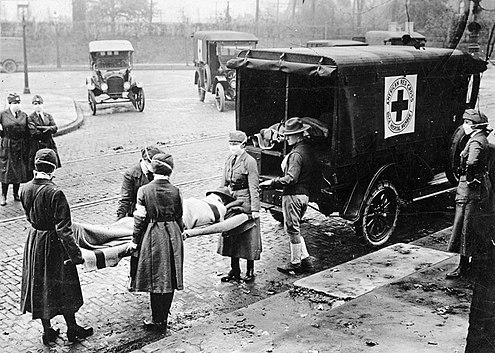
Pandemic

1918 Flu Victims St Louis
(Wikipedia, Uncredited photographer
for St. Louis Post Dispatch / Public domain)
'A pandemic (from Greek πᾶν, pan, "all" and δῆμος, demos, "people") is an epidemic of an infectious disease that has spread across a large region, for instance multiple continents or worldwide, affecting a substantial number of people.' From Pandemic, Wikipedia (2020, June 30).

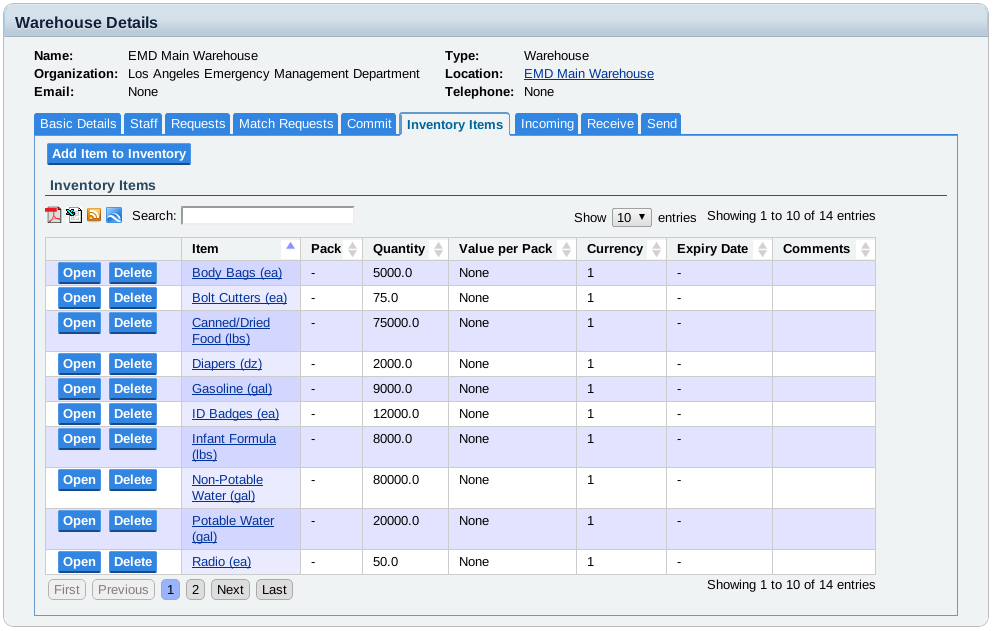
Sahana Disaster Management System

Warehouse Inventory Page fromSahana Eden (2014)
"Sahana is a Free and Open Source Disaster Management system that has been deployed with Gov, NGOs and Civil Society in enabling effective coordination and resource management particularly in a coordinated multi-agency response. The project has its inception during the Boxing Day Indian Ocean Tsunami of 2004 that required a large scale response effort bringing together multiple partners to help 500,000+ victims including displaced and injured in Sri Lanka." From Sahana Applicability for COVID-19, Wikipedia (2020, June 30).

Some questions for the hackerthon participants:

  1. Who are you helping manage the logistics?
  2. What is being managed (personnel, medical supplies and equipment)?
  3. How are places and need identified?
  4. How are resources allocated?

See also:

  1. E-government for emergencies: dealing with a bird flu pandemicusing the wireless web and podcasting, Tom Worthington, for CeBIT Australia, 9 May 2006, Sydney
  2. Sahana Meetup with Tom Worthington, Sri Lanka, 2013

Monday, January 27, 2020

Educational Institutions Could Offer Blended Learning in Response to Novel Coronavirus

NUS  eLearning Week Video, 2014
NUS eLearning Week Video, 2014
This is to suggest that Australian educational institutions be prepared to implement blended/e-learning, if some, or all, students are not able to attend campus, due to the Novel Coronavirus, bush-fires, or other natural disasters. In addition to allowing students to continue their study, this would have positive mental health benefits, allowing the students to keep in touch, and have something to keep them occupied. There is a precedent for this in Singapore's "e-Learning Week" (Chandran, 2010).

Australian universities, vocational educational institutions, colleges, and many secondary schools, already have e-learning tools used to supplement classroom teaching. However, teachers may need extra support for this, some administrative procedures may need to be changed, and institutions may need wavers for some legal requirements. In particular visa regulations limit the amount of e-learning international students can undertake, and the regulations assume students are in Australia.

Singapore e-­Learning Week


One public health measure for the 2003 SARS outbreak was the closure of educational institutions. In response, Singapore  Polytechnic, and the National University of Singapore (NUS) implemented an “e-­Learning  Week” (Chandran, 2010). This was designed to prepare the institutions for possible future closure due to quarantine, or other public health conditions. NUS mentions "severe haze" as one reason for closing a campus, which has occurred in Australia. NUS provided a short video, explaining the 2014 e-learning week.

Since the first e-learning week in 2006, the availability of tools, and the understanding of their use has increased. Teaching formats, such as the "flipped classroom" lend themselves to the provision of a blended mode of teaching which can become pure online delivery, if required. With this approach, there is no need for an abrupt change in teaching mode: those students who can get to class can have a class, those who can't use the online option.

eBook with Videos


Many teachers are reluctant to adopt e-learning due to the time it takes to prepare materials. However, research shows that slick broadcast-quality videos are not required. Students learn just as well with a video recorded by their teacher sitting at their desk on a $50 web camera, or no camera at all (as NUS points out). An approach I have used is to prepare an e-book of notes, and then produce videos from that using synthetic speech and slides. What is most important, as with a face-to-face classroom, is to have activities for the students, working together, and to provide them with feedback on how they are doing.

Victorian Educaiton Pandemic Plan


Victoria's Department of Education and Training has a Pandemic Influenza Incident Response Plan (2016), which includes in the containment strategy:
"If required, schools may be closed on advice of the Chief Health Officer, DHHS. In these circumstances:
  • inform teachers of their obligations during school closures 
  • for students at home, provide access to educational materials including online learning." (page 28)

However, the plan does not appear to have been tested.


 References


Chandran, R. (2010, May). National University of Singapore'sCampus-Wide ELearning Week. In Global Learn (pp. 2062-3302). Association for the Advancement of Computing in Education (AACE). URL https://cpb-us-w2.wpmucdn.com/blog.nus.edu.sg/dist/0/119/files/2011/03/national-university-of-singapores-campus-wide-elearning-week.pdf