Showing posts with label UK Open University. Show all posts

Monday, December 4, 2023

Being effective is authentic

Greetings from ASCILITE 2023 in Christchurch, where David White, Dean of Academic Strategy (Online) at University of the Arts London, and President of the Association of Learning Technology, is speaking on "Being effective isn’t authentic: Building digital education culture". So far I am finding the talk annoying. Like many speakers in the last few years he talked about how well educational institutions did switching to online education and how important this was. I have no problem with that, but online learning was not a new thing these institutions stumbled across. Institutions and individual spent decades working on e-learning, including for deployment in an emergency, including an epidemic. 

Something I agreed with more that university staff's ideal student is one who lives nearby (or on campus), attends, and structures their life around their studies. This is also not a new thing. Distance education has provided for students who can't get to campus, and want an education to improve their life, not a lifestyle. This was thoroughly explored with the founding of the Open University

David White suggested the wish of employers to have staff return to the office, and academics have students back was power, not efficient work or learning. I suggest it is not necessarily that Machiavellian, it is just that this is what they are used to. If you spent your formative years in meetings, or lectures, then that is all you know and trust. A few months forced online in had hoc arrangements is not necessarily going to change your views. In contrast I was trained, educated and mentored online, to teach online, so this seems normal and natural. 

David White  ended by suggesting thinking of universities as "Digital institutions that also own buildings". I suggesting dropping "digital", as the virtual university was possible, and existed in the age of paper mail. This was discussed, at length, in Robert M. Pirsig's "Zen and the Art of Motorcycle Maintenance". 

Sunday, August 23, 2020

Online Plus is the Post-COVID19 Future of Higher Education

Learning and teaching
reimagined
, JISC, 2020
The UK's JISC think-tank have put forward the hyflex plus university as a vision for Higher Educaiton after COVID-19. This would offer options of online study, on campus with work placements, or accelerated intensive on campus study. However, the campus options appear to be a marketing strategy designed to prop up a fading business model, rather than based on pedagogy. There is one model for the university of the future: online plus. This can include online accelerated and work placement options, plus optional on-campus study.

Students can be offered fully online, part-time study as the foundation of their university experience. There can be work placement included in this and accelerated options. Neither of these require attending, or living, on a campus, although that can also be offered. This online anchored form of HE is not some fantasy: in 2011 I set out to learn to teach, starting in a classroom 2 km from where I live, six years later I graduated from a university I had never seen, 13,586 km away.

Any university which adopts JISC's long term vision for 2030 is likely to be out of business before then. While I don't have JISC's committee to back up my predictions, in the last paragraph of the capstone for my MEd in 2016, I warned that universities should be prepared to teach online if students were kept away by a global crisis. Also I predicted that students would be studying 80% online by 2020. Those who planned an online contingency before 2020, as I did, had less difficulty with the transition this year. Those who build campus options onto this online foundation, I suggest, will prosper.

It doesn't make a lot of sense from an educational point of view to have students on campus all the time. Studying exclusively on campus in a face to face classroom would hinder completion of a degree, by excluding quality online learning and co-curricular learning opportunities off campus.

Living on a campus is a lifestyle choice, unrelated to the quality of education provided. Apart from restricting student's opportunity to learn real world skills, being restricted to a campus would severely limit employment opportunities.

This is not to say students should study entirely at home, isolated in front of a computer screen. Ideally students should be studying part time while in related employment, so they have supervision and support from working professionals. Also the student should have access to a face to face group of fellow students and, occasionally, an instructor. This does not need to be on the main campus where the student is enrolled, or a university campus at all.

Some students will require specialized equipment and environments, however, COVID-19 measures show that much of this can be provided outside the university, and much can be simulated online. Some professions which previously relied on face to face contact, such as medicine and the law, have shown that they can be provided partly online, making online training more feasible and more realistic.

There will be students wanting a campus lifestyle and prepared to pay extra for it. This can be provided in the same way luxury cars are now manufactured. Bentley is thought of as hand built UK premium brand. However, hand built cars are less reliable than robot made ones and the engineering needed for a modern vehicle cannot be amortized over a limited production run. So Bentley cars are based on mass produced designs from their parent company Volkswagen. Components made by robots in Germany are imported to the UK, assembled and hand finished. The result is a car which looks premium but is also safe, reliable and profitable. The same approach can be applied to education: start with a well designed curriculum of online learning which is delivered to hundreds of thousands of students world wide, then add a campus experience. The student can follow the same syllabus as those off-campus, but with the option of a face to face instructor. The educational outcomes will be no better on campus for the average student and so this option should not receive additional government subsides, but some students will still opt for it, just as some pay extra for a Volkswagen with a Bentley badge.

Another aspect of the motor vehicle industry which can be applied to higher education is brands for different regions. The engineering design underpinning the German made Volkswagen Golf is also used for the Spanish SEAT and Czech Škoda vehicles. Some universities and consortia take a similar approach, offering the same curriculum nationally, or worldwide under different institution brands. Torrens University Australia is based in Adelaide and accredited to award Australian degrees, but is part of the for-profit Laureate Education Inc. in Baltimore. Laureate has almost one million students worldwide and so can spread the cost of course development better than it could for just their 11,500 Australian students., while still having local campuses. Laureate has also incorporated several specialist campuses in Australia such as the Blue Mountains International Hotel Management School (BMIHMS).

Open Universities Australia (OUA) offers another model for the future university. This is a consortium of Australian universities which offers online degrees. Students can mix courses from the member universities, but graduate with a degree from one of them (not OUA). OUA students and courses are administered separately from the university's own students. However, the cooperation might be extended to allow regular students to enroll in online courses at member universities. This may require some changes to government regulations which restrict online courses for some students. Government might go further and require universities to allow and recognize such cross enrollment, but perhaps not to the extent of the vocational sector, where curricular are nationally standardized.

Reference

Learning and teaching reimagined, JISC, 11 August 2020, URL http://repository.jisc.ac.uk/7921/1/ltr-report-change-and-challenge-for-students-staff-and-leaders-aug-2020.pdf

Thursday, March 15, 2018

Australia's Largest University Hidden

In "Australia doesn’t have too many universities. Here’s why" (The Conversation, 15 March 2018), , Adjunct professor, RMIT University, compares enrollments of Australia, Canadian and UK universities. He concludes that the average Australian university has twice as many students as the UK and triple Canada. However, the distribution of students amongst students at Australian universities differs from Canada and the UK, and our largest institution does not appear in the lists.

Australia has an almost even spread of small, medium and large universities. Canada has many more small institutions and a few very large ones. The University of Toronto is about 50% larger than the next largest. The UK statistics are dominated by the Open University UK (OUUK). 

The closest Australian equivalent to the OUUK is Open Universities Australia (OUA). The students in the OUA consortium are usually hidden in the statistics of the member universities. If counted as a university, OUA would rival Melbourne as the largest in Australia.

As Gavin Moodie writes, a university with less than 10,000 students would have difficulty providing the range of teaching and research required. However, OUA provides an alternative model. Australia doesn't have to make a choice between small and large universities. Universities can cooperate to make better use of shared resources, while retaining an identity, local presence and brand.

Tuesday, June 20, 2017

Open University Going Digital by Design

The Open University UK (OUUK) has announced a "root and branch review of every aspect of its operations", with  "major savings and reinvestment plan" for a university "digital by design". The  Vice-Chancellor, Peter Horrocks, gets a poetic proposing to  “... transform the University of the Air ... to a University of the Cloud ...". But the media release "The Open University outlines plans for radical reinvention" (14 June 2017) is vague as to what exactly intended.

Athabasca University, Canada's open on-line university, recently released the results of an independent report into the institution's financial viability. In 2014 UBC released a Flexible Learning Strategic Vision. These, like OUUK, discuss addressing life long learning in a flexible way, but are vague on exactly how to do this and even vaguer on how to attract students to it.

OUUK was a pioneer in how to design and deliver cost-effective higher education programs. Most of the on-line programs of other institutions (and MOOCs) are an adaption of OUUK's approach. It will be interesting to see how, and if, OUUK can improve on its current techniques. It may be that this is not so much about how to design or deliver courses, so much as identifying what the student needs and getting just that to the student, when they need it (an approach emphasized in Vocational Education).

OUUK proposes to "to enhance its reputation as a world leader in lifelong and distance learning". However, I suggest this may make the situation worse, not better, driving away students, not attracting them. As the Athabasca report notes, many conventional universities are now offering on-line distance courses.

I suggest that OUUK, Athabasca, and similar open on-line institutions, have an image problem. Open and distance universities are seen as less prestigious than traditional campus based institutions. Students do not attend an open on-line university because they prefer it, they do so because they do not have a good alternative. By emphasizing lifelong and distance learning these institutions are making themselves less attractive to students.

Perhaps OUUK needs to adopt the marketing approach traditional universities are applying to their on-line courses: emphasize high academic standards and a traditional on-campus experience. As an example, MIT have experimented with on-line courses with optional attendance. Most students will never take up the optional attendance, but will be comforted it exists. Students do benefit from interaction with other students and with an instructor, but this need not be face-to-face, or on campus.

This on-campus dream/off-campus reality is similar to the way automotive companies market off-road vehicles to consumers who never drive them off-road. The companies know that their customers would be better off with a safer, more fuel efficient, lower cost family wagon, but that this is not attractive. The buyers know they are never really going to drive along a beach or across a desert, but the dream is very powerful. Similarly, the dream of attending an ox-bridge style campus is a powerful way to sell on-line courses.

Wednesday, January 18, 2017

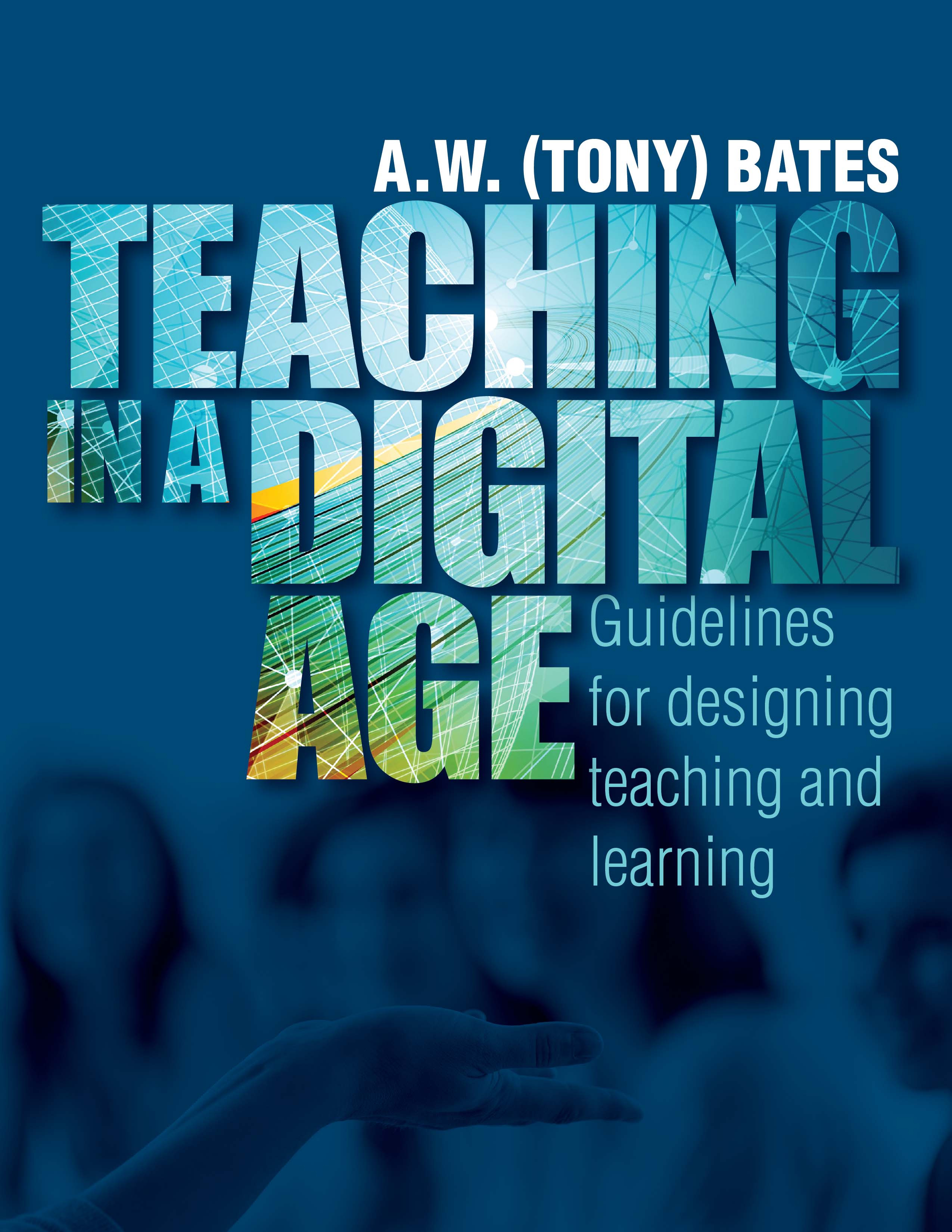
Teaching in a Digital Age

The book "Teaching in a Digital Age" by A.W. (Tony) Bates (2016, 528 pages) is an excellent free resource available on-line from the Canadian B.C. Open Textbook Project. This book is intended for college and university instructors who want to know how digital technology can help them teach.

The book is available a variety of electronic formats and three languages (English, French, and Vietnamese). Print editions of the book can be purchased, with a black and white edition at half the price of color (an option I have never seen before).

At 22 Mbytes, the PDF version is a bit large to expect a student to download just to read one chapter. However, the web version is divided into short sections and so would be useful for referencing as reading material in a course. It would be useful to have a PDF and EPUB edition which leaves out most of the images, which are only decorative but take up a lot of file space.

Each chapter is accompanied by a three-minute audio introduction by the author. This audio adds a useful personal touch and is not too long.

There is also a "Scenario" at the start of each chapter, setting out a hypothetical situation. However, these are only briefly referred to in the text of the chapters. In particular, I was disappointed that the scenarios were not used as part of the discussion questions contained in the chapters.

The first chapter (Fundamental Change in Education), looks at how universities and students are changing. There is perhaps a little too much of the author's views on the nature of education than is strictly necessary, but such a distinguished author can be allowed a little latitude.

It is important to realize that this is not just a book about online learning, but about teaching in general and where on-line learning fits in. Chapter 2 provides a reasonably conventional introduction to theories of learning. This is a part of teaching courses where my eyes (and I suspect of other students) glaze over. As noted in Chapter 3 (Methods of teaching), real world teaching does not fit neatly into these categories, and I suggest it might be better to reverse the usual order and first teach students the how and provide the theory of why later (moving this section to later in the book).

The book reflects the author's background in the UK and Canada. There is extensive use of reports from the OECD. This comes as a relief for someone like myself, a student of education who as had to read many works from US authors who do not seem to realize that the rest of the world exists.

While the book has extensive references and a bibliography, it does not have a reading list (which would be a useful addition to a course). A bigger the problem is that the book spends a little too much time arguing the case for digital learning (and in the case of MOOCs, arguing against them). A better approach, I suggest, would be to simply cover the different educational techniques, pointing out where and when they should be used, and why.

There is a danger in e-learning being seen as something new which a case has to be made for when it has been around for deaconess and is proven in day-to-day use.  The different techniques should be covered in proportion to how important the author thinks they are. As an example, I suggest that the order should be reversed, so that on-line teaching is covered first and lectures later.

Chapter 5 (MOOCs), spends a little too long on a case for or against MOOCs. In my view, MOOCs are not a new form of on-line education, just a way to promote conventional distance education. The MOOC label makes DE more palatable to prestigious research universities, which do not want to admit adopting educational techniques developed by teaching orientated institutions. Universities and others also use "Free" MOOCs to promote their for-fee programs.

Chapter 7 (Pedagogical differences between media), makes the important point that text still has a major role in education and that audio is useful. Something I find surprising is that most teachers (and students) think of recorded lectures and live webinars as being "video," when the mostly consist of audio with still images of text and graphics.

Chapter 8 (Choosing and using media in education) is largely redundant. Higher Education students today typically have a smartphone and a laptop computer, or tablet, or access to some other larger screen device. They have low-speed broadband Internet access. So the course designer should design for these tools. Some institutions (and educational systems) have wasted resources on equipping students with specialized hardware. In other cases, teachers refuse to make use of the IT the students have, for fear this will distract them from studying using paper books.

In Chapter 9 (Modes of delivery) presents evidence that on-line learning is at least as good as face-to-face. This case needs to be put. However, the chapter perpetuates the myth that on-campus learning depends on the direct face-to-face interaction between students and teachers. Most interaction on campus between students and teachers is mediated by technology. A student, at least an undergraduate or coursework graduate student, will rarely speak face to face with a professor. The student does not hear the professor's voice directly in a lecture theater; it is instead conveyed via a digital audio system. This is increasingly also the case in the labs replacing conventional lectures and tutorials.

In traditional labs and tutorials, the student would be able to see and hear the instructor directly. However,  the X-lab at the University of Sydney has up to 240 students at work benches, under the direction of one instructor. Each student is provided with a video screen so they can see the instructor, who can't easily be seen directly, due to the equipment in the lab. To make this point clearer, as a thought experiment, imagine the instructor being in another room, on the other side of the world: would the students notice? Would this make any difference to the quality of the education?

The book "Teaching in a Digital Age" is a very useful resource, but could do with some editing down and rearrange. As the book is provided with a Creative Commons license, I might try remixing it.

ps: I confess a fondness for Canadian educational work, having recently completed a Masters of Education at Athabasca University.

Teaching in a Digital Age 

Table of Contents

Chapters
  1. Fundamental Change in Education
  2. The nature of knowledge and the implications for teaching
  3. Methods of teaching: campus-focused
  4. Methods of teaching with an online focus
  5. MOOCs
  6. Understanding technology in education
  7. Pedagogical differences between media
  8. Choosing and using media in education: the SECTIONS model
  9. Modes of delivery
  10. Trends in open education
  11. Ensuring quality teaching in a digital age
  12. Supporting teachers and instructors in a digital age
Appendices
  1. Building an effective learning environment
  2. Questions to guide media selection and use
  3. Online learning quality standards, organisations and research
  4. Independent commissioned reviews

Saturday, August 13, 2016

Changing Attitudes to On-line Learning

Lowe, Mestel and  Williams (2016) report on attitudes of staff and students to on-line mathematics and computing courses at the UK Open University.  What makes this study unusual and useful, is that it was conducted over five years, to see how attitudes have changed.
The researchers conclude that what has not changed is students  prefer face-to-face classes, if these available.  On-line tutorials are an acceptable alternative, but "... could be made more engaging and more interaction could be encouraged" and  better training for tutors is suggested. Text-chat has become less popular, as have webcams. The researchers suggest that Skype and Facetime have increased student expectations as to what is provided.
However, the researchers caution that live webinars "often becomes more of a one-way lecture". But students also wanted access to recording of live sessions. The recordings are obviously not interactive (until someone builds a time shifted learning system). 

The researchers recommend:
  1. "Distance-learning courses should include the use of eSessions to support students; however, they should be used as a supplement to, not as a replacement for, face-to-face sessions.
  2. Developers of virtual classrooms should include better support for the communication of mathematics and other symbolically-rich disciplines.
  3. Developers of virtual classrooms should better consider the needs of disabled users in future designs of their software.
  4. Future studies of this nature should consider the demographics and the backgrounds of students surveyed, including prior experiences of synchronous Internet communication tools.
  5. Where appropriate to the content, eSessions should be recorded, subject to obtaining the permission of all participants. In general such recordings should be kept for a maximum of 2 years. Participants should be given advanced notice of the possible uses to which the recordings might be put.
  6. For large student groups, it may be more effective to record shorter eSessions without students present rather than to record a live tutorial.
  7. Tutors leading eSessions should share best practice in the use of virtual classrooms."
Many of these are familiar from introductory courses on how to design e-learning. The use of live sessions to support courses is what distance education has been doing for a hundred years. The support of non-text disciplines, such as mathematics is still a work in progress. Disabled users should be considered in educational software design, not the least because this is the law, but regrettably are not.

Providing short pre-recorded studio sessions is a form of flipped classroom. The idea being the student watches the recording and then participates in live group work.


The background of students is an issue not just for researchers, but also for educational institutions, for both on-line and face-to-face courses. One approach has been to offer short, free or low cost, study preparation courses. One example is North Shore Community College's "Online Learning 101". Some Australian courses are: "Preparing for University Learning" (OUA), "Learning Online" (UTAS) and "Preparing for Success" (SCU).  However, do such courses better prepare students, or just filter out students before they can enroll in a full program? This would improve the institution's completion statistics, but not necessarly help the students.

Reference

Lowe, T., Mestel, B., & Williams, G. (2016). Perceptions of online tutorials for distance learning in mathematics and computing. Research In Learning Technology, 24. doi:http://dx.doi.org/10.3402/rlt.v24.30630

Friday, August 12, 2016

Improve Student Retention in Australian On-line Higher education

Dr Cathy Stone, a Fellow at the National Centre for Student Equity in Higher Education, dropped in this week to talk about how student retention could be improved for on-line students. On-line courses provide access to education for students who would otherwise be excluded. However, like paper-based distance education courses which preceded them, on-line courses have a lower completion rate than face-to-face courses.

Cathy is and is undertaking research for "
improving student transition, participation and success in online higher education". She has visited Open University UK (OUUK), as well as University of New England (UNE),  and other Australian on-line institutions.  I pointed out to Cathy that some of the techniques later used by OUUK were developed in Australia at UNE.

While focusing on students from specific backgrounds undertaking on-line education the same techniques for helping these students can help students more generally. Some techniques suggested in Cathy's latest bulletin are to welcome the students, post regular bulletins and follow up missing students. These and other techniques are now incorporated into training for educators, but regrettably many academics do not receive this training and fewer implement it.

Cahty is currently in Canberra and is keen to talk to educators about improving on-line education.

Monday, March 16, 2015

Environmental impact e-learning much lower than campus

In looking for some papers for my ICT Sustainability students to read, I came across "Designing low carbon higher education systems: Environmental impacts of campus and distance learning systems" by Roy, Potter and Yarrow at Open University UK (2007). They, not surprisingly, found that Distance Education uses about 65% less energy (and correspondingly lower carbon emissions) than campus-based courses. But they found e-learning only produced a modest 20% energy reduction over print-based courses, as students tended to print out the e-learning materials. It would be interesting to see if this still applies in 2015, with student more used to electronic documents and having mode potable devices to read them on.

Tuesday, March 10, 2015

Online Degrees Are Official

Edmon de Haro writes in the New York Times that "... information technology is poised to transform college degrees" ("Online Degrees That Are Seen as Official", 5 March 2015). However, this happened about twenty years ago, when paper-based correspondence distance education evolved into e-learning, at places such as Open University UK (OU) and University of New England Australia. Up until recently the teaching institutions which offered on-line degrees  posed no threat to prestige research universities, but the likes of Harvard, Stanford and M.I.T. are now scrambling to catch up by offering "MOOCs" (which is a Canadian term).

Walter Perry, first Vice-Chancellor of OU detailed  the struggle for acceptance, lessons learned in supporting remote students and the transformation to on-line education in his 1976 book "The Open University: History and Evaluation of a Dynamic Innovation in Higher Education". OU also published a series of books about how to design, run and cost on-line courses.

For the last four years I have been an on-line university student at institutions in Australia and North America. The courses I am doing about how to design on-line courses are not new and in some cases have been run for more than a decade. It is at times amusing, and times frustrating, to see MOOC developers at prestige research universities learning to designed e-learning courses by trial and error, when they could simply sign up for a course and learn to do it properly.

There seems to be at times a willful ignorance, as if to read the results of decades of research on on-line education would force MOOC developers to admit that most of what they are doing is not new. In some cases this seems to be a matter of ego: a science professor at a high status research university can't bring themselves to enroll in a teaching course at a low status college (where the best on-line teaching is done).

The problem now is not how to design low cost courses, we have known that for decades, or how to assemble them into degree programs. The problem is how to market such courses, without them being seen as a cheap and second rate option. It is in this area which MOOC proponents have made some advances, by taking the on-line eduction already routinely run by teaching institutions and giving it the marketing gloss of prestige research universities.

While the USA struggles with how to produce a viable on-line education system, Australia already has a solution, combining the strengths of our two higher education systems: Vocational Education and Training (VET) and universities. Several Australian universities now have arrangements with VET. Students do bridging and introductory units at VET before transferring to university. This way VET gets students (and some of the prestige of university) and the university gets students educated at low cost and well. The university also gets the benefit of VET's nationally standardized courses and recognition of prior learning procedures. Unfortunate this system is under threat from a few rogue VET operators (not associated with universities) who are exploiting the students and threatening the reputation of the sector.

Sunday, April 13, 2014

MOOC Designers Relearning Decades of Distance Education Lessons

studying online can induce a sense of isolation (I experience this being an international distance education student myself). But this is nothing new: forty years ago the UK Open University found the students were spontaneously creating their own local study groups. This was then formalised.

Online university routinely organise local groups in their own satellite campuses and those of affiliated institutions. This happens all over the world (in Sri Lanka last year I saw campuses of the Open University of Sri Lanka in several cities).

It is a little disingenuous for MOOC creators to pretend they invented the idea, as this is something any student of distance education learns (hopefully some of the MOOC designers have formally studied the discipline of distance education). It is a shame that MOOC designers do not acknowledge this heritage and build on it.

Thursday, February 27, 2014

Designing courses for higher education

Susan Toohey's book "Designing Courses For Higher Education" was published in 1999, but is very relevant to today's debates over issues such as the role of MOOCs, support for international students and professional masters courses. This book is part of the excellent series published by Open University Press, on the how and why of higher education. The book is very readable, having been written for the Australian context. It contains some comments to deflate the egos of professors and senior administrators clinging to old modes of education, such as:
  • "Many teachers in higher education work in departmental environments that are quite hostile to good teaching and where little thought goes into the design of the curriculum." (page1).
  • on the cost of producing web based web based educational content : "Packages may be relatively expensive to produce, but probably less so than building more lecture halls". (Page 119)
  • In support of the use of print, video and computer based materials: "There doesn't seem to be much point any longer in bringing students together in mass lecture halls to supply them with information." (page 120).
The pressures for change evident in 1999 are still present for HE in 2014: more international students, increasing demands for accountability to government, more emphasis on vocational work ready skills and limited resources. Toohey details the opportunities of the Internet and the world wide web could improve education, which unfortunately as yet to be embraced by much of Australian higher education, a decade later.

ps: It happens I met Susan Toohey, months before I discovered she had anything to do with higher education, or had written a book on the topic.

Tuesday, January 28, 2014

eAssessment with Moodle from the UK Open University

In "eAssessment with Moodle" the UK Open University has produced a short set of examples of how quiz questions can be set and in many cases automatically answered, using the Moodle Learning Management System. There are options beyond the usual multiple choice questions, in particular I like the use of numeric answers. With this you can ask the students to calculate a value, but with each student getting different figures to work from. The figures they get are randomly generated from a range you specify. As an example, I could ask students to calculate the Carbon Dioxide Equivalent emissions from a given amount of electricity used and emissions factor (with a few extra erroneous parameters thrown in to confuse the unprepared).

Saturday, September 21, 2013

Remove Barriers to Australian On-line Universities

Professor Barber, Vice Chancellor of the University of New England (UNE), is reported to be suggesting changes to regulations to make it easier to set up new Australian on-line universities. Rather than create new on-line only, teaching only universities in Australia, I suggest that the barriers which separate distance/on-campus, full-time/part-time, coursework/research should be removed for all higher education. All students and universities should be funded and treated the same. A university might decide to specialize in one area, such as on-line education: there should be no special rules to prevent this and no need for special rules to encourage it. Current rules should be "flipped" so that part-time, on-line, life long, multi-institution learning, incorporating coursework and experience/research is assumed the norm. This would still allow for less common full-time, on-campus intensive programs, specializing in coursework or research.

It is not clear what Professor Barber thinks is holding up creation of an Australian on-line only university, or why UNE could not simply expand its on-line offering to satisfy the perceived demand.

UNE was a pioneer in distance education, with its "Armidale model of Distance Education", being adopted by the UK Open University (UKOU). The UKOU received very generous special funding from the UK Government to be established, but then went through the same registration process as other universities. If there are barriers to on-line unviersites in Australia, these should be removed. But the spcial access to resources which UKOU received (including special access to a BBC TV channel) should not now be needed, due to the much lower cost and ubiquity of communications technology.

Australia previously had Colleges of Advanced Education (CAEs), which were teaching only institutions, offering courses at an educational level above those of Technical and Further Education (TAFE), but below unviersites. In the mid 1990s the CAEs became new universities, or campuses of existing ones. As universities the former CAEs are required to carry out research as well as teach.

New Australian Government's Position on Online Education

The Prime Minister, Mr. Tony Abbott, then leader of the federal opposition, made an Address to Universities Australia Higher Education Conference in Canberra, 28 February 2013. He started by referring to his studies at Oxford University and his time boxing there (but did not mention Oxford has been offering on-line courses since at least 2009).  Mr Abbott expressed a wish for Australian universities to take advantage of online learning and Massive Open Online Courses (MOOCs), however no funding or other support was proposed for this. A Coalition Online Higher Education Working Group, was formed to look at how "... online technology improve existing campus-based teaching with all the benefits of interaction, in the classroom and beyond...". In response to an e-mail request from the working group chair (Alan Tudge MP, now Parliamentary Secretary to the Prime Minister), I prepared a responses to the online higher education topics, suggesting:
  1. Online learning will be integrated into most university courses, with blended learning (on-line plus classroom), using the "flipped classroom" model being  the norm
  2. Online learning is lower cost when used with large volumes of students. However, this requires a high initial investment in course design and highly trained staff. Most Australian university academics are not currently qualified to design or deliver on-line courses.
  3. Global choice of online courses will be limited by accreditation requirements. There is likely to be a flood of poor quality, unaccredited courses. 
  4. Online learning allows for learning while employed and in remote areas. However, being a student is still hard work and requires considerable amounts of time. 
  5. Institutions will require staff to be retrained in online pedagogy and use of technology. This retraining can make use of online technology and a stepwise approach.
  6. Online learning can enhance quality and standards through more detailed and frequent monitoring. However, measures to prevent cheating by students will need to be enhanced. Also teaching staff and students will require explicit training in how to communicate online.
  7. The learning technology already being introduced to universities and vocational institutions can be ungraded for larger scale use. In particular, Australia is a world leader in learning management systems, by virtue of the locally developed Moodle system, which could be enhanced.
  8. Current accreditation processes for domestic courses will require minor modification for online courses. International accreditation will require government or industry agreements. Work by the Australian Computer Society in accrediting global professional qualifications can serve as a model.
  9.  Governments can assist Australian providers by removing barriers which prevent online courses from being undertaken by students. Government can also set an example by allowing their own staff to undertake online courses and teach in them. As an example, the online engagement courses proposed by the Department of Finance for all Australian Public Servants could be delivered online by Australian tertiary institutions.
  10. Australian institutions can be encouraged to join international partnerships for online course creation.  
  11. Visa restrictions which limit International students undertaking online courses should be relaxed. Currently an international student is expected to be on campus for about three quarters of a full time course. This should be reduced to one quarter.
  12. Australian experience suggests that all university courses will be delivered at least in part online, with the typical student spending about 25% of their time in a face-to-face class and 75% online. Undergraduate degrees will have more face to face components, and  postgraduate courses less. This will result in a drop in Australian students on campus, but allow for millions more online from our region.  
  13. With most education online, Australian and international students will be able to choose courses from anywhere in the world. Retaining a proportion of the Australian students and capturing part of the international market will require maintaining Australia's very high standards for accreditation. A national course recognition program, so students can combine courses from multiple Australian universities, would be useful to promote "Brand Australia". The Australian government can also fund Australian academics to reach out to the region.
  14. Australian universities are already reconfiguring their campuses with accommodation and "learning commons" to suit the new blended learning. Campuses are being redesigned to be pleasant places to be, not just study.
  15. No specific regulatory barriers exist, with online courses being covered by existing regulations on education. However, it would be useful for the Australian Government to advance bilateral and multilateral agreements on mutual recognition of educational standards. Support to professional bodies to advance standards for disciplines would also be of assistance.


Open Universities Australia


Australia has Open Universities Australia (OUA) delivering on-line courses. This is a consortium of Australian unviersites (some of which were previously CAEs). The OUA courses are delivered by the individual institutions and while the student can select from courses across several institutions, their degree is awarded by one and they have to meet the requirements of that university. OUA has introduced some short MOOC-like free open courses, but most of the on-line offerings are conventional ones in the format pioneered by UKOU.

OUA also has non-university bodies offering courses, including the Australian Computer Society (ACS). OUA offers the ACS course "Green ICT Strategies", which I designed (also run by ANU as ICT Sustainability and Athabasca University Canada as COMP 635).

Creating low cost education-only universities would in effect re-establish the CAE system. While universities promote the benefits of research informing their teaching, in practice there is little connection between the research conducted by advanced degree students and the coursework of graduate and undergraduate students. However, I suggest it would be better to reconnect research and education, rather than further separate the two.

Blend Separation of Coursework and Research


Australia has a bifurcated system, where advanced students enroll in either a coursework/professional or research degrees. The coursework/professional students are seen to be the exception, with pure research being the main product of the university. This division is enforced by government funding which pays for research degrees separately and more generously.

In my view this separation of coursework and research is harmful to the education of all students and holds back innovation. A better approach would be to have all students enroll in the same program, undertake initial coursework and the decide the mix of research and coursework. Government funding should not discourage professional masters and doctorates, as while these may have a smaller component of original research, what they do have is likely to be applied for economic and community benefit much sooner.

Assume Students Have a Life Outside University


Another useful reform to education would be to abolish the divisions between full time, part time, distance and on-campus students. Currently government and university rules favor full-time on-campus students. Universities assume a normal student is on campus and has no work or family commitments, and then makes exceptions for others. However, most students are working part time or have family commitments (or both) and can't be on campus all day, every day.

I suggest government regulations and university procedures should be flipped, so the average student is assumed to be distance, part time. The average student would be assumed not to be able to get to something at a set time on campus. Educational materials would be provided in a format suitable for distance mode, except where this is not possible.

This approach is analogous to the change in the way disabled students are catered for. In the past students were assumed to not have a disability and special arrangements would be made for those with a disability. However, most people have some disability at some time in their life and so the law now requires educational institutions to allow for this. Australian law requires educational offerings to be designed for those with a disability, except where this is not feasible. A university which simply waits for disabled students to ask for special access is acting unlawfully.

Education for Life


Another reform would be to encourage students to undertake education at multiple university and over extended periods.  At present it is possible, but difficult, to incorporate education from multiple universities. Government policies also make it difficult for students to study over extended periods. The system assumes the student will be at one university and do nothing but their degree and makes it very difficult for most potential students where this is not the case.

As an example, last year I undertook a Graduate Certificate in Higher Education at ANU. As I was interested in on-line distance teaching techniques, my supervisor agreed it would be useful to incorporate two on-line courses from University of Southern Queensland (USQ). The process of cross institutional enrollment proved prohibitively complex (on my reading of the rules it appeared impossible, as I was required to get the approval from each institution before the other). To bypass the problem enrolled as a professional studies student, bypassing the cross-institutional procedures and paying the full fee.

As an student at two institutions I was required to have two different student numbers and to pay two Student Services and Amenities fees  (one for a campus I have never seen). I was then required to pay extra for a printed transcript from one institution to present to the other to have my results credited.

An better approach would have Australian students issued with one student identifier for all higher education institutions, electronic results and an exemption from paying more than one Student Services and Amenities fee.

Another way that the realities could be recognized would be foAr institutions to allow  students to undertake further studies to build on their existing qualifications. Many Australian universities allow multiple exit points from higher degrees (Graduate Certificate, Diploma, Masters, Doctorate). But this is less common with undergraduate programs. Also articulation into a program is usually only allowed from the same university and same program.

The Australian Vocational Education and Training (VET) sector has standards applying to institutions which allow students more flexibility. However, these standards limit the freedom of each institution and are less appropriate for universities. After completing the GCHE, I obtained the equivalent Certificate IV in Training and Assessment, so as to teach in the VET sector. Some of the features of the VET process could be applied to universities, but many could not.

Australian Higher Education is Competing with the World

Australian universities value their autonomy and freedom from government regulation. However, they need to understand they are competing in a world market, not just for international students, but increasingly for domestic students. If Australian universities do not offer students the flexibility they need, then those students can enroll in universites elsewhere.

Changes to allow for more flexibility for domestic students will also help Australian universities to compete internationally. As an example, after completing my Graduate Certificate in Higher Education, I wanted to study and research the field further. However, the choice of programs in Australia is limited and restrictive, so I am looking to study on-line overseas.

Thursday, September 19, 2013

eLearning in the Developing World

Continuing my browsing of the shelves of the ADFA Library, I came across "Reconsidering Open and Distance Learning in the Developing World: Meeting Students' Learning Needs"  by David Kember (Routledge, 2007). This traces the development of distance university education in developing nations, especially as it relates to the UK Open University Model. This is very much a personal account with the author having experience in education in Hong Kong, Australia, Papua New Guinea, Fuji and the UK. While written in the relatively early days of Internet education, the principles are still very applicable today's MOOCs. The University of the South Pacific provides an interesting model, being an institution run in cooperation by twelve nations, spread across a significant portion of the world. Many will find it surprising that the model of distance education made world famous by Open University UK was largely derived from what is called the "Armidale model" at University of New England, Australia. The experience of the University of South Africa, with an unsuccessful attempt at placing computers in schools for distance education, provides a lessen in the risks of technological optimism.

Friday, September 6, 2013

Preparing Materials for Open, Distance and Flexible Learning

The book "Preparing Materials for Open, Distance and Flexible Learning" (by Derek Rowntree, is another of the excellent series of books from the UK Open University on the mechanics of delivering higher education.While first published in the early 1990s, the techniques described are still applicable for today's Internet based education, as well as being of benefit for classroom teaching. Rowntree goes through the steps of planning, writing and rewriting materials for education, giving numerous examples. In the glamor of smart-phones, tablets and phablets, it is important to remember that education still relies on having good content, designed and delivered by people who know about teaching.

Thursday, August 29, 2013

Costs and Economics of Open and Distance Learning

Greville Rumble's "The Costs and Economics of Open and Distance Learning" (Routledge, 1997) was written in the early days of Internet based education, but is applicable to today's MOOCs. At the time the book was written, Rumble was a planning manager at UK's Open University (OU). This experience shows in the books non-nonsense analysis of the cost of design and delivery of large scale distance education.

Rumble first provides a gentle introduction to budgets, costing, the effect of volume on cost, attribution and activity costing. Academics might ask what any of this has to do with their design and delivery of education, but resources for education are always limited and so it helps to plan for their use.

Rumble then discusses costing the design of courses, comparing traditional face-to-face courses with distance education. While this was written at the dawn of the Internet age, where dial-up modems were new hot technology, the concepts and approach are still relevant. The central point of distance education, including today's MOOCs, are that you need a large number of students to make them cost effective. The materials must be designed carefully, most likely by a team of people and then tested.

Rumble discusses the cost of developing text versus multimedia (audio, video). Open University was conceived as being reliant on broadcast TV, with full professional program making by the BBC. But the point is made that the production quality of the video makes no difference to the educational outcomes. High quality professional video production does not help the students learn any better (although I suggest it may influence their perception of the quality of the course).

Surprisingly, given OU's comprehensive approach to course material design, Rumble suggests that simple conversion of face-to-face courses is cost and educationally effective. This involves conversion of lecture notes into a booklet and recording of lectures on video.

One area Rumble does not explore at length is the cost of assessment. This is a significant part of any course and teaching techniques which use progressive assessment preclude it being simply relegated to an examination at the end.

Academics do not need to know all the detail of costing courses, particularly not the equations presented in this book. But the general principles should be part of the basic training of all of those who design university courses.

Many institutions pioneers of distance education are mentioned by Rumble. Some which caught my attention are Athabasca University (which offers my Green IT course), University College of Southern Queensland, which is now the University of Southern Queensland (I was an online higher education student there last year) and Indira Gandhi Open University (which I was presented with a tie from by Professor Uma Kanjilal, Director of the School of Social Sciences, INGOU on a visit to ANU).

Opportunities for Academic Librarians with MOOCs

Cameron Barnes' paper "MOOCs: The Challenges for Academic Librarians", (Australian Academic & Research Libraries, 1 Aug 2013) provides a useful checklist of issues raised with Massive Open On-line Courses (MOOCs) for academic librarians.  As Barnes points out, MOOC have no formal entrance requirements, are free, delivered on-line and have thousands of students. But the issues MOOCs raise are not new and have been addressed by universities offering online courses (and distance education on paper before that) for decades.

Recently I have been working my way through some of the books written about the UK Open University decades ago, which I found while wandering down the shelves at the ADAF library. All the issues brought up by MOOCs, to do with courses with no formal entrance requirements, low cost, students with disability, copyright clearance  and having tens of thousands of students are covered there

Wednesday, August 21, 2013

Waiting for the Penny to Drop on MOOCs

In "MOOCs vended learning" (Higher Education section, The Australian newspaper, 21 Aug 2013), e-learning innovator Gilly Salmon uses vending machines as an analogy for Massive Open On-line Courses (MOOCs). Like vending machines, MOOCs provide a prepackaged low cost convenient product (in this case education). She points out that it is not clear if the small samples of education offered with MOOCs will induce students to sign up for a full program.

I don't agree with Salmon's assertion that that MOOCs are a "disrupter to the 1000-year history of university education". It is the e-learning techniques which Salmon helped pioneer which is causing that disruption. MOOCs are just a re-packaging of those techniques. Many of the issues around mass higher education were debated and systematized by the UK Open University, 40 years ago.

The current fuss over MOOCs reminds me of the DOT.COM bubble of the turn of the last century. People from the IT industry and business would rush up and breathlessly ask if I has seen this new technology called "The Web", just invented by a company in the USA. I would try to patiently explain the web was from a European physics lab, invented by an Englishman, and I had been producing web pages since 1994. The person would usually not hear what I was saying and rush off to tell someone else about this new invention the web, from the USA. Most DOT.COM companies went out of business when the bubble burst and the same is likely to happen with MOOCs. Hopefully most of the failures will be private companies with risk capital, but some may be public universities.

To extend Salmon's vending machine analogy, we should wait for the penny to drop and it is realized that MOOCs are not a miracle answer to education.

Thursday, August 15, 2013

Lessons for MOOCs from the Open University

Recently I was browsing the shelves of the education section of the Australian Defence Force Academy Library (ADFA) in Canberra. I came across the book "The Open University: History and Evaluation of a Dynamic Innovation in Higher Education" by Walter Perry (1976, also published in the UK as "Open University: A Personal Account by The First Vice-Chancellor", Open University Press, 1988).

Perry was the first Vice Chancellor of the UK Open University, which was originally to be called "University of the Air". The university set out to provide a low cost education, with no academic limit on entry, using the information technology of its day (broadcast TV). Debates over completion rates and educational standards were essentially the same as those now about MOOCs.

Over the decades, the Open University evolved an approach to education, which later incorporated the use of the Internet. I was trained in a evolved version of that approach to on-line education, used by the Australian Computer Society for teaching masters level professionals and attended on-line courses in a similar technique used by the University of Southern Queensland. I now use at the Australian National University and get good results (with student feedback scores of 5 out of 5 for satisfaction with the course).  I stopped teaching in a classroom in 2009 and now regard on-line education as routine.

What I find surprising is that much of the current debate over MOOCs has not been informed by decades of research and experience with on-line courses. The debate should not be about if MOOCs are better than classrooms, but what is the value of this new, and slightly different form, of on-line distance education.

Perry mentions several distance education institutions as having helped shaped Open University. These include University of South Africa, at the time the largest distance education university in the western world. Also mentioned is the University of New England, in Armidale, Australia.

Perry's book provides a fascinating first hand account of the top-down creation of a university.  Rather than dealing with the minute detail of courses, it starts with the idea, the political debate and securing funding. Chapter 3 "Early Problems" has a two page PERT Chart, showing the interrelationships between the tasks needed to set up the university. Some tasks, such as building facilities and hiring staff, have a long lead time and had to be started while the details of what was to be done was still unclear. The book progresses to discussion of degree structures, course creation, accreditation, what might be the student demand and distribution of materials.

Looking back from the 21st century, some of the challenges of the OU seem irrelevant. As OU had to produce materials on paper and post them to thousands of students. Use of computers was in its infancy and the idea of supplying all the course material on line was a distant possibility. Video materials were produced by professional BBC TV staff, edited using reel-to-reel videotape and distributed by broadcast TV or film (no computer editing or downloading).

Some challenges of distance education (and education generally) have not changed. OU required a team approach to the creation of quality course materials and a long lead time for development and testing. Being able to distribute materials on-line has cut some weeks off the production process for distance education, but developing courses still takes considerable time and effort, which is not understood by educators used to ad-hoc live lectures.

The issue of credit exemptions is one which remains alive today. Universities remain reluctant to grant credit for courses undertaken elsewhere. The issue of recognition of prior learning remains contentious for the more elite universities.

Funding of courses remains a perennial issue for universities. OU's budget depended on economies of scale from large numbers of students using standardized materials and this is one of the ideas which todays MOOCs are based on.

What I find curious is that while I have been learning and teaching e-learning for several years, there has been little mention of the Open University's experience. On the shelf next to Perry's work there were several other books from Open University authors about the development of courses. One which caught my attention was on the costing of courses, an important topic which was not addressed in any of the higher education courses I have undertaken.