Showing posts with label digital certificate. Show all posts

Monday, September 25, 2023

National Skills Passport Doesn't Need $9M Consultation: Just Get On With It

Tom Worthington's
digital ANU certificate,
Copyright ANU 2013
The Australian Government has announced consultation on a National Skills Passport. This is a teaser, from an Employment White Paper due out tomorrow. The government proposes to spend $9M on a business case and consultation. A Skills Passport is a good idea, and one which higher education has been working on, in Australia and around the world. There are some minor technical issues, but the major challenge is acceptance. The ANU provided me with an electronic version of my Graduate Certificate, but Athabasca University did not accept this when I applied to study there (I had to pay ANU to courier a paper copy). Fortunately Athabasca now provides electronic certificates provided by a consortium of Canadian universities (so presumably accepts them). 

It would be useful for the federal government to consult with employees, employers, educators, and other governments. However, this is not something new. It should be well within the capabilities of government staff, and should not cost $9M to do. Instead I suggest the money be spent on building the system.

Friday, July 21, 2023

Canadian Digital University Transcript Less Useful Than Australian Ones

Athabasca University offered a digital version of my MEd transcript. This is not as useful as the one issued to me by ANU. That has both the testamur, and transcript. The former is the fancy looking certificate you hang on the wall, the latter is the details of your course results. Athabasca just provides the transcript electronically, and so somewhere you are applying to might still ask for a genuine paper copy of the former, negating most of the value in having an electronic transcript. Also the company Athabasca have contracted to provide the electronic service charges $10 Canadian per year for access, whereas the company ANU uses charges nothing.

The Canadian transcripts are provided by MyCreds, which is owned by the Association of Registrars of the Universities and Colleges of Canada (ARUCC).  

Saturday, June 29, 2019

Digital Credentials Initiative from EdEx Universites

A consortium of universities is proposing a common standard for  digital credentials for degrees, professional certificates and online course.  There have been many such proposals, but Delft, Harvard, MIT, UC Berkeley, and  University of Toronto, have a tack record in tech based education with EdEx, which might make this proposals more viable.

A digital credential could use public key infrastructure, public ledgers, and blockchain to be technically secure, but it also has to be accepted. Some years ago I was delighted to be issued with a digital certificate, for graduate studies by a leading Australian university. But when I applied to study in North America, the digital certificate was not accepted, and I had to pay to have a paper copy certified and sent by courier. This was all a bit silly, as I could have easily faked the paper certificate.

However, the biggest challenge for Australian universities which  take part in such standardized credential activities is how it cuts across their existing business model. Australian universities use their reputation for excellence, particularly in research, to attract students.  They also use degree programs to retain students. If students can shop around, selecting courses from different institutions, and selecting where to study based on the quality of the education offered, that will require Australian universities to change what they do.

It might be argued that the overall improvement in quality will be good for everyone: "a rising tide will lift all boats". But this might be more like a tsunami: smashing the unprepared. ;-)

Saturday, August 22, 2015

Universities Can and Should Educate for Employment

Stefan Popenici, Senior Lecturer at University of Melbourne argues that "Universities can’t, and shouldn’t, educate to suit employers" (The Conversation, 12

Friday, April 3, 2015

Digital Certificates to Stop Fake Degrees

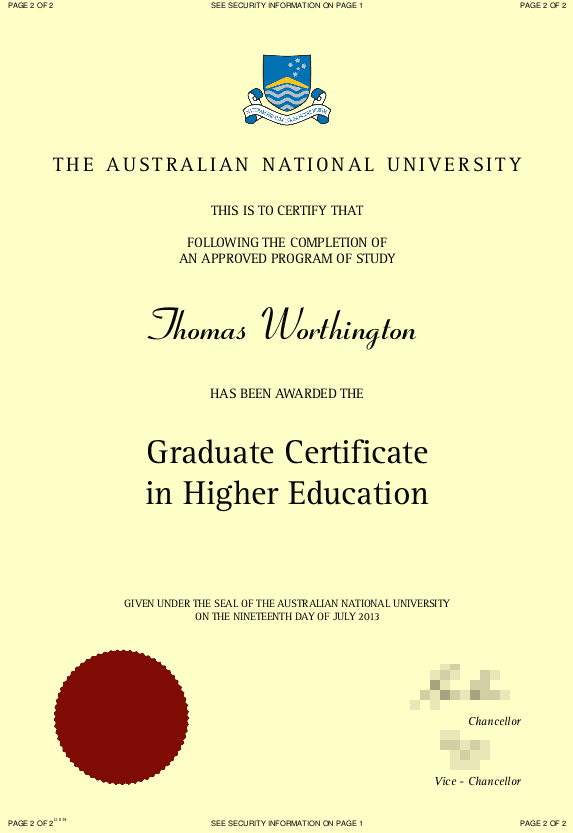
Thomas (Tom) Worthington's Graduate Certificate in Higher Education from the Australian National University (ANU) 19 July 2013. Please note that the signatures and some other details have been obscured for security
Media reports indicate that sophisticated fakes are being sold of Australian university degrees, complete with university seals. There is no easy way to make an unforgeable paper document. A much more secure approach is to issue certified digital documents, as ANU now does. Shown is my my ANU Graduate Certificate in Higher Education (at low resolution and with the signatures blurred, so as not to help the forgers).

The ANU certificates are distributed through  the Digitary service, which was a spin-off of Dublin City University. Instead of providing a certified paper copy or a scan of it, students can provide a hypertext link to the document in the on-line service. Copies printed from the service have instructions on them of how to verify the details.

Saturday, August 31, 2013

Digitally Certified University Certificates

Thomas (Tom) Worthington's Graduate Certificate in Higher Education from the Australian National University (ANU) 19 July 2013. Please note that the signatures and some other details have been obscured for security. Original at: https://certifieddocs.anu.edu.au/verifier/servlet/DocumentVerifierApp/template/VerifyDAT.vm?datid=uabywlqxl1
The Australian National University now issues Certified digital documents, to graduates. Provided in electronic form  are the academic transcript, Australian Higher Education Graduation Statement (AHEGS) and testamur. These are provided at no charge to the students (in contrast, USQ charges a fee for paper transcripts and provide no electronic certificates).

One of the problems for students and university administrators alike is producing certificates, transcripts and other evidence of study. Paper documents are easily forged and despite anti-copy features I find that laser printed copies of university certificates often look more genuine than the originals. One solution is digital certificates verified on-line.

The ANU certificates are distributed through  the Digitary service, which was a spin-off of Dublin City University. Instead of providing a certified paper copy or a scan of it, students can provide a hypertext link to the document in the on-line service. Copies printed from the service have instructions on them of how to verify the details.

This is a much more secure and convenient system, than trying to verify a paper copy of a document, or a facsimile of it. A university can provide such a service directly, via its own web site, but using a service shared by other universities (including the University of Cambridge and the London School of Economics) increases the credibility of the documents.

In practice the system has a few problems. There are several weeks delay between graduation and the documents being provided on-line. Also there is no notification to the students that the documents are available, they have to keep checking the system. Given that a student is likely to want to make us of their qualifications for applying for positions immediately, this delay would be frustrating and result in much of the value of the system being negated.

The student uses their university user-id and password to access the Digitary system, via the university website. The student has control over who can access their documents. They can choose to have open access, limit access to users registered with the Digitary system or only a specific email address. Also the access can be set to expire after a specified period (default is 90 days). For limited access, Digitary sends an email to the recipient with details of how to get the document.

The documents when "printed" is a PDF file consisting of a cover sheet explaining the digital security process, followed by a facsimile of the university's printed certificates. By emulating the printed certificate, the reader of the electronic version will feel more comfortable. However, there is nothing on the facsimile (or the paper original) to aid verification. It would be preferable if all the certificates included a URL (and perhaps a machine readable QR Code) which could be used to verify the document. Also a photograph of the student, would be useful.

One problem is that my email system warned the message Digitary sent may be Spam. The company might want to reformat its messages so they do not look suspicious.

So as to demonstrate the system, I have set open access for my ANU Graduate Certificate in Higher Education (for the next 90 days). There seemed to be no harm in making this document public as the fact that I received a qualification from the university is not something I want to hide. However, the details of my marks for specific subjects is something I may not want to make so readily available.