Showing posts with label Blockchain. Show all posts

Saturday, January 23, 2021

Blockchain to Stop Academic Plagiarism

Professor Rory McGreal, who taught me open educational resources (OER) at Athabasca University, has proposed the use of blockchain for their dissemination. While most OER are free and authors are happy to see their work widely, they still want to be acknowledged for their work. 

The Creative Commons licenses, commonly used for open materials, all have a "by attribution" requirement: "... the original creator (and any other nominated parties) must be credited and the source linked to". However, this is only a legal and moral requirement, the technology doesn't enforce it. Professor McGreal proposes to go a step further and use a blockchain to securely record who first created the work, and all the changes made and by whom. 

While technically feasible, using block chain would throw up some challenges. As an example, nothing can ever be deleted from the blockchain, so if there was something which was incorrect, or harmful, or illegal, it would be there in perpetuity.

The idea of using blockchain in academia might have other uses. Recently I have been considering how students could record their progress with assessed work, such as assignments. One problem is to find an easy way for students to record what they did, but not be able to falsify the record. I have been looking at using some form of electronic logbook stored on the educational institution's system, so the student can't tamper with it. An alternative would be a blockchain.

Reference

McGreal, Rory. (January 20, 2021) How blockchain could help the world meet the UN’s global goals in higher The Conversation. URL https://theconversation.com/how-blockchain-could-help-the-world-meet-the-uns-global-goals-in-higher-education-152885

Friday, March 6, 2020

Open Discussion Session on Media Blockchain in Sydney with JPEG

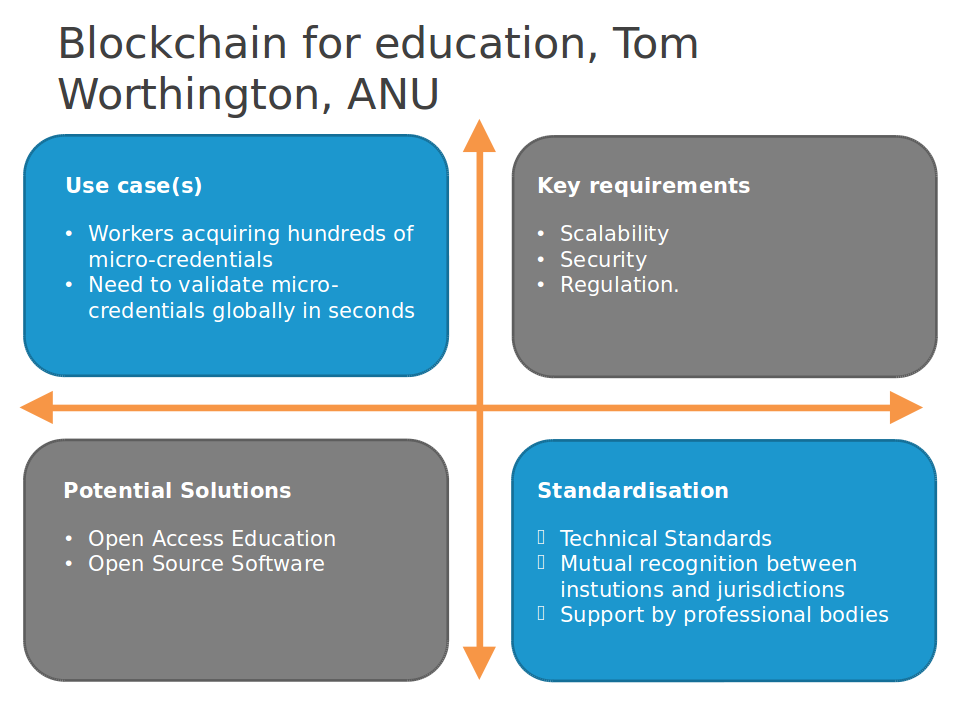
Quad-chart for Blockchain for education
Few realize that JPEG is not just a series of technical standards for images, but also a group of people. The "EG" is for "Experts Group" and I had the pleasure of giving a presentation to the group, when they were in Sydney last month. This was an "Open Discussion Session on Media Blockchain". I talked on "Blockchain for education" Also  Dr Sabrina Caldwell, from ANU presented.

We were all asked to provide a one page quad chart on blockchain. The presentation slides are available.

Thursday, January 30, 2020

Blockchain Law Conference in Canberra 27 February

Professor Sjef van Erp
The Australian National University is hosting a free conference on "Blockchain Technology, Data Management and Smart Contracts", in Canberra, Thursday 27 February 2020.
"Blockchain and smart contracts are technological developments with significant implications for private law transactions in a range of areas. Blockchain or ‘distributed ledger technology’ (DLT) is already being used in the financial services sector and has great potential in a range of areas including land registration systems and global supply chains. These technologies also raise questions concerning data management, data protection, adjudication and dispute settlement."

Speakers

  • Professor Sjef van Erp
  • Dr Phillipa Ryan
  • Matthew Baldwin
  • Hannah Glass
  • Karen Cohen
  • Katrina Donaghy
  • Scott Chamberlain
  • Samuel Brooks
  • Dr Damian Clifford
  • Rajiv Cabraal

Tuesday, January 21, 2020

Blockchain for Education

Dr Sabrina Caldwell
Greetings from the University of Technology Sydney, where I am taking part in a workshop with members of the International Standards Organization's Joint Photographic Experts Group (better known as "JPEG"), on the use of blockchain. There are image processing experts from around the world, including my colleague Dr Sabrina Caldwell, from ANU.

We were each asked to provide a one page quad chart on blockchain. I am not an expert in JPEG or Blockchain and feel a little out of my depth in this company. So I will stick to an application for education.

Blockchain for education

1. Use case(s)

  • Workers acquiring hundreds of micro-credentials
  • Need to validate micro-credentials globally in seconds

2. Key requirements

  • Scalability
  • Security
  • Regulation

 3. Potential Solutions


  • Open Access Education
  • Open Source Software 

4. Standardisation

  • Technical Standards
  • Mutual recognition between instutions and jurisdictions
  • Support by professional bodies 
 Notes

The Australian National University introduced Micro-credentials procedures in October 2019 (Worthington, 2019).

During their career a worker may acquire hundreds of micro-credentials. These would need to be validated before the worker could undertake a specific job, or task. With the gig-economy, this may need to be done several times a day in seconds, in a country away from where the credentials were issued. This will require a system which can scale for billions of workers, securely, and be recognized by governments around the world. Blockchain implementation of micro-credentials could be aided by open source software for implementation, and open access education to teach its use.

The report, Blockchain Challenges for Australia (ACS, 2019), listed micro-credentials as a potential application for blockchain, requiring low computational power, a high volume of data storage and users,  but low throughput (ACS, p 22, 2019).

References
ps: GovTech Singapore developed OpenCerts in cooperation with the OpenCerts Consortium.

Sunday, November 24, 2019

Blockchain Skills

The Australian Computer Society (ACS) is one of the bodies supporting work on blockchain in Australia. ACS uses the Skills Framework for the Information Age (SFIA). Skills for Blockchain, Distributed Ledger Technology, and Smart Contracts, have been requested for the next version of SFIA (Version 8). But this is up to the SFIA Foundation based in the UK. The Foundation is reasonably responsive: I asked for ICT Sustainability skills to be added and got them. 

In terms of vocational skills standards for blockchain, Australia already has an Advanced Diploma of Applied Blockchain (10747NAT).  There are nine blockchain specific course modules for this:

BLKPER010 - Analyse performance of a business model deployed on a blockchainAnalyse performance of a business model deployed on a blockchain Current
BLKSMC004 - Create trust and activate a blockchain with smart contractsCreate trust and activate a blockchain with smart contracts Current
BLKDBM002 - Develop a blockchain business modelDevelop a blockchain business model Current
BLKERE008 - Develop a blockchain governance model for stewardshipDevelop a blockchain governance model for stewardship Current
BLKFRS003 - Develop a blockchain network functional requirements specificationDevelop a blockchain network functional requirements specification Current
BLKOBN005 - Develop a framework for operating a blockchain networkDevelop a framework for operating a blockchain network Current
BLKEBF001 - Establish a blockchain framework for decentralised peer to peer consensus and innovationEstablish a blockchain framework for decentralised peer to peer consensus and innovation Current
BLKRFB009 - Lead recruitment strategy for blockchain projectsLead recruitment strategy for blockchain projects Current
BLKTBO007 - Prepare the organisation for transitioning operations to a blockchain networkPrepare the organisation for transitioning operations to a blockchain network Current
 

Monday, October 14, 2019

Blockchain Roadmap

Greetings from the Department of Innovation, Industry and Science in Canberra, where I am attending The Inaugural Blockchain Australia National Meetup Roadshow. There are about sixty people present, mostly lawyers in dark suits. I am here as a member of the ACS Blockchain Technical committee. My aim was to mention the ACS' reports on blockchain, but the first speaker has already mentioned them.
  1. Blockchain Innovation: A Patent Analytics Report by IP Australia
  2. Blockchain 2030: A Look at the Future of Blockchain in Australia.by CSIRO
  3. Blockchain Challenges for Australia  by the ACS Blockchain Technical Committee (I suggested to the section on blockchain for education)
We are having discussions around the tables and contributing via an app.  I have suggested there is a barrier to blockchain use through the lack of IT professionals trained in its use. This creates an opportunity for Australia to provide training and qualifications on blockchain to the world.

Two speakers mentioned the idea of a Blockchain Cooperative Research Center (CRC). I don't think this is a good idea. Blockchain is moving so fast it needs something more flexible than a CRC. This could be linked to the startup centers associated with universities and bodies such as the ACS.

The last question we were asked was what the National Blockchain Roadmap should be called. we looked at each other on our table and typed in: "National Blockchain Roadmap". ;-)

I am sitting next to the Blockchain Collective,  who have developed an Advanced Diploma of Applied Blockchain. Also I bumped into Neil Alexander from coina.ge (in the ACS Harbour City Labs in Sydney).


 ps: It is a very Utopia event, with the MC mentioning there had been an episode of the TV comedy sending up government blockchain use.Already I have had two lawyers tell me about their parenting techniques, and received one invitation to give a presentation on the ethics of IT. ;-)

Tuesday, April 9, 2019

ANU Seminar on Blockchain Smart Contracts, Canberra, 3 pm, 12 April 2019

Dr. Neville Grech, from University of Athens, will speak on "Gigahorse: Thorough Smart Contract Decompilation and Security Analyses" at the Australian National University in Canberra, Computer Science and IT Building (No 108), room N224, 3pm, 12 April 2019. Free, no RSVP required.

Abstract:

Smart contracts on blockchain platforms (e.g., Ethereum) represent a software domain with critical correctness needs. Smart contract users and security auditors can greatly benefit from a mechanism to recover the original structure of contracts, as evident from past work: many security analyses of smart contracts begin with a decompilation step.

In this talk, we present the Gigahorse framework, which is at the core of the the contract-library.com service. Contract-library.com contains the most complete, high-level decompiled representation of all Ethereum smart contracts, with security analyses applied to these in realtime.

The Gigahorse framework is a decompilation and security analysis framework that natively supports Ethereum Virtual Machine (EVM) bytecode. Its internal intermediate representation of smart contracts makes implicit data- and control-flow dependencies of the EVM bytecode explicit. Using this framework we have developed and adapted several advanced high-level client analyses, including MadMax and Ethainter. All our client analyses benefit from high-level domain-specific concepts (such as "dynamic data structure storage" and "safely resumable loops") and achieve high precision and scalability.

 One such client analysis, MadMax, flags contracts with a current monetary value in the $B range. (Manual inspection of a sample of flagged contracts shows that 81% of the sampled warnings do indeed lead to vulnerabilities.)

Speaker:

I am currently a Reach High fellow at the University of Athens, as well as at the University of Malta. My areas expertise include program analysis, applied to security and other properties. I have also published in the areas of embedded systems, smart contracts (including a distinguished paper award at OOPSLA), semantics and generative programming. My research tools include decompilers and security analyzers for the Ethereum platform (contract-library.com) and Java pointer and taint analysis frameworks (Doop, P/Taint and HeapDL). Previously, I was a Senior Research Associate at the University of Bristol, and have worked in industry as a Data Scientist and Software Engineer. I hold a PhD from the University of Southampton.

Thursday, November 8, 2018

Cryptomining Consumes More Energy Than Gold Mining

Krause and Tolaymat (2018), estimate that "mining" of the four commonly used cryptocurrencies (Bitcoin, Ethereum, Litecoin and Monero), from 1 January 2016 to 30 June 2018, produced between 3 and 15 million tonnes of carbon dioxide emissions. They also estimate this is more energy intensive, in terms of value produced, than conventional mining of copper, gold, platinum or rare earth oxides.  Only production of aluminum was more energy demanding than cryptocurrency. One worrying trend is that as the cryptocurrencies drop in value the energy needed to mine them increases. The good news is there are alternatives, such as Ripple, which does not use mining.

ps: Last semester I asked my ICT Sustainability graduate students at the Australian National University: "Are Bitcoin and Blockchain Bad for the Environment?". 

Reference


Krause, M. J., & Tolaymat, T. (2018). Quantification of energy and carbon costs for mining cryptocurrencies. Nature Sustainability, 1. url
https://doi.org/10.1038/s41893-018-0152-7

Tuesday, September 4, 2018

Mobile Learning from Canberra with Microcredentials and Blockchain for the Indo-Pacific: Colombo Plan 2.0

Greetings from the opening of the Australian Computer Society Canberra Conference. One speaker couldn't make it, so I am filling in at 1:15pm, on "Computer Professionals Providing Mobile Learning for the Digital Economy". In this I suggest Australia can provide courses on-line to students in the Indo-Pacific, to complement China's Belt and Road Project. The idea would be a formal university level courses, but delivered as a series of micro-credentials, digitally certified using a blockchain. This is a preview of a presentation I prepared for NICT 2018 in Colombo, on 3 October.

Tuesday, May 15, 2018

Law and the Gig Economy

Greetings from the Australian National University where a panel is discussing "Law and global financial security".

Pauline Bomball started by pointing out that most gig economy workers are regraded as contractors and so do not receive employee entitlements. A court will decide if the worker is working in their own business, or that of the company.


Cameron Roles went back to when an employee was a "servant" working for a "master". He argued this did not fit today and that even those now regarded as "employees" are not adequately protected, let alone those of the gig economy. The gig economy platforms can provide cheap labor by excluding employee entitlements. Consumers have become used to the lower fees resulting. He also suggested that government reforms contribute to this, such as with the National Disability Insurance Scheme (NDIS), which favor outsourced services. He wants to research innovative solutions, such as casual employees having entitlements bought out in exchange for flexibility. 


Professor Peta Spender discussed crowd funding. One success was Flowhive, but Professor Spender pointed out that two third of crow funding campaigns fail to reach their funding target. Crowd funding can be for general community benefit (with ANU suggesting researchers should explore this option).  The Ukraine is crowdfunding its army. Professor Spender expressed concern over a privatized welfare system with Go-fund-me having an "accidents and emergencies" area.  Also there may be difficulties with unsophisticated investors in crowdfunding and possible fraud. Australia has laws to attempt to limit harmful outcomes but enforcement through class actions may not work (it occurs to me that class actions are a sort of crown funded legal case).

Professor Sally Wheeler, pointed out that technology had been accommodating contract law since the days of the telex (I suggest it actually goes back much further to the telegram). Despite a bad press from the dark web Professor Wheeler suggested that blockchain could be used positively for tracking a fish from catch to plate. Contracts are about trust, but are we trusting the blockchain technology or the business partner.

The question I put to the panel was how these developments will change what law academics do, in terms of research and education. Professor Spender pointed out that crowdfunding is already funding some ANU research and Professor Wheeler that teaching was already largely casualised.

Friday, April 6, 2018

Higher Education Using Blockchain

Two recent proposals for using block-chain in education are Switzerland based public limited company ODEM SA, "Unlocking Higher Education" and Gibraltar based Woolf Development Ltd, with their "Blockchain University". Over the next year I expect we will see many similar proposals, applying a gig-economy business model to education. These will seek to replace conventional educational institutions with an on-line marketplace, where students are matched with teachers.

The credentials of the teachers and their students results will be verified via a blockchain. The organization providing the blockchain will take a percentage of each transaction to cover their costs (and in most cases to also make a profit for the private investors). As with other gig-economy companies, they will also try to limit their liability, claiming not to be an educational institution and avoiding to be accredited through regulatory systems. This will be similar to the way companies offering taxi-like services claim not to be taxi companies and not to be employing the drivers. The blockversities will claim not to be employing any tutors and not enrolling any students.

It will be interesting to see if established institutions, and consortia of institutions, launch their own blockchain offerings. Open and distance institutions, and consortia of institutions providing so called MOOCs, would seem in the best position.

Wednesday, December 20, 2017

ICT Sustainability and Bitcoin

The Australian National University is offering my course "ICT Sustainability" (COMP7310) in Semester 1, 2018. Enrollment are now open, so I made a short video to promote the course. This is a little different to the usual university course as it is entirely on-line (students can enroll form anywhere and do not have to be in a degree program), plus there are no examinations. I have added a small section on block-chain and bitcoin to the course, asking students to consider the energy use of this technology. The notes are available free and anyone is welcome to run their own version of the course. Athabasca University (Canada), run the course as Green ICT Strategies: COMP 635.

ps: The video was made using the Kdenlive free open source editor on a low power laptop running Linux. Stock video footage is from Unripe Content. The audio commentary was created with the Text-to-Speech YAKiToMe service. Images are from Wikimedia Commons.

Saturday, November 4, 2017

Are Bitcoin and Blockchain Bad for the Environment?

Harald Vranken at the Open University of the Netherlands (2017) estimates that bitcoin's ‘proof-of-work’ algorithm is using up to 500 MW of energy. Unlike other computing protocols, which could be improved using a more efficient algorithm, or a faster processor, the inefficiency of Blockchain is an essential part of the protocol. A question I may to put to my ICT Sustainability students next semester at ANU is "Are Bitcoin and Blockchain bad for the environment?".

In the original paper proposing Bitcoin and Blockchain, Nakamoto (p. 1, 2008) wrote "... the longest chain not only serves as proof of the sequence of events witnessed, but proof that it came from the largest pool of CPU power...". Vranken (p. 3, 2017) traces the evolution of bitcoin "mining" computers, which started using general purpose CPUs in 2009, then GPUs in 2010,  FPGAs in 2011 and Application-Specific Integrated Circuits (ASICs) in 2013. Each change in technology brought about an improvement in energy efficiency, from CPUs with an efficiency of up to 0.1 Mh/J (million hashes per Joule of energy). Four years later the ASICs were up to ten-thousand times as efficient, at 10,000 Mh/J.

Vranken (p. 5, 2017) speculates about possible improvements in the energy efficiency of  bitcoin mining hardware, however, the Blockchain design has built into it a mechanism which increases the computation required as hardware (or software) becomes more efficient:
"To compensate for increasing hardware speed and varying interest in running nodes over time, the proof-of-work difficulty is determined by a moving average targeting an average number of blocks per hour. If they're generated too fast, the difficulty increases." (Nakamoto, p. 3, 2008).
This proof of work is used not only to reduce the possibility of fraud, but also to combat inflation of the digital currency (Nakamoto, p. 4, 2008). Those processing the transactions are rewarded with newly generated "coins". If this becomes too easy, then there would be runaway inflation.

Apart from the hardware, the major cost in bitcoin mining is the energy to run the equipment. As Vranken (p. 7, 2017) notes bitcoin's proof-of-work wastes energy, and there have been proposals to replace it with some useful task and alternative schemes to prevent fraud and inflation.However, the current proof-of-work scheme has proved remarkably effective. It would be interesting to conduct a more detailed analysis of how it compares with other more conventional financial systems, in terms of energy efficiency.

The Australian National University is offering my course "ICT Sustainability" (COMP7310) in Semester 1, 2018. I have added a reading on block-chain and bitcoin to the course, asking students to consider the energy use of this technology. The notes are available free and anyone is welcome to run their own version of the course. Athabasca University (Canada), run the course as Green ICT Strategies: COMP 635.

Reference


Nakamoto, Satoshi [Szabo, Nick?] (1 Nov 2008). Bitcoin: A Peer-to-Peer Electronic Cash System. URL https://bitcoin.org/bitcoin.pdf
Vranken, H. (2017). Sustainability of bitcoin and blockchains. Current Opinion in Environmental Sustainability, 28, 1-9. URL https://doi.org/10.1016/j.cosust.2017.04.011

Friday, October 27, 2017

ACS Blockchain Committee

The Australian Computer Society (ACS) has announced the members of their Blockchain Committee for 2017/2018. I am delighted to have been included. The committee is to look into the technical aspects and use of blockchain, including Smart Contracts.

ACS Blockchain Committee

Chair: Dr Vincent Gramoli, Head of the Concurrent Systems Research Group at the University of Sydney.

Vice-Chair: Dr Philippa Ryan, barrister and lecturer, Faculty of Law, University of Technology.

Members:

  • Mr Ambarish Natu, IT Architect, Australian Taxation Office 
  • Professor Ren Ping Liu, Head of Discipline, Network and Cyber Security, School of Electrical and Data Engineering, University of Technology Sydney. 
  • Mr Scott Nelson, member of the National Committee of the IEC in Australia. 
  • Mr Steven Pereira, Chief Information Officer, GS1 Australia 
  • Mr Tom Worthington, Honorary Senior Lecturer, Research School of Computer Science, Australian National University.

Saturday, April 1, 2017

Online Bitcoin Masters

The University of Nicosia is offering a Master of Science in Digital Currency. This is notable for not only being offered on-line, but also having the introductory course free. The university also accepts payment for later courses using bitcoin and uses the blockchain technology the students learn about to issue a digital certificate to graduates. This is an example of dogfooding: the university is demonstrating it is willing and able to use the technology, not just teach about it. The full cost of the Masters is €11,760 (about AUD$16,000). This is about a third less than I paid for a Masters (of Education) in Canada and quite a bit cheaper than at an Australian university degree.

Some Australian universities are offering credit towards a degree for completion of a low cost introductory on-line course. Four go further and offer credit for one quarter of a masters degree for completion of on-line courses. It will be interesting to see if these increase program enrollments and improve program completion rates. However, this may have some negative public education policy implications.

One of the advantages for students is that with a free open course you can have a look at the materials, so I filled in the enrollment form for Introduction to Digital Currencies (DFIN-511). This provided intimidate access to the program's Moodle website. The course has a conventional e-learning format, with twelve weekly topics, each with notes, a quiz and a live forum. The course web page is very plain, easy to read and uncluttered with excess images and formatting (just the way I like it). The live forums are at 5pm UTC, which is inconvenient for Canberra, being 2am, but the sessions are recorded. Also the time is not given in UTC for some forums (I am not sure what EEST, EDT, BST, or PDT are).

While I was not intending to undertake the course now (the latest cohort of students is up to week 8), I completed the pre-course survey. This asks about the background of the student and any experience with the topic of the course. It was implemented using Survey Monkey and at the end left me stuck at a Survery Monkey advertisement. I had to use the browser back button to find my way back to Moodle. It would be less confusing if Moodle own survey module was used.

The first video was a "talking head": the instructor sitting in a bare room just talking. The audio was clear, but an hour long video of one person talking is forty minutes too much. The notes for week 1 are a 2.4 MB PDF file (not too large), containing 50 slides. These are excellent slides, but I would have preferred a set of notes. The slides are not much use without an accompanying audio commentary (which I could not find).

The first quiz had twenty multiple choice questions. This took me six minutes and I scored 8.33 out of 10.00 (83%). This was without having read the notes, but with a reasonable level of background knowledge of the topic. The quiz is well implemented with the Moodle quiz module, providing the student with feedback for incorrect answers. This quiz would be enough to encourage me to study the material carefully, but not so hard as to be discouraging. The quiz allows another attempt, so I can study what I had missed and with the higher grade recorded from the attempts.

I could not find a description of the assessment scheme for the course. The Moodle grade-book showed eleven weekly quizzes, each out of ten, equally weighted for a course total. However, there is no indication of what the pass mark is. Australian universities usually have a grading system with 50% as a pass, whereas vocational education may have a higher requirement.

Thursday, November 10, 2016

Blockchain Learning System

In 2013, cyber-security company Mandiant warned of large scale government-sponsored cyber espionage campaigns. Educational institutions have students who are corporate and government employees, as well as military personnel, making them a target for cyber espionage. Cloud based systems are particularly attractive to cyber spies, especially if the server is located in the country doing the spying, so it can be done easily, perhaps even legally.

Sharples, and Domingue (2016) suggest blockchain technology, used for digital currency, could also be used for education. For example, you could prove you completed an assessment task on time, without having to submit the work to a central system. The assessor would check the blockchain certificate to see the work was on time, and add your mark to the blockchain.


Along with m-Learning, this might provide an alternative to large cloud based services for education. The student would be issued with  a digital certificate, and then pointed to where to get the learning resources. The student could use their digital certificate to securely communicate with other students and submit their work for assessment, using on-line resources not provided by the educational institution.

Richards, McGreal and Stewart  (2010) refer to cloud computing supplanting the “cottage industry” of institutions providing their own computing. However, companies such as Amazon.com not only provide cloud computing, they also offer e-publishing and other "vertical" services. It may be that once small institutions have educated students on the benefits of cloud based education, the large cloud providers will take over this market, offering courses themselves. As an alternative, smaller not-for-profit institutions might use digital certificates and other technology to create large virtual academies, which share resources on-line, but can also provide human scale local services.

References

Mandiant. (2013). APT1 Exposing One of China’s Cyber Espionage Units. Retrieved from http://nsarchive.gwu.edu/NSAEBB/NSAEBB424/docs/Cyber-083.pdf

Richards, G., McGreal, R., & Stewart, B. (2010). Cloud computing and adult literacy: How cloud computing can sustain the promise of adult learning. AlphaPlus: Toronto. Retrieved from http://auspace.athabascau.ca:8080/bitstream/2149/3037/1/Alpha%20Plus%20Cloud%20Report.pdf
 
Sharples, M., & Domingue, J. (2016, September). The Blockchain and Kudos: A Distributed System for Educational Record, Reputation and Reward. In European Conference on Technology Enhanced Learning (pp. 490-496). Springer International Publishing. Retrieved from http://link.springer.com/chapter/10.1007/978-3-319-45153-4_48